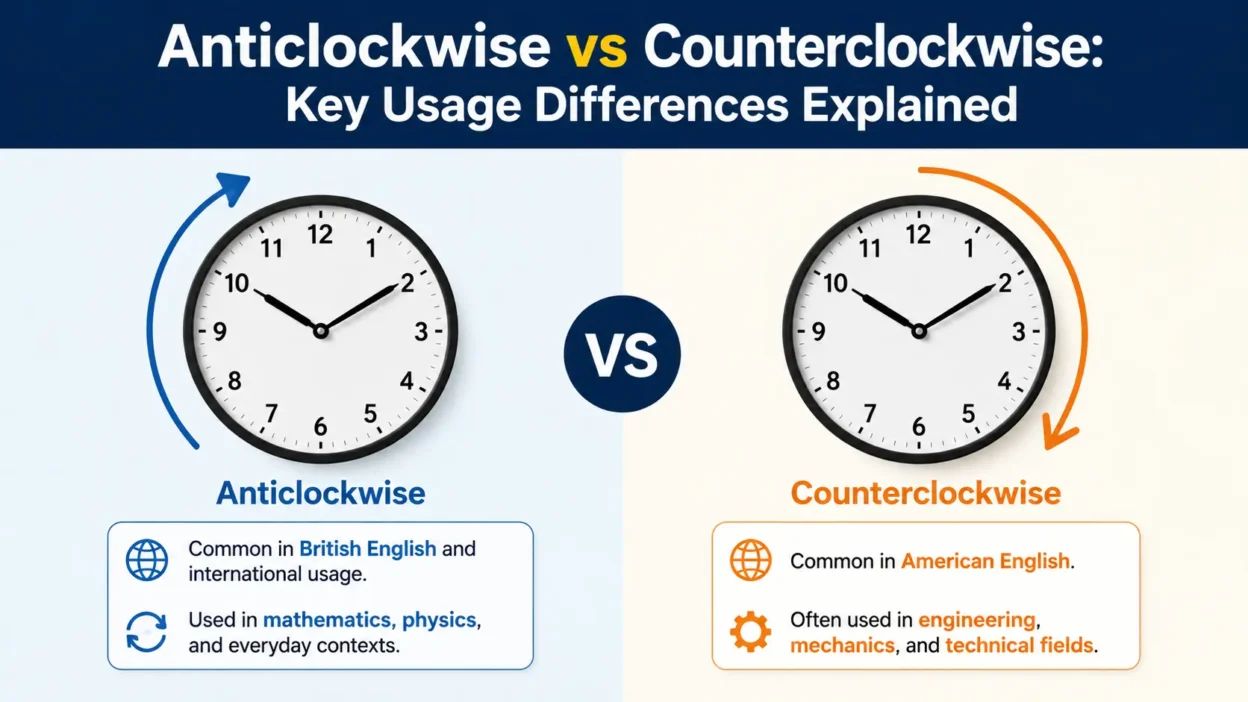
“Anticlockwise” and “counterclockwise” describe the same type of motion: rotation in the opposite direction of a clock’s hands. The difference is not meaning, but regional language preference. British English typically uses anticlockwise, while American English uses counterclockwise.
Both words mean the same thing. The only difference is usage:
- Anticlockwise → Common in British English
- Counterclockwise → Standard in American English
In all cases, both refer to a rotation opposite to the direction of a clock’s hands.
Many English words have different spellings in American and British English. Learn more about Airplane vs Aeroplane: Correct US and UK Spelling Guide to discover another common spelling difference
Why Two Different Words Exist

The difference comes from how English evolved across regions. As English spread globally, different regions developed preferred vocabulary for describing direction and motion.
Instead of creating new meanings, each region simply adopted a different prefix:
- “Anti-” meaning against
- “Counter-” meaning opposite
Both describe the same rotational concept, just with different linguistic framing.
Meaning in Real-World Contexts

Both terms are used across everyday and technical situations:
- Turning a screw or knob
- Describing circular motion in physics
- Explaining navigation or rotation direction
- Sports movement patterns (track direction)
- Engineering diagrams and machine design
Despite different wording, the physical direction remains identical.
Scientific and Technical Usage

In mathematics and science, direction consistency matters more than vocabulary choice.
- In many American textbooks, counterclockwise is preferred in geometry and trigonometry.
- In British academic materials, anticlockwise is standard.
- In global scientific communication, both are understood, but diagrams often define direction visually rather than relying on wording.
In physics, rotation direction is often linked to coordinate systems and torque direction, making clarity more important than terminology preference.
Like many English words that vary between American and British usage, spelling differences can sometimes be confusing. Explore Anticlockwise vs Counterclockwise: Correct Usage and Meaning to understand another common regional spelling variation.
Programming, UI, and Modern Usage

In software and digital design, the terminology still appears, especially in:
- Loading spinners rotating anticlockwise/counterclockwise
- Animation loops and transitions
- Game development movement logic
- Robotics rotation instructions
Most American-based documentation uses counterclockwise, while international codebases may mix both terms depending on contributor origin.
Which One Should You Use?

Choose based on your audience:
- US academic or business writing → counterclockwise
- UK writing or British audience → anticlockwise
- Global or technical documentation → counterclockwise (slightly more common globally)
- Casual communication → either is acceptable
Consistency within the same document is more important than the choice itself.
Common Mistakes to Avoid

- Mixing both terms in one article or document
- Assuming one term is more “correct” than the other
- Overthinking usage in math or physics problems
- Ignoring audience expectations in formal writing
Simple Mental Model

Imagine a clock face:
- Clock hands move clockwise
- The opposite movement is:
- Anticlockwise (UK)
- Counterclockwise (US)
Both point in the same direction, just labeled differently.
Similar to traveled and travelled, English spelling can change depending on regional preferences. Discover Anticlockwise vs Counterclockwise: Correct Usage and Meaning to learn about another common American and British English spelling difference.
FAQ
Is anticlockwise the same as counterclockwise?
Yes. Both describe the same direction of rotation opposite to clock hands.
Which term is correct in the US?
Counterclockwise is the standard American English term.
Which term is used in the UK?
Anticlockwise is the standard British English term.
Is one term more correct than the other?
No. Both are correct; usage depends on regional English conventions.
Can I use them interchangeably?
Yes, but you should stay consistent within a single document.
Conclusion
Anticlockwise and counterclockwise mean exactly the same thing. The difference lies in regional English usage, not in definition or function. For clear communication, choose the term that matches your audience and maintain consistency throughout your writing.