
Last Updated: July 28, 2026
Use therefore when you mean “as a result,” “for that reason,” or “so.”
Use therefor only when you mean “for that,” “for it,” or “in return for that.” It is a real word, but it is rare in modern English and appears mostly in legal, financial, or very formal writing.
Correct: The road was closed; therefore, we took another route.
Correct but formal: The buyer paid the fee and received a receipt therefor.
More natural: The buyer paid the fee and received a receipt for it.
For everyday writing, therefore is almost always the word you want.
Many English learners confuse similar-looking words that have completely different meanings. Learn the difference between A Lot vs Allot to avoid another common word-choice mistake.
Quick Answer
Shouldn’t “therefore” be spelled “therefor” based on its origin?
No. Although the two words share the same roots, they developed different meanings over time. Therefore means as a result, while therefor means for that.
How do you use “therefore” in a sentence?
Use therefore to introduce a result or conclusion. For example: She studied hard; therefore, she passed the exam.
Do you put a comma before or after “therefore”?
In most cases, place a comma after “therefore” when it starts a clause. For example: Therefore, we decided to leave early.
Therefore vs. therefor are different words with different meanings. Therefore is a common adverb meaning for that reason or as a result, while therefor is a rare formal adverb meaning for that or for it, often used in legal writing. In modern American English, therefore is correct in almost every everyday situation, so choose therefor only when its specific legal meaning is intended.
Therefore Vs. Therefor At A Glance

| Feature | Therefore | Therefor |
|---|---|---|
| Meaning | As a result; for that reason; consequently | For that; for it; in return for that |
| Commonness | Common | Rare |
| Tone | Formal but normal | Legal, old-fashioned, or very formal |
| Main Use | Shows a result or conclusion | Refers back to something already mentioned |
| Grammar Role | Conjunctive adverb | Adverb, but not normally a sentence connector |
| Simple Replacement | As a result, so, consequently | For it, for that, in return for that |
| Best Example | The form was late; therefore, it was rejected. | The tenant paid the deposit and received a receipt therefor. |
| Everyday Choice | Usually correct | Usually too stiff |
What Does Therefore Mean?
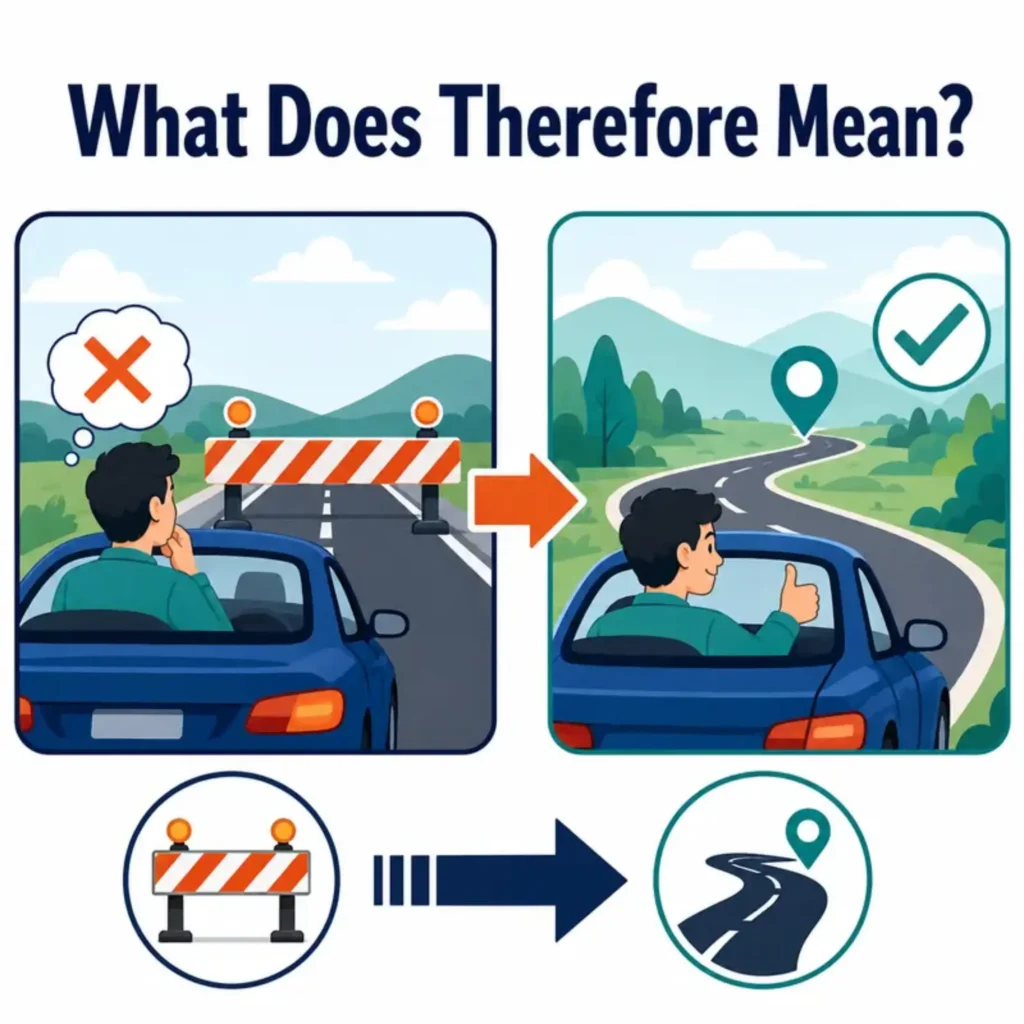
Therefore means “as a result,” “for that reason,” or “consequently.” It connects a reason to a result.
Example:
The package arrived damaged; therefore, I requested a replacement.
The first part gives the reason: The package arrived damaged.
The second part gives the result: I requested a replacement.
Use therefore when one idea logically follows from another.
More examples:
- The deadline changed; therefore, the team updated the schedule.
- The data was incomplete; therefore, the report needs another review.
- I forgot my ID. Therefore, I could not enter the building.
- The app kept crashing; therefore, I reinstalled it.
In casual writing, so often sounds more natural.
Formal: The office was closed; therefore, we worked from home.
Casual: The office was closed, so we worked from home.
What Does Therefor Mean?
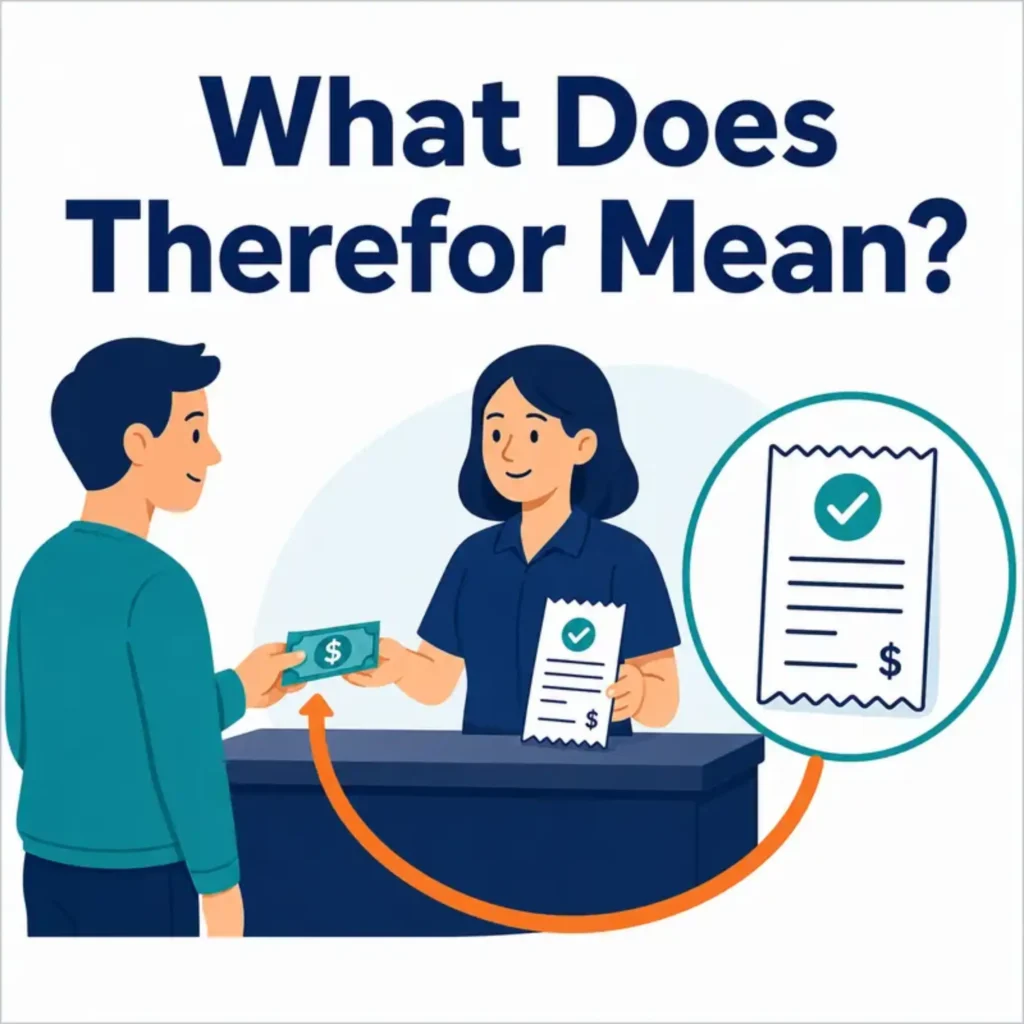
Therefor means “for that,” “for it,” or “in return for that.” It points back to something already mentioned.
Example:
The tenant paid the deposit and received a receipt therefor.
That means:
The tenant paid the deposit and received a receipt for it.
The word therefor is correct, but it sounds stiff in most modern writing. You are most likely to see it in contracts, invoices, legal documents, formal notices, or older texts.
Formal: The company listed the services and the charges therefor.
Natural: The company listed the services and the charges for them.
Formal: The applicant paid the filing fee and received confirmation therefor.
Natural: The applicant paid the filing fee and received confirmation for it.
The Main Difference Between Therefore And Therefor
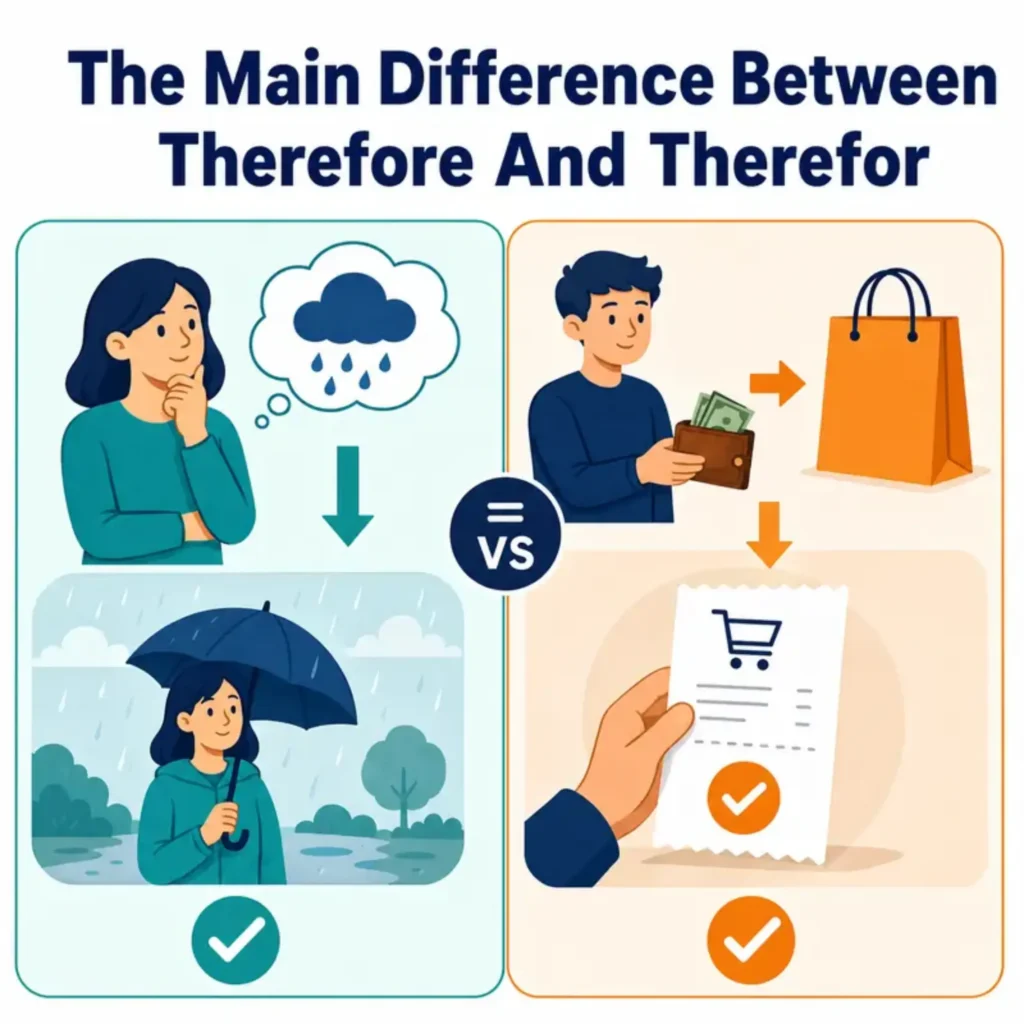
The difference is not just spelling. The two words do different jobs.
Therefore shows a result.
Example:
The meeting ran long; therefore, lunch started late.
Meaning:
The meeting ran long, and as a result, lunch started late.
Therefor refers back to something.
Example:
The customer returned the item and received store credit therefor.
Meaning:
The customer returned the item and received store credit for that item.
A simple test:
- If you can replace the word with “as a result,” use therefore.
- If you can replace the word with “for it” or “for that,” use therefor.
- If therefor sounds too legal or stiff, use for it or for that instead.
How To Use Therefore Correctly
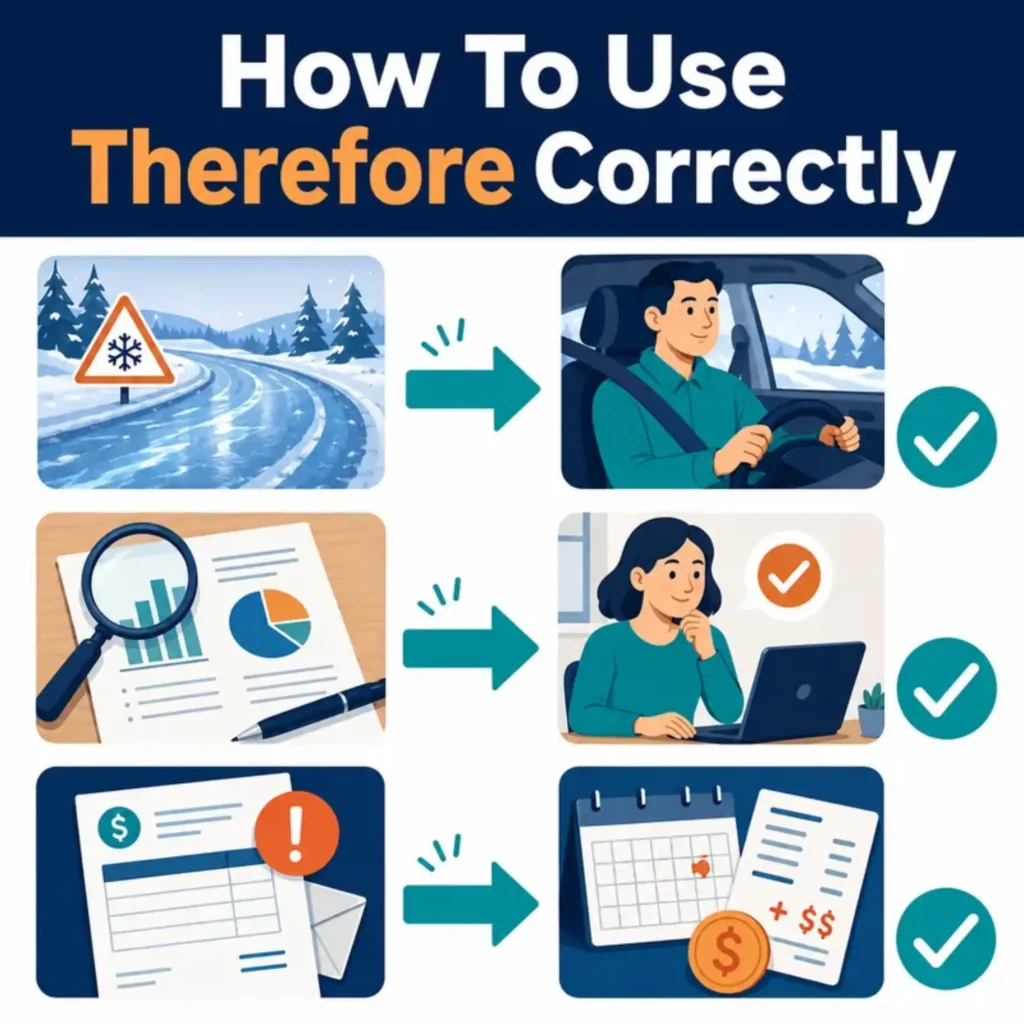
Use therefore when your sentence shows cause and effect, logic, or a conclusion.
Use Therefore For A Result
The road was icy; therefore, we drove slowly.
Use Therefore For A Conclusion
The evidence is incomplete; therefore, we cannot make a final decision.
Use Therefore In Academic Or Professional Writing
The sample size was too small; therefore, the findings should be interpreted carefully.
Use Therefore In Business Writing
The invoice is past due; therefore, a late fee may apply.
Understanding confusing word pairs can improve your writing accuracy—learn more about Affect vs Effect: Meaning, Difference, and Examples to master another commonly mixed-up English pair.
How To Punctuate Therefore
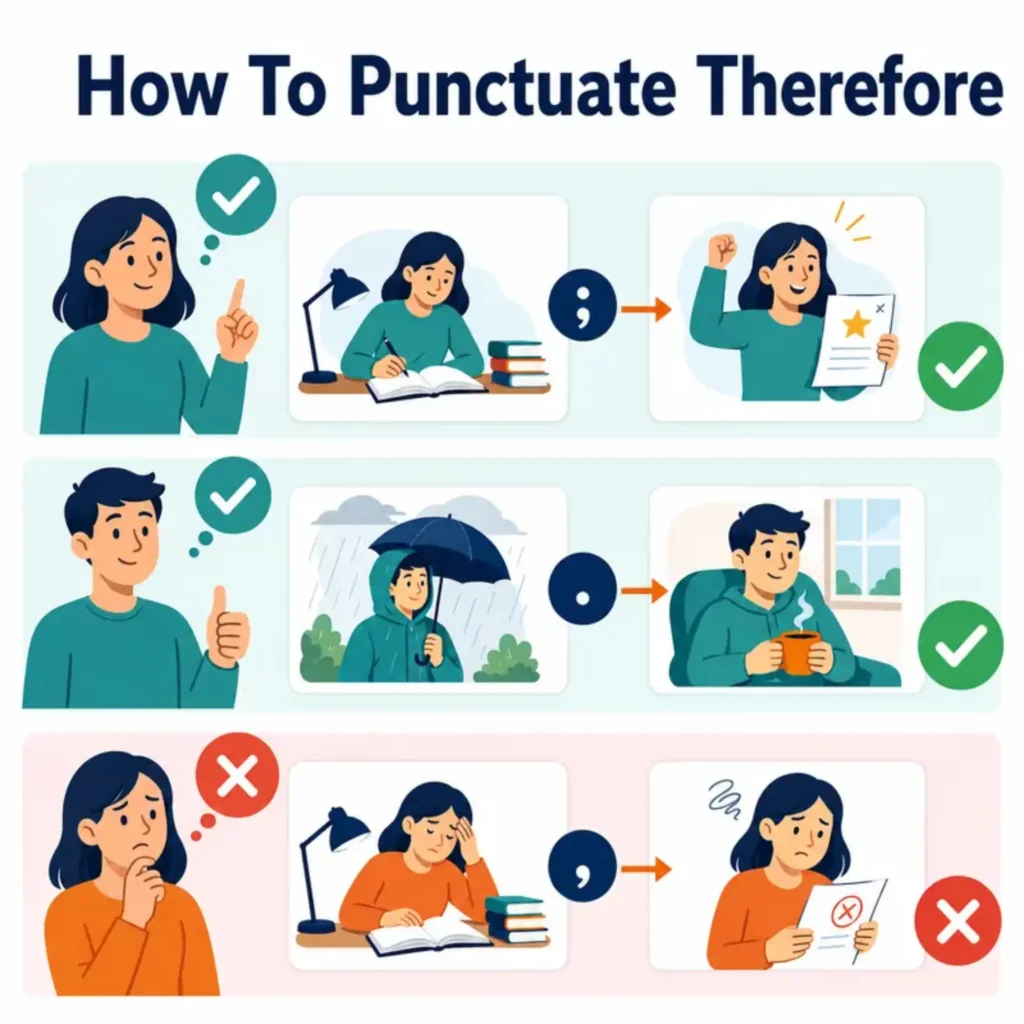
Because therefore is often a conjunctive adverb, punctuation matters.
Use A Semicolon Before Therefore Between Two Complete Sentences
Correct:
The form was incomplete; therefore, we returned it.
Wrong:
The form was incomplete, therefore we returned it.
The wrong version is a comma splice because it joins two complete sentences with only a comma.
Use A Period Before Therefore For A Cleaner Style
Correct:
The form was incomplete. Therefore, we returned it.
This version is clear and easy to read, especially when the sentence is long.
Use Commas Around Therefore When It Interrupts A Sentence
Correct:
The policy is, therefore, still in effect.
This style is more formal. In everyday writing, a simpler version often sounds better:
Therefore, the policy is still in effect.
Do Not Overuse Therefore
Therefore is useful, but too many therefore sentences can make writing sound stiff.
Stiff:
The system failed. Therefore, the team restarted it. Therefore, the report was delayed.
Better:
The system failed, so the team restarted it. As a result, the report was delayed.
How To Use Therefor Correctly
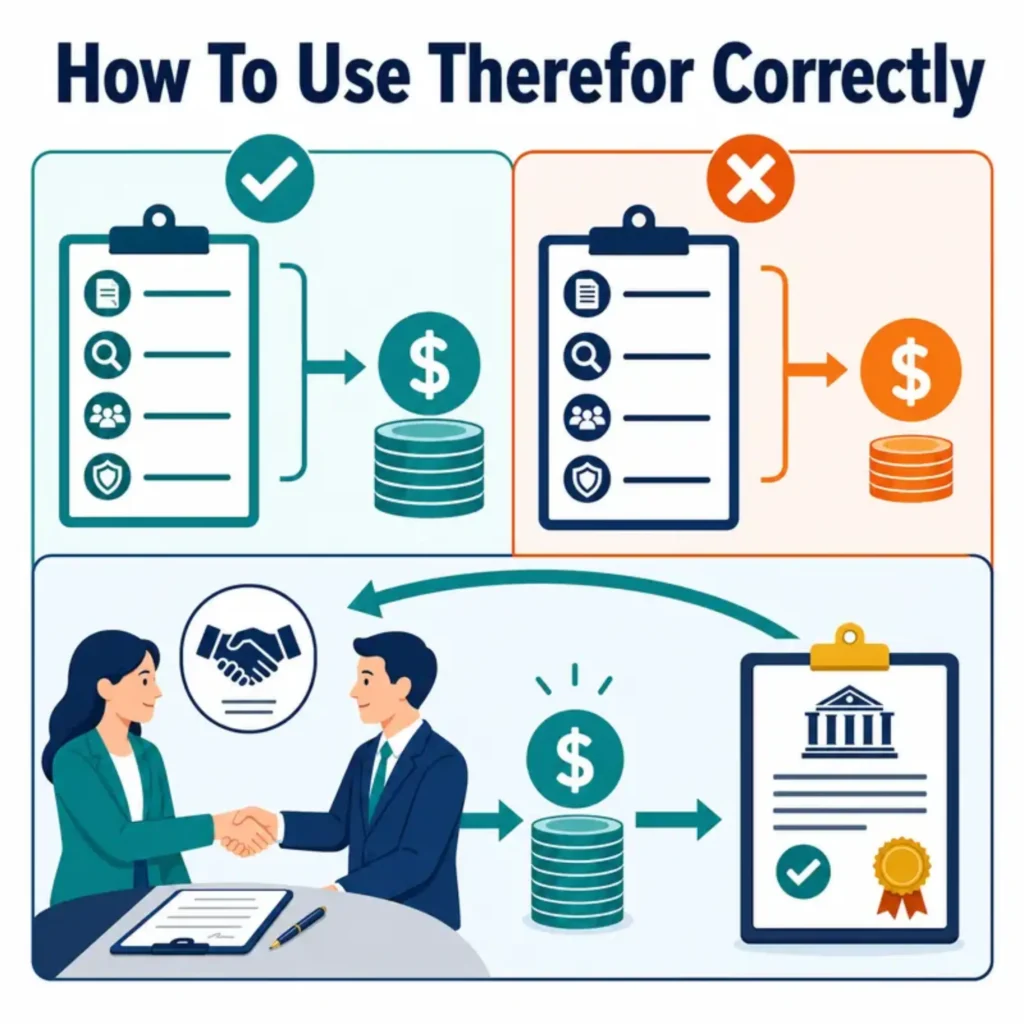
Use therefor only when it means “for that” or “in return for that.”
Correct:
The agreement lists the services and the fees therefor.
Meaning:
The agreement lists the services and the fees for those services.
Correct:
The court reviewed the claim and the evidence therefor.
Meaning:
The court reviewed the claim and the evidence for that claim.
Correct:
The buyer paid the required fee and received a permit therefor.
Meaning:
The buyer paid the required fee and received a permit in return for that payment.
In most modern writing, though, for it, for that, or for those services will sound clearer.
Formal: The client received compensation therefor.
Better: The client received compensation for it.
Best, when possible: The client received compensation for the delay.
When Therefor Sounds Wrong
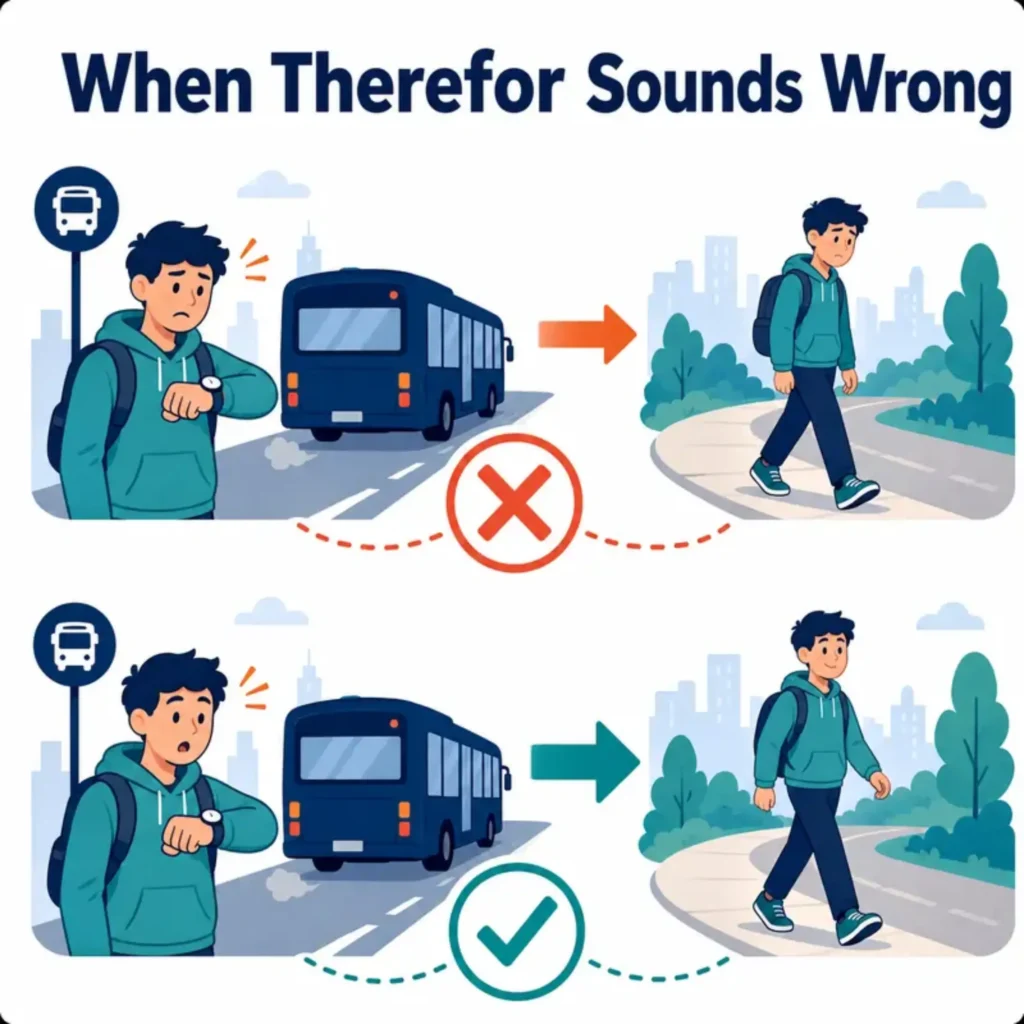
Therefor sounds wrong when the sentence needs a result word.
Wrong:
I missed the bus; therefor, I walked to work.
Correct:
I missed the bus; therefore, I walked to work.
Why?
The sentence means:
I missed the bus; as a result, I walked to work.
That is a job for therefore, not therefor.
When Therefore Sounds Wrong
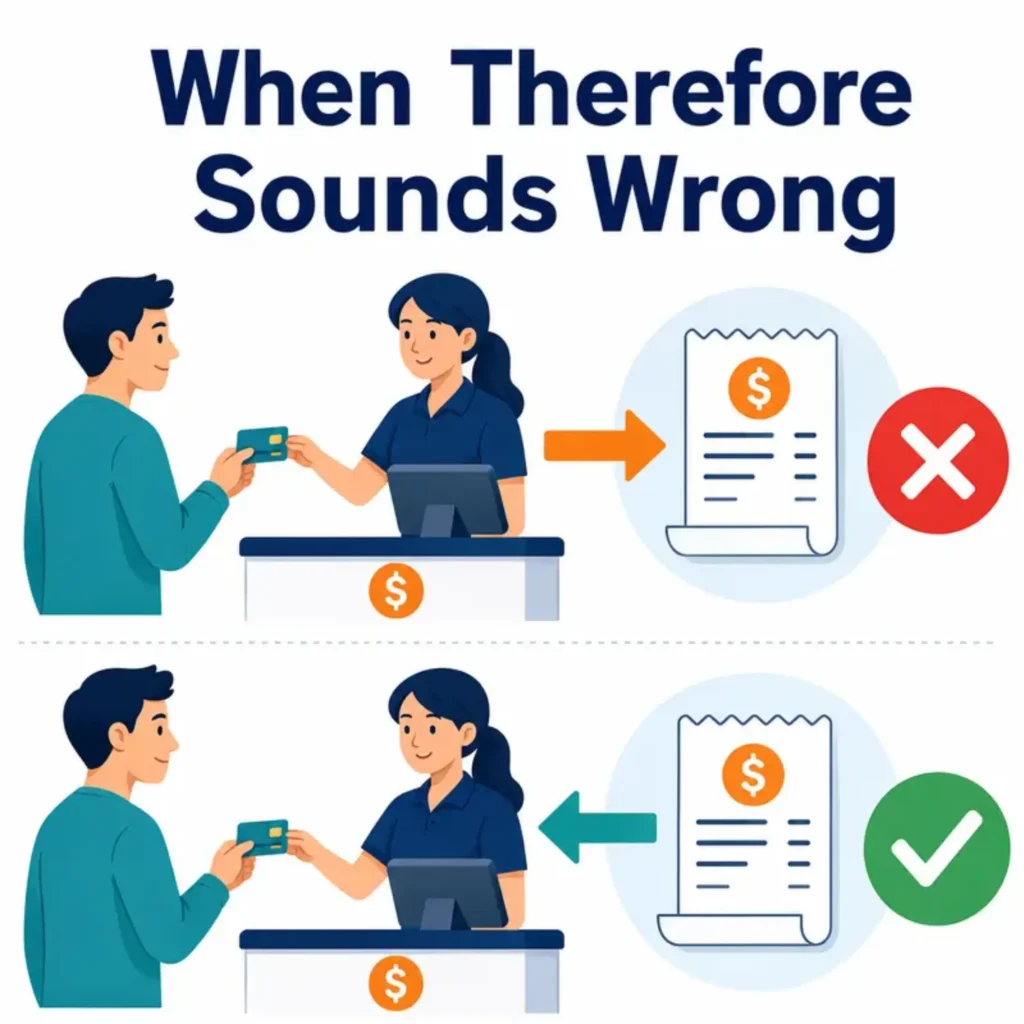
Therefore sounds wrong when the sentence means “for that thing.”
Awkward:
The buyer paid the fee and received a receipt therefore.
Better:
The buyer paid the fee and received a receipt therefor.
Most natural:
The buyer paid the fee and received a receipt for it.
In everyday US English, the best fix is often not therefor. The best fix is a clearer phrase.
Common Mistakes With Therefore And Therefor
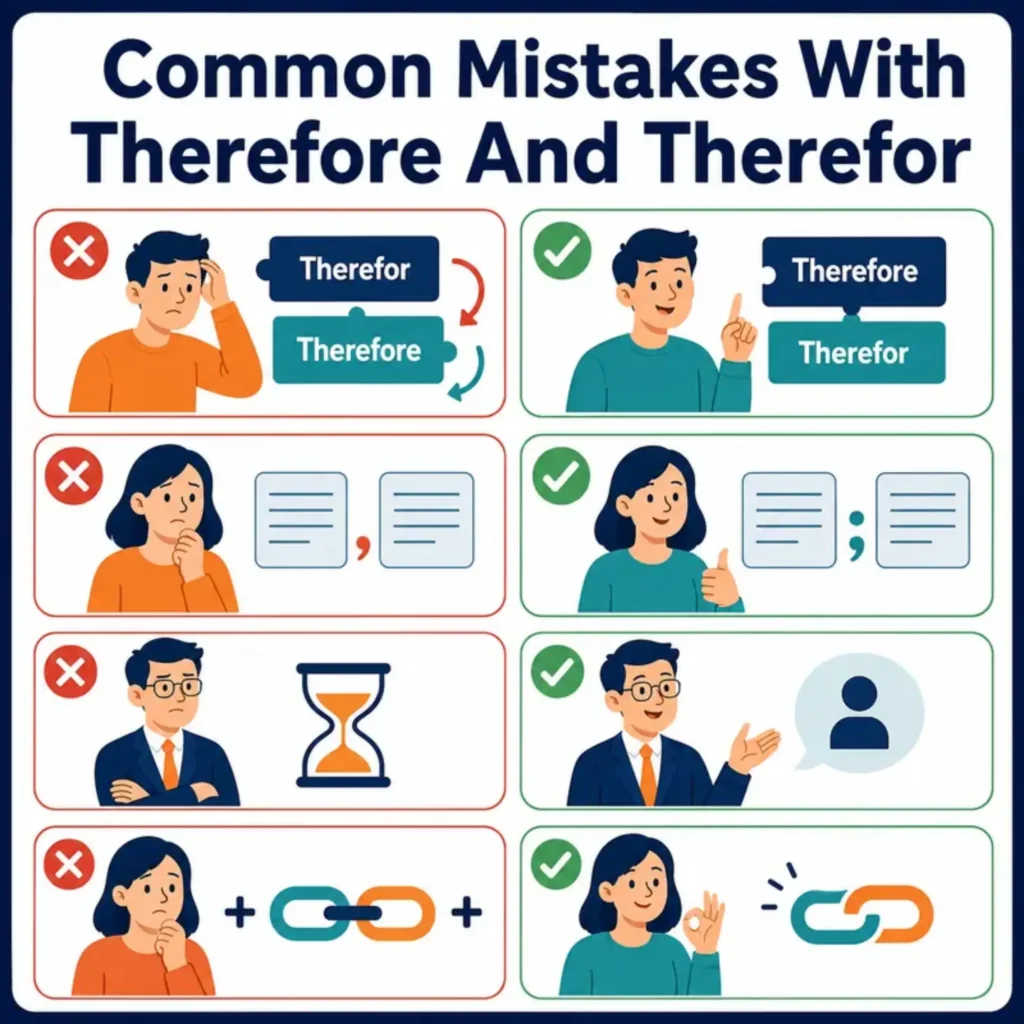
Mistake 1: Using Therefor As A Fancy Spelling Of Therefore
Wrong:
The weather was terrible; therefor, the event was canceled.
Correct:
The weather was terrible; therefore, the event was canceled.
Mistake 2: Using A Comma Splice With Therefore
Wrong:
The report was late, therefore the client complained.
Correct:
The report was late; therefore, the client complained.
Also correct:
The report was late. Therefore, the client complained.
Mistake 3: Using Therefor In Normal Writing When For It Is Clearer
Stiff:
She paid the renewal fee and got confirmation therefor.
Better:
She paid the renewal fee and got confirmation for it.
Mistake 4: Using Because And Therefore Together Awkwardly
Awkward:
Because the store was closed, therefore we went home.
Better:
Because the store was closed, we went home.
Also correct:
The store was closed; therefore, we went home.
Examples Of Therefore In Sentences
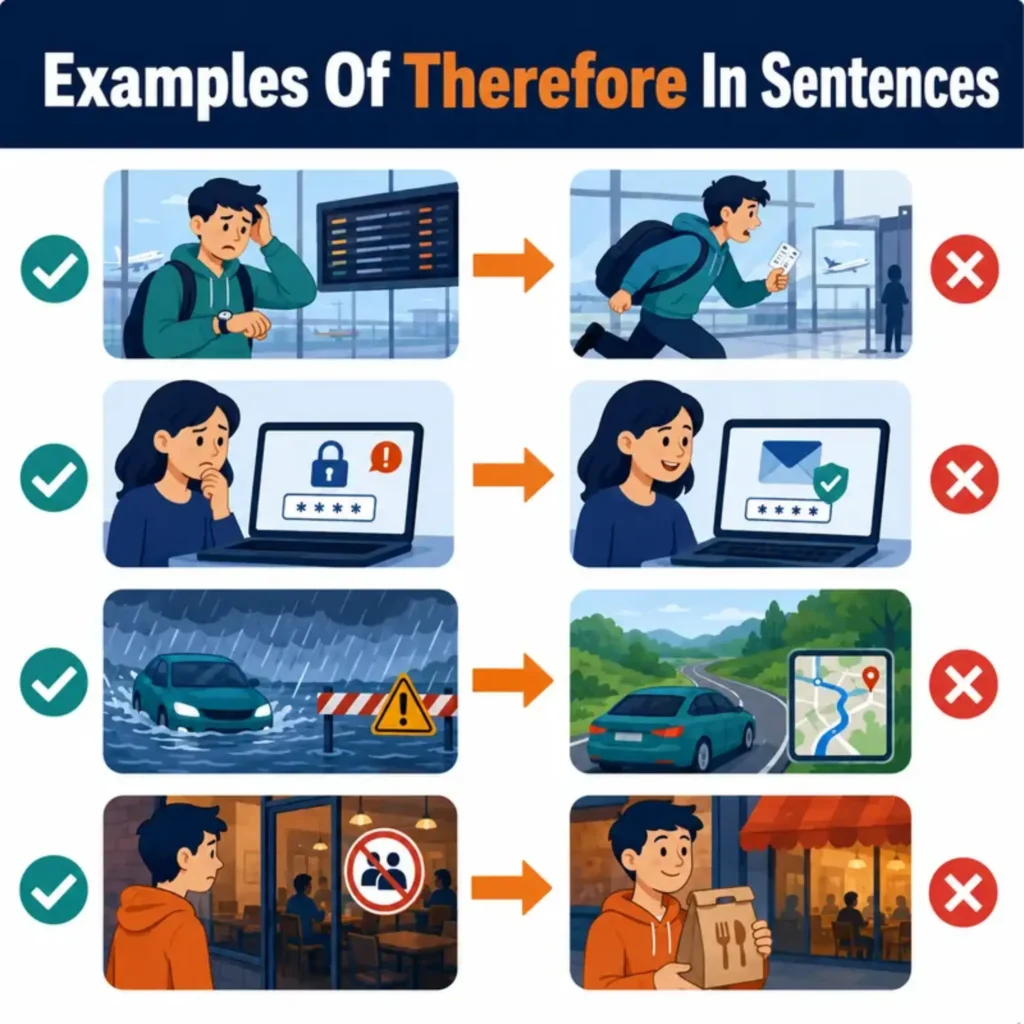
- The flight was delayed; therefore, we missed our connection.
- The instructions were unclear; therefore, several users made the same mistake.
- The team finished early. Therefore, the launch moved ahead of schedule.
- The payment did not go through; therefore, the order was canceled.
- The evidence supports the claim; therefore, the conclusion is reasonable.
- The road was flooded; therefore, traffic was rerouted.
- The password expired; therefore, I had to reset it.
- The restaurant was full; therefore, we ordered takeout.
Examples Of Therefor In Sentences
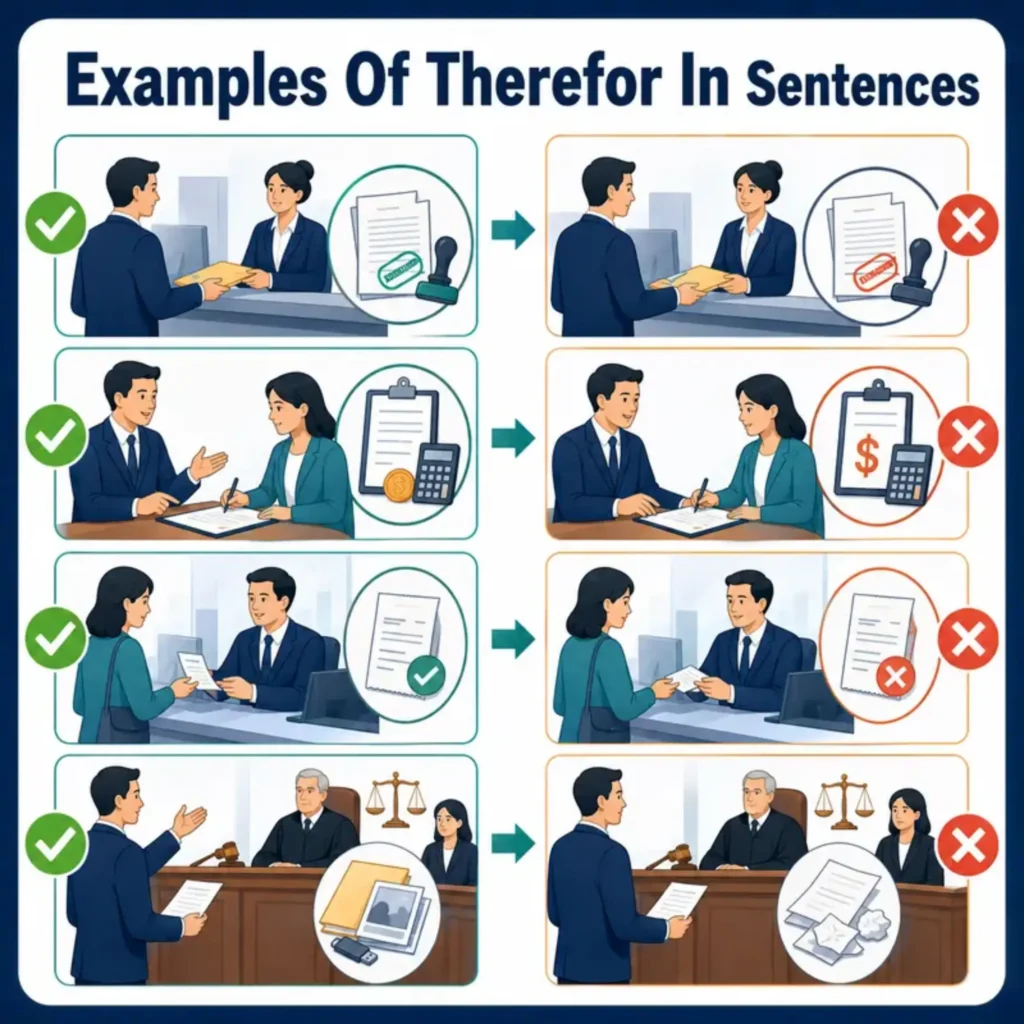
- The applicant paid the filing fee and received a stamped copy therefor.
- The contract lists the services and the charges therefor.
- The tenant paid the deposit and received a receipt therefor.
- The company provided additional work and billed the client therefor.
- The court reviewed the motion and the evidence therefor.
These are correct, but they sound formal. In most cases, modern readers will prefer:
- receipt for it
- charges for those services
- evidence for that claim
- compensation for the loss
Therefore Or Therefor In Everyday Writing
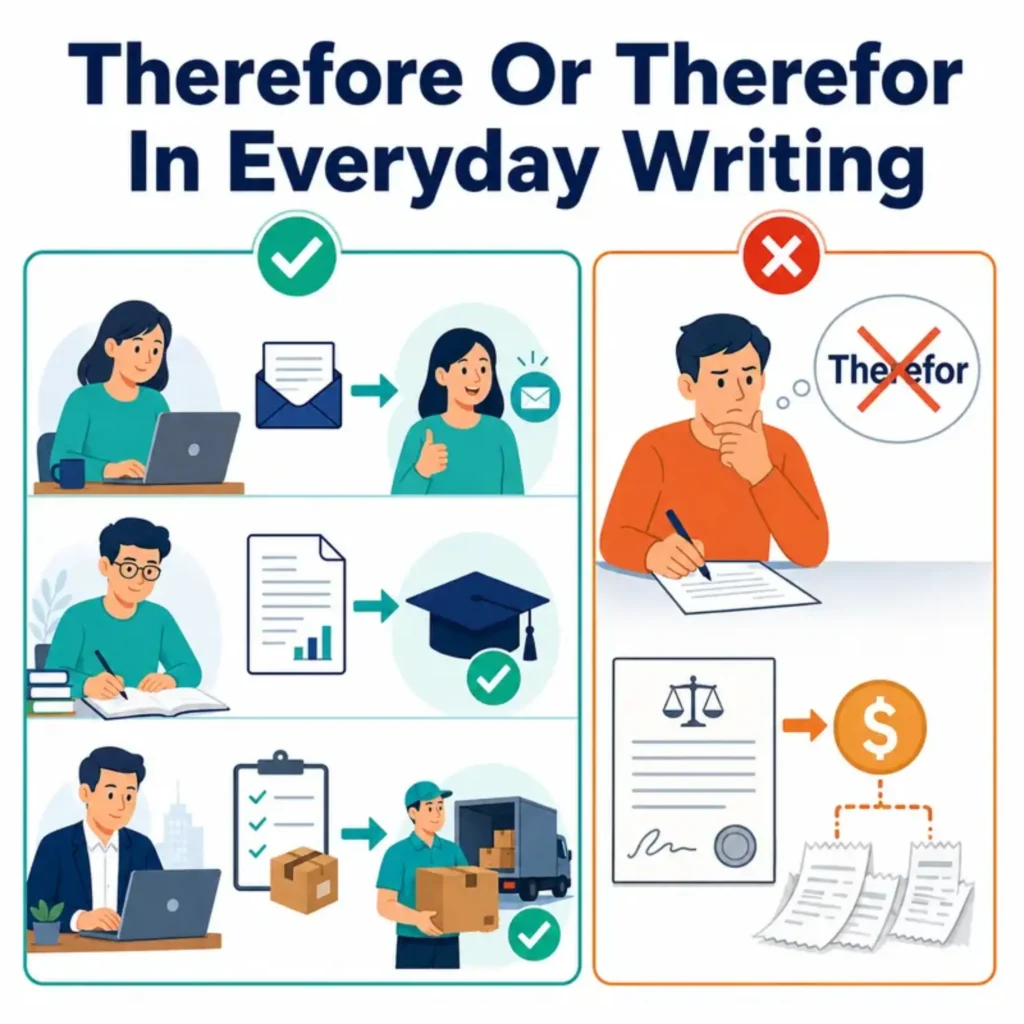
In everyday writing, use therefore when you are showing a result.
Use therefor only if you are intentionally using legal or formal language.
Email example:
The file was too large; therefore, I sent it as a shared link.
Academic example:
The results were inconsistent; therefore, further testing is needed.
Business example:
The shipment arrived late; therefore, the delivery schedule must be revised.
Legal/formal example:
The claimant requested reimbursement and submitted receipts therefor.
Natural version:
The claimant requested reimbursement and submitted receipts for it.
Easy Memory Trick

Think of the final e in therefore as standing for effect.
Therefore = result or effect.
Therefor = for that.
Another quick test:
- Therefore answers: What happened as a result?
- Therefor answers: For what?
Example:
The alarm did not work; therefore, the building was evacuated.
Question: What happened as a result?
Answer: The building was evacuated.
Example:
The customer paid the fee and received a receipt therefor.
Question: For what?
Answer: For the fee.
Just like therefore and therefor, many English words sound similar but have different meanings and uses. Learn the difference between advice vs advise to use the correct word in every situation.
FAQS
Is therefor a real word?
Yes. Therefor is a real word. It means “for that,” “for it,” or “in return for that.” Writers rarely use it in modern English, and it appears mainly in legal, financial, or highly formal writing.
Can I use therefor instead of therefore?
No. Therefor and therefore are not interchangeable. Use therefore for a result. Use therefor only when you mean “for that” or “for it.”
Wrong:
The office was closed; therefor, we left.
Correct:
The office was closed; therefore, we left.
Can I start a sentence with therefore?
Yes. You can start a sentence with therefore.
Correct:
The payment was late. Therefore, the account was temporarily suspended.
This is often clearer than forcing therefore into the middle of a long sentence.
Do I need a comma after therefore?
Usually, yes, when therefore starts a sentence or clause.
Correct:
Therefore, we changed the plan.
Correct:
The test failed; therefore, we repeated it.
When therefore appears in the middle of a sentence, commas may be used around it.
Correct:
The rule is, therefore, still valid.
Is therefor outdated?
Therefor is not wrong, but it is old-fashioned and uncommon outside formal contexts. Most modern readers will find for it, for that, or a more specific phrase clearer.
Is there a difference between US and UK English?
The main difference is not regional. In both US and UK English, therefore means “as a result,” and therefor means “for that” or “in return for that.” In both varieties, therefor is rare and formal.
Which word should I use in essays?
Use therefore when you are showing a logical result or conclusion.
Example:
The evidence is limited; therefore, the claim requires more support.
Do not use therefor in an essay unless you are quoting legal language or discussing the word itself.
Which word should I use in business emails?
Use therefore for cause and effect.
Example:
The attachment was missing; therefore, I resent the document.
Avoid therefor in normal business emails. It usually sounds stiff.
What is the simplest way to remember the difference?
Use this test:
Therefore = as a result
Therefor = for that
If neither test sounds natural, rewrite the sentence.
Conclusion
Therefore and therefor are both real words, but they do not mean the same thing.
Use therefore when you mean “as a result,” “for that reason,” or “consequently.”
Use therefor only when you mean “for that,” “for it,” or “in return for that.”