There is no difference in meaning between afterward and afterwards. Both are adverbs that mean “at a later time” or “after something happens.”
The only real difference is regional usage:
- Afterward → Preferred in American English
- Afterwards → More common in British English
Both are correct and fully acceptable in modern English writing.
Quick Answer
If you only remember one rule:
- Write “afterward” for US audiences
- Write “afterwards” for UK audiences
- Otherwise, both are correct
Why Two Forms Exist
The difference comes from historical English spelling variation. Over time, English developed two accepted adverb forms:
- afterward (shorter American preference)
- afterwards (British preference with suffix “-s”)
Neither form is newer or more correct. Both have been used for centuries in standard English writing.
Afterward vs Afterwards: Usage Comparison Table
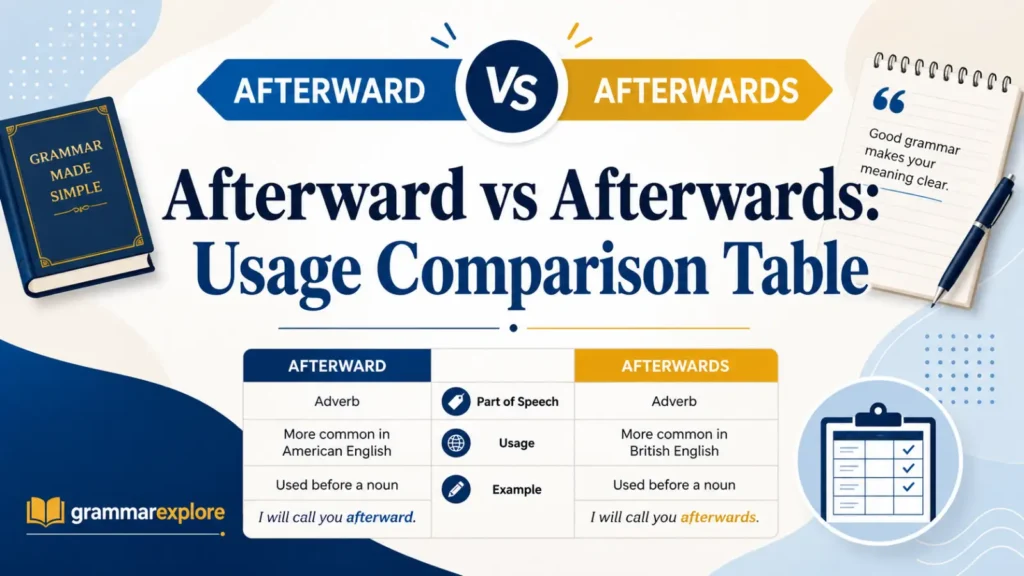
| Context | Best Choice | Reason |
|---|---|---|
| US academic writing | afterward | Standard American style |
| UK academic writing | afterwards | Standard British style |
| Journalism (US) | afterward | AP-style preference |
| Journalism (UK) | afterwards | UK editorial norm |
| Casual writing | either | No meaning change |
| Formal business writing | follow style guide | Consistency matters more than form |
Meaning And Real Usage In Sentences
Both words function as adverbs and are interchangeable in meaning.
Afterward Examples
- We finished the meeting and talked afterward.
- She left the office and called me afterward.
- The presentation ended, and afterward we reviewed feedback.
Afterwards Examples
- We finished the meeting and talked afterwards.
- He went home afterwards to rest.
- The concert ended, and afterwards the crowd slowly left.
Each sentence means exactly the same thing.
Which One Should You Use?

Use this practical rule used by editors and writers:
- Identify your audience
- US readers → use afterward
- UK readers → use afterwards
- Check your style guide
- AP Style (US) → afterward
- UK editorial style → afterwards
- Be consistent
- Never mix both in the same document
Common Mistakes To Avoid
Mixing Both Forms Randomly
Incorrect:
- We met afterward, and afterwards we went home.
Correct:
- We met afterward, and afterward we went home.
OR - We met afterwards, and afterwards we went home.
Using It As A Noun
Incorrect:
- The afterward was confusing.
Correct:
- What happened afterward was confusing.
Thinking One Is More Formal
Both forms are equally formal. Neither is more professional or more correct.
Style And Tone Differences
There is no difference in formality, tone, or grammatical strength between the two words.
The only difference is regional writing preference, not meaning or correctness.
Common Contexts Where Both Are Used
- Academic essays
- Business reports
- Journalism
- Emails
- Storytelling and fiction writing
In all of these, either form is correct if used consistently.
Frequently Asked Questions
Is afterward or afterwards correct in American English?
Both are understood, but afterward is the preferred American English form.
Is afterwards incorrect?
No. Afterwards is fully correct English, especially in British usage.
Is one more formal than the other?
No. Both are equally formal and professional.
Can I use them interchangeably?
Yes, but only if consistency is maintained within the same document.
Which one should I use in academic writing?
Use whichever matches your required style guide or target audience region.
Final Summary
Afterward and afterwards mean exactly the same thing: at a later time.
The difference is purely regional:
- Afterward → American English preference
- Afterwards → British English preference
For most US-focused writing, afterward is the safest and most natural choice.
Both are understood, but afterward is the preferred American English form.
No. Afterwards is fully correct English, especially in British usage.
No. Both are equally formal and professional.
Yes, but only if consistency is maintained within the same document.
Use whichever matches your required style guide or target audience region.