
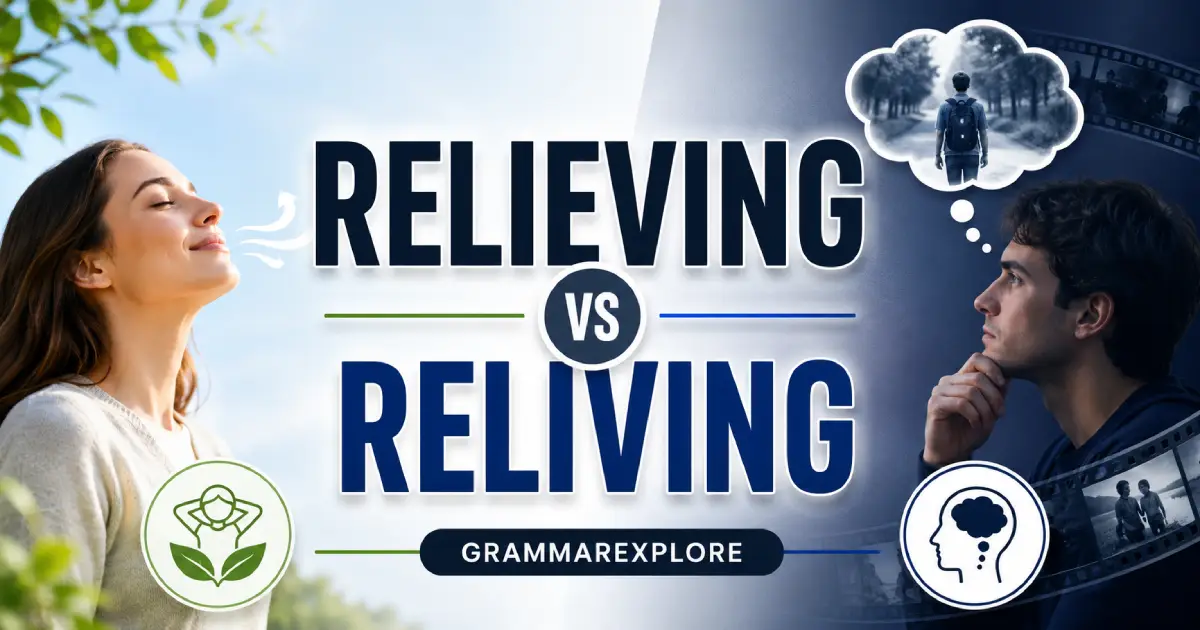
The words relieving and reliving look almost identical, but they describe completely different actions. Because they differ by only one letter, many writers accidentally choose the wrong one.
Relieving is related to relief and means reducing pain, stress, pressure, or another burden. Reliving comes from relive and means experiencing a past event again in your mind.
Once you understand what each word means, choosing the correct one becomes much easier.
Quick Answer
Use relieving when you mean easing pain, reducing stress, or making something less difficult.
Examples:
- The medicine is relieving my headache.
- Talking to a friend was relieving.
- A cool breeze was relieving on a hot afternoon.
Use reliving when you mean remembering or mentally experiencing something from the past again.
Examples:
- She enjoys reliving childhood memories.
- We spent the evening reliving our vacation.
- Watching the video felt like reliving the concert.
A simple memory trick:
- Relieving = Relief
- Reliving = Live Again
Why People Confuse Them

The confusion comes from their similar spelling and pronunciation.
Both words begin with re- and end with -ing, but they come from different base verbs:
- Relieving comes from relieve.
- Reliving comes from relive.
Because only one letter is different, it’s easy to type one when you mean the other, especially when writing quickly.
Their meanings are also connected to experiences, which can add to the confusion. However, one refers to reducing discomfort, while the other refers to remembering the past.
Understanding the base word is the easiest way to avoid mistakes.
Key Differences at a Glance

| Context | Best Choice | Why |
|---|---|---|
| Reducing pain | Relieving | Means easing discomfort |
| Reducing stress | Relieving | Means making something easier |
| Taking over someone’s duties | Relieving | Means replacing someone temporarily |
| Remembering a past event | Reliving | Means experiencing it again mentally |
| Looking through old photos | Reliving | Refers to revisiting memories |
| Watching old videos | Reliving | Suggests mentally returning to the past |
Quick Comparison
| Feature | Relieving | Reliving |
|---|---|---|
| Base verb | Relieve | Relive |
| Part of speech | Present participle / adjective | Present participle |
| Main meaning | Reducing pain or stress | Experiencing the past again |
| Related idea | Relief | Memory |
| Interchangeable | ✘ No | ✘ No |
Meaning and Usage Difference
Although relieving and reliving are both -ing forms of verbs, they describe completely different actions.
Relieving
Relieving is the present participle of relieve.
It means:
- reducing pain
- easing stress
- removing pressure
- making something less difficult
- taking over another person’s duties
Examples:
- The medication is relieving his back pain.
- Finishing the project was relieving.
- Drinking water was relieving after the long hike.
- The evening manager is relieving the day manager.
In each example, relieving refers to making a situation easier or reducing discomfort.
Reliving
Reliving is the present participle of relive.
It means:
- remembering a past event
- mentally experiencing something again
- revisiting memories
- emotionally returning to an earlier experience
Examples:
- She kept reliving the exciting finish of the game.
- Looking at old photographs was like reliving childhood.
- He enjoys reliving family vacations.
- Watching the documentary helped veterans relive important moments from history.
In these examples, reliving refers to experiencing memories again rather than reducing discomfort.
Pronunciation

Both words are pronounced similarly, but not identically.
- Relieving: rih-LEEV-ing
- Reliving: ree-LIV-ing
The difference is in the middle syllable:
- Relieving rhymes with leave.
- Reliving rhymes with live (as in “live through an experience”).
Paying attention to this pronunciation difference can help you recognize which word fits the sentence.
Parts of Speech
Relieving
Relieving functions as:
- the present participle of the verb relieve
- an adjective in some contexts
Examples:
- The treatment is relieving her pain. (verb form)
- The cool breeze was relieving. (adjective)
Reliving
Reliving functions as the present participle of the verb relive.
Examples:
- He is reliving his childhood memories.
- They spent hours reliving their favorite moments.
Although both words end in -ing, they come from different verbs and should never be used interchangeably.
A helpful way to remember them is:
- Relieving = Giving relief
- Reliving = Living through something again
I’ll be ready to help with another comparison article whenever you need one.
Tone, Context, and Formality
Both relieving and reliving are standard English words, but they are used in very different situations. The difference is based on meaning, not formality. Each word comes from a different verb and describes a different action.
Using Relieving
Relieving is the present participle of relieve and describes the act of reducing pain, stress, pressure, worry, or another burden. The word can also refer to taking over someone else’s duties, such as relieving a coworker at the end of a shift. In everyday use, it often describes something that makes a difficult situation easier or less stressful.It is common in:
- healthcare
- everyday conversations
- workplace communication
- education
- self-help writing
Examples:
- A short walk can be relieving after a stressful meeting.
- Talking with a friend was relieving.
- The medicine is relieving her headache.
- A second employee arrived, relieving the cashier.
In these examples, relieving refers to making a difficult situation easier or taking over a responsibility.
Using Reliving
Reliving is the present participle of relive. It means experiencing something again in your mind, often by remembering a past event.
It commonly appears in:
- storytelling
- memoirs
- psychology
- history
- sports discussions
- everyday conversations
Examples:
- She spent the evening reliving her childhood memories.
- Fans enjoyed reliving the championship game.
- He keeps reliving the embarrassing moment.
- Looking through old photos felt like reliving the vacation.
Here, reliving refers to mentally experiencing something from the past.
Formal vs. Informal Writing
Both words work well in formal and informal writing when they match the intended meaning.
Formal:
- The new procedures are relieving pressure on hospital staff.
- The documentary allows viewers to experience reliving important historical moments through personal stories.
Informal:
- That vacation was so relaxing that thinking about it feels like reliving it.
- Finishing the exam was incredibly relieving.
The key is choosing the word that accurately expresses your idea.
Which One Should You Use?
The easiest way to decide is to ask yourself what you’re trying to say.
Choose Relieving if you mean:
- reducing pain
- easing stress
- removing pressure
- making something easier
- taking over someone’s duties
Examples:
- Deep breathing is relieving anxiety.
- The cool breeze was relieving on a hot day.
- The night manager is relieving the afternoon supervisor.
- Finishing the project was relieving.
Choose Reliving if you mean:
- remembering the past
- experiencing a memory again
- mentally returning to an earlier event
- thinking through a previous experience
Examples:
- She enjoys reliving family vacations.
- He keeps reliving the conversation in his mind.
- Watching the video was like reliving graduation day.
- The reunion gave everyone a chance to start reliving old memories.
A Simple Memory Trick
Use this easy reminder:
- Relieving = Relief
- Reliving = Live Again
If the idea is making something easier, choose relieving.
If the idea is experiencing the past again, choose reliving.
When One Choice Sounds Wrong
Using the wrong word can completely change what a sentence means.
Incorrect:
- Looking at old photos was relieving my childhood.
Correct:
- Looking at old photos was reliving my childhood.
You’re experiencing memories again, not reducing them.
Another example:
Incorrect:
- The medicine is reliving my back pain.
Correct:
- The medicine is relieving my back pain.
Medicine eases pain; it doesn’t remember it.
Common Mistakes (and Quick Fixes)
Here are several mistakes writers often make.
Mistake 1: Using Relieving Instead of Reliving
❌ We spent hours relieving our vacation memories.
✔ We spent hours reliving our vacation memories.
You are remembering the vacation, not easing it.
Mistake 2: Using Reliving Instead of Relieving
❌ This cream is reliving muscle pain.
✔ This cream is relieving muscle pain.
The cream reduces pain, so relieving is correct.
Mistake 3: Confusing Similar Spellings
The words differ by only one letter, making them easy to mix up.
Remember:
- Relief → Relieving
- Live again → Reliving
Mistake 4: Ignoring the Context
Always ask:
- Is something becoming easier?
- Or am I remembering the past?
The answer tells you which word to choose.
Mistake 5: Forgetting the Meaning
Before writing, think about the action.
If the sentence is about reducing discomfort, choose relieving.
If it’s about experiencing memories again, choose reliving.
Everyday Examples
Here are natural examples showing both words in everyday American English.
Using Relieving
- Stretching is relieving my back pain.
- The rain was relieving after the long heat wave.
- Hearing the good news was incredibly relieving.
- The evening nurse is relieving the day nurse.
- Finishing my taxes felt relieving.
Using Reliving
- We laughed while reliving our college adventures.
- He’s still reliving his first championship win.
- Looking through old yearbooks felt like reliving high school.
- They spent the evening reliving childhood memories.
- Watching the home videos was like reliving the holiday.
Side-by-Side Examples
Incorrect:
- She keeps relieving that embarrassing moment.
Correct:
- She keeps reliving that embarrassing moment.
Incorrect:
- The medication is reliving my headache.
Correct:
- The medication is relieving my headache.
By focusing on the meaning of the sentence, you’ll know whether you should use relieving or reliving.
Dictionary-Style Word Details
Verb
Relieving:
Relieving is the present participle of the verb relieve. It means to reduce pain, stress, worry, pressure, or another burden, or to take over someone’s duties or responsibilities.
Examples:
- The medication is relieving her pain.
- Deep breathing is relieving stress.
- A coworker arrived, relieving the receptionist for lunch.
- Drinking water was relieving after the long hike.
Reliving:
Reliving is the present participle of the verb relive. It means to experience a past event again in your mind, often by remembering it vividly.
Examples:
- She is reliving her happiest childhood memories.
- Watching the video was like reliving the concert.
- He keeps reliving the final moments of the game.
- They spent the evening reliving their family vacation.
Relieving:
Not commonly used as a noun in standard American English.
Reliving:
Not commonly used as a noun in standard American English.
Both words function primarily as verb forms and occasionally as adjectives (especially relieving), but not as nouns.
Synonyms
The best synonyms depend on the intended meaning.
Relieving
Closest plain alternatives:
- Easing
- Comforting
- Soothing
- Reducing
- Lessening
- Alleviating
Reliving
Closest plain alternatives:
- Remembering
- Recalling
- Revisiting
- Re-experiencing
- Reflecting on
Antonyms
For relieving:
- Worsening
- Increasing
- Aggravating
- Intensifying
For reliving:
There is no exact opposite, but these may fit depending on context:
- Forgetting
- Ignoring
- Moving on from
Relieving
- The cool breeze was relieving after the afternoon heat.
- Yoga is relieving her back pain.
- The manager is relieving the night supervisor.
- Finishing the project felt relieving.
- Good news can be incredibly relieving.
- The treatment is relieving his symptoms.
- A short break was relieving after hours of studying.
- The volunteers are relieving emergency workers during the shift change.
Reliving
- She smiled while reliving her wedding day.
- We enjoyed reliving our college memories.
- He’s still reliving the winning goal.
- Looking through old photos felt like reliving childhood.
- The reunion gave everyone a chance to start reliving old friendships.
- Veterans often spoke about reliving important moments from their service.
- Watching the recording was like reliving the event.
- He couldn’t stop reliving the conversation in his mind.
Word History
Although relieving and reliving look very similar, they come from different verbs.
- Relieving comes from relieve, which developed from words meaning to lighten, lessen, or ease a burden.
- Reliving comes from relive, meaning to live through an experience again, especially in memory.
Today, the meanings remain clearly separate in standard American English. Relieving refers to easing discomfort or taking over a duty, while reliving refers to mentally experiencing the past again.
Phrases Containing
Common expressions using relieving include:
- relieving stress
- relieving pain
- relieving pressure
- relieving anxiety
- relieving symptoms
- relieving tension
- relieving discomfort
- relieving someone of duty
Common expressions using reliving include:
- reliving memories
- reliving childhood
- reliving the past
- reliving the experience
- reliving old moments
- reliving the excitement
- reliving a dream
- reliving history
These expressions highlight the clear difference between the two words.
Conclusion
Although relieving and reliving differ by just one letter, they express completely different ideas.
Use relieving when talking about reducing pain, stress, pressure, or another burden, or when someone takes over another person’s responsibilities.
Use reliving when referring to remembering or mentally experiencing a past event again.
A simple way to remember the difference is:
- Relieving = Giving relief
- Reliving = Living through a memory again
What Is the Difference Between Relieving and Reliving?
Relieving means reducing pain, stress, pressure, or another burden. Reliving means mentally experiencing a past event again through memory.
Is Relieving the Same as Reliving?
No. Although these words look similar, they have different meanings. Relieving refers to easing discomfort or reducing a burden, while reliving refers to experiencing past memories again.
When Should I Use Relieving?
Use relieving when you describe making something less painful, less stressful, or easier. You can also use it when someone takes over another person’s duties.
When Should I Use Reliving?
Use reliving when you talk about memories, past events, or experiences that someone mentally experiences again.
Can Relieving Describe Emotions?
Yes. Relieving can describe the feeling of becoming less worried, stressed, or anxious.
Example:
Hearing the test results was very relieving.
Can Reliving Describe Happy Memories?
Yes. Reliving can describe both happy and difficult memories.
Examples:
Reliving family vacations.
Reliving an unforgettable achievement.
How Can I Remember the Difference?
Use this simple memory trick:
Relieving = Relief
Reliving = Live Again
This memory aid helps you choose the correct word in most situations.
Are Both Words Common in Everyday English?
Yes. People commonly use both words, but they appear in different contexts. Relieving often appears in discussions about health, work, and emotions, while reliving commonly appears when people talk about memories, stories, and past experiences.