Quick Answer
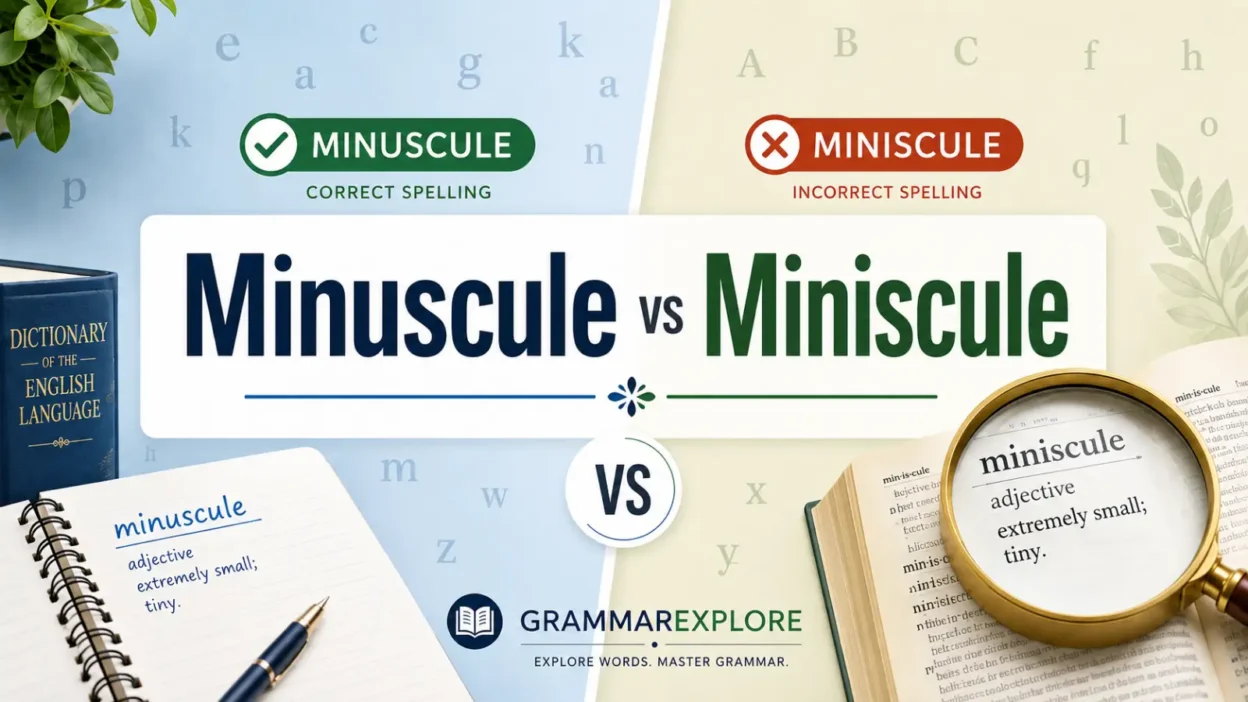
Use minuscule. It is the standard spelling for something extremely small.
Miniscule means the same thing when people use it, but it is a disputed spelling. Some dictionaries record it because it appears often, yet many careful readers still see it as an error. For school, work, publishing, and polished US writing, minuscule is the better choice.
What Does Minuscule Mean?
Minuscule usually means very small, tiny, or extremely slight.
You can use it for size:
The label used minuscule print.
You can use it for amount:
The fee was minuscule compared with the full cost.
You can use it for importance or effect:
The change had a minuscule impact on the final result.
Minuscule can also refer to lowercase letters or small writing. In that sense, it belongs to typography and writing history. A minuscule letter is a lowercase letter, as opposed to a capital letter.
What Does Miniscule Mean?
Miniscule is a disputed spelling variant of minuscule. It is usually intended to mean the same thing: very small.
The problem is not meaning. The problem is acceptance.
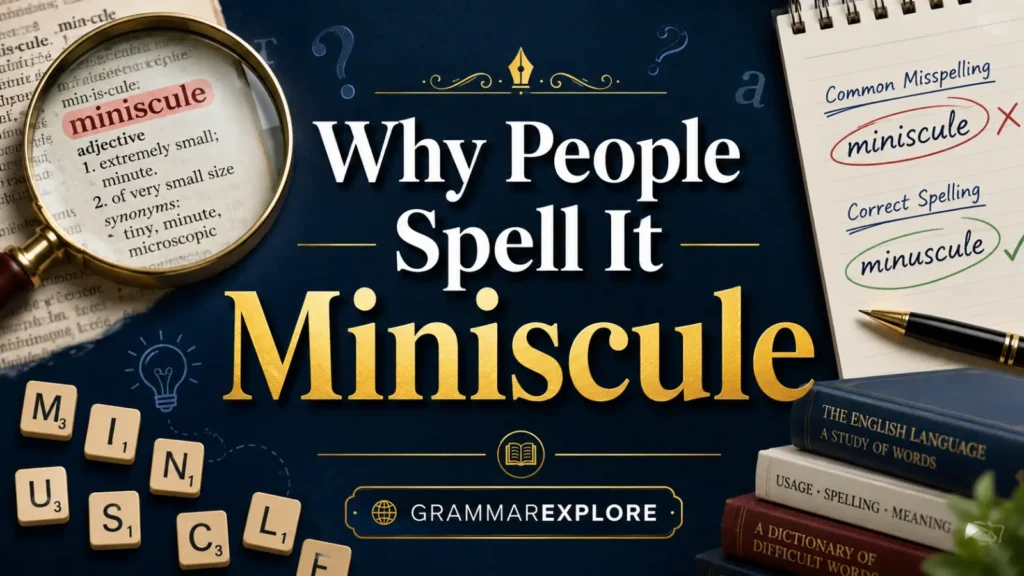
Many people write miniscule because it looks connected to mini, a familiar word part that suggests smallness. That spelling feels logical, but the standard form is minuscule, with a u after min.
So, if you write this:
The mistake was miniscule.
Readers will probably understand you. However, some may see the spelling as careless. The safer edited version is:
The mistake was minuscule.
Minuscule vs Miniscule At A Glance
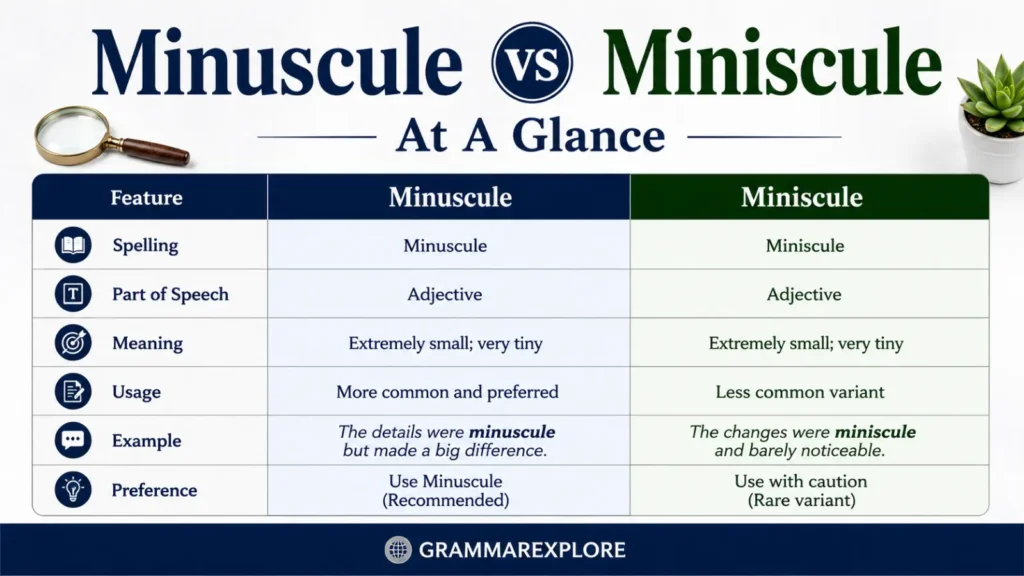
| Context | Better Choice | Why |
|---|---|---|
| School Essay | Minuscule | Teachers usually expect the standard spelling. |
| Business Email | Minuscule | It looks polished and careful. |
| News Article | Minuscule | It follows the safer edited form. |
| Resume Or Cover Letter | Minuscule | It avoids a distracting spelling issue. |
| Casual Text | Minuscule | Still the better habit. |
| Quoting Someone’s Exact Wording | Miniscule | Keep it only if you must preserve the original spelling. |
| Explaining The Spelling Debate | Miniscule | Use it when discussing the variant itself. |
Why People Spell It Miniscule
The confusion comes from the word mini.
Since mini means small, miniscule looks natural. Many writers assume the word should follow the same pattern as miniature, minivan, or miniseries.
But minuscule is tied to minus, meaning smaller or less. That is why the standard spelling uses u, not i.
A simple memory trick works well:
Minuscule has minus in it. Think minus, not mini.
Is Miniscule Wrong?
In careful writing, yes, miniscule is risky and should usually be changed to minuscule.
However, it is not accurate to say that miniscule is never recorded anywhere. Major dictionaries may list it as a disputed or variant spelling because it appears often in real writing. Merriam-Webster calls it a disputed spelling variant and says it remains widely regarded as an error.
That means the best advice is practical:
Use minuscule when you want your writing to look correct.
Recognize miniscule when you see it, but do not choose it in edited writing.
When To Use Minuscule
Use minuscule when you mean something is extremely small, very slight, or barely noticeable.
Examples:
The company reported a minuscule increase in revenue.
Only a minuscule amount of paint was needed.
The typo was minuscule, but the editor caught it.
There is a minuscule chance of delay.
The designer adjusted a minuscule spacing issue.
The directions were printed in minuscule type.
The word works best when small is not strong enough. If something is just ordinary-small, use small instead.
Better:
The apartment had a small kitchen.
Too strong unless you mean extremely tiny:
The apartment had a minuscule kitchen.
When To Avoid Miniscule
Avoid miniscule in almost all polished writing.
Do not use it in:
School assignments
College essays
Business emails
Reports
Resumes
Articles
Client work
Professional profiles
Product descriptions
Published content
Risky:
The update made a miniscule difference.
Better:
The update made a minuscule difference.
Risky:
The contract included a miniscule fee.
Better:
The contract included a minuscule fee.
The meaning stays the same, but the corrected spelling looks more professional.
Pronunciation Of Minuscule And Miniscule
Both forms are commonly pronounced like:
MIN-uh-skyool
Some dictionaries also recognize another pronunciation pattern, but most everyday readers are not confused by the sound. The main issue is spelling, not pronunciation.
Common Mistakes And Quick Fixes
Mistake: Writing miniscule because it looks like mini.
Fix: Write minuscule. Remember minus, not mini.
Mistake: Thinking minuscule and miniscule have different meanings.
Fix: Treat miniscule as a disputed spelling, not a separate meaning.
Mistake: Using minuscule when you only mean slightly small.
Fix: Use small, minor, or slight when the idea is less extreme.
Mistake: Ignoring the lowercase-letter meaning.
Fix: Remember that minuscule can also refer to lowercase writing or letters.
Mistake: Leaving miniscule in final copy.
Fix: Search your draft for miniscule and replace it with minuscule.
Correct And Incorrect Examples
Incorrect: The logo change was miniscule.
Correct: The logo change was minuscule.
Incorrect: She noticed a miniscule scratch on the screen.
Correct: She noticed a minuscule scratch on the screen.
Incorrect: The risk is miniscule, but we should mention it.
Correct: The risk is minuscule, but we should mention it.
Incorrect: He wrote the note in miniscule letters.
Correct: He wrote the note in minuscule letters.
Incorrect: Their profit margin was miniscule last year.
Correct: Their profit margin was minuscule last year.
Better Alternatives To Minuscule
Use minuscule when you want a precise word for something extremely small. Use a simpler alternative when it fits better.
Good alternatives include:
Tiny: plain and conversational
Very small: clear and simple
Minute: formal and precise
Microscopic: extremely tiny, often visual or scientific
Negligible: so small that it barely matters
Slight: small in degree
Minor: small in importance
Examples:
The difference was negligible.
The change was minor.
The print was tiny.
The amount was minuscule.
Do not use these words as perfect replacements in every sentence. Negligible means small enough to be unimportant, while minuscule mainly means extremely small.
Dictionary-Style Details
Verb
Minuscule: Not commonly used as a verb in standard US English.
Miniscule: Not commonly used as a verb in standard US English.
Noun
Minuscule: Can be a noun in specialized writing. It may mean a lowercase letter or a small handwriting style.
Example:
The old manuscript used a clear minuscule.
Miniscule: Sometimes appears as a variant form, but it is not the best choice for the noun sense. Use minuscule when referring to lowercase letters or script style.
Synonyms
Minuscule: tiny, very small, minute, microscopic, slight, negligible.
Miniscule: same intended meaning, but the stronger edit is usually to replace it with minuscule.
Useful antonyms for minuscule include large, huge, enormous, massive, and substantial.
Example Sentences
- Minuscule: The budget change was minuscule.
- Minuscule: A minuscule crack appeared near the phone’s camera.
- Minuscule: The chance of an error is minuscule.
- Minuscule: The designer fixed a minuscule alignment problem.
Miniscule: If your draft says miniscule, change it to minuscule before final review.
Word History
Minuscule comes from forms connected with the idea of something smaller. That history explains why the standard spelling contains minus, not mini. Merriam-Webster traces the word through French and New Latin forms related to Latin minusculus, meaning somewhat smaller.
Miniscule spread because writers associated the word with mini- and other smallness-related words. That spelling has appeared for a long time, but it remains disputed.
Phrases Containing Minuscule
minuscule amount
minuscule chance
minuscule detail
minuscule difference
minuscule effect
minuscule fee
minuscule handwriting
minuscule improvement
minuscule risk
minuscule scratch
minuscule text
minuscule type
Avoid these edited forms:
miniscule amount
miniscule chance
miniscule detail
miniscule risk
Use these instead:
minuscule amount
minuscule chance
minuscule detail
minuscule risk
FAQ
Is miniscule a word?
Some dictionaries record miniscule as a disputed or variant spelling of minuscule, but many careful readers still consider it an error. The safest choice is minuscule.
Which spelling should I use in formal writing?
Use minuscule in formal writing. It is the standard spelling and is less likely to distract teachers, editors, clients, or hiring managers.
Why is minuscule spelled with a u?
Minuscule is connected with minus, not mini. The spelling reflects that history, even though the meaning makes many people think of mini.
Does minuscule only mean tiny?
No. In everyday writing, minuscule usually means very small. In typography or writing history, it can also refer to lowercase letters or a small script style.
Can I use miniscule in casual writing?
People will usually understand miniscule, but it is still better to write minuscule. Good spelling habits matter even in casual writing.
What is the easiest way to remember minuscule?
Remember this: minuscule contains minus. If something is minus-sized, it is very small.
Conclusion
The correct and safest choice is minuscule. Use it when you mean extremely small, tiny, or very slight.
Miniscule is understandable, and some dictionaries record it as a disputed variant, but it can still look wrong to careful readers. For clean US writing, do not take that risk.
Write minuscule in essays, emails, reports, articles, resumes, and final drafts. Think minus, not mini, and the spelling becomes easy to remember.
Some dictionaries record miniscule as a disputed or variant spelling of minuscule, but many careful readers still consider it an error. The safest choice is minuscule.
Use minuscule in formal writing. It is the standard spelling and is less likely to distract teachers, editors, clients, or hiring managers.
Minuscule is connected with minus, not mini. The spelling reflects that history, even though the meaning makes many people think of mini.
No. In everyday writing, minuscule usually means very small. In typography or writing history, it can also refer to lowercase letters or a small script style.
People will usually understand miniscule, but it is still better to write minuscule. Good spelling habits matter even in casual writing.
Remember this: minuscule contains minus. If something is minus-sized, it is very small.