Dreamed and dreamt are both correct past forms of the verb dream. You can say I dreamed or I dreamt, and the basic meaning is usually the same.
In American English, though, dreamed is the better default. It sounds natural in everyday writing, school assignments, business messages, and formal prose. Dreamt is also standard English, but many US readers hear it as more British, literary, poetic, or old-fashioned.
Quick Answer
Use dreamed in most American English.
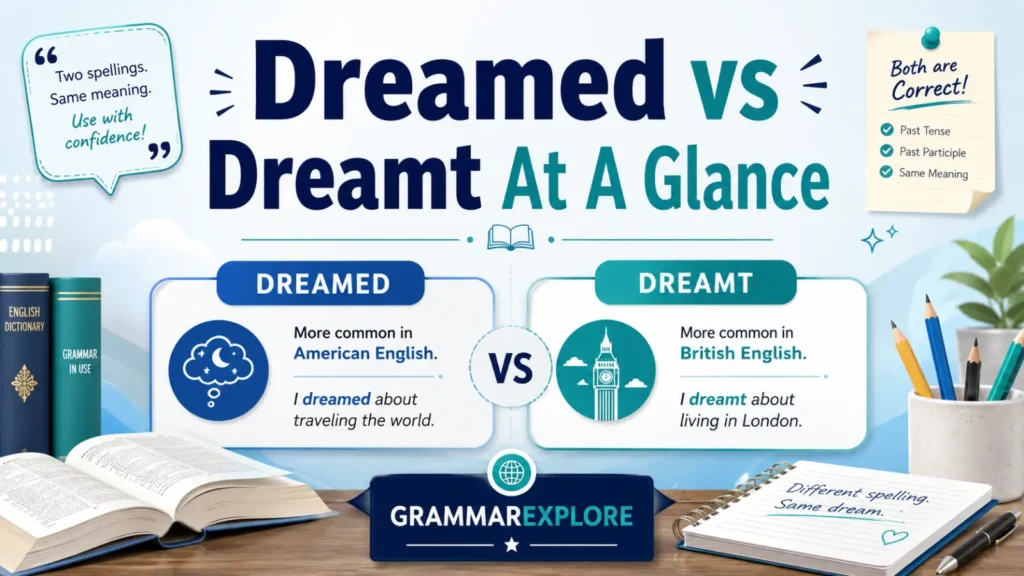
Both dreamed and dreamt can work as the simple past tense and past participle of dream. The difference is not meaning. The difference is mainly style and regional preference. Dreamed is more common and neutral in US English, while dreamt can sound more literary or British.
Dreamed vs Dreamt At A Glance
| Context | Best Choice | Why |
| Everyday American English | dreamed | It sounds natural and familiar. |
| School or business writing in the US | dreamed | It is the safest neutral choice. |
| British-style writing | dreamed or dreamt | Both forms are accepted. |
| Literary or poetic writing | dreamt | It can sound shorter and more stylized. |
| After has, have, or had | dreamed or dreamt | Both can work as past participles. |
| When you are unsure | dreamed | It is the clearest default for US readers. |
What Dreamed Means

Dreamed is the regular past-tense and past-participle form of dream. It follows the common English pattern of adding -ed.
Examples:
- I dreamed about my old apartment last night.
- She dreamed of becoming a surgeon.
- We had dreamed about this trip for years.
- He dreamed that he was late for the exam.
In US English, dreamed is usually the cleanest choice. It works in casual speech, formal writing, emails, essays, stories, and workplace communication.
What Dreamt Means

Dreamt is the irregular past-tense and past-participle form of dream. It is also correct.
Examples:
- I dreamt about my old apartment last night.
- She dreamt of becoming a surgeon.
- We had dreamt about this trip for years.
- He dreamt that he was late for the exam.
For American readers, dreamt may feel more literary or British. That does not make it wrong. It only means the word may stand out more than dreamed in ordinary US writing.
The Main Difference Between Dreamed And Dreamt
The main difference is usage, not meaning.
Both forms can describe something that happened while sleeping:
- I dreamed about the ocean.
- I dreamt about the ocean.
Both can also describe hope, ambition, or imagination:
- She dreamed of opening a bakery.
- She dreamt of opening a bakery.
The sentence meaning stays the same. The tone changes slightly. Dreamed sounds plain and modern in American English. Dreamt can sound more compact, reflective, or literary.
American English Vs British English
In American English, dreamed is the standard everyday choice. Collins notes that American English uses dreamed as the past tense and past participle, while British English uses either dreamed or dreamt.
That does not mean Americans can never use dreamt. It means dreamed is usually the safer choice when writing for a US audience.
Use dreamed for:
- school writing
- business writing
- everyday stories
- news-style writing
- professional emails
- clear instructional content
Use dreamt when:
- the tone is poetic
- the voice is literary
- the audience expects British-style English
- the sentence sounds better with the shorter form
Past Tense And Past Participle Use
Both dreamed and dreamt can work as the simple past tense.
Simple past:
- I dreamed about flying.
- I dreamt about flying.
Both can also work as the past participle after has, have, or had. QuillBot also lists both forms as possible past participles.
Present perfect:
- She has dreamed about this moment for years.
- She has dreamt about this moment for years.
Past perfect:
- They had dreamed of moving to Denver.
- They had dreamt of moving to Denver.
For American English, the dreamed versions sound more neutral in most contexts.
Dreamed About, Dreamed Of, And Dreamed That
The word after dreamed or dreamt depends on the meaning.
Dreamed about or dreamt about is used for a person, place, event, or experience in a dream.
- I dreamed about my childhood home.
- I dreamt about a city I had never seen.
For hopes, goals, and wishes, use dreamed of or dreamt of.
- She dreamed of becoming a pilot.
- He dreamt of living by the ocean.
Before a full clause, use dreamed that or dreamt that.
- I dreamed that I lost my phone.
- He dreamt that the house was floating.
For US readers, dreamed about, dreamed of, and dreamed that are usually the safest choices.
Dreamed Up Or Dreamt Up
Both dreamed up and dreamt up can mean “invented” or “imagined.” Merriam-Webster lists dream up as a phrasal verb meaning to think of or create something in the mind.
Examples:
- The team dreamed up a new name for the app.
- She dreamt up a strange ending for the story.
In American English, dreamed up usually sounds more natural in everyday writing.
Better for a US business context:
- Our team dreamed up a simpler checkout process.
More literary:
- He dreamt up a world where the stars could speak.
Pronunciation Difference
The two words are not pronounced the same.
Dreamed sounds like dreemd.
Dreamt sounds like dremt.
That short final sound helps explain why dreamt can feel sharper or more poetic. However, pronunciation does not change the meaning. It only affects sound and style.
Common Mistakes And Quick Fixes
Mistake: Saying dreamt is wrong.
Fix: Dreamt is correct, but dreamed is usually better for American English.
Mistake: Using the present tense with a past-time phrase.
Incorrect: I dream about the beach last night.
Correct: I dreamed about the beach last night.
Also correct: I dreamt about the beach last night.
Mistake: Using dreamed to before a goal.
Incorrect: She dreamed to become a doctor.
Correct: She dreamed of becoming a doctor.
Mistake: Switching between forms without a reason.
Awkward: I dreamed about the trip, then dreamt about the hotel.
Better: I dreamed about the trip, then dreamed about the hotel.
Mistake: Using the base verb after has or had.
Incorrect: He has dream about this moment for years.
Correct: He has dreamed about this moment for years.
Also correct: He has dreamt about this moment for years.
Everyday Examples
- I dreamed about missing my flight.
- She dreamed of buying a house near the lake.
- We had dreamed about this vacation for months.
- He dreamed that his laptop disappeared.
- They dreamed up a fun name for the podcast.
- I never dreamed the project would grow this fast.
- Last night, I dreamt about walking through an empty airport.
- She dreamt of a quiet cabin in the woods.
- He had dreamt about that day since childhood.
- The writer dreamt up a city made of glass.
In most US contexts, the dreamed examples sound more direct. The dreamt examples work best when the tone is creative, reflective, or literary.
Which One Should You Use?
Choose dreamed if you want the safest, clearest American English form.
Choose dreamt if you want a more literary sound or if you are writing for an audience that accepts British-style forms more naturally.
A simple rule works well:
- Dreamed = best default for American English
- Dreamt = correct alternative with a more stylized feel
When consistency matters, pick one form and use it throughout the same piece.
Dictionary-Style Word Details
Verb
Dreamed: A past-tense and past-participle form of the verb dream. It is the regular form and the usual American English choice.
Example:
She dreamed about moving to Seattle.
Dreamt: A past-tense and past-participle form of dream. It is an irregular form and remains standard English.
Example:
She dreamt about moving to Seattle.
Noun
Dreamed: Not used as a noun in standard English. Use dream as the noun.
Example:
I had a strange dream.
Dreamt: Not used as a noun in standard English. Use dream as the noun.
Example:
That dream felt real.
Synonyms
For the verb meaning “imagined” or “hoped for,” close alternatives include:
- imagined
- envisioned
- pictured
- fantasized
- hoped for
Examples:
- She dreamed of a better future.
- She envisioned a better future.
- He dreamt of a different life.
- He imagined a different life.
There is no perfect all-purpose antonym for dreamed or dreamt. The opposite depends on the sentence. In some contexts, accepted reality or stopped imagining may express the contrast.
Example Sentences
Dreamed:
- I dreamed about my grandmother last night.
- They dreamed of opening a food truck.
- She has dreamed about this job since college.
- We dreamed up a better way to organize the files.
Dreamt:
- I dreamt about my grandmother last night.
- They dreamt of opening a food truck.
- She has dreamt about this job since college.
- We dreamt up a better way to organize the files.
Word History
Dreamed is the regular form because it uses the common -ed ending.
Dreamt is an irregular form with a -t ending. Both forms have long been part of English, and both are still correct. For modern American writing, the history matters less than the audience. If the audience is mainly in the US, dreamed is usually the smoother choice.
Phrases Containing
Common phrases with dreamed:
- dreamed about
- dreamed of
- dreamed that
- dreamed up
- never dreamed
- had dreamed
Common phrases with dreamt:
- dreamt about
- dreamt of
- dreamt that
- dreamt up
- never dreamt
- had dreamt
Both sets are grammatical. In American English, the dreamed phrases usually sound more natural in everyday writing.
Frequently Asked Questions
Is dreamt wrong in American English?
No. Dreamt is not wrong in American English. It is a correct past-tense and past-participle form of dream. However, dreamed is usually more natural for American readers, especially in school, business, and everyday writing.
Should I say I dreamed or I dreamt?
For American English, say I dreamed in most situations. I dreamt is also correct, but it may sound more literary, poetic, or British.
Is dreamed more formal than dreamt?
Not exactly. Dreamed is more neutral in American English. Dreamt can sound more literary or stylized, but that does not automatically make it more formal.
Can I use dreamt after has or had?
Yes. You can write has dreamt or had dreamt. You can also write has dreamed or had dreamed. In US English, has dreamed and had dreamed usually sound more natural.
Is it dreamed of or dreamed about?
Use dreamed about for something that appeared in a sleeping dream. Use dreamed of for hopes, goals, or wishes. For example, I dreamed about my old school means it appeared in a dream. I dreamed of becoming a teacher means it was a goal or hope.
Which form is better for US writing?
Dreamed is better for most US writing. It is clear, familiar, and neutral. Use dreamt only when it fits the tone, voice, or audience.
Conclusion
Dreamed and dreamt are both correct. They usually have the same meaning and can both work as the past tense or past participle of dream.
For American English, dreamed is the best default. It sounds natural in everyday sentences, school writing, business communication, and formal prose. Dreamt remains correct, but it works best when you want a more literary, poetic, or British-sounding style.