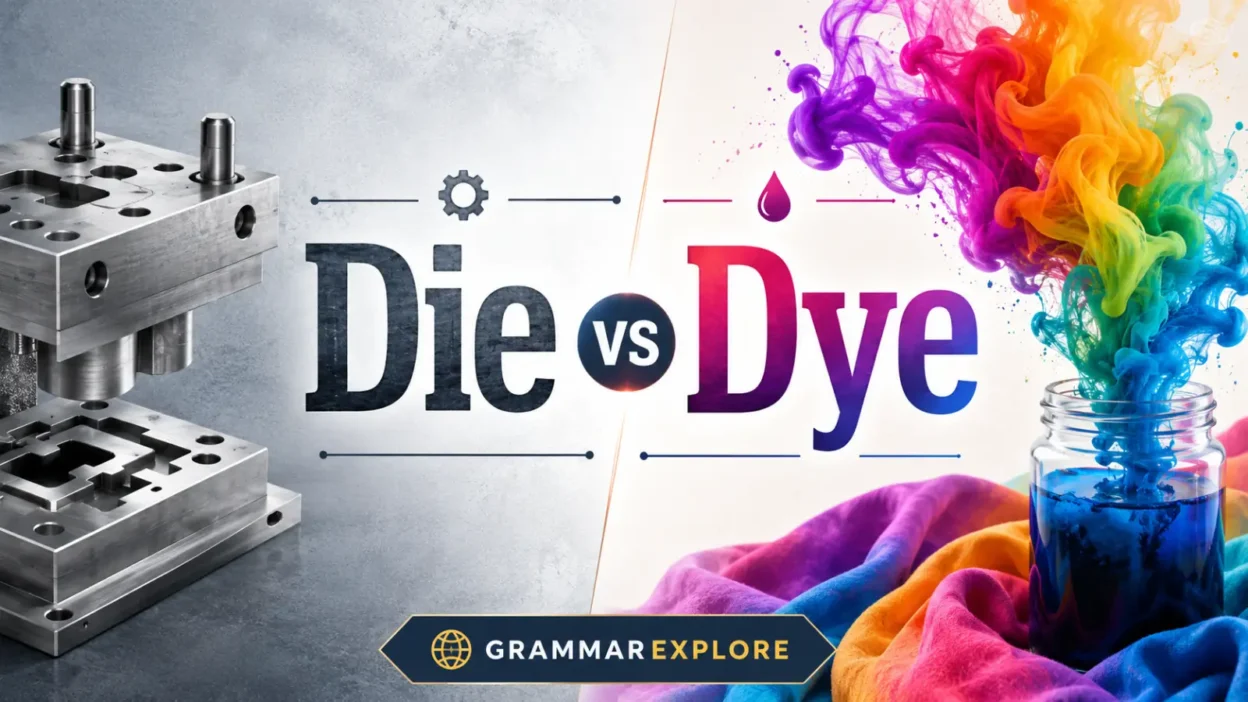
Die and dye sound exactly the same, but they mean very different things. Use die when something stops living, stops working, fades away, or refers to one cube used in a game. Use dye when you mean color, a coloring substance, or the action of adding color.
The easiest rule is simple: if the sentence is about color, choose dye. If it is about death, stopping, fading, or one game cube, choose die.
Quick Answer
Die means to stop living, stop working, disappear, fade, or come to an end. It can also be a noun meaning one cube used in games or a device used for cutting, shaping, or stamping. Dye means a substance used to add color, or the act of coloring hair, fabric, food, or another material.
Why People Confuse Them
People confuse die and dye because they are homophones. In American English, both words sound like dī, rhyming with pie, sky, and try.
You cannot hear the spelling difference in speech. If someone says, “I need to dye my shirt,” the meaning tells you which word is correct.
The confusion also grows because both words can be verbs and nouns. Die can be a verb about death or stopping. It can also be a noun for one game cube. Dye can be a verb about coloring or a noun for the color substance.
Key Differences At A Glance
| Context | Best Choice | Why |
| A person, animal, or plant stops living | die | It means to stop being alive. |
| A phone, battery, or engine stops working | die | It can mean to stop functioning. |
| A sound, trend, habit, or feeling fades | die | It can mean to weaken or disappear. |
| Hair, fabric, yarn, or clothing gets color | dye | It means to add color. |
| A coloring substance is used | dye | It names the material that adds color. |
| One cube is used in a board game | die | It is the singular form of dice. |
Meaning And Usage Difference
The main difference between die and dye is meaning.
Use die when the sentence is about life ending, a machine stopping, energy fading, a trend disappearing, or one game cube.
Examples:
- The flowers may die without water.
- My phone will die before I get home.
- The music began to die down after midnight.
- Roll one die and move that many spaces.
Use dye when the sentence is about color or coloring something.
Examples:
- She wants to dye her hair red.
- The shirt was soaked in blue dye.
- We used food dye for the frosting.
- He will dye the old jeans black.
Both words can be nouns, but their noun meanings are not the same. A die can be one cube used in a game or a device used to shape or stamp material. A dye is a coloring substance.
| Feature | Die | Dye |
| Pronunciation | Same as dye | Same as die |
| Common Verb Meaning | Stop living, stop working, or fade | Add color |
| Common Noun Meaning | One game cube or a shaping device | Coloring substance |
| Past Tense | died | dyed |
| Present Participle | dying | dyeing |
Tone, Context, And Formality

Die can sound serious when it refers to people or animals. Use it carefully in sensitive situations.
Examples:
- The patient did not die from the injury.
- Several fish may die if the water is not clean.
In casual writing, die can also describe devices, batteries, sounds, jokes, habits, and trends.
Examples:
- My laptop might die during the meeting.
- The rumor finally started to die.
- The applause slowly died down.
Dye is usually neutral. It appears in beauty, fashion, cooking, crafts, textiles, and manufacturing.
Examples:
- I bought black hair dye.
- The bakery used green dye in the icing.
- The company will dye the fabric before cutting it.
Neither word is automatically more formal. The right choice depends on meaning.
Which One Should You Use?
Use die if the sentence is about death, stopping, fading, failing, or one game cube.
Correct:
- The plant will die in the heat.
- My headphones died yesterday.
- Please roll one die.
Use dye if the sentence is about adding color or a substance that adds color.
Correct:
- I want to dye my hair brown.
- The red dye stained the sink.
- They used fabric dye on the curtains.
A helpful memory trick: dye has y, and yellow is a color. That can help you connect dye with color. Still, meaning is the real rule.
When One Choice Sounds Wrong
Die sounds wrong when the sentence clearly means coloring.
Wrong: I want to die my hair blonde.
Correct: I want to dye my hair blonde.
Wrong: The artist used blue die on the cloth.
Correct: The artist used blue dye on the cloth.
Dye sounds wrong when the sentence means death, stopping, fading, or failure.
Wrong: The battery will dye soon.
Correct: The battery will die soon.
Wrong: The old tree is dyeing.
Correct: The old tree is dying.
Also watch the forms died and dyed.
Wrong: She died her jacket green.
Correct: She dyed her jacket green.
Wrong: He dyed last year.
Correct: He died last year.
Common Mistakes (And Quick Fixes)
Mistake: Using die for hair color
Wrong: She will die her hair black.
Correct: She will dye her hair black.
Mistake: Using dye for death
Wrong: The flowers will dye without sunlight.
Correct: The flowers will die without sunlight.
Mistake: Mixing up dying and dyeing
Wrong: I am dying my shirt.
Correct: I am dyeing my shirt.
Wrong: The plant is dyeing.
Correct: The plant is dying.
Mistake: Using dice when careful writing needs the singular form
Less precise: Roll one dice.
Better: Roll one die.
In casual speech, many people use dice for one cube and more than one cube. In careful writing, die is singular and dice is plural.
Everyday Examples
- The houseplants will die if we forget to water them.
- My phone died during the video call.
- The engine died at the red light.
- The crowd noise slowly began to die down.
- That trend will probably die out by next month.
- Roll one die and move your game piece.
- The factory uses a metal die to stamp the parts.
- She bought purple dye for her hair.
- The red dye stained my fingers.
- We used food dye to color the frosting.
- He wants to dye his old jeans black.
- The costume shop is dyeing shirts for the school play.
Dictionary-Style Word Details
Verb
die: A verb meaning to stop living, stop functioning, fade, disappear, or come to an end.
Example:
The battery may die before the movie ends.
dye: A verb meaning to add color to something with dye.
Example:
She plans to dye the curtains navy blue.
Noun
die: A noun with two main meanings. It can mean one cube used in games, or a device used to cut, shape, stamp, or form material.
Example:
Roll one die before you move.
dye: A noun meaning a substance used to color something.
Example:
The blue dye left a mark on the counter.
Synonyms
die: Close alternatives include perish, expire, stop working, fade, disappear, and end, depending on the sentence. Clear opposites include live, survive, continue, and work.
dye: Close alternatives include color, tint, stain, and colorant, depending on whether the word is used as a verb or noun. In some color-removal contexts, bleach may act as a loose opposite, but it is not a perfect opposite in every sentence.
Example Sentences
die:
- The old tree may die this winter.
- My car battery died in the parking lot.
- The music slowly began to die away.
- The player rolled one die.
dye:
- I want to dye this white shirt blue.
- The salon used a gentle hair dye.
- She dyed the fabric by hand.
- The baker added red dye to the icing.
Word History
die: The verb die has long been used for the end of life. The noun die has a separate use for one game cube and for certain cutting, shaping, or stamping devices.
dye: The word dye is tied to color. In modern standard English, it is the correct word for a coloring substance and for the act of adding color.
Phrases Containing
die:
- die down
- die out
- die away
- never say die
- to die for
- do-or-die
- the die is cast
- old habits die hard
dye:
- hair dye
- fabric dye
- food dye
- natural dye
- dye your hair
- dye the fabric
- tie-dye
- dye job
Frequently Asked Questions
Is die the same as dye?
No. Die and dye sound the same, but they have different meanings. Die is about death, stopping, fading, or one game cube. Dye is about color or coloring something.
Is it die your hair or dye your hair?
The correct phrase is dye your hair. Hair color uses dye, not die.
Correct: I want to dye my hair dark brown.
Wrong: I want to die my hair dark brown.
Is it dying or dyeing clothes?
Use dyeing for clothes because the sentence is about adding color.
Correct: She is dyeing her shirt blue.
Wrong: She is dying her shirt blue.
Use dying when something is losing life or stopping.
Correct: The plant is dying.
What is the past tense of die and dye?
The past tense of die is died.
Example:
The phone died during the call.
The past tense of dye is dyed.
Example:
She dyed her jacket black.
Is die singular for dice?
Yes. In careful writing, die is singular and dice is plural.
Correct: Roll one die.
Correct: Roll two dice.
Can die mean stop working?
Yes. Die can mean stop working when you talk about a phone, battery, car, engine, or machine.
Example:
My phone might die before I find a charger.
Conclusion
Die and dye are easy to mix up because they sound the same. However, their meanings are separate.
Use die for death, stopping, fading, failure, one game cube, or a shaping device. Use dye for color, coloring substances, and the act of adding color. When the sentence is about hair, fabric, food coloring, or clothing, dye is the correct choice.
No. Die and dye sound the same, but they have different meanings. Die is about death, stopping, fading, or one game cube. Dye is about color or coloring something.
The correct phrase is dye your hair. Hair color uses dye, not die.
Correct: I want to dye my hair dark brown.
Wrong: I want to die my hair dark brown.
Use dyeing for clothes because the sentence is about adding color.
Correct: She is dyeing her shirt blue.
Wrong: She is dying her shirt blue.
Use dying when something is losing life or stopping.
Correct: The plant is dying.
The past tense of die is died.
Example:
The phone died during the call.
The past tense of dye is dyed.
Example:
She dyed her jacket black.
Yes. In careful writing, die is singular and dice is plural.
Correct: Roll one die.
Correct: Roll two dice.
Yes. Die can mean stop working when you talk about a phone, battery, car, engine, or machine.
Example:
My phone might die before I find a charger.