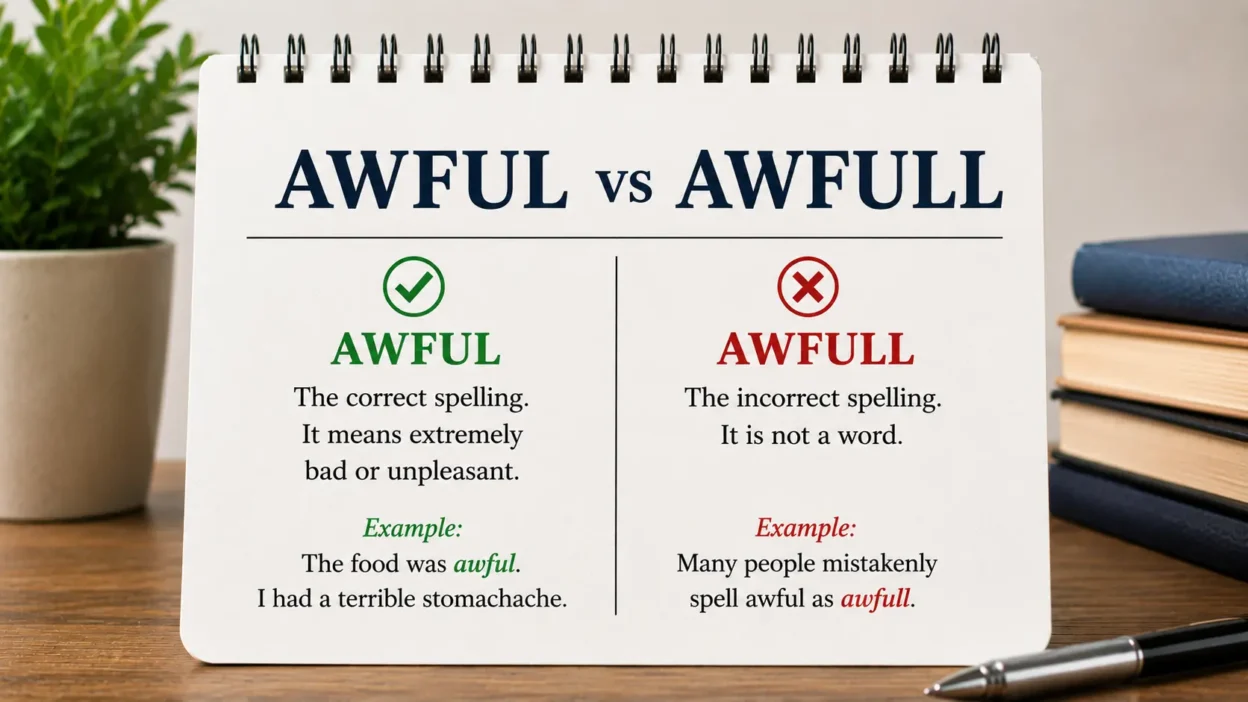
Awful is the correct spelling. Awfull is incorrect.
Use awful when something is very bad, unpleasant, terrible, painful, or upsetting.
Correct: The weather was awful all weekend.
Incorrect: The weather was awfull all weekend.
Correct: I felt awful after missing the meeting.
Incorrect: I felt awfull after missing the meeting.
The spelling tip is simple: awful ends in -ful, with one final l.
What Awful Means
Awful is usually an adjective. It means very bad, unpleasant, terrible, or extremely poor.
Examples:
- Correct: The food tasted awful.
- Correct: She had an awful headache.
- Correct: That was an awful mistake.
- Correct: The room smelled awful.
In everyday American English, awful is a strong negative word. It can describe bad weather, poor service, pain, guilt, fear, smell, taste, behavior, or an unpleasant experience.
Example: I had an awful day at work.
That means the day was very bad, not just slightly annoying.
Is Awfull A Word?
Awfull is not a standard English word.
It is a misspelling of awful. The mistake happens when writers add an extra l at the end.
Incorrect: awfull
Correct: awful
Do not use awfull in essays, emails, reviews, captions, reports, resumes, or published writing.
Why Awful Has One L
The word awful ends with the suffix -ful, not the word full.
That is why it has one final l.
The same pattern appears in many common words:
- beautiful
- careful
- helpful
- painful
- peaceful
- useful
- wonderful
You would not write beautifull, helpfull, or wonderfull in standard writing. For the same reason, do not write awfull.
Correct: awful
Incorrect: awfull
Awful Vs Awfull At A Glance
| Word | Correct? | Meaning | Use It? |
|---|---|---|---|
| awful | Yes | Very bad, unpleasant, terrible, or extremely poor | Yes |
| awfull | No | No standard meaning; misspelling of awful | No |
This is not a British vs American spelling difference. It is not a formal vs casual spelling difference. Awful is correct everywhere, and awfull is a typo.
How To Use Awful In A Sentence
Use awful to describe something strongly negative.
- Correct: The traffic was awful this morning.
- Correct: I feel awful about forgetting your birthday.
- Correct: The hotel room smelled awful.
- Correct: The service was awful, so we left early.
- Correct: That was an awful thing to say.
- Correct: The team played an awful game.
Awful can describe how someone feels physically or emotionally.
Correct: I feel awful after eating that.
Correct: She felt awful about the argument.
It can also describe quality.
Correct: The audio in the video was awful.
Correct: The first draft was awful, but the final version was strong.
Awful Can Sound Blunt
Awful is clear, but it can sound harsh. In casual speech, that may be fine.
Example: That movie was awful.
In professional writing, awful may sound too emotional or blunt. A more specific word is often better.
Blunt: The report was awful.
Better: The report had serious errors.
Blunt: The customer service was awful.
Better: The customer service was slow and unhelpful.
Blunt: Your presentation was awful.
Better: Your presentation needs clearer examples and stronger organization.
Use awful when you want a strong, direct word. Use a more specific word when you want to sound fair, professional, or precise.
An Awful Lot
Awful can also appear in informal phrases such as an awful lot.
- In this phrase, awful does not mean terrible. It means “very much” or “a large amount.”
- Correct: We spent an awful lot of time on that project.
Correct: She has an awful lot of homework tonight.
Correct: There were an awful lot of people at the airport.
This use is common in conversation, but it is informal. In formal writing, use many, much, a large amount, or a great deal instead.
Informal: We received an awful lot of feedback.
Formal: We received a large amount of feedback.
Awful Vs Awfully
Awful is usually an adjective.
Example: The food was awful.
Awfully is the adverb form.
Example: I’m awfully sorry.
In modern use, awfully often means very or extremely.
- Correct: That was awfully kind of you.
- Correct: I’m awfully tired.
- Correct: The instructions were awfully confusing.
Do not use awfull for either form.
Incorrect: I feel awfull.
Correct: I feel awful.
Incorrect: I’m awfull sorry.
Correct: I’m awfully sorry.
Awful, Terrible, Horrible, And Bad
These words are close, but they do not always feel the same.
Bad is general and less intense.
Example: The food was bad.
Awful is stronger than bad and often more emotional.
Example: The food was awful.
Terrible is also strong and can describe serious problems, poor quality, or intense discomfort.
Example: I had a terrible headache.
Horrible can feel more dramatic, especially for fear, disgust, pain, or cruelty.
Example: That was a horrible accident.
For everyday writing, bad is mild, awful is strong, and horrible or terrible can sound even more intense depending on context.
Common Misspellings And Better Fixes
- Incorrect: awfull
Correct: awful - Incorrect: aweful
Correct: awful - Incorrect: awefull
Correct: awful - Incorrect: awfil
Correct: awful - Incorrect: awfel
Correct: awful
The safest memory trick is:
aw + ful = awful
Not:
aw + full = awfull
Real-World Examples
For reviews:
Correct: The food was awful, and the order arrived cold.
Correct: The hotel had an awful smell in the hallway.
For school writing:
Correct: The character makes an awful decision in the final chapter.
Correct: The storm caused awful damage across the town.
For emails:
Correct: I feel awful about the delay.
Correct: I’m sorry you had such an awful experience.
For workplace writing:
Correct: The first version had serious issues.
Too blunt: The first version was awful.
For casual speech:
Correct: I slept terribly and feel awful today.
Correct: That traffic was awful.
For informal emphasis:
Correct: We waited an awful lot longer than expected.
Correct: That sounds like an awful lot of work.
FAQ
Is awfull ever correct?
No. Awfull is not correct in standard English. The correct spelling is awful.
Why does awful have only one l?
Awful uses the suffix -ful, which has one l. It does not end with the word full.
Is it awful or aweful?
The correct spelling is awful. Aweful is also a misspelling in modern standard English.
What does awful mean?
Awful usually means very bad, unpleasant, terrible, or extremely poor.
Example: The smell was awful.
Is awful always negative?
Usually, yes. In modern everyday English, awful is most often negative. But in informal phrases like an awful lot, it can mean a very large amount.
What does an awful lot mean?
An awful lot means a large amount or a great deal.
Example: We spent an awful lot of money on repairs.
Is awful an adjective or adverb?
Awful is mainly an adjective. It can also be used informally as an adverb in some expressions, but awfully is the standard adverb form.
What is the adverb form of awful?
The adverb form is awfully.
Example: I’m awfully sorry.
What is a better word than awful?
A better word depends on the meaning. Try terrible, horrible, unpleasant, painful, rude, dangerous, messy, unfair, or poor-quality.
Conclusion
Awful is correct. Awfull is a misspelling.
Use awful when something is very bad, unpleasant, terrible, or upsetting.
Correct: The weather was awful.
Incorrect: The weather was awfull.
Remember the spelling this way: awful ends in -ful, with one final l.