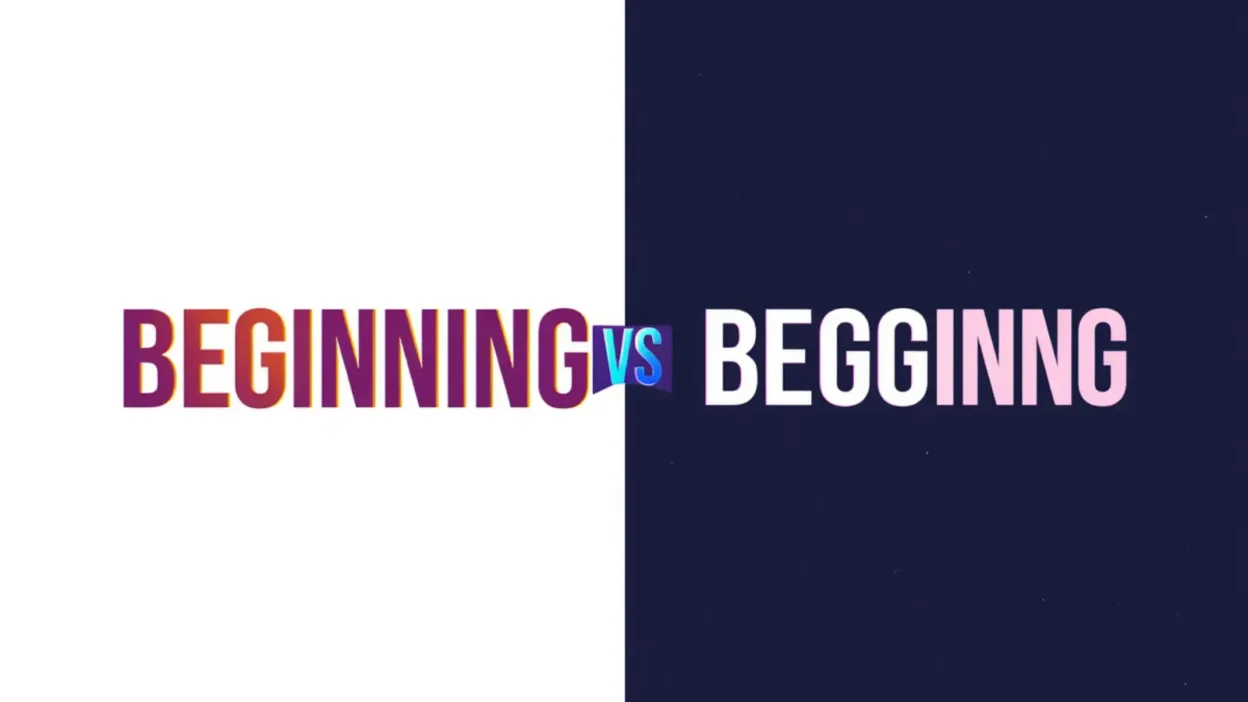
Beginning is the correct spelling. Beggining is incorrect.
Use beginning when you mean the start, first part, or early stage of something. You can also use beginning as the -ing form of the verb begin.
Correct: The beginning of the movie was slow.
Incorrect: The beggining of the movie was slow.
Correct: The class is beginning now.
Incorrect: The class is beggining now.
The spelling tip is simple:
begin + ing = beginning
Use one g and two n’s.
What Beginning Means
Beginning usually means the start or first part of something.
Examples:
- Correct: The beginning of the book was exciting.
- Correct: We missed the beginning of the meeting.
- Correct: The school year starts at the beginning of September.
- Correct: I knew from the beginning that the project would take time.
- Correct: The school year starts at the beginning of September.
- Correct: We missed the beginning of the meeting.
Beginning can also describe an early stage.
Example: The company is still in the beginning stages of the plan.
In simple words, beginning means “the start.”
Is Beggining A Word?
Beggining is not a standard English word.
It is a misspelling of beginning. The mistake happens when writers double the g instead of keeping the correct begin + ing pattern.
Incorrect: beggining
Correct: beginning
Do not use beggining in essays, emails, captions, reports, stories, school assignments, or published writing.
Why People Misspell Beginning As Beggining
People often misspell beginning because the word has a tricky double-letter pattern.
The base word is begin. When you add -ing, the final n doubles.
Correct pattern:
begin + ing = beginning
The g does not double.
That is why beggining is wrong. It puts the extra letter in the wrong place.
Correct: beginning
Incorrect: beggining
A helpful memory trick:
begin + ning = beginning
Think of begin, then add ning.
Beginning Vs Beggining At A Glance
| Word | Correct? | Meaning | Use It? |
|---|---|---|---|
| beginning | Yes | The start, first part, early stage, or the -ing form of begin | Yes |
| beggining | No | No standard meaning; misspelling of beginning | No |
This is not a British vs American spelling difference. It is not a casual spelling. Beginning is correct, and beggining is a typo.
Why Beginning Has One G And Two N’s
The correct spelling is:
b-e-g-i-n-n-i-n-g
The word has:
- one g
- two n’s
- the ending -ing
The spelling comes from begin + ing. Since begin ends with n, the n doubles before -ing.
Correct: begin → beginning
This same pattern appears in other words where the final consonant doubles before -ing.
Examples:
- run → running
- sit → sitting
- plan → planning
- begin → beginning
But the g in begin is not the final sound, so it does not double.
Incorrect: beggining
Correct: beginning
Beginning As A Noun, Verb Form, And Adjective
Beginning can work in three useful ways.
As a noun, beginning means the start or first part.
Example: The beginning of the speech was strong.
As a verb form, beginning means starting.
Example: The meeting is beginning now.
As an adjective, beginning can mean basic or introductory.
Example: She joined a beginning Spanish class.
The spelling stays the same in all three uses.
Correct: beginning
Incorrect: beggining
Begin Vs Beginning
Begin is the base verb.
Example: We will begin soon.
Beginning is the -ing form or the noun form.
Example: We are beginning soon.
Example: The beginning was confusing.
Use begin after words like will, can, may, might, should, and to.
Correct: We will begin the project tomorrow.
Incorrect: We will beginning the project tomorrow.
Use beginning after helping verbs like am, is, are, was, and were when describing an action in progress.
Correct: The project is beginning tomorrow.
Incorrect: The project beginning tomorrow.
Began, Begun, And Beginning
These forms belong to the same verb family.
| Form | Use | Example |
|---|---|---|
| begin | base verb | We will begin soon. |
| began | simple past | The meeting began at noon. |
| begun | past participle | The work has begun. |
| beginning | -ing form / noun | The event is beginning now. |
Do not use beginning where began or begun is needed.
Incorrect: The class beginning yesterday.
Correct: The class began yesterday.
Incorrect: The project has beginning.
Correct: The project has begun.
Common Misspellings And Better Fixes
- Incorrect: beggining
Correct: beginning - Incorrect: begining
Correct: beginning - Incorrect: begginning
Correct: beginning - Incorrect: beginnning
Correct: beginning - Incorrect: biginning
Correct: beginning - The safest spelling pattern is:
begin + ing = beginning
Use one g and two n’s.
Common Mistakes With Beginning
Mistake: Doubling the g.
Incorrect: The beggining was confusing.
Correct: The beginning was confusing.
Mistake: Using only one n.
Incorrect: The begining of the story was slow.
Correct: The beginning of the story was slow.
Mistake: Using beginning after will.
Incorrect: We will beginning soon.
Correct: We will begin soon.
Mistake: Using beginning without a helping verb.
Incorrect: The meeting beginning now.
Correct: The meeting is beginning now.
Mistake: Using beginning where began is needed.
Incorrect: The show beginning at 8 p.m. yesterday.
Correct: The show began at 8 p.m. yesterday.
Common Phrases With Beginning
At the beginning means at the start.
Example: The teacher explained the rules at the beginning of class.
From the beginning means from the start.
Example: I trusted her from the beginning.
In the beginning means in the earliest stage or first period.
Example: In the beginning, the business had only two employees.
New beginning means a fresh start.
Example: Moving to a new city felt like a new beginning.
Humble beginnings means a modest or simple start.
Example: The company grew from humble beginnings.
Beginning stages means the early part of a process.
Example: The plan is still in the beginning stages.
Real-World Examples
For school writing:
Correct: The beginning of the essay should introduce the main idea.
Correct: The story becomes more exciting after the beginning.
For stories and books:
Correct: The beginning of the novel sets up the conflict.
Correct: I liked the ending more than the beginning.
For work:
Correct: The new policy starts at the beginning of July.
Correct: We are beginning the training session now.
For everyday speech:
Correct: I missed the beginning of the game.
Correct: She is beginning to feel better.
For captions:
Correct: A new beginning starts today.
Correct: Just the beginning of something better.
Synonyms For Beginning
Good alternatives depend on the sentence.
Use start for everyday writing.
Example: The start of the movie was slow.
Use opening for books, speeches, movies, or events.
Example: The opening of the speech was powerful.
Use first part when you want plain wording.
Example: The first part of the lesson was easy.
Use origin when talking about where something came from.
Example: The book explains the origin of the tradition.
Use early stage when talking about development.
Example: The project is still in an early stage.
Useful opposites include end, ending, finish, and conclusion.
Do not use beggining as an alternative. It is a spelling error.
FAQ
Is beggining ever correct?
No. Beggining is not correct in standard English. The correct spelling is beginning.
Why does beginning have two n’s?
Beginning comes from begin + ing. The final n in begin doubles before -ing, so the correct spelling is beginning.
Does beginning have one g or two?
Beginning has one g.
Correct: beginning
Incorrect: beggining
Is begining also wrong?
Yes. Begining is also incorrect. The correct spelling is beginning, with two n’s.
Is beginning a noun or a verb?
Beginning can be a noun or the -ing form of the verb begin.
Noun: The beginning was slow.
Verb form: The class is beginning now.
Can beginning be an adjective?
Yes. Beginning can work as an adjective meaning basic or introductory.
Example: He joined a beginning guitar class.
What is the plural of beginning?
The plural is beginnings.
Example: The company grew from humble beginnings.
What is a simpler word for beginning?
A simpler word is start.
Example: The start of the movie was slow.
For a deeper breakdown of why “accommodate” is frequently misspelled and how to remember its correct form, you can explore the detailed guide on Accommodate vs Accomodate – Which Spelling is Correct, which explains the rule in a clear, SEO-friendly way.
Conclusion
Beginning is correct. Beggining is a misspelling.
Use beginning when you mean the start, first part, or early stage of something. You can also use it as the -ing form of begin.
Correct: The beginning of the movie was slow.
Incorrect: The beggining of the movie was slow.
Remember the spelling this way:
begin + ing = beginning
Use one g and two n’s.