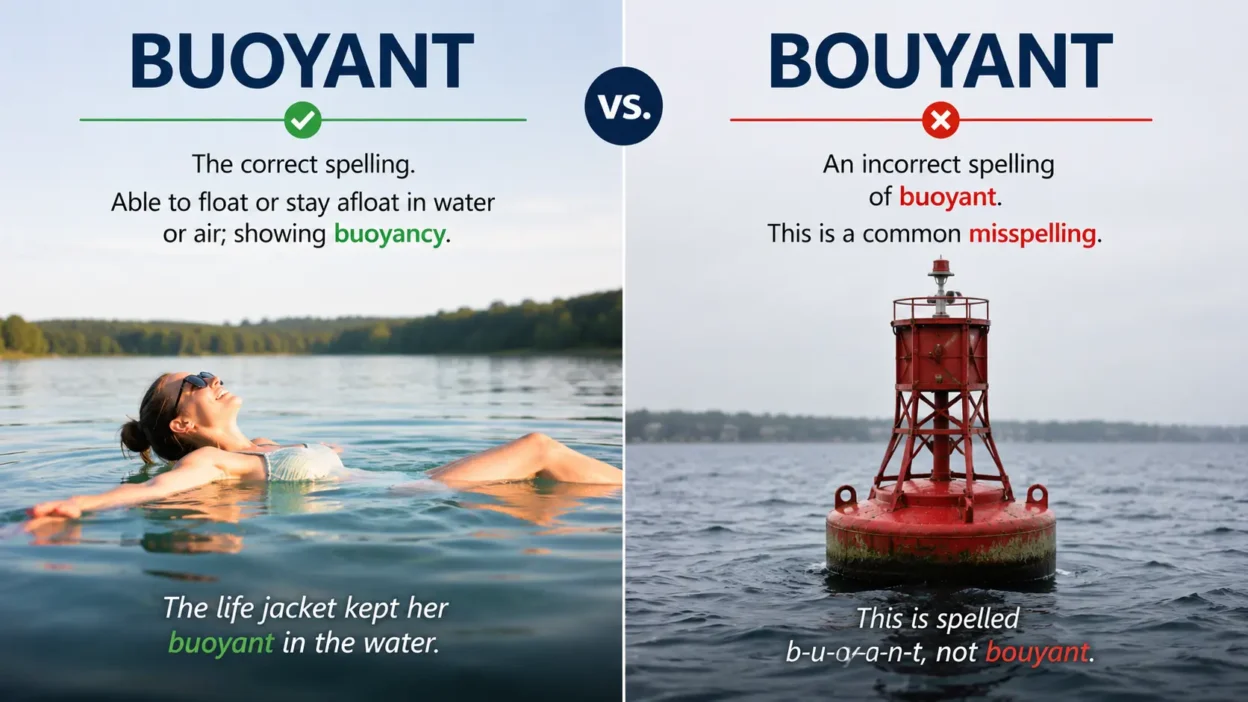
Buoyant is the correct spelling. Bouyant is a misspelling.
Use buoyant when you mean able to float, cheerful and confident, or strong in a business or economic sense. Major dictionaries list buoyant as the standard adjective, while spelling references and dictionary entries treat bouyant as incorrect or a misspelling.
Correct:
- The foam board is light and buoyant.
- She sounded buoyant after the interview.
- The market stayed buoyant through spring.
Incorrect:
- The foam board is light and bouyant.
- She sounded bouyant after the interview.
- The market stayed bouyant through spring.
The correct spelling is B-U-O-Y-A-N-T.
Buoyant Vs Bouyant At A Glance
| Word | Correct? | Meaning | Example |
|---|---|---|---|
| Buoyant | Yes | Able to float; cheerful; strong or successful | The team was in a buoyant mood. |
| Bouyant | No | Misspelling of buoyant | Change bouyant to buoyant. |
What Buoyant Means
Buoyant is an adjective with three common meanings.
First, it can mean able to float or rise in a liquid or gas. This is the physical meaning.
Examples:
- Cork is buoyant in water.
- A life jacket helps keep a swimmer buoyant.
- Warm air is more buoyant than cool air.
Second, buoyant can mean cheerful, hopeful, or confident. This is the emotional meaning.
Examples:
- She was in a buoyant mood after getting the job.
- The players sounded buoyant before the final game.
- His confidence remained buoyant despite the setback.
Third, buoyant can mean strong, active, or successful, especially in business or economic writing. Cambridge and Collins both include business-related senses such as a successful or active market or economy.
Examples:
- The housing market remained buoyant.
- The company entered the year with buoyant expectations.
- Consumer demand stayed buoyant through the holiday season.
Why Bouyant Is Wrong
Bouyant is wrong because the accepted spelling is buoyant.
The mistake usually happens because of the related word buoy. Writers see buoy, hear a pronunciation that may sound like boy or boo-ee, and then rearrange the letters into bouyant. That spelling may look easier, but it is not standard.
Use these forms:
- buoyant
- buoyancy
- buoyantly
Avoid these misspellings:
- bouyant
- bouyancy
- bouyantly
A simple memory trick: buoyant starts with buoy, the floating word. Keep the order B-U-O-Y, then add -ant.
How To Pronounce Buoyant
Buoyant is commonly pronounced BOY-unt. Some speakers also use a pronunciation closer to BOO-yunt, especially because the related word buoy has more than one accepted pronunciation in American English.
The spelling does not change.
Write:
- buoyant
Not:
- bouyant
Pronunciation may vary, but the correct spelling stays B-U-O-Y-A-N-T.
Buoyant As A Physical Word
Use buoyant when something floats, rises, or stays up in water, air, or another fluid.
Common physical phrases include:
- buoyant material
- buoyant object
- buoyant force
- buoyant foam
- buoyant raft
- buoyant life jacket
Examples:
- The lightweight foam is highly buoyant.
- Salt water can make a swimmer feel more buoyant.
- The raft stayed buoyant even with two people on it.
- A helium balloon is buoyant because it rises in air.
- Engineers tested the buoyant force on the floating platform.
In this sense, buoyant is often used in science, swimming, boating, engineering, and safety writing.
Buoyant As An Emotional Word
Use buoyant when someone feels cheerful, hopeful, lively, or confident.
Common emotional phrases include:
- buoyant mood
- buoyant spirit
- buoyant personality
- buoyant confidence
- buoyant attitude
Examples:
- She walked into the room with a buoyant smile.
- The students were in a buoyant mood after the performance.
- The coach tried to keep the team’s spirits buoyant.
- He sounded calm and buoyant on the call.
- Her confidence was buoyant after weeks of practice.
This use is polished but still natural. In casual writing, simpler words like cheerful, upbeat, or hopeful may work better.
Buoyant In Business And Markets
Use buoyant in business writing when a market, economy, company, or demand level is strong, active, or holding up well. Collins gives examples such as buoyant economy and buoyant market, and Merriam-Webster includes the sense of maintaining a high level.
Common business phrases include:
- buoyant market
- buoyant economy
- buoyant demand
- buoyant sales
- buoyant expectations
- buoyant outlook
Examples:
- Sales stayed buoyant through the summer.
- A buoyant market helped new businesses raise capital.
- Demand for travel remained buoyant during the holiday season.
- The company gave a buoyant forecast for the next quarter.
- Analysts described consumer spending as buoyant.
This use is common in news, finance, business reports, and market commentary.
Common Forms And Misspellings
| Correct Form | Wrong Form | Use |
|---|---|---|
| buoyant | bouyant | adjective |
| buoyancy | bouyancy | noun |
| buoyantly | bouyantly | adverb |
Examples:
- The material is buoyant.
- The material has strong buoyancy.
- She answered buoyantly.
Incorrect:
- The material is bouyant.
- The material has strong bouyancy.
- She answered bouyantly.
Buoyant, Buoyancy, And Buoyantly
Buoyant is the adjective.
Example:
- The kayak is stable and buoyant.
Buoyancy is the noun.
Example:
- The kayak’s buoyancy helps it stay afloat.
Buoyantly is the adverb.
Example:
- She spoke buoyantly about the team’s chances.
Use the form that matches the sentence.
- The swimmer stayed buoyant.
- The swimmer’s buoyancy helped him float.
- The swimmer moved buoyantly through the water.
When To Use A Simpler Word
Buoyant is correct, but it can sound a little polished. A simpler word may be better when you want a more direct tone.
- Use afloat when you mean staying on top of water.
- The life jacket kept him afloat.
2. Use floating when you mean physically resting on water or air.
- The toy was floating in the pool.
3. Use cheerful or upbeat when you mean happy.
- She sounded upbeat after the meeting.
4. Use strong or healthy when you mean business conditions are good.
- The market stayed strong.
Use buoyant when you want a word that suggests lift, energy, confidence, or strength.
Common Mistakes And Quick Fixes
Mistake: Writing Bouyant Instead Of Buoyant
Wrong:
- The raft stayed bouyant.
Right:
- The raft stayed buoyant.
Mistake: Writing Bouyancy Instead Of Buoyancy
Wrong:
- The vest has strong bouyancy.
Right:
- The vest has strong buoyancy.
Mistake: Writing Bouyantly Instead Of Buoyantly
Wrong:
- She spoke bouyantly after the win.
Right:
- She spoke buoyantly after the win.
Mistake: Using Buoyant Only For Floating
Buoyant can describe floating, mood, or business strength.
Correct:
- The cork is buoyant.
- The crowd was buoyant.
- The economy remained buoyant.
Mistake: Using Buoyant When Popular Is Meant
Buoyant does not simply mean popular. It means lifted, strong, hopeful, floating, or holding up well.
Weak:
- The singer is very buoyant online.
Better:
- The singer is very popular online.
Better use of buoyant:
- The singer gave a buoyant performance.
Synonyms For Buoyant
The best synonym depends on the meaning.
- For floating:
- floating
- afloat
- light
- floatable
2. For mood:
- cheerful
- upbeat
- hopeful
- confident
- optimistic
- lively
3. For business:
- strong
- healthy
- active
- successful
- resilient
Examples:
- The raft stayed buoyant.
- The raft stayed afloat.
- She felt buoyant.
- She felt upbeat.
- The market remained buoyant.
- The market remained strong.
Possible antonyms include sinking, heavy, gloomy, downbeat, weak, or sluggish, depending on the sentence.
Examples Of Buoyant In Sentences
- The cork stayed buoyant in the water.
- A life jacket keeps a swimmer buoyant.
- The foam was light, strong, and buoyant.
- The balloon became more buoyant as the warm air rose.
- She was in a buoyant mood after the interview.
- The team looked buoyant during practice.
- His voice was calm but buoyant.
- Sales remained buoyant through the holiday season.
- The company issued a buoyant forecast.
- A buoyant market helped small businesses expand.
- The material’s buoyancy made it useful for rescue gear.
- She answered buoyantly, even after a long day.
FAQs
Is buoyant or bouyant correct?
Buoyant is correct. Bouyant is a misspelling.
Is bouyant a real word?
Bouyant appears as a misspelling, but it is not the standard spelling. Use buoyant in edited writing. Wiktionary labels bouyant as a misspelling of buoyant.
What does buoyant mean?
Buoyant means able to float, cheerful and confident, or strong and successful in a business or economic sense.
How do you spell buoyant?
The correct spelling is B-U-O-Y-A-N-T.
How do you pronounce buoyant?
Buoyant is commonly pronounced BOY-unt. Some speakers also say it closer to BOO-yunt. The spelling remains buoyant.
What is the noun form of buoyant?
The noun form is buoyancy.
Example:
- The vest’s buoyancy helped keep the swimmer afloat.
What is the adverb form of buoyant?
The adverb form is buoyantly.
Example:
- She spoke buoyantly about the new project.
What does buoyant mood mean?
A buoyant mood is a cheerful, hopeful, or confident mood.
Example:
- He was in a buoyant mood after hearing the good news.
What does buoyant market mean?
A buoyant market is a strong, active, or successful market. This use is common in business and finance writing.
How can I remember the spelling of buoyant?
Remember that buoyant starts with buoy, the floating word. Keep the order B-U-O-Y, then add -ant.
Final Answer
Use buoyant, not bouyant.
Buoyant is the correct adjective for something that floats, someone who feels cheerful and confident, or a market or economy that is strong. Bouyant is a misspelling.
The easiest way to remember it: buoyant begins with buoy. Keep the letter order B-U-O-Y-A-N-T.