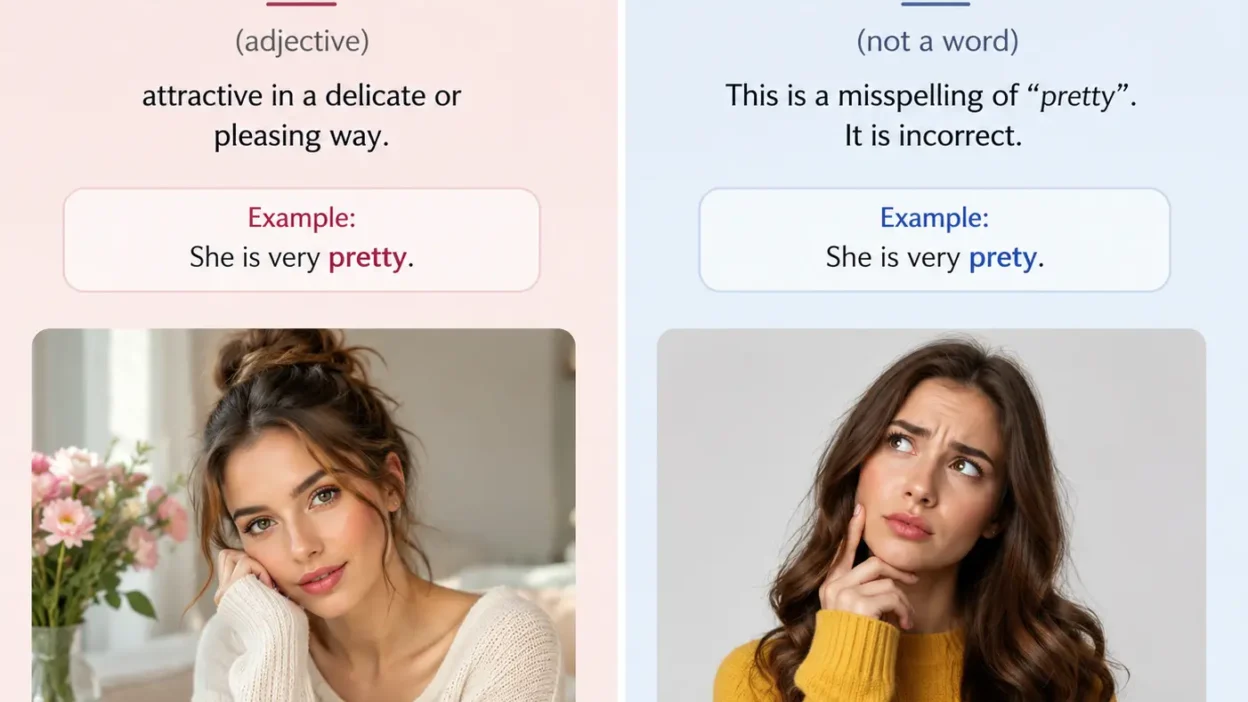
Feature Image Prompt: A clean modern graphic comparing “pretty” and “prety,” with “pretty” highlighted as correct and “prety” marked as a typo in a stylish pastel design.
Alt Text: Correct spelling of pretty compared with incorrect spelling prety
If you are deciding between “pretty” and “prety,” the correct spelling is “pretty.”
“Prety” is a misspelling and is not accepted in standard American English.
The confusion is common because double-letter words are easy to mistype, especially in fast texting, emails, and casual writing. Still, only “pretty” belongs in correct English writing.
Quick Answer
Here is the simple rule:
| Context | Best Choice | Why |
|---|---|---|
| School writing | pretty | Correct standard spelling |
| Professional emails | pretty | Accepted English usage |
| Casual texting | pretty | Still the correct form |
| Social media captions | pretty | Standard spelling |
| “prety” | Incorrect | Typo or spelling mistake |
Use “pretty” in every situation.
Why People Confuse Them
Most people misspell “pretty” for one of two reasons.
First, double letters are easy to forget while typing quickly.
Second, pronunciation does not strongly emphasize both “t” sounds. In everyday American speech, “pretty” often sounds soft and fast, making the second “t” less noticeable.
That is why many people accidentally type:
- prety
- pritty
- prettey
Even fluent English speakers make this mistake occasionally.
Key Differences At A Glance
| Feature | pretty | prety |
|---|---|---|
| Correct spelling | Yes | No |
| Dictionary word | Yes | No |
| Used in formal writing | Yes | No |
| Standard English | Yes | No |
| Accepted in professional communication | Yes | No |
Meaning And Usage Difference
“Pretty” is a real English word with multiple uses.
Most often, it works as an adjective meaning attractive, pleasant, or visually appealing.
Examples:
- That is a pretty apartment.
- She wore a pretty green sweater.
- The beach looked pretty at sunset.
“Pretty” also works as an adverb in conversational American English. In that role, it means fairly, somewhat, or quite.
Examples:
- I am pretty sure we met before.
- The movie was pretty funny.
- Traffic was pretty heavy today.
That second use is extremely common in everyday speech.
“Prety” has no accepted meaning because it is simply an incorrect spelling of “pretty.”
Tone, Context, And Formality
As an adjective, “pretty” usually sounds friendly, natural, and positive.
Examples:
- They bought a pretty little house.
- Your presentation looked pretty professional.
As an adverb, “pretty” sounds more casual than words like:
- very
- extremely
- highly
For example:
- The meeting was pretty long.
That sentence sounds conversational and relaxed.
In formal business or academic writing, some writers prefer more precise alternatives depending on the tone they want.
Still, “pretty” itself is not incorrect in formal English.
“Prety,” however, looks careless in every context, including:
- resumes
- presentations
- websites
- emails
- school assignments
Which One Should You Use?
Always choose “pretty.”
There is no standard English situation where “prety” is considered correct.
An easy memory trick is this:
“Pretty” has two “t” letters in the middle.
You can also remember common phrases like:
- pretty good
- pretty sure
- pretty close
Seeing the correct spelling repeatedly helps reinforce it naturally.
When One Choice Sounds Wrong
These sentences look normal and polished:
- That restaurant is pretty popular downtown.
- I am pretty excited about the concert.
- She gave a pretty thoughtful answer.
These immediately look incorrect:
- That restaurant is prety popular downtown.
- I am prety excited about the concert.
- She gave a prety thoughtful answer.
Because “pretty” is such a common word, spelling mistakes stand out quickly to readers.
Common Mistakes (And Quick Fixes)
Common misspellings include:
- prety
- pritty
- prettey
Quick ways to avoid mistakes:
- Remember the double “t”
- Slow down when typing repeated letters
- Proofread short messages before sending
- Read sentences aloud if something looks off
- Use familiar phrases like “pretty good” as spelling anchors
Spell-check catches many errors, but proofreading still matters in professional writing.
Everyday Examples
Here are natural examples using the correct spelling.
- The café looked pretty busy this morning.
- That was a pretty smart decision.
- Her office has a pretty modern design.
- I am pretty sure the store closes at nine.
- The weather was pretty nice over the weekend.
Incorrect examples:
- The café looked prety busy this morning.
- I am prety sure the package arrived.
Dictionary-Style Word Details
Verb
pretty:
Not commonly used as a verb in standard American English.
prety:
Not a recognized English verb.
Noun
pretty:
Rarely used as a noun in modern American English outside uncommon informal expressions.
prety:
Not a standard English noun.
Synonyms
pretty:
As an adjective, close alternatives include:
- attractive
- lovely
- charming
- appealing
As an adverb, close alternatives include:
- fairly
- quite
- somewhat
Possible antonyms in some contexts:
- unattractive
- ugly
prety:
No valid synonyms because it is not a standard English word.
Example Sentences
pretty:
- The neighborhood looks pretty quiet tonight.
- She bought a pretty blue notebook.
- I am pretty confident about the interview.
prety:
- Incorrect: He lives in a prety neighborhood.
- Correct: He lives in a pretty neighborhood.
Word History
pretty:
The word developed through older English forms connected to cleverness, attractiveness, and pleasing appearance. Over time, its usage expanded into both descriptive and conversational meanings.
prety:
No recognized word history because it is a misspelling.
Phrases Containing
pretty:
- pretty much
- pretty good
- pretty sure
- sit pretty
- pretty close
prety:
Not used in accepted English phrases.
Frequently Asked Questions
Is prety ever correct?
No. “Prety” is always considered a spelling mistake in standard American English.
Why do people misspell pretty?
Most mistakes happen because double letters are easy to forget during fast typing.
Can pretty be used as an adverb?
Yes. In conversational English, “pretty” often means “fairly” or “quite.”
Is pretty formal or informal?
It depends on usage. As an adjective, it works in both formal and casual writing. As an adverb, it usually sounds more conversational.
How do you remember how to spell pretty?
A simple trick is to remember that “pretty” always contains two “t” letters in the middle.
Conclusion
In the comparison of “pretty vs prety,” only “pretty” is correct.
“Prety” is a common typo caused mostly by fast typing and double-letter confusion.