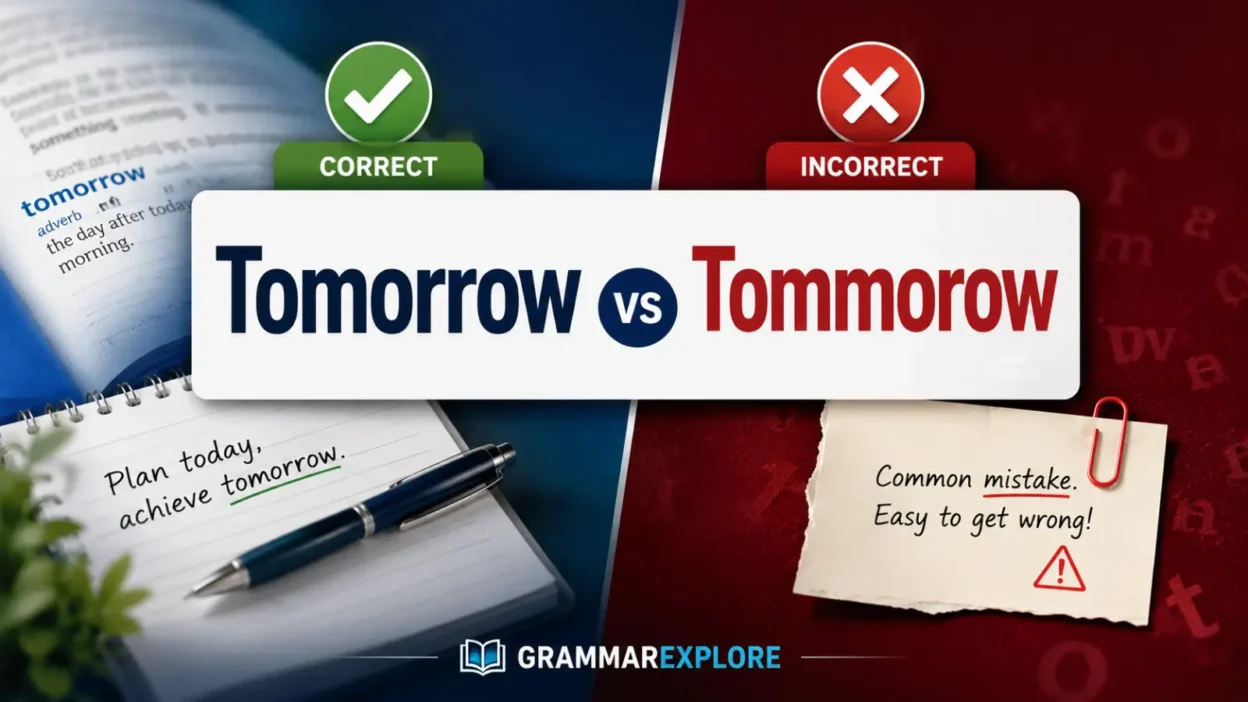
TL;DR: Tomorrow is correct. Tommorow is always a misspelling. The rule is one M and two R’s — t-o-m-o-r-r-o-w. Break it into to + morrow. The same spelling is standard in American and British English, works as both a noun and an adverb, and belongs in every email, essay, resume and text you write.
Written by Ethan Brooks, an English teacher and copy editor who has marked and proofread thousands of student essays, business emails and blog drafts. “Tommorow” turns up in almost every batch I edit — which is exactly why this guide exists.
Have you ever paused before typing tomorrow because you weren’t sure whether it has one m or two? You’re not alone. Many English learners and even native speakers accidentally write tommorow, making it one of the most common spelling mistakes in everyday writing.
The good news is that the answer is simple: tomorrow is the correct spelling, while tommorow is always incorrect. In this guide, you’ll learn the difference between tomorrow vs tommorow, why the mistake happens so often, easy ways to remember the correct spelling, and plenty of real-life examples to help you use tomorrow with confidence in school, work, emails, and daily conversations.
Tomorrow vs tommorow is one of a whole family of look-alike errors. If this one has been tripping you up, our full guide to commonly confused words covers the rest of the set the same way.
“Tomorrow” vs. “Tommorow”: Which Spelling Is Correct?
“Tomorrow” is the correct spelling. “Tommorow” is an incorrect spelling and should not be used in standard English. The correct spelling is “T-O-M-O-R-R-O-W.” An easy way to remember it is “one M and two R’s.” If you are choosing between “tomorrow” and “tommorow,” always use “tomorrow.”
“Tomorrow” means “the day after today.” It can also refer more generally to a future time or event. The spelling “tomorrow” is standard in both American and British English. On the other hand, “tommorow” is not a British spelling, American spelling, regional variant, or informal alternative. It is simply a misspelling of “tomorrow.”
The difference is straightforward: “tomorrow” is the correct word, while “tommorow” is the spelling error. If you are writing an email, essay, article, assignment, resume, or professional message, use “tomorrow.”
“How Do You Spell Tomorrow?”
The correct spelling of “tomorrow” is “T-O-M-O-R-R-O-W.” A simple memory rule is “tomorrow = one M + two R’s.”
Another useful way to remember the spelling is to break the word into “to + morrow.” The word “morrow” is an older English word associated with the following day, and it is spelled “M-O-R-R-O-W.” When “to” is added to “morrow,” the result is “tomorrow.”
This gives you a useful spelling clue because the doubled letter belongs to “R,” not “M.” Therefore, the correct pattern is “T-O-M-O-R-R-O-W,” not “T-O-M-M-O-R-O-W.”
“How Many M’s Are in Tomorrow?”
There is “one M” in “tomorrow.” The incorrect spelling “tommorow” has two M’s, while the correct spelling “tomorrow” has only one M. The M appears after “to,” giving the spelling pattern “to-m-o-r-r-o-w.”
If you are unsure whether to write “tomorrow” or “tommorow,” remember that the M is never doubled. The doubled consonant in “tomorrow” is the “R.”
“How Many R’s Are in Tomorrow?”
There are “two R’s” in “tomorrow.” The middle of the word contains “RR,” which is one of the easiest features to remember when spelling it.
The complete spelling is “T-O-M-O-R-R-O-W.” In other words, “tomorrow” contains “one M,” “two R’s,” and “one final W.”
A useful visual reminder is “tomo-RR-ow.” Once you remember that the R is doubled, it becomes much easier to avoid the common misspelling “tommorow.”
“How Many Letters Are in Tomorrow?”
“Tomorrow” has “eight letters.” They are “T-O-M-O-R-R-O-W.” The word is commonly pronounced with “three syllables,” represented as “to-mor-row.”
Knowing the number of letters can also help when checking the spelling. If you write “tomorrow,” you should have eight letters in total, with only the “R” appearing twice.
“Why Is Tommorow Incorrect?”
“Tommorow” is incorrect because the doubled consonant is in the wrong position. The correct spelling is “tomorrow,” which contains “one M and two R’s.” The incorrect form “tommorow” contains “two M’s and one R.”
The correct spelling is “T-O-M-O-R-R-O-W,” while the incorrect spelling is “T-O-M-M-O-R-O-W.” The problem is not that “tommorow” represents another English word. It is simply a misspelling of “tomorrow.”
“Is Tommorow Ever Correct?”
No. “Tommorow” is not a standard English spelling or an accepted alternative form of “tomorrow.” It is not a British variant, American variant, Australian variant, formal spelling, or informal alternative.
If you are writing an email, essay, resume, article, school assignment, or professional message, the correct form is always “tomorrow.”
“Why Do People Spell Tomorrow as Tommorow?”
The mistake is common because “tomorrow” contains a doubled consonant, but the doubled letter is “R” rather than “M.” When people remember that a letter is doubled but forget its exact position, they may write “tommorow” instead of “tomorrow.”
Compare the incorrect pattern “to-mm-orow” with the correct pattern “to-m-o-rr-ow.” The easiest way to avoid this mistake is to remember the simple rule: “one M + two R’s = tomorrow.”
“Tommorow” in a Sentence: Incorrect vs. Correct
The sentence “I will call you tommorow” is incorrect because “tommorow” is misspelled. The correct sentence is “I will call you tomorrow.”
Similarly, “The meeting is tommorow morning” is incorrect. The correct version is “The meeting is tomorrow morning.”
Another incorrect example is “We will finish the project tommorow.” The correct sentence is “We will finish the project tomorrow.”
These examples show that the problem is only the spelling of the word. The meaning remains clear, but “tommorow” should always be corrected to “tomorrow” in standard writing.
“Common Misspellings of Tomorrow”
“Tomorrow” is commonly misspelled in several ways. Most mistakes involve doubling the wrong consonant, leaving out one of the R’s, changing a vowel, or omitting the final W.
“Tommorow” is incorrect because it contains an extra M and is missing one R. “Tommorrow” is incorrect because it contains an extra M. “Tomorow” is incorrect because one R is missing. “Tommarow” has an incorrect letter pattern, while “tomarrow” uses the wrong vowel pattern. “Tomorro” is also incorrect because the final W is missing.
The correct spelling in every case is “T-O-M-O-R-R-O-W.”
The most recognizable misspelling is “tommorow” because the writer remembers that the word contains a doubled letter but doubles the “M” instead of the “R.” The easiest solution is to remember “one M, two R’s, and one final W.”
“Tommorow” vs. “Tomorrow”
“Tommorow” contains two M’s and only one R, while “tomorrow” contains one M and two R’s. Therefore, “tommorow” is incorrect and “tomorrow” is correct.
The correct spelling is “T-O-M-O-R-R-O-W.” If you remember the pattern “one M + two R’s,” you can quickly identify which spelling is correct.
“Tommorrow” vs. “Tomorrow”
“Tommorrow” contains an unnecessary second M. The correct spelling “tomorrow” contains only one M. Therefore, “tommorrow” is another incorrect spelling of “tomorrow.”
The correct form is “T-O-M-O-R-R-O-W.”
“Tomorow” vs. “Tomorrow”
“Tomorow” is missing one of the two R’s. The correct spelling contains the double “RR” in the middle: “tomorrow.”
Therefore, “tomorow” is incorrect, while “tomorrow” is correct.
“Tommarow” vs. “Tomorrow”
“Tommarow” has the wrong letter pattern and does not follow the standard spelling of the word. The correct spelling is “tomorrow,” written as “T-O-M-O-R-R-O-W.”
“Tomarrow” vs. “Tomorrow”
“Tomarrow” uses an incorrect vowel pattern. The standard English spelling is “tomorrow,” not “tomarrow.”
You do not need to memorize a separate rule for every possible misspelling. Remember the complete spelling “T-O-M-O-R-R-O-W,” or simply remember “one M + two R’s.”
“Which Is Correct: Tomorrows or Tomorrow’s?”
Both “tomorrows” and “tomorrow’s” can be correct, but they have different grammatical uses.
“Tomorrows” is the plural form of “tomorrow.” It can be used when referring to multiple future days, especially when “tomorrow” is being used figuratively. For example, “We can look forward to better tomorrows.”
“Tomorrow’s” contains an apostrophe and can function as either a possessive form or a contraction.
When “tomorrow’s” is possessive, it describes something associated with or connected to tomorrow. For example, “Tomorrow’s meeting starts at nine.” Here, “tomorrow’s meeting” means the meeting scheduled for tomorrow.
“Tomorrow’s” can also be a contraction of “tomorrow is.” For example, “Tomorrow’s going to be busy” means “Tomorrow is going to be busy.”
In some contexts, “tomorrow’s” can also represent “tomorrow has,” depending on the sentence.
The base word remains “tomorrow,” so the correct forms are “tomorrow,” “tomorrows,” and “tomorrow’s,” depending on the grammatical meaning. The misspelled form “tommorow’s” is incorrect because the base word itself is misspelled.
“Tomorrow’s” vs. “Tomorrows”
The apostrophe changes the grammatical function of the word. In “Tomorrow’s weather looks sunny,” “tomorrow’s” is possessive because the weather is associated with tomorrow.
In “We can build better tomorrows,” “tomorrows” is plural because the sentence refers to multiple future days.
A common mistake is writing “Tomorrows meeting.” When you mean the meeting associated with tomorrow, the correct form is “Tomorrow’s meeting.”
Remember that “tommorow’s” is also incorrect. The correct spelling is “tomorrow’s.”
“Is Tomorrows’ Correct?”
“Tomorrows’” is grammatically possible as a plural possessive form, but it is uncommon in normal English. It would be used when something belongs to or is associated with multiple “tomorrows.”
In most everyday writing, you will usually need either “tomorrow” or “tomorrow’s,” rather than “tomorrows’.”
“Is Tomorrow Double R?”
Yes. “Tomorrow” has “two R’s.” The correct spelling is “T-O-M-O-R-R-O-W,” with the double “R” appearing in the middle of the word.
The R is the only doubled letter in “tomorrow.” The word contains “one M,” “two R’s,” and “one final W.”
This means “tommorow” is incorrect because the M is doubled, while “tomorow” is incorrect because one R is missing. The correct form is “tomorrow” because the R is doubled.
“Why Is the R Doubled in Tomorrow?”
A useful way to remember the spelling is through the older English word “morrow,” which was associated with the following day.
You can remember the structure as “to + morrow = tomorrow.” Since “morrow” is spelled “M-O-R-R-O-W,” the double R carries into “tomorrow.”
You do not need to use “morrow” in everyday English. It simply provides a useful spelling clue for remembering why “tomorrow” contains two R’s.
“Easy Way to Remember the Double R”
When spelling “tomorrow,” break the word into smaller parts such as “to-MO-RR-ow.” Another simple memory rule is “one M + two R’s = tomorrow.”
This makes it easier to avoid the common mistake “tommorow,” where the M is incorrectly doubled.
“Why Is Tomorrow Hard to Spell?”
“Tomorrow” can be difficult to spell because its pronunciation does not make every part of its written form obvious. The word has three syllables, commonly represented as “to-MOR-row,” but the pronunciation does not necessarily make the double R visually obvious.
Spoken English does not always reveal the exact written letter pattern. Because of this, relying only on pronunciation can make it easier to write “tomorow” instead of “tomorrow.”
The spelling pattern is more reliable: “T-O-M-O-R-R-O-W.”
“Why Do People Write Tommorow?”
People may write “tommorow” because they remember that “tomorrow” contains a doubled consonant but place the doubling after the M instead of after the O.
The incorrect version is “tommorow,” while the correct version is “tomorrow.” The easiest way to avoid this mistake is to remember “one M + two R’s.”
Fast typing can also cause the error. When people type quickly, they may repeat a letter or place a repeated letter in the wrong position. Because “tomorrow” is such a familiar word, it may be typed automatically without consciously checking every letter.
A quick visual check can help. Look for “RR” in the middle of the word: “to-mo-RR-ow.”
“The Best Way to Remember Tomorrow”
Instead of trying to memorize “tomorrow” as one long sequence, focus on its unusual letter pattern: “T-O-M-O-R-R-O-W.”
The easiest rule is “one M + two R’s + one final W = tomorrow.”
Once you remember this pattern, most common spelling mistakes become easy to identify.
“Is ‘To Morrow’ Spelled Correctly?”
In modern English, “tomorrow” is normally written as one word. The forms “to morrow” and “to-morrow” can be found in historical or older English texts, but they are not the standard forms used in modern everyday English.
“Tomorrow” is the standard modern spelling. “To morrow” is an older historical form, while “to-morrow” is an older hyphenated form.
The word “tomorrow” developed historically from the expression “to morrow.” Over time, the expression became established as the single word “tomorrow.” This is why older English texts may use forms that look different from modern spelling.
Today, the standard form is “tomorrow,” rather than “to morrow.”
“Why Was ‘To Morrow’ Written as Two Words?”
“Tomorrow” developed historically from the expression “to morrow.” As English spelling evolved, the expression became standardized as the single word “tomorrow.”
This explains why older books and historical texts may contain “to morrow” or “to-morrow.” These forms reflect earlier spelling conventions rather than the normal spelling of modern English.
For contemporary writing, use “tomorrow” as one word.
“What About ‘To-Morrow’ in Old Books?”
You may encounter “to-morrow” in older books, newspapers, letters, and literary works. This is a historical spelling rather than the normal spelling used in contemporary English.
If you are quoting an original historical source, it may be appropriate to preserve the spelling used in that source. However, if you are writing a modern email, article, essay, assignment, resume, website, or professional message, use “tomorrow.”
“Should You Write ‘To Morrow’ Today?”
Generally, no. In modern standard English, write “tomorrow” as one word.
For example, “I will see you tomorrow” is the standard modern form. “I will see you to morrow” and “I will see you to-morrow” use historical forms that are not normally appropriate in contemporary everyday writing.
The modern rule is simple: “tomorrow” is one word, contains “one M,” contains “two R’s,” and ends with “W.”
Final Answer: “Tomorrow” or “Tommorow”?
The correct spelling is “tomorrow.”
“Tommorow” is a common misspelling and should be avoided in standard English writing. Remember the simple spelling rule: “one M + two R’s = tomorrow.”
So, whenever you are unsure whether to write “tomorrow” or “tommorow,” choose “tomorrow.”
How do Americans spell tomorrow?
Americans spell it tomorrow. The spelling is also standard in British English, so there is no US-versus-UK spelling difference.
American English: tomorrow British English: tomorrow
This is worth stressing because so many English pairs do split across the Atlantic. Tomorrow does not.
| Word | American | British |
|---|---|---|
| tomorrow | tomorrow | tomorrow |
| color / colour | color | colour |
| traveled / travelled | traveled | travelled |
| organize / organise | organize | organise |
So if someone defends “tommorow” as a British, Australian, Canadian or Indian-English variant, they are mistaken — no major dictionary lists it. I have checked this question more than once for editing clients working across US and UK style guides, and the answer never changes.
Tomorrow is one of the words that stays the same. Plenty of others do not — here is our full comparison of American vs British spelling differences.
Why do we say “tomorrow” and not “morrow”?
Tomorrow developed from the older expression “to morrow,” which referred to the following day.
Morrow is an old or literary word meaning the following day. Today, tomorrow is the normal word in everyday English.
Language shortens and fuses over time. “To morrow” originally meant on the morrow — the preposition to plus the noun morrow. Once the phrase became an everyday time word, the space disappeared, exactly as it did in today and tonight:
- to + day → today
- to + night → tonight
- to + morrow → tomorrow
That trio is the clearest memory hook I know. If today and tonight are one word, tomorrow is one word too — and it keeps the morrow spelling intact, double R and all.
Today and tonight travelled the same road — see today, tonight and tomorrow for the full history of all three.
Is it ever correct to spell it “tommorrow”?
No. Tommorrow is not the standard spelling.
The correct spelling is tomorrow, with one M and two R’s.
“Tommorrow” is arguably the sneakiest of all the variants, because it doubles both consonants. It looks thorough. It is still wrong.
| Misspelling | What went wrong |
|---|---|
| tommorow | extra M, missing R |
| tommorrow | extra M, correct R’s |
| tomorow | correct M, missing R |
| tomarrow | wrong vowel |
| tomorro | missing final W |
When I mark papers, “tommorrow” is the one students argue about most, because the double R “looks right.” It is right — the M beside it is not. Remove one M and you are finished.
What is the old-fashioned way to say “tomorrow”?
Morrow is an old-fashioned or literary way to refer to the following day.
For example:
We shall meet on the morrow.
In everyday modern English, tomorrow is the natural choice.
Beyond morrow, older and literary English also used:
- on the morrow — the following day
- the morn — chiefly Scottish and northern English
- the next day — plain, and still perfectly current
You will meet morrow mostly in Shakespeare, the King James Bible, and poetry. “Good morrow” was a greeting, not a time reference. I use it exactly once a year, in a birthday card, purely for the joke. In any modern email it would read as costume, not style — so keep it for quotations and creative writing.
When did morrow become morning?
Morrow has a long history in English and has been used for the following day and, in older usage, the morning or beginning of that day.
Over time, morning became the normal modern word for the early part of the day.
The two words share an ancestor. Old English morgen meant both the morning and the day that follows — a sense that survives in German Morgen, which still means both “morning” and “tomorrow.” As English separated the two ideas, morning took the early-hours meaning and morrow drifted toward “the next day,” then faded from daily speech.
- Old English morgen → morning / the following day
- Middle English morwe, morwen → morrow
- Modern English → morning (time of day) + tomorrow (the next day)
Knowing this chain is what finally locked the spelling in for me: the rr is inherited, not invented. It has been sitting in the middle of the word for a thousand years.
When did “tomorrow” become a word?
Tomorrow developed from the older phrase “to morrow.” Over time, the phrase became written as one word.
The word has been used in English for many centuries, although its form and spelling changed throughout the history of the language.
A rough timeline helps here:
| Period | Form | Note |
|---|---|---|
| Old English | to morgen | two words: preposition + noun |
| Middle English | to morwe | still open |
| Early Modern English | to-morrow | hyphen widespread |
| 19th century | to-morrow / tomorrow | both forms in print |
| Modern English | tomorrow | closed form standard |
The closed spelling took centuries to settle — which is a useful thing to remember when someone insists English spelling is arbitrary. It is not arbitrary; it is layered. Every stage of that chain carried the double R forward, and the modern spelling simply closed the gap.
How do you remember to spell tomorrow?
Use this simple rule:
Tomorrow = 1 M + 2 R’s
You can also remember it as:
to + mor + row
The key pattern is one M, two R’s → tomorrow.
Pick the mnemonic that matches how your memory actually works:
- Visual: picture the word with the rr in bold red — to-morr-ow.
- Verbal: say “one M, two R’s” out loud before you type it.
- Structural: split it as to + morrow, the same way you split to + day.
- Rhythmic: tap it out in three beats — to · mor · row.
I give students all four and let them keep one. The structural split wins about eight times out of ten, because it connects to a word they already spell correctly without thinking: today.
How can you remember spellings easily?
Try these simple techniques:
Break the word into parts: to + mor + row
Remember the tricky letters: one M and two R’s
Write it several times: tomorrow, tomorrow, tomorrow
Use it in a sentence: I’ll finish the project tomorrow.
Compare the correct and incorrect forms: tomorrow ✅ / tommorow ❌
The most effective method is to focus on the letter pattern that causes the mistake.
Two more techniques work especially well on high-frequency words like this one:
- Deliberate error-spotting. Write the wrong version once, cross it out, then write the right version three times. Your brain remembers the correction, not just the word.
- Anchor to a word you already own. Tomorrow ↔ today. Recommend ↔ commend. Necessary ↔ “one collar, two sleeves.”
The words that give English writers the most trouble are almost always double-consonant decisions: accommodate, occurred, embarrass, committee — and tomorrow, which fools people by needing no doubled M at all. Group them and study the group; you fix five words in the time it takes to fix one.
If English spelling feels random, it mostly is not. Start with our overview of English spelling rules for learners.
Why Tomorrow Is Correct
Tomorrow means “the day after today.”
Examples:
I have a meeting tomorrow.
We leave for Chicago tomorrow morning.
The store opens at 9 a.m. tomorrow.
Tomorrow can also refer to the future in a broader way.
Examples:
Today’s students are tomorrow’s leaders.
We need better plans for tomorrow.
The technology of tomorrow may look very different.
In these sentences, tomorrow is the only correct spelling.
That second, figurative sense matters more than people expect. It carries the idea of what comes next — of hope, of the unwritten — which is why the word turns up in speeches, slogans, song titles and book titles far more often than a plain calendar word ever would.
A quick example from my own work: I once edited a nonprofit’s annual report where the tagline read “Building a better tommorow.” It was on the cover. Ten thousand copies had already gone to the printer. That is the practical case for knowing this word cold — the figurative uses are exactly the ones that end up large, printed, and public.
Why Tommorow Is Wrong
Tommorow is a misspelling of tomorrow. It is not a separate word, a regional spelling, or a formal variant.
Incorrect: The deadline is tommorow. Correct: The deadline is tomorrow.
Incorrect: Tommorow is my first day at work. Correct: Tomorrow is my first day at work.
Readers will usually understand tommorow, but it still looks like an error. That matters in school assignments, resumes, business emails, job applications, blog posts, and any public writing.
It also carries a quiet cost that most writers never see:
- Resumes and cover letters — recruiters treat spelling errors as a proxy for attention to detail.
- Client emails — a typo in a deadline line quietly undercuts the deadline itself.
- Published web content — search quality raters are explicitly asked to weigh how much care went into a page.
- Search visibility — misspelled body copy weakens the topical signal your page sends.
I have watched a single “tommorow” in an email subject line get an otherwise excellent pitch ignored. Nobody replies to tell you why. That is what makes this particular error worth twenty seconds of attention.
The same reasoning applies to every high-frequency typo. Definitely vs definately is the one I catch second-most often.
How To Remember The Correct Spelling
The easiest rule is:
Tomorrow = one m, two r’s
Break it into this pattern:
to + morrow = tomorrow
The older word morrow refers to the next day or morning. You do not need to use morrow in normal modern writing, but it can help you remember the spelling.
Think of it this way:
to = t-o
morrow = m-o-r-r-o-w
tomorrow = t-o-m-o-r-r-o-w
That gives you one m and two r’s.
Two extra checks I use on every final proofread:
- The Ctrl+F check. Before publishing anything, search your own document for tommorow, tommorrow, tomorow and tomarrow. It takes about eight seconds and catches every instance, including the ones inside image captions and headings where spell check never looks.
- The read-backwards check. Read the word right to left — w-o-r-r-o-m-o-t. Reading backwards strips out meaning and forces you to see letters, which is how professional proofreaders catch what their eyes normally smooth over.
I run the Ctrl+F check on every article I publish, including this one. It is not a confidence problem; it is a typing problem, and typing problems need a mechanical fix.
The read-backwards trick is one of several that professional editors use — we collect the rest in how to proofread your own writing.
Why People Misspell Tomorrow
People often write tommorow because the word sounds like it might need a double m. The stress falls near the middle of the word, so the spelling can feel heavier than it is.
Fast typing also causes the mistake. Once your fingers double one letter, it is easy to double the wrong one.
Common wrong forms include:
| Misspelling | Problem | Correct Form |
|---|---|---|
| tommorow | Extra m | tomorrow |
| tommorrow | Extra m and extra confusion | tomorrow |
| tomorow | Missing one r | tomorrow |
| tomarrow | Wrong vowel sound | tomorrow |
| tomorro | Missing final w | tomorrow |
The safest fix is to check for the pattern: one m, two r’s, final w.
There is one more cause worth naming: autocorrect dependence. Phone keyboards silently repair tommorow to tomorrow, so your fingers never learn the pattern. Then you type it on a laptop, in a form field with no spell check, or inside a website editor — and the error appears in public for the first time.
Spell checkers are also inconsistent here. Tommorow is usually flagged. Tomorrows is not, because it is a real word — so a possessive error slips straight through where a spelling error would not. I never rely on the red squiggle alone for this word, and I would not advise anyone else to either.
Other Words With the Same Double-Letter Trap
Tomorrow does not misbehave alone. Almost every high-frequency English misspelling is a double-consonant decision, and learning the group is far faster than learning the words one at a time.
| Word | The trap | Correct pattern |
|---|---|---|
| tomorrow | tempted to double the M | one M, two R’s |
| recommend | tempted to double the C | one C, two M’s |
| necessary | tempted to double the C | one C, two S’s |
| accommodate | tempted to single a letter | two C’s, two M’s |
| occurred | tempted to single the R | two C’s, two R’s |
| embarrass | tempted to single the R or S | two R’s, two S’s |
| committee | genuinely crowded | two M’s, two T’s, two E’s |
| until | tempted to double the L | one L |
My shortcut: for every one of these, I memorise the count, never the look. “Tomorrow: one, two.” “Recommend: one, two.” “Necessary: one, two.” The rhythm carries over, and once you have the counting habit, a whole family of errors disappears at the same time.
Each of these follows a predictable pattern once you know it — we break the full system down in our guide to words with double letters.
Tomorrow As An Adverb
Tomorrow often works as an adverb. That means it tells when an action happens.
Examples:
I’ll email the file tomorrow.
She starts training tomorrow.
We can review the draft tomorrow.
The package should arrive tomorrow afternoon.
In these examples, tomorrow answers the question when?
When will I email the file? Tomorrow. When does she start training? Tomorrow.
Grammatically, tomorrow is an adverb of time (a temporal adverb), and it is flexible about where it sits in a sentence:
- End position (most natural): I’ll send the report tomorrow.
- Front position (for emphasis): Tomorrow, I’ll send the report.
- Mid position (awkward, avoid): ❌ I’ll tomorrow send the report.
Note that it needs no preposition. “On tomorrow” is non-standard in edited English, though you will hear it regionally. When I edit business writing, “on tomorrow” is one of the corrections I make most often — right after the spelling itself.
Tomorrow belongs to a whole class of words that answer when? — see our full list of adverbs of time and where each one sits in a sentence.
Tomorrow As A Noun
Tomorrow can also work as a noun. In this use, it names the next day or a future time.
Examples:
Tomorrow is Friday.
Tomorrow will be busy.
We are planning for a better tomorrow.
No one knows what tomorrow will bring.
When tomorrow starts a sentence, capitalize it like any other first word.
Correct: Tomorrow is the deadline. Incorrect: tommorow is the deadline.
As a noun it can take determiners and modifiers, which is what makes the figurative use possible:
- a better tomorrow
- our shared tomorrow
- the tomorrows ahead
- no tomorrow (as in like there’s no tomorrow)
It can also be the subject of a sentence — Tomorrow brings the results — and take a possessive, as in tomorrow’s forecast.
One caution I give writers: the noun sense drifts into cliché fast. “Building a brighter tomorrow” is fine in a speech and tired in a report. Use the calendar sense freely; ration the inspirational one.
When To Use A Date Instead Of Tomorrow
Tomorrow is clear when the reader knows the current date. However, exact dates work better for deadlines, contracts, schedules, and official notices.
Less Clear: Please send the signed form tomorrow. Clearer: Please send the signed form by March 3, 2027.
Less Clear: The office will reopen tomorrow. Clearer: The office will reopen on March 3, 2027.
Use tomorrow for normal conversation. Use an exact date when the timing must be precise.
Here is a simple rule of thumb from years of editing operational documents:
| Context | Use |
|---|---|
| Text to a friend | tomorrow |
| Team chat | tomorrow |
| Client email with a deadline | tomorrow and the date |
| Contract, invoice, legal notice | date only |
| Scheduled or automated email | date only |
That last row matters more than people expect. Anything scheduled, queued, or automated may be read on a different day than it was written — and “tomorrow” quietly becomes wrong the moment it lands late. I have seen a reminder email fire two days behind schedule and turn a correct sentence into a false one.
Correct Examples In Everyday Writing
Use tomorrow in casual and formal writing.
Text message: I’ll see you tomorrow after class.
Email: Please send the updated invoice by tomorrow morning.
School writing: Our group will present the project tomorrow.
Work message: The team meeting has been moved to tomorrow at 10 a.m.
Social caption: New city, new plans, big day tomorrow.
Reminder: Your appointment is tomorrow afternoon.
Two more contexts are worth covering, because they are where the misspelling is most visible and most expensive:
Job application: I am available to start tomorrow, or on any date that suits your team.
Customer service reply: Your order will ship tomorrow and should arrive within three business days.
Calendar invite title: Budget review — tomorrow, 2 p.m.
I add the job-application line deliberately. It is the sentence where a misspelling costs the most and gets noticed the fastest.
If you learn better by watching than reading, watch short spelling lessons on My English Pictionary — the tricky-word series covers this exact pattern in under a minute.
Incorrect Vs Correct Sentence Fixes
Incorrect: I will pay the bill tommorow. Correct: I will pay the bill tomorrow.
Incorrect: Are you free tommorow night? Correct: Are you free tomorrow night?
Incorrect: Tommorow is my interview. Correct: Tomorrow is my interview.
Incorrect: We can discuss it tommorrow. Correct: We can discuss it tomorrow.
Incorrect: The event starts tomorow at noon. Correct: The event starts tomorrow at noon.
Here are five more real-world fixes, taken from the kinds of drafts I edit weekly:
Incorrect: Please confirm by tommorow EOD. Correct: Please confirm by tomorrow, end of day.
Incorrect: See you tommorow! Correct: See you tomorrow!
Incorrect: Tommorow’s agenda is attached. Correct: Tomorrow’s agenda is attached.
Incorrect: The results come out tomarrow. Correct: The results come out tomorrow.
Incorrect: I’ll get back to you tomorow. Correct: I’ll get back to you tomorrow.
Notice that every fix is the same fix: one m, two r’s, final w. There is no separate rule to learn for any of these variants.
Common Phrases With Tomorrow
These common phrases all use tomorrow, not tommorow:
- tomorrow morning
- tomorrow afternoon
- tomorrow night
- by tomorrow
- until tomorrow
- starting tomorrow
- see you tomorrow
- the day after tomorrow
- tomorrow is another day
- like there’s no tomorrow
Examples:
I’ll call you tomorrow morning.
The sale ends tomorrow night.
She danced like there was no tomorrow.
Don’t worry. Tomorrow is another day.
A few more fixed expressions are worth knowing, along with what they actually mean:
| Phrase | Meaning |
|---|---|
| tomorrow never comes | putting things off indefinitely |
| here today, gone tomorrow | short-lived, temporary |
| jam tomorrow | a promised benefit that never arrives |
| put off till tomorrow | procrastinate |
| tomorrow’s another day | reassurance after a setback |
Every one of these uses the standard spelling. Idioms in English are fixed strings — you cannot vary the spelling inside them any more than you can swap out a word. That is a useful thing to tell learners who assume informal phrases license informal spelling. They do not.
“Tomorrow, and Tomorrow, and Tomorrow”: The Famous Phrase Explained
If you searched for tomorrow’s spelling, autocomplete probably offered you something unexpected: tomorrow and tomorrow and tomorrow. That phrase has two famous homes.
The first is Shakespeare’s Macbeth, Act 5, Scene 5 — a soliloquy delivered after Macbeth learns of his wife’s death, in which the repeated word turns the future into a monotonous, meaningless procession of days. It is one of the most quoted passages in English literature, and it is where the phrase’s weary tone comes from.
The second is Gabrielle Zevin’s 2022 novel of the same title, a bestselling story about two friends who design video games together across three decades. Zevin borrowed the phrase from Macbeth deliberately — games, like Macbeth’s days, let you begin again endlessly.
Why this belongs in a spelling guide: in both the play and the novel, the word is spelled tomorrow, three times over, with one M and two R’s each time. If you are quoting either work — or searching for either — the spelling never changes. Get one letter wrong in a literature essay and the quotation stops being a quotation.
A note from teaching: I have seen “tommorow and tommorow and tommorow” in a submitted essay. The error was repeated three times in a single line, which is somehow worse than once.
Synonyms And Alternatives For Tomorrow
When tomorrow means the next day, you can sometimes use:
the next day
the following day
the day after today
Example:
Original: We met again tomorrow. Better for past-time narration: We met again the next day.
When tomorrow means the future, you can sometimes use:
the future
the coming years
the years ahead
Example:
Original: We must prepare for tomorrow. Alternative: We must prepare for the future.
Do not use tommorow as an alternative. It is only a misspelling.
One caution about substitution: these alternatives are not always interchangeable.
| Alternative | Works when | Does not work when |
|---|---|---|
| the next day | narrating the past | speaking about now |
| the following day | formal or written reports | casual speech |
| 24 hours from now | precision matters | the exact hour is unknown |
| mañana (informal) | joking about delay | formal English writing |
The example above about “We met again tomorrow” points to a rule worth stating outright: tomorrow is anchored to the present moment, so it cannot be used inside past-tense narration. In a story set last year, the correct word is the next day. Learners often get the spelling right and the tense anchor wrong, which is the harder mistake to see.
What Comes After Tomorrow? (And What It’s Called)
English has a small gap here that surprises people. There is a single word for the day after today — tomorrow — but no common single word for the day after that.
- The day after tomorrow — the standard phrase, four words long
- Overmorrow — a genuine English word, now archaic, almost never used
- In two days’ time — clear, and note the apostrophe placement
Other languages fill the gap easily: German has übermorgen, Spanish has pasado mañana. English lost overmorrow somewhere along the way and never replaced it.
The practical point for writers: because the phrase is long, it is also easy to garble in a hurry — and “the day after tommorow” carries the same error, just buried deeper where the eye skips over it. When I proofread, I check every instance of that phrase separately, because the misspelling hides better inside a longer string.
Frequently Asked Questions
Is tommorow ever correct?
No. Tommorow is not correct in standard English. Write tomorrow instead.
How many m’s are in tomorrow?
Tomorrow has one m. Correct spelling: t-o-m-o-r-r-o-w
How many r’s are in tomorrow?
Tomorrow has two r’s. The correct pattern is one m and two r’s.
Why do people write tommorow?
People often write tommorow because the middle of tomorrow sounds strong when spoken. That sound can make writers add an extra m by mistake.
Can tomorrow be a noun?
Yes. Tomorrow can be a noun. Example: Tomorrow is my first day at the new job.
Can tomorrow be an adverb?
Yes. Tomorrow can be an adverb when it tells when something happens. Example: I’ll finish the report tomorrow.
What is the best way to remember tomorrow?
Remember this simple rule: tomorrow has one m and two r’s. You can also break it into to + morrow.
How do you spell tomorrow in a text message?
The same way: tomorrow. Informal messaging does not change spelling rules. Short forms like 2moro, tmrw or tmw are accepted slang between friends, but tommorow is not slang — it is simply an error, and readers register it as one.
What is the correct spelling of tomorrow’s date?
Use tomorrow’s date, with an apostrophe before the s, because the date belongs to tomorrow. Tomorrows date is missing the possessive, and tommorow’s date doubles the wrong letter.
Will spell check always catch tommorow?
Usually, but not reliably. Most desktop and mobile spell checkers flag or autocorrect tommorow. They will not flag tomorrows used where tomorrow’s belongs, because tomorrows is a real word. Plain text fields, website editors, image captions and social captions often have no checker at all.
What does “tomorrow and tomorrow and tomorrow” mean?
It comes from Macbeth’s soliloquy in Act 5, Scene 5, where the repetition expresses the empty crawl of days. The phrase also titles Gabrielle Zevin’s 2022 novel about two friends who build video games. Both spell the word the standard way — one M, two R’s, three times over.
How do you pronounce tomorrow?
Three syllables, with the stress on the middle one: tuh-MOR-oh. In American English the double R is pronounced as a single quick tap, which is precisely why the ear does not warn you that two R’s are needed.
Is tomorrow capitalized?
Only at the start of a sentence, in a title, or in a proper name such as a book or song title. It is not a proper noun, so I’ll see you Tomorrow is incorrect mid-sentence — write I’ll see you tomorrow.
Conclusion
The correct spelling is tomorrow. The spelling tommorow is a common mistake, but it is not accepted in standard writing.
Use tomorrow for the day after today or for the future. Remember the pattern: one m, two r’s. If you write tommorow, remove the extra m and spell it tomorrow.
That single pattern — one m, two r’s, final w — covers every situation in this guide: tomorrow as a noun, tomorrow as an adverb of time, tomorrow’s as a possessive, tomorrows as a plural, and every idiom from see you tomorrow to like there’s no tomorrow. It holds in American English and British English alike, in a text message and in a contract, in Shakespeare and in a Gabrielle Zevin novel.
Here is the thought I leave writers with. Tomorrow is one of the few words we use to talk about hope, and it is also one of the few we routinely misspell. Getting it right costs three seconds of attention: count the letters, one m and two r’s, then keep writing. Do that once and you will never spend another moment hesitating over it again.