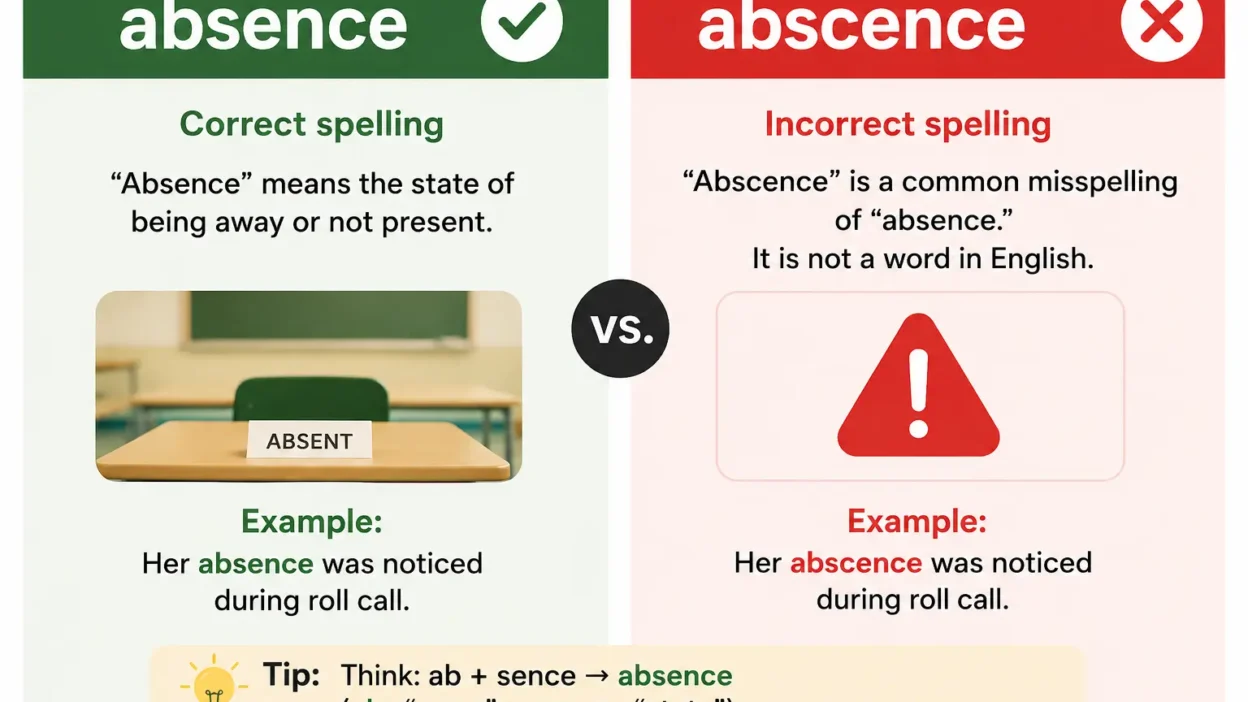
Absence is correct. Abscence is a misspelling and appears in no English dictionary.
The difference is one letter in one position:
✅ a-b-s-e-n-c-e
❌ a-b-s-c-e-n-c-e
Absence has one c, and it sits between the n and the final e. The misspelling adds a second c immediately after the s. That’s the correction. The more useful part is why the mistake happens — because the cause is a real English pattern, and once you can name it, you stop repeating it.
Key Takeaways
- Absence is the only correct spelling, in American, British, Australian, Canadian, and Indian English.
- Abscence inserts a second c after the s. Absense swaps the ending to -ense. Both are non-words.
- Absence is a noun: the state of not being present, a period spent away, or a lack of something.
- Pronounced AB-suhns — two syllables, two /s/ sounds spelled with two different letters, which is the root of the confusion.
- Fastest check: absent has no c, so absence doesn’t gain one after the s.
Absence vs. Abscence: Quick Answer
| Spelling | Correct? | What’s Wrong With It |
|---|---|---|
| absence | ✅ Yes | Standard spelling in every variety of English |
| abscence | ❌ No | Extra c inserted after the s |
| absense | ❌ No | Ending swapped to -ense; it should be -ence |
| absance | ❌ No | Vowel swapped in the ending: -ance for -ence |
| abcense | ❌ No | c and s transposed, plus the wrong ending |
| apsence | ❌ No | b heard as p and spelled that way |
Merriam-Webster records three senses for the noun — the state of being absent, the time one is absent, and want or lack — and gives the pronunciation as ˈab-sən(t)s. Merriam-Webster
How to Spell Absence Correctly
The Letter-by-Letter Breakdown
A – B – S – E – N – C – E
Seven letters. Two syllables: AB · sence (AB-suhns).
The part worth memorizing is the middle. After abs, the next letter is e, not c:
abs + ence = absence
Every misspelling of this word is a failure at exactly one of two junctions: the letter right after the s, or the last three letters of the ending.
The plural is absences: she has three absences on record this term.
Is Absence Spelled the Same in British and American English?
Yes — and this is worth stating plainly, because English does have genuine -ce/-se regional splits that make careful writers second-guess this word.
| Word | American | British |
|---|---|---|
| defense / defence | defense | defence |
| license / licence (noun) | license | licence |
| offense / offence | offense | offence |
| absence | absence | absence |
Absence was borrowed whole from French and Latin. It is not a -ce/-se pair, so it never varies by region. Abscence is not a British spelling, an American spelling, or an accepted alternative anywhere.
Why People Write “Abscence” (And the Other Misspellings)
Ginger Software publishes crowd data on which version writers actually type. Across recorded errors for this word, absense accounts for 3.7%, abscence for 2.7%, abcense for 1.2%, and the French-influenced d’absence for 1.1%. Merriam-Webster
So abscence is the second most common error — and the two leading mistakes have completely different causes.
Abscence: The Extra C Comes From a Real English Pattern
Writers don’t invent absc. English hands it to them twice.
First, -scence is a genuine, productive noun ending:
- adolescence
- convalescence
- obsolescence
- reminiscence
- acquiescence
- luminescence
Second, absc- is a real letter sequence at the start of real words:
- abscess
- abscond
- abscissa
When your fingers type absc, they’re applying patterns that exist. They just don’t apply here. Absence is built directly on absent, and absent contains no c at all.
The rule: if the base word has no c, the noun doesn’t grow one in the middle.
Absense: The Ending Trap
The more frequent error has a different cause: sound. Absence contains two /s/ sounds spelled with two different letters — the s in abs- and the c in -ence. Your ear hears “AB-suhns” and offers you sense, which is spelled the way it sounds.
The fix is a pattern test. Absence belongs to the -ence family:
- science
- presence
- existence
- patience
- essence
- confidence
Not the -ense family: sense, nonsense, defense, expense, immense.
Ask yourself: science or sense? It’s science. So the c stays.
Absance, Abcense, and Apsence
Three smaller errors with three quick diagnoses:
- absance — the -ance ending. English uses both -ance (importance, distance, guidance) and -ence, and in unstressed position they sound identical. Absence takes -ence, matching presence, its own opposite.
- abcense — the c and s have swapped places. This is a typing error more than a knowledge error, and it’s the one spell-check catches most reliably.
- apsence — the b in abs- is devoiced in normal speech and sounds like a p. Write the prefix as ab-, as in absent, absorb, and abstain, and it resolves.
One pattern worth noticing: abscence almost never turns up in handwriting. It appears in typed text, in the same documents as definately and seperate — words where a live English pattern quietly overrides the correct one. If you write it, you’re pattern-matching, not guessing.
What Absence Means
Absence is a noun. In practice its meanings resolve into three uses.
A person or thing is not where it’s expected to be:
Her absence from the meeting delayed the decision.
The teacher recorded his absence from class.
Something is missing or doesn’t exist:
The absence of evidence weakened the case.
The absence of clear instructions caused confusion.
The absence of communication created problems.
A period of time spent away:
She returned to work after a six-week absence.
There is also the older, still-current sense preserved in absence of mind — inattention to what’s in front of you, which is where absent-minded comes from.
Countable or Uncountable?
Both, and the distinction matters in real writing:
- Countable when it means occasions or periods away: three absences this semester, repeated absences, unexplained absences.
- Uncountable when it means lack: an absence of light, a complete absence of proof. You would never write two absences of light.
How to Use Absence in a Sentence
Three patterns cover nearly every real use.
Absence From — A Place, Event, or Activity
Use absence from when someone is missing from somewhere they were expected.
- His absence from school was unexplained.
- The player’s absence from the game was noticeable.
- She apologized for her absence from the ceremony.
- The company recorded his absence from work.
Absence Of — A Thing, Quality, or Condition
Use absence of when something is lacking or does not exist.
- The absence of information made planning impossible.
- The absence of leadership showed within a week.
- The absence of symptoms doesn’t rule out the condition.
- The absence of noise made the house feel eerie.
The rule in one line:
Absence from = someone isn’t there. Absence of = something isn’t there.
In the Absence Of — A Fixed Phrase Meaning “Without”
This behaves as a set phrase and appears constantly in formal, legal, and academic writing. Merriam-Webster lists it as its own entry. Merriam-Webster
- In the absence of a signed agreement, the original terms apply.
- In the absence of the director, the deputy chairs the meeting.
- In her absence, the team missed two deadlines.
- During his absence, the department ran on a skeleton crew.
Absence, Absent, Absents, and Presence
Four related forms — and two of them cause more trouble than the spelling itself.
| Word | Part of Speech | Example |
|---|---|---|
| absence | Noun | Her absence was noticed. |
| absent | Adjective | She was absent from class. |
| absent | Verb | He absented himself from the vote. |
| absent | Preposition (US, formal) | Absent further evidence, the claim fails. |
| absents | Verb, 3rd person | He absents himself whenever there’s conflict. |
| presence | Noun (opposite) | Her presence steadied the room. |
Absence vs. absent. Absence names the condition; absent describes the person or thing. Both take from: his absence from work / he was absent from work.
Absence vs. absents. Absents is a real English word, so spell-check will not flag it. Autocorrect occasionally produces it from a mistyped absence, and it survives proofreading because it looks correct. This is the only genuinely dangerous error in the group.
Absence vs. presence. Direct opposites, near-identical in shape — which makes presence the best spelling anchor available. Nobody writes prescence. If presence ends in -ence, so does absence.
The Absence Word Family and Everyday Phrases
The Word Family
- absent — not present (adjective, verb, preposition)
- absence — the state, the period, or the lack (noun)
- absentee — a person who is absent: absentee ballot, absentee landlord
- absenteeism — a pattern of frequent absence, usually in workplace contexts
- absent-minded — inattentive; from the older sense absence of mind
- in absentia — Latin for “in absence,” used of trials, sentences, and awards
- absence seizure — a medical term for a brief lapse of consciousness, historically called petit mal; in clinical use it’s often pronounced closer to the French, ab-SAHNS
Every one of these has abs- with no c after the s. The family is completely consistent, which is itself an argument against abscence.
School and Workplace Vocabulary
This is where most people actually write the word — and where an error is most visible:
- excused absence / unexcused absence
- authorized / unauthorized absence
- leave of absence — formally approved time away
- absence rate — a standard HR metric
- absence from class, absence from work, absence from school
- absent without leave (AWOL)
Idioms Worth Knowing
- Absence makes the heart grow fonder. The line comes from “Isle of Beauty,” a song by the English poet and composer Thomas Haynes Bayly. Etymonline
- Conspicuous by his absence — noticeably missing.
- Absence of evidence is not evidence of absence — the standard formulation for why “we found nothing” and “there is nothing” are different claims.
Where the Word Absence Comes From
Merriam-Webster traces absence from Middle English through Anglo-French to the Latin absentia, a noun formed from absent-, absens, with first recorded English use in the 14th century. Behind absens sits the Latin verb abesse, “to be away” — literally ab, “away from,” plus esse, “to be.” The word has carried its current range of meanings since roughly 1350–1470, and the 1611 King James Bible already uses it in the familiar modern form in Philippians 2:12. Merriam-Webster + 2
That history is a spelling argument, not trivia. The word arrived as absentia — s, then e. There was never a c after the s anywhere in the chain from Latin to Anglo-French to English. Abscence has never been a variant, an archaism, or a regional form. It has only ever been a mistake.
How to Remember the Correct Spelling
Three checks, in order of speed.
The Absent Check
Start from the base word:
absent → absence
Absent has no c. Adding -ence doesn’t insert one after the s. If you can spell absent, you can spell absence.
The Science Check
When you hesitate at absen__e, ask: science or sense?
Answer: science. So it ends in -ence, with the c. This one kills absense and absance at the same time.
The One-C Check
Count the c before moving on. Absence has exactly one, sitting beside the n:
absence ✅
abscence ❌
Two cs means you’ve written the wrong word.
A Proofreading Note
Abscence, absense, absance, and abcense are all non-words, so every spell-checker flags them. The errors that survive are the ones nothing flags: absents (a real verb) and absence used where absent belongs. When you proofread anything containing attendance language — a leave request, a school note, a performance review — search the document for absen and read each hit. Ten seconds, and it catches the two mistakes software won’t.
Absence vs. Abscence: Side-by-Side Summary
| Feature | Absence | Abscence |
|---|---|---|
| Valid English word | ✅ Yes | ❌ No |
| Letters | A-B-S-E-N-C-E (7) | A-B-S-C-E-N-C-E (8) |
| Number of cs | One, between n and e | Two — one is wrong |
| Part of speech | Noun | Not a word |
| Meaning | Not being present; a period away; a lack | None |
| Dictionary entry | Merriam-Webster, Cambridge, OED | None |
| American English | absence | Incorrect |
| British English | absence | Incorrect |
| Example | absence from work | ❌ abscence from work |
Frequently Asked Questions
Is “abscence” ever correct?
No. It is not a British spelling, an American spelling, an archaic form, or a technical variant. It appears in no dictionary. The correct spelling is absence in every context.
How do you spell absence?
A-B-S-E-N-C-E — seven letters, two syllables, one c, positioned between the n and the final e.
How do you pronounce absence?
AB-suhns, with stress on the first syllable. Merriam-Webster gives it as ˈab-sən(t)s. The s and the c both produce an /s/ sound, which is exactly why the spelling feels unreliable. Merriam-Webster
Why do people write “abscence”?
Because English really does have an -scence ending (adolescence, obsolescence, reminiscence) and real absc- words (abscess, abscond). The error is an overgeneralization of live patterns — but absence follows neither.
Is “absense” also wrong?
Yes, and it’s the more common mistake. It accounts for 3.7% of recorded misspellings of this word, ahead of abscence at 2.7%. The word ends in -ence, like science and presence, not -ense, like sense. Merriam-Webster
Is absence a noun or an adjective?
Absence is a noun: Her absence was noticed. The adjective is absent: She was absent from class. Absent also works as a verb (he absented himself) and, in formal American usage, as a preposition (absent any objection).
What is the difference between “absence from” and “absence of”?
Use absence from for a place, event, or activity someone is missing from: his absence from work. Use absence of for something that is lacking: the absence of evidence.
What is the opposite of absence?
Presence. His absence was noticed; her presence was reassuring. It doubles as the best spelling anchor available, since both words end in -ence.
What does “leave of absence” mean?
An officially approved period away from work or study, with the expectation of returning. It’s a countable, formal use: she took a three-month leave of absence.
Is absence spelled the same in British and American English?
Yes, identically. Unlike defense/defence or license/licence, absence has no regional variant.
Can absence be plural?
Yes — absences — when it refers to separate occasions: four unexcused absences this term. When it means a lack, it stays singular: an absence of light.
The Bottom Line
If you’re choosing between absence and abscence, choose:
✅ ABSENCE
Seven letters, one c, and it sits beside the n — never after the s. Abscence isn’t a variant or a regional form; it’s a misspelling produced by two real English patterns that happen not to apply here.
When the word comes up mid-sentence and you hesitate, run the fastest check: absent has no c, so absence doesn’t gain one. And if the ending is what’s bothering you, ask whether it’s science or sense. It’s science — every time.