Title Tag: Acquit Vs. Aquit: Correct Spelling, Meaning, And Examples
Meta Description: Acquit is correct. Aquit is a misspelling. Learn the meaning of acquit, why the c matters, and how to use acquitted correctly.
Introduction
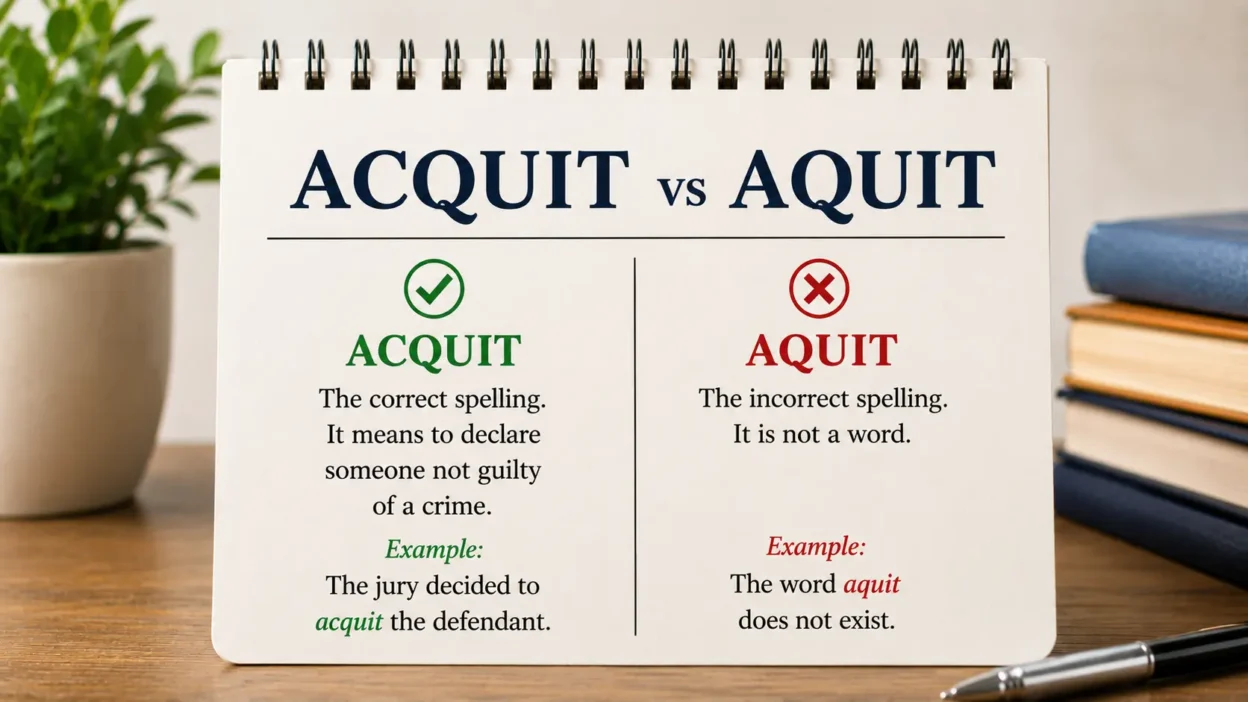
Acquit is the correct spelling. Aquit is a misspelling.
Use acquit when you mean to officially find someone not guilty of a crime or charge. You can also use it in the formal phrase acquit yourself well, which means to perform or behave well in a difficult situation.
Write this:
Correct: The jury voted to acquit the defendant.
Incorrect: The jury voted to aquit the defendant.
The spelling is:
a-c-q-u-i-t
Do not drop the c.
Quick Answer
The correct choice is always acquit.
| Context | Best Choice | Why |
|---|---|---|
| Legal writing | acquit | It means to find someone not guilty. |
| Court reporting | acquit | It is the standard legal verb. |
| School essays | acquit | Aquit is a spelling error. |
| Formal performance writing | acquit | It appears in “acquit yourself well.” |
| Casual writing | acquit | It is still the correct spelling. |
| Past tense | acquitted | The final consonant doubles. |
| Present participle | acquitting | The final consonant doubles before -ing. |
Cornell’s Wex defines acquit in criminal law as a formal judgment of not guilty after a jury or judge finds that the prosecution has not proven guilt beyond a reasonable doubt.
Why People Confuse Them
People confuse acquit and aquit because the c in acquit is easy to miss.
The word is pronounced like:
uh-KWIT
Because the word starts with an uh sound, some writers hear the word and spell it as aquit. That spelling is not correct in standard English.
The correct beginning is:
acq-
Think of the c as part of the word’s legal spelling. A court may acquit, and both court and acquit need the letter c.
Key Differences At A Glance
| Feature | Acquit | Aquit |
|---|---|---|
| Correct spelling? | Yes | No |
| Standard English word? | Yes | No |
| Part of speech | Verb | Misspelling |
| Main meaning | To find someone not guilty | No standard meaning |
| Common legal use | The jury acquitted him. | Incorrect |
| Related noun | Acquittal | None |
| Past tense | Acquitted | Incorrect as “aquitted” |
Meaning And Usage Difference
Acquit is a verb. Its main meaning is to officially decide that someone is not guilty of a crime or charge.
Example: The jury acquitted the defendant after reviewing the evidence.
Oxford gives the structure acquit somebody of something, as in She was acquitted on all charges and The jury acquitted him of murder. Oxford also lists the forms acquits, acquitted, and acquitting.
Aquit has no standard meaning in English. It is not a casual form, a shorter form, or an alternate spelling. It is simply a spelling mistake.
Tone, Context, And Formality
Acquit is most common in legal, news, academic, and formal writing.
It sounds natural in sentences like these:
The court acquitted her of fraud.
The defendant was acquitted on all counts.
The judge instructed the jury to acquit if there was reasonable doubt.
In everyday speech, people may say found not guilty instead of acquitted. Both can be clear, but acquitted is the more precise legal term.
Aquit has no correct tone or formality level. It looks like an error in any serious sentence.
How To Use Acquit Correctly
Use acquit when a court, judge, or jury finds someone not guilty.
- Correct: The jury voted to acquit the defendant.
- Correct: She was acquitted of all charges.
- Correct: The court acquitted him because the evidence was not strong enough.
You can also use acquit yourself well in formal writing. Britannica explains acquit yourself as acting or behaving in a specified way, often to show approval of someone’s performance.
Correct: She acquitted herself well during the debate.
Correct: The new attorney acquitted himself professionally in court.
This use is formal. In everyday writing, you can often say performed well or handled it well.
Common Misspellings And Quick Fixes
The most common mistakes come from leaving out the c or forgetting the doubled t in longer forms.
- Wrong: aquit
Right: acquit - Wrong: aquitted
Right: acquitted - Wrong: aquitting
Right: acquitting - Wrong: The jury may aquit him tomorrow.
Right: The jury may acquit him tomorrow.
Wrong: She was aquitted of the charge.
Right: She was acquitted of the charge.
Wrong: He is aquitting himself well in the role.
Right: He is acquitting himself well in the role.
Acquit Does Not Always Mean Proven Innocent
This point matters in legal writing.
When someone is acquitted, the court has found them not guilty of the charge. That does not always mean the person was proven innocent in every possible sense. It means the legal standard for conviction was not met.
That is why this sentence is careful:
The defendant was acquitted because the prosecution did not prove the charge beyond a reasonable doubt.
This sentence is too strong unless the facts support it:
The defendant was proven completely innocent.
Use acquitted when you are reporting the legal outcome. Use stronger wording only when you have evidence for it.
Everyday Examples
- Correct: The jury voted to acquit after two days of deliberation.
- Correct: The defendant was acquitted of theft.
- Correct: The article said the mayor had been acquitted on all charges.
- Correct: The court acquitted the officer after reviewing the evidence.
- Correct: She acquitted herself well during the interview.
- Correct: The debate team acquitted itself well at the state final.
Incorrect: The jury voted to aquit.
Correct: The jury voted to acquit.
Incorrect: He was aquitted of fraud.
Correct: He was acquitted of fraud.
Incorrect: She aquitted herself well.
Correct: She acquitted herself well.
Word Forms Of Acquit
The base verb is acquit.
The third-person singular form is acquits.
Example: The court rarely acquits without strong doubt about the evidence.
The past tense and past participle form is acquitted.
Example: The defendant was acquitted.
The present participle is acquitting.
Example: The judge is not acquitting the defendant; the jury is deciding the verdict.
The related noun is acquittal.
Example: The verdict was an acquittal.
Do not write aquittal. The correct noun also keeps the c: acquittal.
Synonyms And Related Words
Useful alternatives for acquit include:
clear
exonerate
absolve
release
discharge
find not guilty
These words are not always exact replacements.
Merriam-Webster notes that acquit implies a formal decision in someone’s favor on a definite charge, while exonerate suggests fuller clearance from blame or suspicion.
Convict is the clearest opposite of acquit.
Correct: The jury may acquit him.
Opposite: The jury may convict him.
Word History
Acquit comes through older French forms connected with releasing, freeing, or discharging someone. Collins traces the word to Old French aquiter, related to ideas of release or being free from an obligation.
That history fits the modern legal meaning. To acquit someone is to free that person from a criminal charge by a not-guilty judgment.
Aquit has no separate English word history as a correct spelling. It is only a misspelling of acquit in English. Wiktionary labels aquit as an English misspelling of acquit.
Phrases With Acquit
Common phrases include:
acquit the defendant
acquitted of all charges
acquitted on all counts
jury acquitted
court acquitted
acquit yourself well
acquit yourself honorably
Examples:
The jury acquitted the defendant on all counts.
She acquitted herself well in a difficult meeting.
Do not use aquit in these phrases.
FAQ
Is aquit a word?
In standard English, aquit is not the correct spelling. The correct word is acquit.
What does acquit mean?
Acquit means to officially find someone not guilty of a crime or charge. It can also mean to behave or perform in a certain way in the phrase acquit yourself well.
Is it acquitted or aquitted?
The correct spelling is acquitted. The misspelling aquitted drops the c.
Is acquit a legal word?
Yes. Acquit is commonly used in legal writing when a judge or jury finds a defendant not guilty.
Does acquitted mean innocent?
Not always. Acquitted means legally found not guilty. It usually means the prosecution did not prove the charge to the required legal standard.
How do you remember the spelling of acquit?
Remember that acquit starts with acq-. Do not write aquit. The correct spelling is a-c-q-u-i-t.
Conclusion
For acquit vs. aquit, the correct spelling is acquit.
Use acquit when a judge or jury finds someone not guilty. You can also use it in the formal phrase acquit yourself well, meaning to perform or behave well.
Avoid aquit. It is not a correct English spelling.
The easiest way to remember it is simple:
Acquit starts with acq. Do not drop the c.