Quick Answer
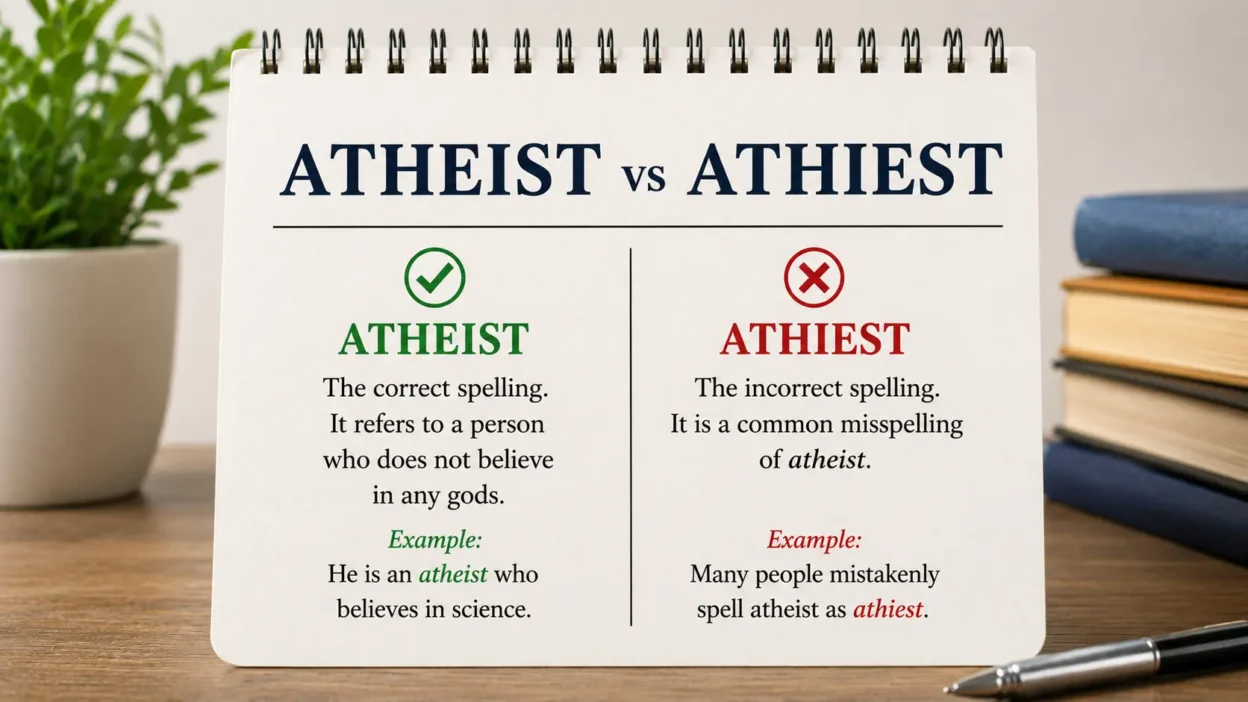
Atheist is the correct spelling. Athiest is incorrect.
Use atheist when you mean a person who does not believe in God or gods.
Correct: She identifies as an atheist.
Incorrect: She identifies as an athiest.
Correct: The article included an atheist viewpoint.
Incorrect: The article included an athiest viewpoint.
The spelling tip is simple: atheist has ei, not ie.
What Atheist Means
An atheist is a person who does not believe in the existence of God or gods.
The word is usually a noun.
Correct: He is an atheist.
Correct: The survey included atheists, agnostics, and religious respondents.
Atheist can also be used before another noun, almost like an adjective.
Correct: The panel included an atheist speaker.
Correct: She wrote from an atheist perspective.
When using the word, keep the tone factual and respectful. Atheist describes a position on belief. It should not be used as an insult or as a label for someone who does not use it.
Is Athiest A Word?
Athiest is not a standard English word.
It is a misspelling of atheist. The mistake happens when the e and i are reversed.
Incorrect: athiest
Correct: atheist
Do not use athiest in essays, emails, articles, captions, reports, or academic writing.
Why People Misspell Atheist As Athiest
People often write athiest because the middle of atheist sounds like thee.
The word is commonly pronounced like AY-thee-ist. Since that sound feels like it might be spelled thie, writers may reverse the letters and type athiest.
The correct spelling keeps ei:
a-t-h-e-i-s-t
A helpful memory trick is to see theist inside the word:
a + theist = atheist
The the in aTHEist can help you remember the correct order.
Atheist Vs Athiest At A Glance
| Word | Correct? | Meaning | Use It? |
|---|---|---|---|
| atheist | Yes | A person who does not believe in God or gods | Yes |
| athiest | No | No standard meaning; misspelling of atheist | No |
The difference is not about American vs British English. It is not a formal vs casual choice. Atheist is correct everywhere. Athiest is a spelling error.
Atheist, Agnostic, And Theist
These words are related, but they do not mean the same thing.
An atheist does not believe in God or gods.
Example: She is an atheist.
An agnostic does not claim certainty or knowledge about whether God or gods exist.
Example: He describes himself as agnostic.
A theist believes in at least one god.
Example: The discussion included theist and atheist viewpoints.
These terms can overlap in real life because people describe their beliefs in different ways. In careful writing, use the term a person uses for themselves when possible.
How To Use Atheist In A Sentence
Use atheist for a person or viewpoint connected with atheism.
- Correct: My friend is an atheist, but we rarely discuss religion.
- Correct: The class studied religious, agnostic, and atheist perspectives.
- Correct: The author gave an atheist response to the question.
- Correct: Several atheists joined the public forum.
- Correct: The article compared atheist and theist arguments.
- Correct: She said she became an atheist in college.
Avoid athiest in all of these sentences.
Incorrect: The article quoted an athiest writer.
Correct: The article quoted an atheist writer.
Common Forms And Related Words
The spelling pattern stays the same in related words.
| Form | Meaning | Example |
|---|---|---|
| atheist | a person who does not believe in God or gods | He is an atheist. |
| atheists | plural of atheist | Several atheists spoke at the event. |
| atheism | the position or belief associated with atheists | The essay discussed atheism. |
| atheistic | related to atheism | The book presents an atheistic view. |
| theist | a person who believes in a god or gods | The panel included a theist and an atheist. |
Be careful with these common mistakes:
- Incorrect: athiest
Correct: atheist - Incorrect: athiests
Correct: atheists - Incorrect: athiesm
Correct: atheism - Incorrect: athiestic
Correct: atheistic
Common Misspellings And Better Fixes
- Incorrect: athiest
Correct: atheist - Incorrect: athist
Correct: atheist - Incorrect: atheest
Correct: atheist - Incorrect: ateist
Correct: atheist - Incorrect: athesit
Correct: atheist - Incorrect: athiesm
Correct: atheism
The safest spelling clue is:
aTHEist
If you can see the in the middle, you are closer to the correct spelling.
Tone And Respectful Usage
Atheist is a neutral word when used accurately.
Neutral: She identifies as an atheist.
Neutral: The survey included atheist respondents.
The word can sound disrespectful if it is used as an insult, stereotype, or forced label.
Less respectful: He is just an atheist.
Better: He identifies as an atheist.
Less precise: Anyone who questions religion is an atheist.
Better: Some people identify as atheist, some as agnostic, and some use other terms.
When writing about belief or nonbelief, keep the wording factual. Avoid guessing what someone believes unless they have said it clearly.
Real-World Examples
For school writing:
Correct: The essay compares atheist and religious views on morality.
Correct: The character is described as an atheist, not an agnostic.
For journalism:
Correct: The interview included an atheist activist and a local pastor.
Correct: The poll asked whether respondents identified as religious, atheist, agnostic, or none of the above.
For everyday writing:
Correct: My coworker is an atheist, and his wife is religious.
Correct: She grew up religious but now identifies as an atheist.
For respectful discussion:
Correct: He is an atheist, but he supports religious freedom.
Correct: The group welcomed believers, atheists, and agnostics.
For spelling correction:
Incorrect: She is an athiest.
Correct: She is an atheist.
Incorrect: The speaker gave an athiest argument.
Correct: The speaker gave an atheist argument.
Synonyms And Related Terms
There is no perfect synonym for atheist in every context.
Possible alternatives include:
- nonbeliever
- nontheist
- disbeliever
- secular person
- nonreligious person
Use these carefully.
Nonbeliever can sound broad and sometimes judgmental, depending on context.
Nontheist is more technical and may include people who do not frame belief around theism.
Secular often means not religious, but it does not always mean atheist.
Agnostic is related, but it is not the same as atheist.
For clear writing, atheist is usually the best word when that is the exact meaning.
FAQ
Is athiest ever correct?
No. Athiest is not correct in standard English. The correct spelling is atheist.
Why is atheist spelled with ei?
Atheist is built around theist, a word for someone who believes in a god or gods. Think of it as a + theist. That gives you atheist, with ei, not ie.
How do you pronounce atheist?
Atheist is commonly pronounced like AY-thee-ist.
Is atheist a noun or an adjective?
Atheist is usually a noun.
Example: She is an atheist.
It can also come before another noun.
Example: The article presented an atheist viewpoint.
What is the plural of atheist?
The plural is atheists.
Correct: Several atheists joined the discussion.
Incorrect: Several athiests joined the discussion.
What is the difference between atheist and agnostic?
An atheist does not believe in God or gods. An agnostic does not claim certainty or knowledge about whether God or gods exist.
Is atheist the same as nonreligious?
Not always. Nonreligious is broader. A nonreligious person may be atheist, agnostic, secular, unaffiliated, or something else.
What is the opposite of atheist?
A common contrasting word is theist, meaning someone who believes in a god or gods. In everyday writing, believer may also work, depending on the sentence.
Conclusion
Atheist is correct. Athiest is a misspelling.
Use atheist when you mean a person who does not believe in God or gods.
Correct: He identifies as an atheist.
Incorrect: He identifies as an athiest.
Remember the spelling this way: atheist = a + theist, so the middle letters are ei, not ie.