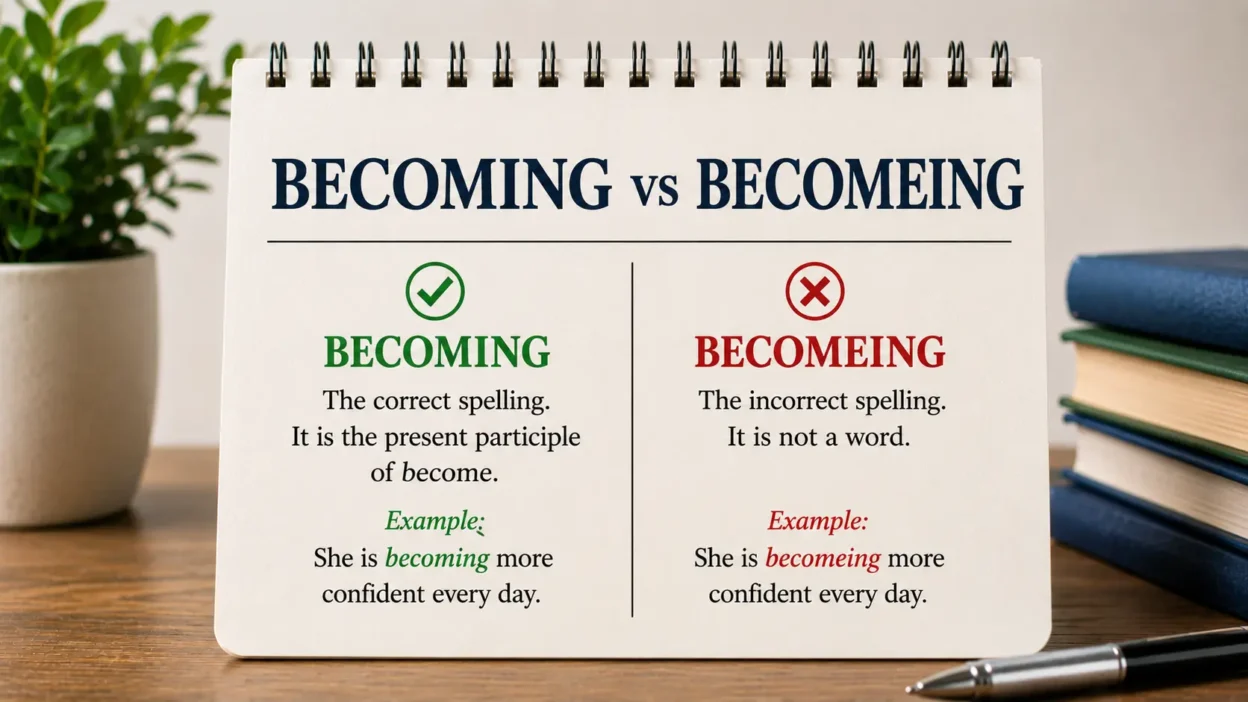
Becoming is the correct spelling. Becomeing is incorrect.
Use becoming when you mean changing into something, starting to be something, or developing into a new state.
Correct: She is becoming more confident.
Incorrect: She is becomeing more confident.
Correct: The project is becoming harder than expected.
Incorrect: The project is becomeing harder than expected.
The spelling rule is simple:
become + ing = becoming
Drop the final e before adding -ing.
What Becoming Means
Becoming is usually the -ing form of the verb become.
It means starting to be, growing into, or changing into something.
Examples:
- Correct: He is becoming a better writer.
- Correct: The weather is becoming colder.
- Correct: The city is becoming more crowded.
- Correct: She is becoming more comfortable in her new job.
In simple words, becoming shows change in progress.
Is Becomeing A Word?
Becomeing is not a standard English word.
It is a misspelling of becoming. The mistake happens when writers keep the final e in become before adding -ing.
Incorrect: becomeing
Correct: becoming
Do not use becomeing in essays, emails, captions, reports, resumes, school assignments, or published writing.
Why Become Drops The Final E
Many English verbs drop a final silent e before -ing.
That is why become changes to becoming.
The same pattern appears in common words:
- make → making
- take → taking
- write → writing
- move → moving
- come → coming
- become → becoming
You do not write makeing, takeing, or comeing. For the same reason, do not write becomeing.
Becoming Vs Becomeing At A Glance
| Word | Correct? | Meaning | Use It? |
|---|---|---|---|
| becoming | Yes | Changing, developing, or starting to be something; also suitable or flattering | Yes |
| becomeing | No | No standard meaning; misspelling of becoming | No |
This is not a British vs American spelling difference. It is not a casual spelling. Becoming is correct, and becomeing is a typo.
How To Use Becoming In A Sentence
Use becoming after helping verbs such as am, is, are, was, and were.
- Correct: I am becoming more organized.
- Correct: She is becoming a strong leader.
- Correct: They are becoming good friends.
- Correct: The problem was becoming serious.
- Correct: The instructions were becoming confusing.
You can also use becoming after words like about or of when talking about the process of change.
Correct: The story is about becoming more independent.
Correct: The book explores the process of becoming an adult.
Become Vs Becoming
Become is the base verb.
Example: She wants to become a doctor.
Becoming is the -ing form.
Example: She is becoming a doctor.
Use become after words like will, can, may, might, should, and to.
Correct: She will become a doctor.
Incorrect: She will becoming a doctor.
Correct: He wants to become more patient.
Incorrect: He wants to becoming more patient.
Use becoming when the change is happening now or was happening at a certain time.
Correct: She is becoming more confident.
Correct: He was becoming impatient.
Became, Become, And Becoming
These forms belong to the same verb family.
| Form | Use | Example |
|---|---|---|
| become | base verb / past participle | I want to become stronger. |
| became | simple past | She became a nurse. |
| become | past participle | He has become more careful. |
| becoming | -ing form | They are becoming close friends. |
Be careful not to use becoming where another form is needed.
Incorrect: She has becoming more confident.
Correct: She has become more confident.
Incorrect: He becoming angry.
Correct: He is becoming angry.
Becoming As An Adjective
Becoming can also be an adjective. In this use, it means suitable, attractive, or flattering.
- Correct: That color is very becoming on you.
- Correct: The jacket is becoming, but the sleeves are too long.
- Correct: Her simple hairstyle was becoming.
This adjective use is correct, but it sounds a little formal. In everyday speech, people often say flattering, looks good, or suits you.
Formal: That dress is becoming.
Natural: That dress looks good on you.
Common Misspellings And Better Fixes
- Incorrect: becomeing
Correct: becoming - Incorrect: becomming
Correct: becoming - Incorrect: becomig
Correct: becoming - Incorrect: becomingg
Correct: becoming - Incorrect: becuming
Correct: becoming
The safest memory trick is:
become + ing = becoming
Drop the e, then add -ing.
Common Mistakes With Becoming
Mistake: Keeping the final e.
Incorrect: The class is becomeing easier.
Correct: The class is becoming easier.
Mistake: Doubling the m.
Incorrect: She is becomming a leader.
Correct: She is becoming a leader.
Mistake: Using becoming after will.
Incorrect: He will becoming a teacher.
Correct: He will become a teacher.
Mistake: Using becoming without a helping verb.
Incorrect: The issue becoming serious.
Correct: The issue is becoming serious.
Mistake: Using became for a change still happening now.
Incorrect: She became more confident this semester and is still improving.
Better: She is becoming more confident this semester.
Real-World Examples
For school writing:
Correct: The main character is becoming more independent.
Correct: The poem shows a child becoming aware of the world.
For work:
Correct: The process is becoming more efficient.
Correct: Remote meetings are becoming more common.
For everyday speech:
Correct: I’m becoming more comfortable with the new routine.
Correct: The days are becoming shorter.
For personal growth:
Correct: She is becoming more patient with herself.
Correct: He is becoming the kind of person he hoped to be.
For appearance:
Correct: That shade of blue is very becoming.
More natural: That shade of blue looks great on you.
Synonyms For Becoming
For the verb sense, good alternatives include:
- turning into
- growing into
- developing into
- changing into
- evolving into
- starting to be
Example: The town is becoming more crowded.
Alternative: The town is growing into a busier place.
For the adjective sense, good alternatives include:
- flattering
- suitable
- attractive
- fitting
- good-looking
Example: That dress is becoming.
Alternative: That dress is flattering.
Do not use becomeing as an alternative. It is a spelling error.
FAQ
Is becomeing ever correct?
No. Becomeing is not correct in standard English. The correct spelling is becoming.
Why is it becoming and not becomeing?
The final silent e in become is dropped before adding -ing.
Correct: become + ing = becoming
Is becoming a verb?
Yes. Becoming is commonly used as the -ing form of the verb become.
Example: She is becoming more confident.
Can becoming be an adjective?
Yes. Becoming can also mean suitable, attractive, or flattering.
Example: That color is becoming on you.
What is the difference between become and becoming?
Become is the base verb. Becoming is the -ing form.
Correct: I want to become stronger.
Correct: I am becoming stronger.
What is the past tense of become?
The simple past tense is became.
Example: She became a teacher.
Is becomming also wrong?
Yes. Becomming is also incorrect. The correct spelling is becoming, with one m.
What is a simpler word for becoming?
A simpler phrase may be turning into, growing into, changing into, or starting to be, depending on the sentence.
Conclusion
Becoming is correct. Becomeing is a misspelling.
Use becoming when something is changing, developing, or starting to be something.
Correct: She is becoming more confident.
Incorrect: She is becomeing more confident.
Remember the spelling this way:
become + ing = becoming
Drop the final e before adding -ing.