
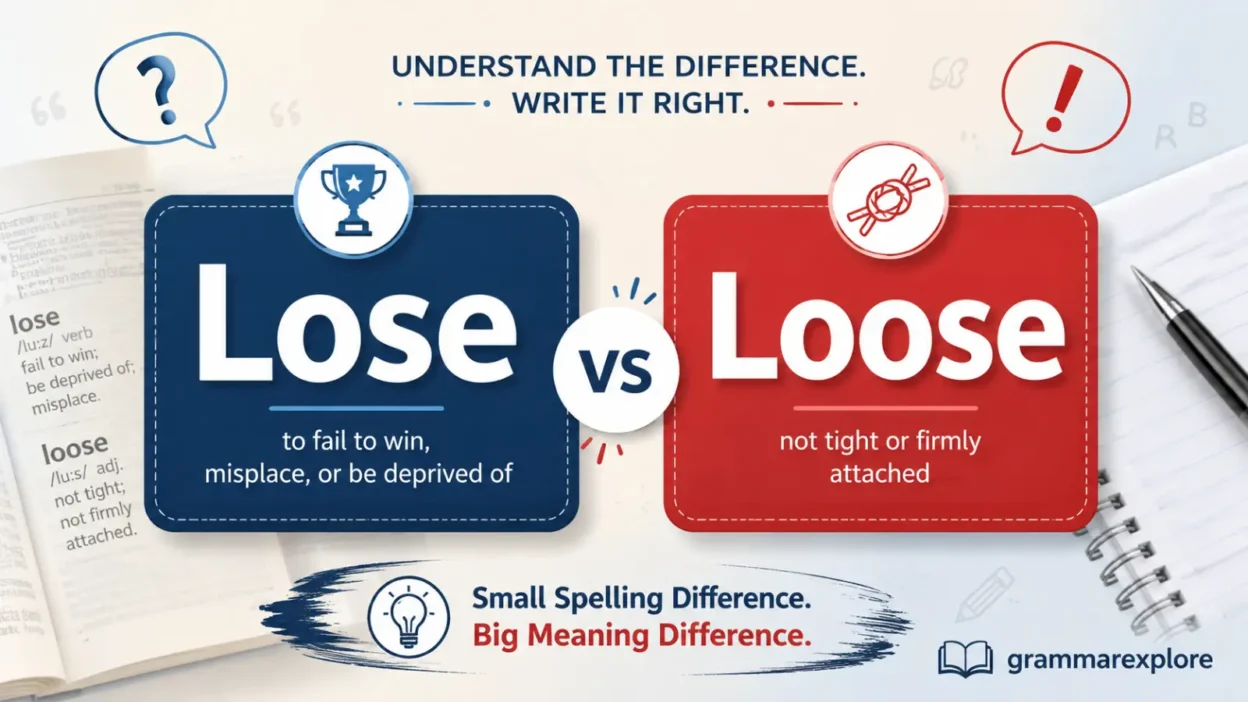
Use lose when you mean to misplace something, fail to win, or no longer have something. Use loose when you mean not tight, not fixed, free, or relaxed.
Correct: I don’t want to lose my keys.
Correct: This screw is loose.
The easiest way to remember the difference is this: lose is usually an action word, while loose usually describes the condition of something.
Lose vs Loose At A Glance
| Context | Correct Word | Example |
|---|---|---|
| You cannot find something | lose | Don’t lose your phone. |
| You fail to win | lose | They might lose the game. |
| You stop having something | lose | She could lose her job. |
| Something is not tight | loose | These jeans are loose. |
| Something is not secure | loose | The door handle is loose. |
| Someone or something is free | loose | The dog got loose. |
What Does Lose Mean?
Lose is a verb. It means to no longer have something, to misplace something, to fail to win, or to stop keeping control of something.
You can lose your wallet, lose a game, lose your balance, lose money, lose focus, or lose patience.
Examples:
I always lose my keys when I’m in a hurry.
Our team did not want to lose the final game.
Try not to lose your temper during the meeting.
The company may lose money this quarter.
In all of these examples, lose shows an action or result. Something is gone, missing, reduced, or not won.
What Does Loose Mean?
Loose is usually an adjective. It describes something that is not tight, not firmly attached, not controlled, or not strict.
A shirt can be loose. A screw can be loose. A tooth can be loose. A dog can be loose if it is not on a leash or inside a fence.
Examples:
This shirt is too loose around the shoulders.
One of the cabinet handles is loose.
The dog got loose when the gate opened.
The teacher gave us a loose outline for the essay.
In these examples, loose describes a condition. It tells you how something fits, feels, moves, or is controlled.
Why People Confuse Lose And Loose
People confuse lose and loose because the spellings are very close. The only visual difference is the extra “o” in loose.
Pronunciation also matters. Lose sounds like “looz,” with a Z sound at the end. Loose sounds like “loos,” with an S sound at the end. They are close, but they are not the same.
Another reason is that many common mistakes appear online, especially in phrases like “loose weight” or “don’t loose it.” Those forms are incorrect in standard writing. The correct forms are lose weight and don’t lose it.
The Main Difference Between Lose And Loose
The main difference is grammar and meaning.
Lose is usually a verb. It shows an action: misplacing, failing, no longer having, or being defeated.
Loose is usually an adjective. It describes something: not tight, not secure, free, relaxed, or not strict.
Examples:
Correct: I might lose my ticket.
Incorrect: I might loose my ticket.
Correct: My shoelace is loose.
Incorrect: My shoelace is lose.
Correct: They could lose the match.
Incorrect: They could loose the match.
Correct: The wheel feels loose.
Incorrect: The wheel feels lose.
How To Remember Lose vs Loose
A simple memory trick is:
Lose has lost one “o.”
Loose has extra room, just like something that is not tight.
So, when you mean something is missing or gone, use the shorter word: lose.
When you mean something has extra space or is not tight, use the longer word: loose.
This trick works for many common sentences:
I don’t want to lose my phone.
These pants are too loose.
She may lose her place in line.
The lid is loose.
Common Mistakes And Quick Fixes
Incorrect: I need to loose weight.
Correct: I need to lose weight.
Incorrect: Don’t loose your wallet.
Correct: Don’t lose your wallet.
Incorrect: Their team will loose again.
Correct: Their team will lose again.
Incorrect: This shirt is too lose.
Correct: This shirt is too loose.
Incorrect: The screw is lose.
Correct: The screw is loose.
Incorrect: I don’t want to loose my chance.
Correct: I don’t want to lose my chance.
When To Use Lose
Use lose when the sentence is about something being gone, missing, reduced, or not won.
Use lose with things you can misplace:
Don’t lose your passport.
I always lose my charger.
She didn’t want to lose the receipt.
Use lose with games, contests, and competitions:
They might lose the game.
No one likes to lose a close match.
The candidate could lose the election.
Use lose with abstract things:
Try not to lose focus.
He didn’t lose hope.
Don’t lose your confidence.
Use lose with body, health, or amount changes:
She wants to lose weight.
The phone began to lose battery power.
The store may lose customers.
When To Use Loose
Use loose when the sentence describes something that is not tight, not firmly attached, free, or relaxed.
Use loose for clothing and fit:
These shoes are too loose.
He wore a loose sweater.
The ring feels loose on my finger.
Use loose for objects that are not secure:
A loose wire caused the problem.
The handle is loose.
Be careful; that railing feels loose.
Use loose for freedom or lack of control:
The dog is loose in the yard.
A few papers came loose from the folder.
The toddler’s hair was loose and messy.
Use loose for relaxed rules, plans, or structure:
We have a loose plan for Saturday.
The office has a loose dress code.
That is a loose interpretation of the rule.
Can Loose Be A Verb?
Yes, loose can be a verb, but it is not common in everyday writing. As a verb, loose means to release, free, or let something go.
Example:
The archer loosed the arrow.
The handler loosed the bird after checking its wing.
This use is real, but it can sound formal, literary, or old-fashioned. In normal modern writing, most people would use release, free, or let go instead.
Do not use this rare verb meaning as a reason to write sentences like “I will loose my keys” or “They will loose the game.” Those are still wrong if you mean misplace or fail to win.
Lose vs Loose In Real Sentences
Correct: I don’t want to lose my notes before the exam.
Wrong: I don’t want to loose my notes before the exam.
Correct: Her tooth is loose.
Wrong: Her tooth is lose.
Correct: We may lose power during the storm.
Wrong: We may loose power during the storm.
Correct: The dog got loose after the gate broke.
Wrong: The dog got lose after the gate broke.
Correct: Try not to lose track of time.
Wrong: Try not to loose track of time.
Correct: The plan is still loose, so we can change it.
Wrong: The plan is still lose, so we can change it.
Lose Weight Or Loose Weight?
The correct phrase is lose weight.
Use lose because weight is something a person reduces or no longer has. Loose weight is incorrect unless you are using loose to describe something related to weight that is not tight or secure, which is not the normal meaning people intend.
Correct: She wants to lose weight before the race.
Incorrect: She wants to loose weight before the race.
Correct: His clothes became loose after he lost weight.
This final example shows both words correctly. He lost weight, so his clothes became loose.
Loose Pants Or Lose Pants?
Both phrases can exist, but they mean different things.
Loose pants means the pants are not tight.
Example:
These loose pants are comfortable for traveling.
Lose pants means to misplace pants, stop having pants, or fail to keep them. That meaning is possible, but it is unusual in everyday writing.
Example:
Don’t lose your pants at the laundromat.
Most of the time, when people describe fit, the correct phrase is loose pants, not lose pants.
Lose My Mind Or Loose My Mind?
The correct phrase is lose my mind.
It means to feel overwhelmed, confused, extremely upset, or out of control. Since this phrase uses an action meaning, lose is correct.
Correct: I’m going to lose my mind if this noise doesn’t stop.
Incorrect: I’m going to loose my mind if this noise doesn’t stop.
The same pattern applies to similar phrases:
lose control
lose patience
lose focus
lose confidence
lose interest
Loose Ends Or Lose Ends?
The correct phrase is loose ends.
A loose end is an unfinished detail, unresolved task, or part that still needs attention. The word loose works here because the detail is not tied up, fixed, or completed.
Correct: We need to tie up a few loose ends before launch.
Incorrect: We need to tie up a few lose ends before launch.
This phrase is a good reminder that loose often describes something unfinished, unsecured, or not firmly connected.
Phrases With Lose
Here are common phrases that use lose:
lose weight
lose track
lose control
lose touch
lose your temper
lose your mind
lose interest
lose confidence
lose a game
lose money
lose hope
lose sight of something
Examples:
I don’t want to lose track of time.
She started to lose interest halfway through the movie.
Try not to lose your temper over one mistake.
Phrases With Loose
Here are common phrases that use loose:
loose ends
let loose
break loose
hang loose
on the loose
loose cannon
loose change
loose fit
loose clothing
loose tooth
loose wire
loose rule
Examples:
The police warned that the animal was on the loose.
We still have a few loose ends to finish.
He kept loose change in the cup holder.
Synonyms And Opposites
For lose, close alternatives include misplace, forfeit, drop, fail to win, give up, and no longer have. Useful opposites include find, keep, retain, and win.
Examples:
I always misplace my keys.
They might fail to win the match.
Please keep your receipt.
For loose, close alternatives include slack, unfastened, unsecured, free, relaxed, and not tight. Useful opposites include tight, secure, fastened, strict, and restrained.
Examples:
The rope is slack.
The lid is unsecured.
The rule is relaxed.
Pronunciation Difference
Lose is pronounced like looz. It ends with a Z sound.
Loose is pronounced like loos. It ends with an S sound.
This pronunciation difference can help you choose the right spelling. If the word sounds like “looz” and means misplace or fail to win, write lose. If it sounds like “loos” and means not tight, write loose.
Quick Test Before You Write
Ask one simple question:
Am I talking about something being gone, missing, reduced, or not won?
If yes, use lose.
Now ask:
Am I describing something that is not tight, not secure, free, or relaxed?
If yes, use loose.
Examples:
I don’t want to _ my wallet.
Correct: lose
The handle feels _.
Correct: loose
They might _ the game.
Correct: lose
The dog got _.
Correct: loose
FAQ
Is it lose or loose?
Use lose when you mean misplace, fail to win, or no longer have. Use loose when you mean not tight, not fixed, free, or relaxed.
Is “loose weight” correct?
No. The correct phrase is lose weight. Weight is something you reduce or no longer have, so the verb lose is correct.
Is “loose” ever a verb?
Yes, but it is uncommon in everyday writing. As a verb, loose means to release or set free, as in “The archer loosed the arrow.”
Why is “loose my keys” wrong?
It is wrong because you mean misplace your keys, not release them. The correct sentence is “I might lose my keys.”
What is the difference in pronunciation?
Lose sounds like “looz,” with a Z sound. Loose sounds like “loos,” with an S sound.
Which is correct: lose the game or loose the game?
The correct phrase is lose the game. A team, player, or person can lose a game by failing to win.
Conclusion
The difference between lose and loose is clear when you focus on meaning. Lose is the word for misplacing something, failing to win, or no longer having something. Loose is the word for something that is not tight, not secure, free, or relaxed.
Use lose in sentences like “Don’t lose your phone” and “They might lose the game.” Use loose in sentences like “This shirt is loose” and “The dog got loose.”
One extra “o” changes the whole word. Lose has one “o” because something is gone. Loose has two “o’s” because something has extra room.
Use lose when you mean misplace, fail to win, or no longer have. Use loose when you mean not tight, not fixed, free, or relaxed.
No. The correct phrase is lose weight. Weight is something you reduce or no longer have, so the verb lose is correct.
Yes, but it is uncommon in everyday writing. As a verb, loose means to release or set free, as in “The archer loosed the arrow.”
It is wrong because you mean misplace your keys, not release them. The correct sentence is “I might lose my keys.”
Lose sounds like “looz,” with a Z sound. Loose sounds like “loos,” with an S sound.
The correct phrase is lose the game. A team, player, or person can lose a game by failing to win.