
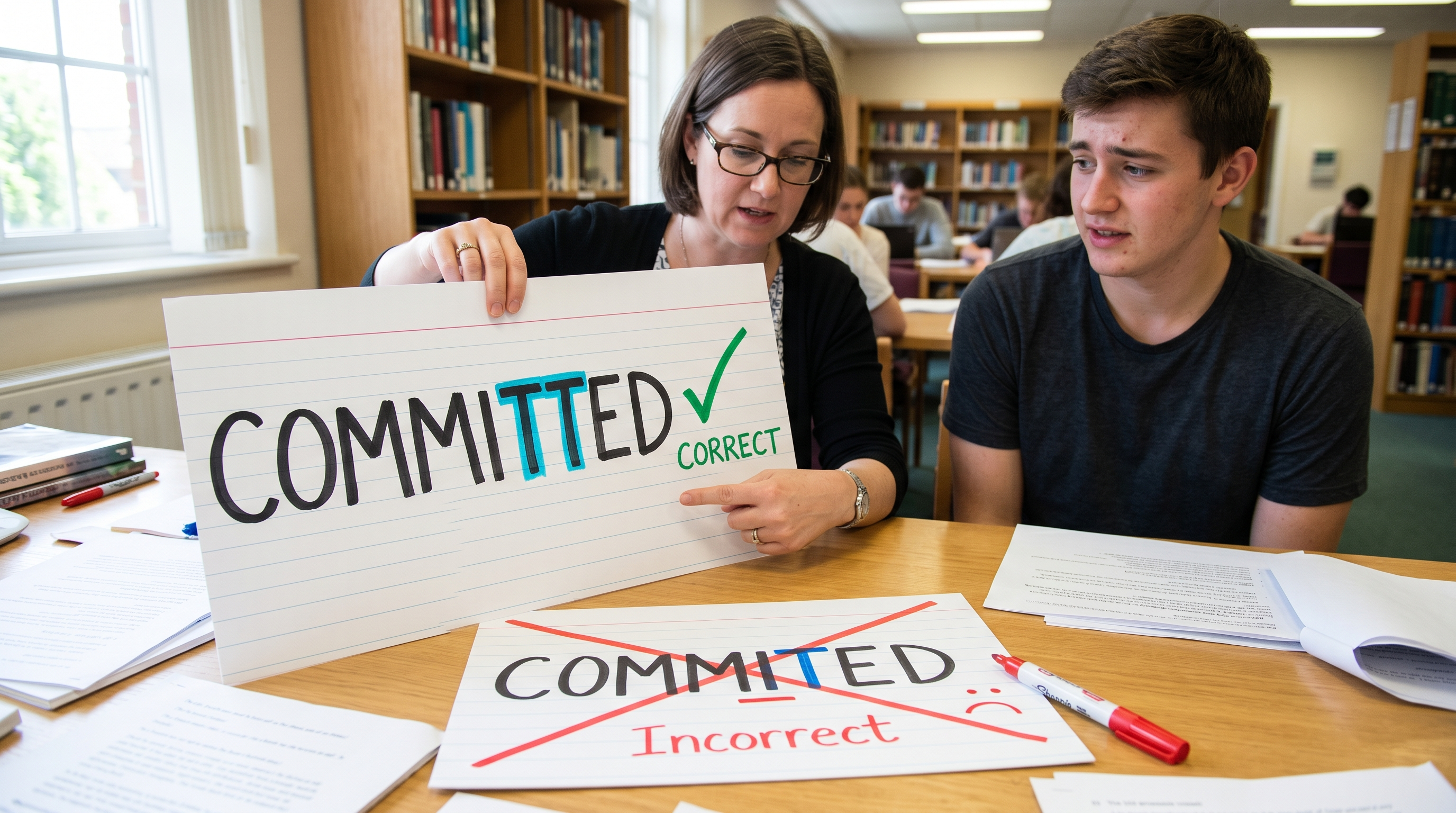
The dictionary confirms that the correct spelling is “committed.”
“Comited” is incorrect and should never use in standard English writing.
Active example:
✅ Active: She commits herself to her work.
Explanation: The active voice shows the subject (she) performing the action (commits).
Incorrect:
- She commits herself to her work.
The same rule applies in:
- emails
- resumes
- academic writing
- business communication
- casual messages
English speakers accept only “committed” as the correct spelling.
Why People Confuse “Committed” And “Comited”
This spelling mistake usually happens because English often doubles consonants in ways that are easy to miss during fast typing.
The word “committed” doubles both the “m” and the “t.”
- commit → committed
When people type quickly, they often remove one of those letters by accident, leading to:
- comited
- commited
The way people pronounce the word also causes confusion because speakers do not strongly emphasize the doubled consonants.
Key Differences At A Glance
| Feature | Committed | Comited |
|---|---|---|
| Correct English spelling | Yes | No |
| Found in dictionaries | Yes | No |
| Accepted in formal writing | Yes | No |
| Standard grammar form | Yes | No |
| Common spelling error | Rarely | Yes |
The difference is straightforward:
- Committed is the correct spelling.
- Comited is a spelling mistake.
What Does “Committed” Mean?
People use “committed” as:
- the past tense of “commit”
- an adjective describing dedication or loyalty
Common meanings include:
- devoted to a goal
- serious about a responsibility
- fully dedicated to something
Examples:
- Our company commits itself to customer satisfaction.
- She stayed committed to her education.
- He committed himself to improving his health.
People widely use the word in:
- workplace communication
- education
- relationships
- personal development
- sports and teamwork
No. English speakers do not recognize “Comited” as a correct spelling in standard American or British English.
It is not:
- an accepted spelling variant
- an informal shortcut
- a regional version
- a separate English word
Most spell check systems automatically flag “comited” as incorrect and replace it with “committed.”
Why Does “Committed” Have Double Letters?
The spelling follows a common English pattern where some verbs double the final consonant before adding endings like:
- -ed
- -ing
Examples:
- commit → committed
- commit → committing
- submit → submitted
- permit → permitted
This rule helps preserve pronunciation and keeps the spelling pattern consistent.
Without the doubled consonants, the word structure would look incomplete in standard English spelling.
Pronunciation And Spelling Connection
In American English, “committed” is commonly pronounced:
- kuh-MIT-id
Because the doubled consonants are not strongly stressed when spoken, many people accidentally remove one while typing.
That is why both:
- comited
- commited
appear so frequently in casual writing and online searches.
Related Word Forms You Should Know
Learning related forms can make the spelling easier to remember.
| Word Form | Correct Spelling |
|---|---|
| Base verb | commit |
| Past tense | committed |
| Present participle | committing |
| Noun | commitment |
Common misspellings include:
- comited
- commited
- commiting
- comitment
Each correct form keeps the double-letter pattern from “commit.”
Examples In Real-Life Writing
Correct examples:
- The team remained committed throughout the season.
- She is committed to helping local students.
- We are committed to delivering better service.
- He committed to finishing the project on time.
- They stayed committed during difficult negotiations.
Incorrect examples:
- The team remained comited throughout the season.
- She is comited to helping local students.
Why The Wrong Spelling Can Hurt Credibility
Even small spelling mistakes can affect how readers view your writing.
Using “comited” in:
- resumes
- job applications
- business emails
- reports
- website content
can make writing appear rushed or unprofessional.
Most readers will understand your meaning, but they will still recognize the spelling error immediately.
Easy Memory Tricks For “Committed”
Here are a few practical ways to remember the spelling:
- Start with the base word:
- commit
- Keep both doubled consonants:
- mm
- tt
- Practice the full word family together:
- commit
- committed
- committing
- commitment
Helpful reminder:
If “commit” has double “m,” “committed” keeps the strong double-letter pattern.
Frequently Asked Questions
Is comited a real English word?
No. “Comited” is not recognized as a standard English word. It is a misspelling of “committed.”
Which spelling is correct: committed or comited?
“Committed” is the correct spelling in both American and British English.
Why do people spell committed incorrectly?
Most spelling mistakes happen because writers accidentally remove one of the doubled consonants while typing quickly.
Is commited also incorrect?
Yes. “Commited” is also incorrect because it is missing one “t.”
What is the noun form of committed?
The related noun is “commitment.”
Example:
- Her commitment to the project impressed the entire team.
How can I remember how to spell committed?
A simple trick is to remember that the word keeps the double-letter structure from “commit.”
Conclusion
When comparing committed vs comited, the correct spelling is always “committed.”
“Comited” is a common spelling mistake caused by dropping letters during typing. It is not a valid English word, accepted variation, or regional spelling.
For accurate and professional writing, always use:
- committed
- committing
- commitment
and avoid spellings that remove the doubled consonants.