

Both partier and partyer are accepted spellings for a person who attends parties or enjoys partying. In most modern US writing, partier is the better choice because it looks more familiar and reads more naturally. Partyer is also a real word, but it can look unusual to readers.
Use partier for everyday writing. Use partyer only if you specifically want the dictionary-style form or do not mind a spelling that may make some readers pause.
Partier vs Partyer At A Glance

| Context | Best Choice | Why |
|---|---|---|
| Everyday US writing | partier | It usually looks more natural to readers. |
| Casual social description | partier | It is clear and easy to recognize. |
| Dictionary-style discussion | partyer | Some dictionaries list it as the main form. |
| Formal writing | neither | Partygoer, guest, or attendee may sound better. |
| Plural form after partier | partiers | This is the matching plural. |
| Plural form after partyer | partyers | This is the matching plural. |
| Describing someone who parties often | partier | It feels more familiar in normal sentences. |
What Does Partier Mean?

A partier is a person who goes to parties, enjoys parties, or is known for partying. The word is a noun.
Examples:
She was a big partier in college.
The hotel lobby was full of weekend partiers.
He is not much of a partier, but he came to the birthday dinner.
In everyday US writing, partier is usually the spelling that feels smoother. It follows the spelling pattern many readers expect because party often changes to parti- before some endings, as in parties.
That does not mean partyer is wrong. It means partier is often the more reader-friendly choice.
What Does Partyer Mean?
A partyer also means a person who parties or attends parties. It is also a noun.
Examples:
New Year’s Eve brings out many partyers.
A regular partyer may know every club downtown.
The word partyer comes from party plus -er, so the spelling makes sense from a word-formation point of view. It keeps the y in party instead of changing it to i.
The issue is not correctness. The issue is reader reaction. Many people expect partier, so partyer can look strange even though it is accepted.
Main Difference Between Partier And Partyer
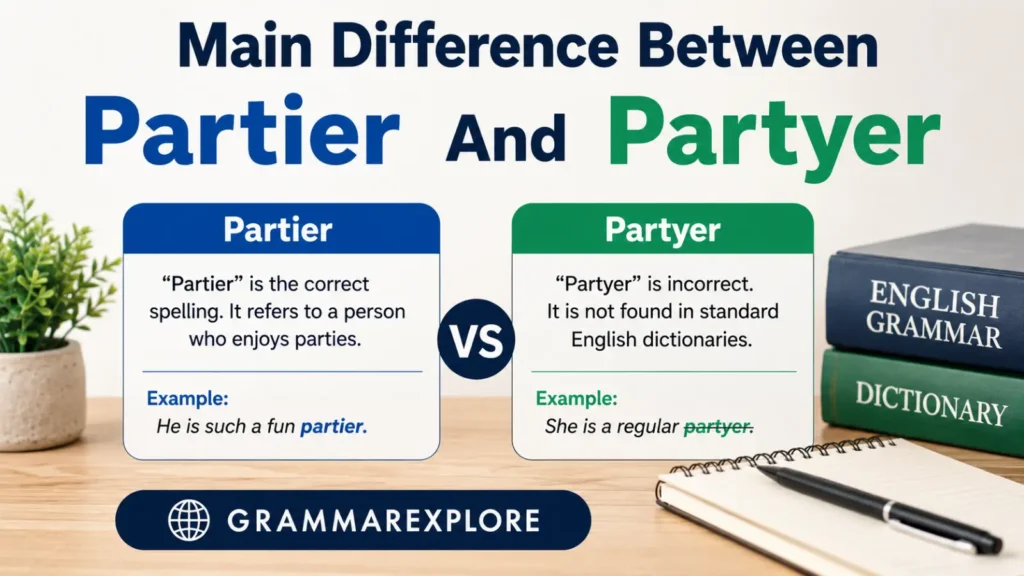
There is no real meaning difference between partier and partyer. Both words refer to someone who parties.
The difference is mainly spelling preference and reader familiarity.
Partier usually looks more natural in modern everyday writing.
Partyer is accepted, but it may look less familiar because the y + er ending is not what many readers expect.
Think of the choice this way:
Partier is the safer practical spelling.
Partyer is the valid but more surprising spelling.
If your goal is smooth reading, choose partier.
Why People Confuse Partier And Partyer
People confuse these spellings because English handles words ending in y in more than one way.
The base word is party. If you add -er directly, you get partyer. That spelling keeps the original word visible.
But many English words change y to i before an ending. That pattern gives us partier. Readers already know similar forms like parties and partied, so partier can feel more natural.
This is why both spellings are easy to understand. One follows the base word closely. The other follows a familiar spelling pattern.
Which One Should You Use?
For most blog posts, captions, messages, and casual articles, use partier.
It is clear, familiar, and unlikely to distract the reader.
Correct: She used to be a serious partier, but now she prefers quiet weekends.
Correct: The beach was crowded with spring break partiers.
Use partyer only when you want that exact spelling or when you are discussing dictionary forms.
Correct: Partyer is an accepted spelling, though some readers prefer partier.
For formal writing, avoid both if the tone feels too casual. Use a more neutral word.
- Better: The event attracted hundreds of guests.
- Better: Several attendees stayed after the reception.
- Better: Late-night partygoers filled the downtown area.
When Partyer Looks Wrong But Is Not Wrong
Partyer often looks wrong because many readers expect the y in party to change to i before the ending.
This sentence is understandable:
The rooftop bar was packed with partyers.
But this version will look smoother to many readers:
The rooftop bar was packed with partiers.
That is the key point. Partyer is not automatically incorrect, but it may distract readers. In public-facing writing, the spelling that causes less distraction is usually the better choice.
When Partier Is The Stronger Choice
Partier is stronger when you want the sentence to feel natural and easy to scan.
Use partier in casual writing:
My roommate is a big partier.
Use partier in lifestyle content:
This city has plenty of late-night spots for partiers.
Use partier in captions:
Not a partier, just here for the cake.
Use partier in simple descriptions:
He was friendly, outgoing, and known as a weekend partier.
In all of these examples, partier works because the reader understands it instantly.
When To Avoid Both Words
Sometimes neither partier nor partyer is the best word.
Both can sound casual. They can also suggest someone who parties often, stays out late, or enjoys nightlife. That meaning may be fine in a relaxed sentence, but it may sound too informal in serious writing.
- Use guest when you mean someone invited to an event.
- Use attendee when you mean someone present at an event.
- Use partygoer when you want a neutral word for someone who goes to a party.
- Use reveler when you want a more lively or literary word.
Examples:
- Better for a formal report: Event attendees entered through the west gate.
- Better for an invitation list: Please confirm the number of guests.
- Better for a news-style sentence: New Year’s Eve revelers filled the streets.
- Better for neutral description: Several partygoers left before midnight.
Common Mistakes And Quick Fixes
Mistake: Saying partyer is always wrong.
Fix: Partyer is accepted, but partier usually reads better.
Mistake: Saying partier and partyer have different meanings.
Fix: They mean the same basic thing.
Mistake: Using partier as a verb.
Incorrect: He likes to partier every weekend.
Correct: He likes to party every weekend.
Mistake: Mixing plural forms.
Incorrect: The article used partiers in one paragraph and partyers in the next.
Correct: Choose one spelling style and stay consistent.
Mistake: Using either word in a formal context where it sounds too casual.
Better: Use guest, attendee, or partygoer.
Everyday Examples
She was a regular partier during her college years.
The club was full of late-night partiers.
He is more of a homebody than a partier.
A few loud partiers kept the hotel staff busy.
The article used partyer as the dictionary spelling.
Some writers prefer partyer because it keeps the base word party.
The plural partyers is understandable, but partiers often looks smoother.
For a formal guest list, write attendees instead of partiers.
Dictionary-Style Word Details
Verb
Partier: Not used as a verb in standard US English. The verb is party.
Correct: They like to party on weekends.
Incorrect: They like to partier on weekends.
Partyer: Not used as a verb in standard US English. It is a noun form.
Correct: She is a partyer.
Incorrect: She likes to partyer every weekend.
Noun
Partier: A noun meaning a person who attends parties or enjoys partying.
Example: He was known as a friendly partier.
Partyer: A noun with the same meaning.
Example: New Year’s Eve brings out many partyers.
Both spellings refer to a person, not an action.
Synonyms
Partier: Closest plain alternatives include partygoer, guest, attendee, reveler, merrymaker, and party animal.
Partyer: The same alternatives apply because the meaning is the same.
- Use partygoer for a neutral tone. Use guest or attendee for formal writing. Use party animal only when you want a stronger, more informal meaning.
Clear opposites are limited. Possible contrast words include homebody or introvert, but they are not exact opposites in every sentence.
Example Sentences
- Partier: She was never a big partier, but she loved small dinners with friends.
- Partier: Downtown hotels were busy with weekend partiers.
- Partier: He has a reputation as a nonstop partier.
- Partyer: A partyer is someone who enjoys parties.
- Partyer: The spelling partyer keeps the base word party visible.
- Partyer: Some readers may pause when they see partyers, even though the word is understandable.
Word History
Partier: This spelling likely feels natural because English often changes y to i before certain endings. It is an accepted noun form for a person who parties.
Partyer: This spelling follows the direct pattern of adding -er to party. It is also accepted and appears as a dictionary form.
For modern writers, the history matters less than the practical choice. Partier usually reads more naturally. Partyer remains valid but less expected.
Phrases Containing
Partier: big partier, regular partier, serious partier, weekend partier, late-night partier, spring break partier, college partier.
Partyer: regular partyer, frequent partyer, New Year’s Eve partyer, dictionary spelling partyer, weekend partyer.
Neither spelling appears in many fixed idioms. Most uses are simple noun phrases.
FAQ
Is partier or partyer correct?
Both partier and partyer are accepted spellings. For most modern US writing, partier is the better practical choice because it looks more familiar.
Is partyer a real word?
Yes. Partyer is a real word meaning a person who parties or attends parties. It may look unusual, but it is not simply wrong.
Is partier a real word?
Yes. Partier is also a real word. It means the same thing as partyer and often reads more naturally in everyday writing.
Which spelling should I use in an article?
Use partier unless you have a specific reason to use partyer. It is clearer for most readers and less likely to look distracting.
What is the plural of partier?
The plural of partier is partiers.
Example: The hotel was full of spring break partiers.
What is the plural of partyer?
The plural of partyer is partyers.
Example: New Year’s Eve brings out many partyers.
Are partier and partyer pronounced differently?
No. In everyday speech, they are pronounced the same: PAR-tee-er.
What word is better for formal writing?
Use partygoer, guest, or attendee. These choices sound more neutral and professional than partier or partyer.
Conclusion
The choice between partier and partyer is not a simple right-or-wrong issue. Both spellings are accepted, and both mean a person who attends parties or enjoys partying.
For most modern US writing, choose partier. It looks familiar, reads smoothly, and will not distract most readers. Partyer is also valid, but it can look unusual because many readers expect the y in party to change to i before the ending.
Use partier for natural everyday writing. Use partyer only when you specifically want that spelling. For a more formal or neutral tone, choose partygoer, guest, or attendee instead.
Both partier and partyer are accepted spellings. For most modern US writing, partier is the better practical choice because it looks more familiar.
Yes. Partyer is a real word meaning a person who parties or attends parties. It may look unusual, but it is not simply wrong.
Yes. Partier is also a real word. It means the same thing as partyer and often reads more naturally in everyday writing.
Use partier unless you have a specific reason to use partyer. It is clearer for most readers and less likely to look distracting.
The plural of partier is partiers.
Example: The hotel was full of spring break partiers.
The plural of partyer is partyers.
Example: New Year’s Eve brings out many partyers.
No. In everyday speech, they are pronounced the same: PAR-tee-er.
Use partygoer, guest, or attendee. These choices sound more neutral and professional than partier or partyer.