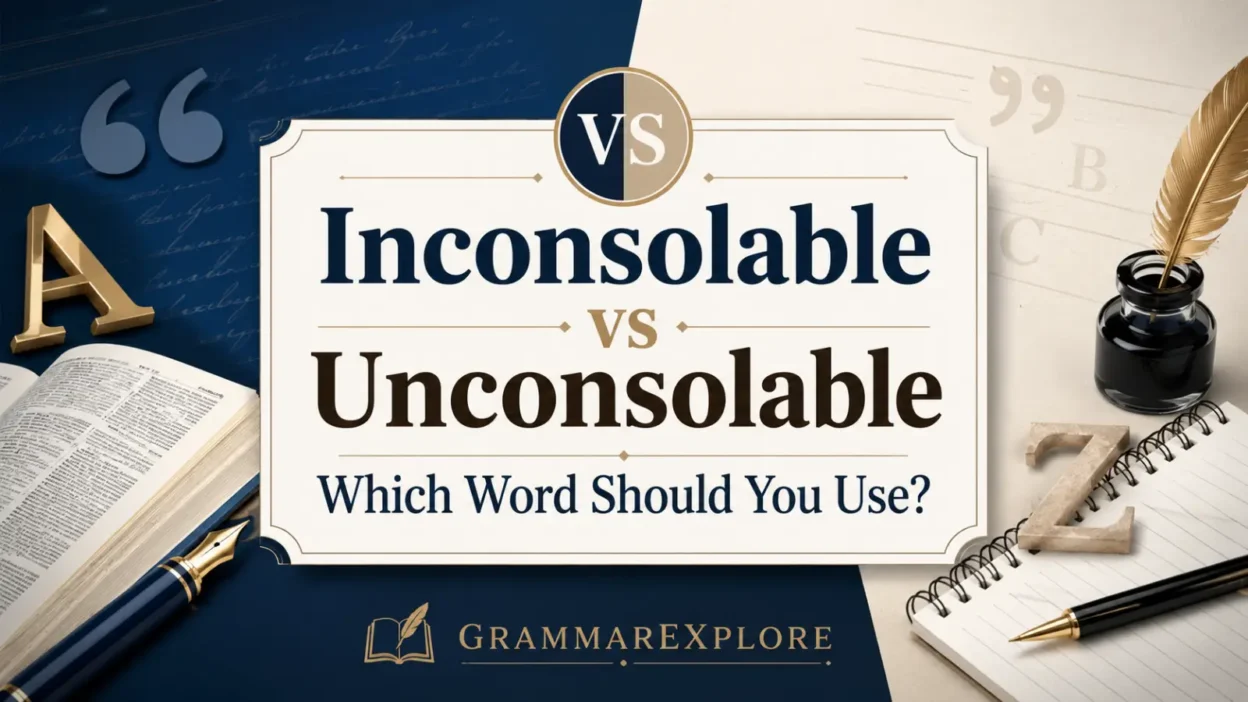
Inconsolable is the word you should use in modern American English. It means someone is so sad, upset, or distressed that comfort does not help.
Unconsolable has the same basic meaning and appears in some dictionaries, but it is much less common. Many readers will see it as unusual, awkward, or possibly mistaken. For school writing, professional writing, emotional storytelling, and everyday use, inconsolable is the safer and more natural choice.
Correct: She was inconsolable after hearing the news.
Less Preferred: She was unconsolable after hearing the news.
Quick Answer
Use inconsolable when you mean unable to be comforted.
Inconsolable is the standard form. Unconsolable may be understood, but it is not the preferred choice in polished US English.
Best: The child was inconsolable after losing his dog.
Avoid: The child was unconsolable after losing his dog.
Why People Confuse Them

People confuse inconsolable and unconsolable because both are built around consolable, which means able to be comforted.
The confusion comes from the prefix. English often uses un- to mean “not,” as in unhappy, unclear, and unfair. Because of that pattern, unconsolable may look logical.
However, the established word is inconsolable. In this word, in- also means “not.” So inconsolable means not consolable, or unable to be comforted.
The issue is not meaning alone. The real difference is usage. Inconsolable is the form readers expect.
Key Differences At A Glance

| Context | Best Choice | Why |
|---|---|---|
| Formal Writing | Inconsolable | It is the standard form. |
| School Writing | Inconsolable | It avoids sounding like an error. |
| Emotional Writing | Inconsolable | It fits serious grief or distress. |
| Casual Speech | Inconsolable | It sounds more natural. |
| Rare Or Creative Wording | Unconsolable | It may be understood, but it can distract readers. |
| Best Everyday Choice | Inconsolable | It is clearer and more expected. |
Meaning And Usage Difference
Inconsolable means extremely sad or upset and unable to be comforted.
Examples:
- The baby was inconsolable after waking from a nightmare.
- She was inconsolable when her cat went missing.
- He looked inconsolable after the final loss.
- The family was inconsolable after the accident.
Unconsolable means nearly the same thing, but it is much less common. It may appear in dictionaries, songs, older writing, or creative contexts, but it is not the best choice for most modern writing.
Compact comparison:
- Inconsolable: standard, expected, polished, common.
- Unconsolable: understandable, rare, less polished, often distracting.
- Best choice: inconsolable.
- Main meaning: unable to be comforted.
Both words are adjectives. They describe a person, mood, reaction, or emotional state.
Tone, Context, And Formality

Inconsolable has a serious emotional tone. It is stronger than sad, upset, or disappointed. Use it when someone cannot calm down or cannot accept comfort.
Natural contexts include:
- grief after a death
- shock after bad news
- a child crying intensely
- heartbreak
- deep distress after a loss
Examples:
- After the funeral, his father was inconsolable.
- The toddler was inconsolable until her mother picked her up.
- She felt sad after the breakup, but not inconsolable.
That last example matters. Inconsolable should not be used for every sad moment. It describes strong distress, not mild disappointment.
Unconsolable can weaken a serious sentence because it may make readers pause over the word instead of the emotion. In formal or emotional writing, that distraction is usually not worth it.
Which One Should You Use?
Use inconsolable almost every time.
It works in casual, formal, academic, journalistic, and creative writing. It is also the word most readers expect when describing someone who cannot be comforted.
Use inconsolable in sentences like these:
- She was inconsolable after the loss.
- The baby was inconsolable for nearly an hour.
- He became inconsolable when he heard what happened.
- The fans were inconsolable after the championship defeat.
Avoid unconsolable in polished writing. It may not be completely meaningless, but it can look like a mistaken version of inconsolable.
When One Choice Sounds Wrong
Unconsolable often sounds wrong because the standard phrase is inconsolable.
Awkward: The family was unconsolable after the tragedy.
Better: The family was inconsolable after the tragedy.
Awkward: She cried with unconsolable grief.
Better: She cried with inconsolable grief.
Awkward: The toddler became unconsolable at bedtime.
Better: The toddler became inconsolable at bedtime.
In each case, the meaning is clear, but inconsolable sounds smoother and more natural.
Common Mistakes And Quick Fixes
Mistake: Using unconsolable as if it were equally common.
Fix: Use inconsolable as the standard form.
Mistake: Saying unconsolable grief in formal writing.
Fix: Write inconsolable grief.
Mistake: Using inconsolable for mild sadness.
Fix: Save it for deep distress that comfort cannot ease.
Mistake: Misspelling the word as inconsoleable.
Fix: Write inconsolable.
Mistake: Using the word as a noun.
Fix: Use it as an adjective: an inconsolable child, an inconsolable parent, inconsolable grief.
Everyday Examples
- The child was inconsolable when his balloon floated away.
- She was inconsolable after her dog died.
- He looked inconsolable after the team lost in overtime.
- The baby was inconsolable during the flight.
- I tried to comfort her, but she was inconsolable.
- The family was inconsolable after the sudden news.
- He was upset, but he was not inconsolable.
- Her grief seemed deep and inconsolable.
- The teacher helped calm the inconsolable student.
- The ending left some fans shocked, but not inconsolable.
Less preferred:
- The baby was unconsolable during the flight.
- His grief seemed unconsolable.
Those sentences can be understood, but inconsolable is still the stronger choice.
Dictionary-Style Word Details
Verb
Inconsolable: Not used as a verb in standard US English. It is an adjective.
Unconsolable: Not used as a verb in standard US English. It is also an adjective.
Use console, comfort, or calm when you need a verb.
Example:
- We tried to console her, but she was inconsolable.
Noun
Inconsolable: Not commonly used as a noun. Use it as an adjective.
Unconsolable: Not commonly used as a noun. Use it as an adjective if you use it at all.
Better noun choices include grief, sorrow, distress, heartbreak, or despair, depending on the sentence.
Example:
- Her grief was overwhelming.
- She was inconsolable.
Synonyms
Inconsolable: close alternatives include heartbroken, devastated, grief-stricken, distraught, desolate, and disconsolate.
Unconsolable: the same alternatives fit the meaning, but inconsolable is the preferred word.
Useful opposites include consolable, comforted, calm, and reassured, depending on the sentence.
Example Sentences
Inconsolable:
- She was inconsolable after learning that her friend had died.
- The toddler was inconsolable until his father came home.
- The loss left him inconsolable for days.
Unconsolable:
- “He felt unconsolable” may be understood, but inconsolable is more natural.
- “Unconsolable grief” is less expected than inconsolable grief.
Word History
Inconsolable: This is the established form in modern English. It is built from a negative form of consolable, meaning not able to be comforted.
Unconsolable: This form uses the familiar negative prefix un-. It is recognized in some dictionaries, but it is less frequent than inconsolable.
The safe usage point is simple: both forms connect to the idea of being unable to receive comfort, but inconsolable is the form most readers expect.
Phrases Containing
Inconsolable:
- inconsolable grief
- inconsolable sorrow
- inconsolable child
- inconsolable parent
- inconsolable after the loss
- completely inconsolable
Unconsolable:
- unconsolable sadness
- unconsolable grief
The unconsolable phrases may appear, but they sound less standard. In polished writing, use inconsolable grief and inconsolable sorrow instead.
FAQ
Is inconsolable or unconsolable correct?
Inconsolable is the correct choice for standard modern writing. Unconsolable may be recognized, but it is less common and often sounds awkward.
Is unconsolable a real word?
Yes, unconsolable appears in some dictionaries, but that does not make it the best choice. Most readers expect inconsolable.
Do inconsolable and unconsolable mean the same thing?
They have the same basic meaning: unable to be comforted. The difference is usage. Inconsolable is standard and common, while unconsolable is rare and less preferred.
Can I use unconsolable in formal writing?
It is better not to. Use inconsolable in formal writing because it sounds more polished and avoids distracting the reader.
What is a simple synonym for inconsolable?
A simple synonym is heartbroken. Other close choices include devastated, distraught, and grief-stricken.
Is inconsolable stronger than sad?
Yes. Inconsolable is much stronger than sad. It means someone is so upset that comfort does not help.
Conclusion
The best choice is inconsolable. It means so sad, upset, or distressed that comfort does not help. Use it for serious emotional moments, such as grief, heartbreak, shock, or deep loss.
Unconsolable has the same basic meaning and appears in some dictionaries, but it is much less common. In most American writing, it can look awkward or mistaken. For clear, natural, and polished English, choose inconsolable.
Inconsolable is the correct choice for standard modern writing. Unconsolable may be recognized, but it is less common and often sounds awkward.
Yes, unconsolable appears in some dictionaries, but that does not make it the best choice. Most readers expect inconsolable.
They have the same basic meaning: unable to be comforted. The difference is usage. Inconsolable is standard and common, while unconsolable is rare and less preferred.
It is better not to. Use inconsolable in formal writing because it sounds more polished and avoids distracting the reader.
A simple synonym is heartbroken. Other close choices include devastated, distraught, and grief-stricken.
Yes. Inconsolable is much stronger than sad. It means someone is so upset that comfort does not help.