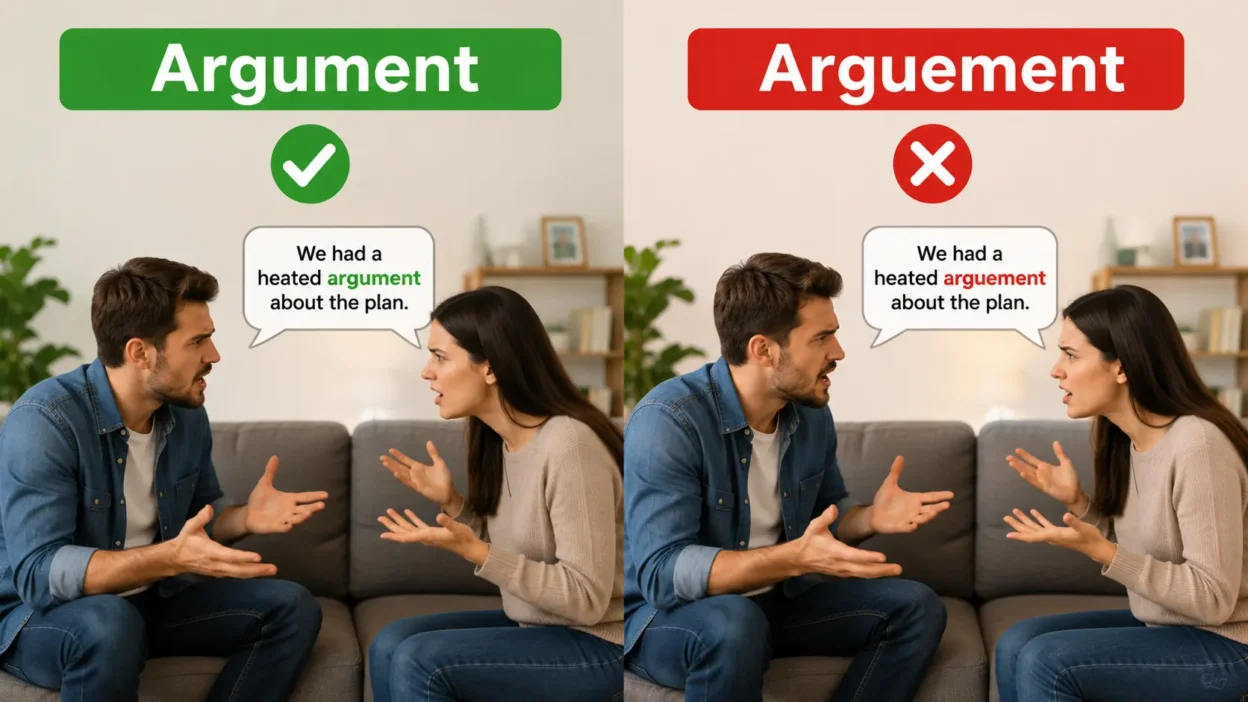
The correct spelling is argument.
Arguement is a misspelling. It is not the standard spelling in American English or British English.
Correct: She made a strong argument for changing the policy.
Incorrect: She made a strong arguement for changing the policy.
The mistake happens because the verb argue ends in e. But the noun argument drops that e.
Think of it this way:
argue → argument
There is no ue in argument.
Use argument every time.
| Word | Correct? | Meaning |
|---|---|---|
| argument | Yes | A disagreement, debate, reason, or case made to support a point |
| arguement | No | A misspelling of argument |
The easiest spelling rule is:
argue + ment = argument
Do not write arguement.
Why People Confuse Argument And Arguement
People confuse argument and arguement because argument comes from the verb argue.
At first, it may seem logical to keep the e:
Wrong pattern: argue + ment = arguement
But that is not the standard spelling. The correct noun drops the final e:
Correct pattern: argue → argument
This is why arguement looks believable. It follows the way many people expect the word to work, but English does not spell it that way.
A helpful memory trick:
You can argue, but there is no “ue” in argument.
Key Differences At A Glance
| Context | Best Choice | Why |
|---|---|---|
| School essays | argument | Correct spelling for a claim or supported point |
| Business writing | argument | Professional and standard |
| Legal writing | argument | Used for legal reasoning or oral argument |
| Everyday disagreement | argument | Means a dispute or quarrel |
| Debate or persuasion | argument | Means a reasoned case |
| British English | argument | Same correct spelling |
| American English | argument | Same correct spelling |
| Any standard sentence | argument | Arguement is a misspelling |
| Showing the mistake itself | arguement | Only correct when discussing the error |
Meaning And Usage Difference
Argument is a noun. It has two common meanings.
First, argument can mean a disagreement.
Example: They had an argument about the budget.
Second, argument can mean a reason or set of reasons used to support a point.
Example: Her argument for flexible hours was clear and practical.
This second meaning is especially common in school, debate, law, and professional writing. An argument does not always mean yelling or conflict. It can be calm, logical, and well supported.
Examples:
- The essay’s main argument needs stronger evidence.
- The lawyer presented a clear argument to the judge.
- His argument for the new policy was based on cost savings.
- I understand your argument, but I still disagree.
Arguement has no separate modern meaning in standard English. It is simply the wrong spelling of argument.
Tone, Context, And Formality
Argument works in casual and formal writing.
In casual speech, it often means a disagreement.
Example: We had an argument after dinner.
In academic writing, it usually means a claim supported by reasons.
Example: The student’s argument was thoughtful but needed more sources.
In legal writing, it can refer to reasoning presented in a case.
Example: The attorney prepared the closing argument.
In professional writing, it can mean a case for or against a decision.
Example: The report makes a strong argument for hiring more staff.
Arguement looks unpolished in every setting. It can weaken an essay, email, resume, report, legal document, or business proposal.
Which One Should You Use?
Use argument whenever you mean:
- a disagreement
- a debate
- a reason
- a claim
- a case for or against something
- a line of reasoning
- a point supported by evidence
Examples:
- I do not want to start an argument.
- That is a fair argument, but it needs proof.
- The article’s central argument is easy to follow.
- The manager rejected the argument that the deadline was impossible.
- A strong argument includes reasons, examples, and evidence.
Do not use arguement unless you are showing the misspelling itself.
When One Choice Sounds Wrong
Arguement sounds and looks wrong in polished writing because it keeps an extra e from argue.
Wrong: The article makes a strong arguement.
Correct: The article makes a strong argument.
Wrong: Their arguement lasted for an hour.
Correct: Their argument lasted for an hour.
Wrong: The attorney gave the closing arguement.
Correct: The attorney gave the closing argument.
Wrong: Your arguement needs more evidence.
Correct: Your argument needs more evidence.
The correct spelling is always:
a-r-g-u-m-e-n-t
Common Mistakes And Quick Fixes
Keeping The E From Argue
Wrong: arguement
Right: argument
The word argue has an e, but argument does not keep it.
Misspelling The Plural
Wrong: The essay included three arguements.
Right: The essay included three arguments.
Confusing Argument With Arguing
Argument is a noun.
Example: That was a weak argument.
Arguing is a verb form.
Example: They were arguing in the hallway.
Assuming Argument Always Means A Fight
An argument can be a fight, but it can also be a calm, logical point.
Casual: They had an argument about money.
Formal: The report presents an argument for reform.
Using Argument When A Simpler Word Fits Better
Sometimes argument is too formal.
Formal: Her argument was persuasive.
Simpler: Her point was persuasive.
Formal: The team discussed both arguments.
Simpler: The team discussed both sides.
Use argument when you mean a supported point, case, or disagreement. Use a simpler word when the sentence calls for a lighter tone.
Everyday Examples
- I do not want an argument before work.
- They had an argument about the rent.
- Her argument made sense after she explained the numbers.
- The article’s main argument appears in the first paragraph.
- Your argument would be stronger with one more example.
- The lawyer’s closing argument was direct and persuasive.
- The teacher asked each student to support the argument with facts.
- His argument for delaying the launch was practical.
- That is not an argument; it is just an opinion without evidence.
- We can disagree without turning this into an argument.
- The report gives a clear argument for reducing costs.
- The judge listened carefully to each legal argument.
Related Forms And Correct Spellings
| Correct Form | Incorrect Form |
|---|---|
| argument | arguement |
| arguments | arguements |
| argumentative | arguementative |
| arguing | argueing |
| argued | arguued |
Notice the pattern:
- argument drops the e from argue.
- arguing also drops the e.
- argued keeps the e because the ending begins with d.
Examples:
- She made a strong argument.
- They presented several arguments.
- His tone sounded argumentative.
- They were arguing about the schedule.
- She argued her point clearly.
Pronunciation Of Argument
Argument is usually pronounced:
AR-gyuh-mint
It has three syllables:
ar-gu-ment
The quick middle sound can make people think there is an extra e after the u. But the spelling stays simple:
argument, not arguement.
Dictionary-Style Word Details
Noun
Argument: A standard noun. It can mean a disagreement, a debate, a reason, or a set of reasons used to support a point.
Examples:
- They had an argument.
- Her argument was based on evidence.
- The brief included three legal arguments.
Arguement: Not a standard noun in modern English. It is a misspelling of argument.
Verb
Argument: Not used as a verb in standard English. The verb is argue.
Example: They began to argue about the decision.
Arguement: Not used as a verb in standard English.
Synonyms
Argument: The best synonym depends on meaning.
For a disagreement:
- disagreement
- dispute
- quarrel
- conflict
For a reasoned point:
- case
- claim
- reason
- position
- rationale
Examples:
- They had a loud disagreement.
- She made a strong case for the new plan.
- His main claim needs more support.
Arguement: No true synonyms, because it is not a standard word. Use argument instead.
Example Sentences
Argument:
- The essay makes a clear argument.
- I agree with your argument, but not your conclusion.
- Their argument became too heated.
- The lawyer gave a strong closing argument.
- The proposal includes a practical argument for change.
Arguement:
- Incorrect: The essay makes a clear arguement.
- Incorrect: I agree with your arguement.
- Incorrect: The lawyer gave a closing arguement.
Word History
Argument: The word comes through Middle English and Old French from Latin argumentum, connected with proof, evidence, and reasoning. That background helps explain why argument is more than a word for a fight. It can also mean a reasoned case.
Arguement: This spelling does not have a separate modern use in standard English. It is a spelling error caused by keeping the e from argue.
Phrases Containing
Argument:
- make an argument
- strong argument
- weak argument
- main argument
- legal argument
- closing argument
- oral argument
- argument for change
- argument against the plan
- get into an argument
Arguement:
- Not used in standard English phrases. Correct it to argument.
FAQ
Is arguement ever correct?
No. Arguement is not correct in standard English. The correct spelling is argument.
Why is argument not spelled arguement?
Because the final e in argue drops before -ment. The correct form is argument, not arguement.
Is arguement British spelling?
No. Arguement is not British spelling. Both American English and British English use argument.
How do you spell argument correctly?
Spell it a-r-g-u-m-e-n-t.
Correct: argument
Incorrect: arguement
What is the plural of argument?
The plural is arguments.
Correct: The essay included three strong arguments.
Incorrect: The essay included three strong arguements.
Is argument a noun or a verb?
Argument is a noun. The verb is argue.
Example: They had an argument.
Example: They began to argue.
Does argument always mean a fight?
No. Argument can mean a fight or disagreement, but it can also mean a reasoned point supported by evidence.
Example: Her essay had a clear argument.
What is the difference between argue and argument?
Argue is the verb. Argument is the noun.
Example: They argue often.
Example: They had an argument yesterday.
How do you remember argument vs. arguement?
Remember this: There is no “ue” in argument.
Write argue, drop the e, and add -ment:
argue → argument
Conclusion
The correct spelling is argument.
Arguement is a misspelling because it keeps an extra e from argue. When the noun is formed, the e drops:
argue → argument
Use argument for a disagreement, debate, reasoned point, legal case, or supported claim.
Correct: Her argument was clear.
Incorrect: Her arguement was clear.