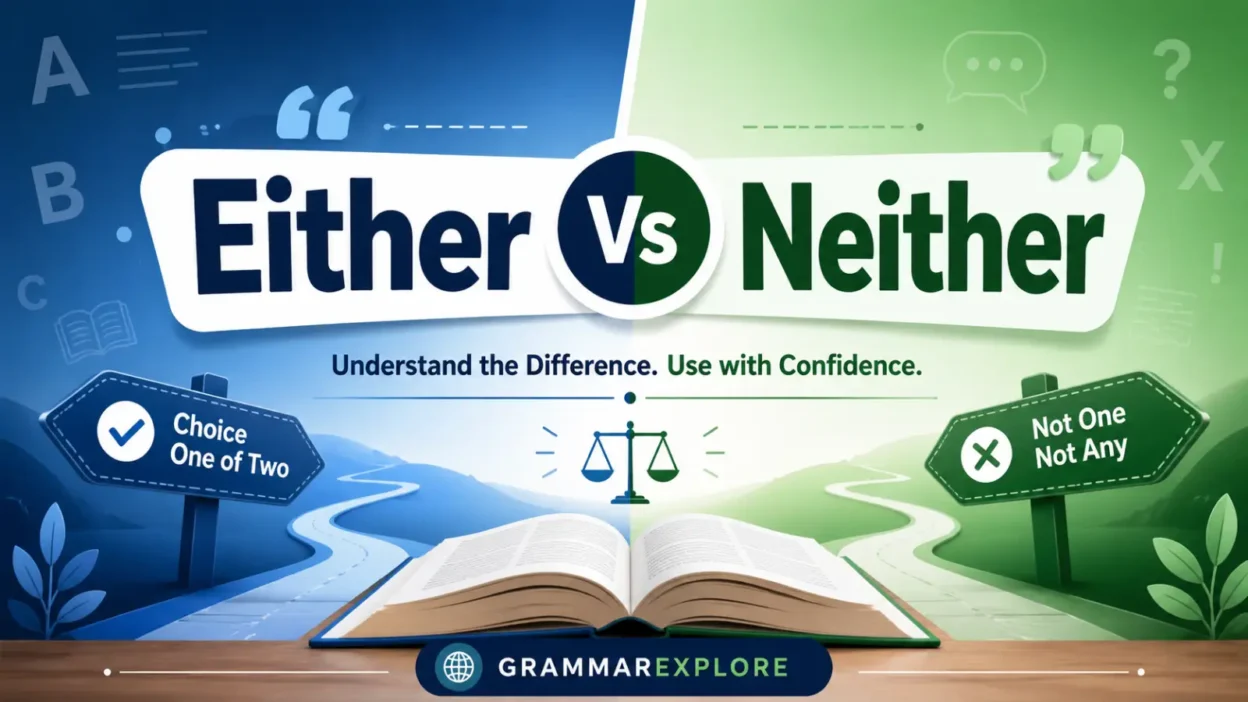
Either vs neither is confusing because both words usually talk about two choices. The difference is that either points to one of two choices, while neither rejects both choices.
Use either when at least one option is possible. Use neither when both options are not possible, not true, or not wanted. Both words are standard in US English, but they fit different sentence patterns.
Quick Answer
Use either when you mean “one or the other” or “one of two choices.” Use neither when you mean “not this one and not that one.” The easiest rule is this: either keeps a choice open, while neither closes both choices.
Why People Confuse Them

People confuse either and neither because both words often appear with two options.
You might hear:
Either coffee or tea is fine.
You might also hear:
Neither coffee nor tea sounds good.
The structure looks similar, but the meaning changes. Either allows a choice. Neither says no to both.
Another reason is negative sentences. In everyday English, either can appear after a negative verb:
I don’t like either option.
That sentence is already negative because of don’t. Adding neither there would create a double negative in standard writing.
Key Differences At A Glance

| Context | Best Choice | Why |
|---|---|---|
| One of two choices is acceptable | either | It means one or the other. |
| Both choices are rejected | neither | It means not either one. |
| Paired with or | either | Use either/or for alternatives. |
| Paired with nor | neither | Use neither/nor for two negatives. |
| After a negative verb | either | “I don’t like either” is standard. |
| At the start of a negative agreement | neither | “Neither do I” agrees with a negative statement. |
| Before a singular noun | either or neither | Both can come before a singular noun. |
| Talking about two sides | either | It can mean both, as in “either side.” |
| Formal writing | either or neither | Both are standard when used correctly. |
| Casual speech | either or neither | Both are common, but sentence pattern matters. |
Meaning and Usage Difference
Either means “one or the other of two.” It can also mean “each of two” in phrases such as on either side.
Examples:
You can take either seat.
Either answer is acceptable.
There were trees on either side of the road.
Neither means “not one and not the other.” It gives a negative meaning without needing not before it.
Examples:
- Neither seat is available.
- Neither answer is correct.
- Neither plan worked.
Both words can work as determiners, pronouns, adverbs, and parts of paired expressions. The most useful point is sentence meaning. Either leaves at least one option open. Neither removes both options.
Pronunciation does not change the meaning. In US English, either may sound like EE-thur or EYE-thur. Neither may sound like NEE-thur or NYE-thur. Both pronunciations are widely understood.
Compact comparison:
• Either: one or the other; one of two; sometimes each of two.
• Neither: not one or the other; not this one and not that one.
• Either/or: presents two choices.
• Neither/nor: rejects or negates two choices.
• Not either: often means the same as neither, but the sentence structure is different.
Tone, Context, and Formality

Either and neither are both normal in formal and informal US English. The tone problem usually comes from the sentence pattern, not from the words themselves.
For a clean, standard tone, use either/or for choices:
We can either meet Monday or move the call to Tuesday.
Use neither/nor when both parts are negative:
Neither the manager nor the client approved the change.
In casual speech, people sometimes say:
Me either.
Many people understand that phrase, but me neither is the more natural casual answer after a negative statement:
I don’t want to go.
Me neither.
For more formal writing, use:
Neither do I.
Which One Should You Use?
Use either when the sentence gives a choice, accepts one of two things, or follows a negative verb.
Correct:
Either jacket will work.
We can either drive or take the train.
I don’t like either color.
Use neither when the sentence rejects two things or agrees with a negative statement.
Correct:
Neither jacket fits.
We can neither confirm nor deny the report.
I don’t like that plan. Neither do I.
A quick test helps: if you can replace the idea with one or the other, use either. If you can replace it with not this one and not that one, use neither.
When One Choice Sounds Wrong
Either sounds wrong when the sentence needs a negative meaning but has no other negative word.
Wrong:
Either answer is correct.
That sentence means one of the answers is correct. If both answers are wrong, use:
Neither answer is correct.
Neither sounds wrong when the sentence already has not, don’t, doesn’t, or didn’t before it.
Wrong:
I don’t like neither option.
Correct:
I don’t like either option.
Also correct:
I like neither option.
In standard US English, avoid mixing neither with another negative unless you are writing very casual dialogue on purpose.
Common Mistakes (and Quick Fixes)
Mistake 1: Using neither after don’t.
Wrong:
I don’t want neither drink.
Correct:
I don’t want either drink.
Also correct:
I want neither drink.
Mistake 2: Pairing either with nor.
Wrong:
Either my phone nor my laptop is charged.
Correct:
Neither my phone nor my laptop is charged.
Mistake 3: Pairing neither with or in careful writing.
Risky:
Neither the coach or the players commented.
Better:
Neither the coach nor the players commented.
Mistake 4: Forgetting parallel structure.
Weak:
Either we can order pizza or tacos.
Better:
We can order either pizza or tacos.
Also good:
Either we can order pizza, or we can order tacos.
Mistake 5: Using a plural verb after a simple either or neither subject.
Wrong:
Neither answer are correct.
Correct:
Neither answer is correct.
Everyday Examples
Either restaurant is fine with me.
Neither restaurant is open after 10 p.m.
You can either email the file or upload it to the folder.
Neither the email nor the attachment came through.
I don’t want either dessert.
Neither dessert has nuts.
Either route will get us downtown.
Neither route avoids traffic.
I haven’t seen either movie.
Neither movie is playing nearby.
Either meeting time works for me.
Neither meeting time works for my manager.
I don’t agree with either suggestion.
Neither suggestion solves the real problem.
Dictionary-Style Word Details
Verb
either: Not commonly used as a verb in standard US English.
neither: Not commonly used as a verb in standard US English.
Noun
either: Not commonly used as a noun. It can function as a pronoun, as in Either is fine, where it stands for one of two choices.
neither: Not commonly used as a noun. It can function as a pronoun, as in Neither is ready, where it stands for not one and not the other.
Synonyms
either: Closest plain alternatives include one or the other, one of the two, any one of the two, and, in some contexts, each.
neither: Closest plain alternatives include not either, not one or the other, none of the two, and not this one or that one.
Clear opposite relationship: neither is often the negative counterpart of either when two choices are involved.
Example Sentences
- either: Either plan would save us time.
- either: You can either call me tonight or send a message tomorrow.
- either: I don’t trust either answer.
- either: There were parking signs on either side of the street.
- neither: Neither plan would save us time.
- neither: Neither the team lead nor the assistant joined the call.
- neither: I didn’t like the first version. Neither did she.
- neither: Neither answer explains the issue clearly.
Word History
either: The word has old roots in English and has long been used for choice between two things. Its exact development is best treated as historical grammar rather than a modern usage rule.
neither: The word is historically connected to a negative form of either. In modern use, that history is less important than the practical rule: neither means not either of two.
Phrases Containing
either: Common patterns include either/or, either way, either one, either side, either of them, and not either.
neither: Common patterns include neither/nor, neither one, neither of them, neither do I, neither here nor there, and neither this nor that.
Conclusion
For either vs neither, the choice depends on meaning. Use either when one of two choices is possible, acceptable, or being offered. Use neither when both choices are rejected, unavailable, false, or unwanted.
What is the difference between either and neither?
Either means one or the other of two choices. Neither means not one and not the other. Use either when one option can still work. Use neither when you reject both options.
Should I use either or neither?
Use either when you offer or accept one of two choices. Use neither when you reject both choices or say both choices do not apply.
When should I use either?
Use either when one of two options can work. For example, Either time works for me means one time or the other time is fine. Also use either after a negative verb, as in I don’t like either option.
When should I use neither?
Use neither when you reject both options. For example, Neither answer is correct means both answers are wrong. You can also use neither to agree with a negative statement, as in Neither do I.
Should I write either/or or neither/nor?
Write either/or when you give choices: You can either call or text me. Write neither/nor when you reject both choices: Neither the manager nor the assistant replied.
Should I say me either or me neither?
Say me neither after a negative statement in standard casual English. For example: I don’t like that movie. Me neither. For a more formal sentence, write Neither do I.
Can either mean both?
Yes. In some phrases, either can mean each of two. For example, There were trees on either side of the road means trees stood on both sides of the road.
Do either and neither take singular or plural verbs?
Use a singular verb when either or neither comes before a singular noun: Either answer is fine and Neither answer is correct. With either of or neither of, choose a singular verb in formal writing.
Can I say I don’t like neither?
Do not write I don’t like neither in standard English. Since don’t already makes the sentence negative, write I don’t like either option. You can also write I like neither option.
What is the easiest way to remember either vs neither?
Remember this: either keeps one choice open, while neither closes both choices. If one option can still work, use either. If both options do not work, use neither.