

Scope and Classification of Specialized Medical Treatments
When we navigate the modern healthcare system, the sheer number of options can feel overwhelming. Most of us start our journey with a primary care provider, but as health needs become more complex or specific, we often require a higher level of precision. This is where Specialized Medical Treatments come into play. These services focus on specific diseases, complex symptoms, or advanced procedures that go beyond the scope of general medicine.
Understanding how to access this level of care is essential for anyone managing a chronic condition or seeking advanced intervention. From far infrared wound healing technology that aids recovery to cutting-edge genetic therapies, the landscape of medicine is shifting toward targeted, highly effective solutions.
In this guide, we will explore the taxonomy of medical specialties, the role of multidisciplinary centers of excellence, and how to effectively coordinate care between your primary doctor and your specialist. We will also break down the financial impact and practical steps for navigating referrals, ensuring you feel confident in the decisions you make for your long-term health.
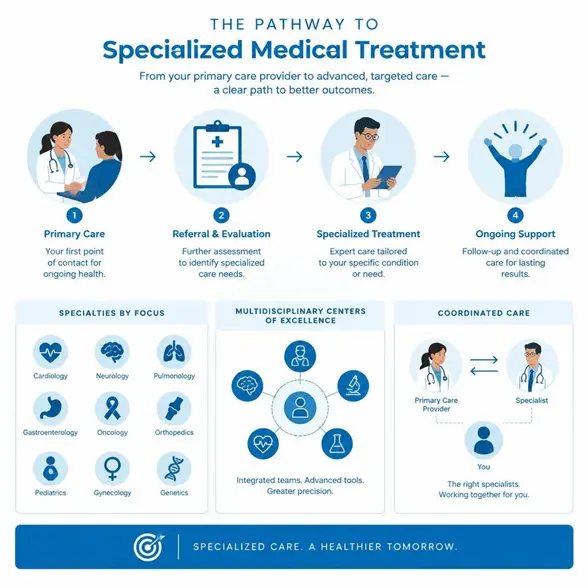
Medical specialization is a structured taxonomy designed to ensure that patients receive care from clinicians with the deepest possible knowledge in a specific domain. While primary care focuses on the “whole person” and preventive health, specialized medical treatments are categorized by organ systems, patient age groups, and specific diagnostic or therapeutic techniques.
Defining Specialty Care Across Clinical Disciplines
Specialists undergo years of additional training—often through fellowships—beyond their general residency. This allows them to obtain board certification in subspecialties like pediatric cardiology, surgical oncology, or interventional neurology.
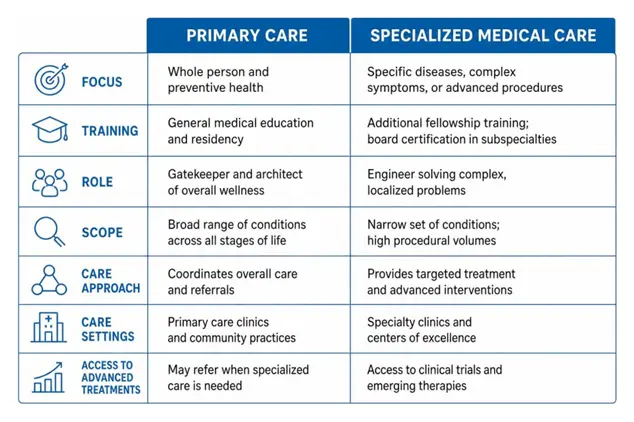
While primary care physicians act as the gatekeepers and architects of your overall wellness, specialists serve as the engineers who solve complex, localized problems. As shown in the table above, the primary distinction lies in the depth of focus; a specialist’s practice is often limited to a narrow set of conditions, allowing them to maintain high procedural volumes and stay at the forefront of clinical research.
Multidisciplinary Centers and Specialized Healthcare Facilities
For patients dealing with multifaceted illnesses, a single specialist may not be enough. This is where “Centers of Excellence” become vital. These facilities, often housed within academic medical centers, bring together multidisciplinary teams—surgeons, radiologists, pathologists, and nurses—to treat a condition from every angle. Whether it is a comprehensive stroke center or an advanced cancer institute, these facilities offer access to clinical trials and emerging therapies that are not available in standard community clinics.
Clinical Modalities and Advanced Targeted Therapies
Modern medicine is moving away from a “one-size-fits-all” approach. We are seeing a surge in targeted interventions that minimize systemic side effects while maximizing healing.
Breakthrough Innovations in Specialized Medical Treatments
The definition of “treatment” is expanding rapidly. For instance, interventional psychiatry is now using technologies like Transcranial Magnetic Stimulation (TMS) and esketamine therapy to provide relief for patients with treatment-resistant depression. Similarly, in the realm of blood-based therapies, therapeutic apheresis and photopheresis allow clinicians to remove or treat specific components of a patient’s blood to manage autoimmune and inflammatory disorders.
Innovation also extends to physical recovery. Many clinics are now integrating far infrared wound healing technology into their post-operative care plans, as this modality has shown promise in accelerating tissue repair and reducing inflammation in chronic wound patients. Furthermore, the rise of cell and gene therapies—often called “living medicines”—is providing durable, sometimes curative, options for monogenic disorders and certain cancers that were previously considered untreatable.
Organ-Specific and Procedural Interventions
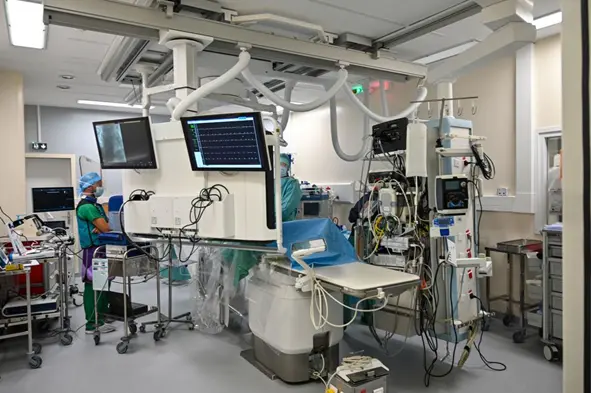
Procedural specialties remain the backbone of acute intervention. From the precision of robotic-assisted neurosurgery to the life-saving capabilities of interventional cardiology, these fields rely on high-tech diagnostic imaging to guide treatment. For patients suffering from complex urinary or reproductive health issues, seeking expert urology services is often the difference between managing symptoms and achieving a long-term resolution. These specialized services allow for minimally invasive techniques that significantly reduce recovery times compared to traditional open surgery.
Healthcare Delivery, Coordination, and Financial Impact
Advanced care is only effective if it is well-coordinated. Fragmented care, where the primary doctor and the specialist do not communicate, often leads to redundant testing and conflicting treatment advice.

Integrating Specialized Medical Treatments with Primary Care
Effective care coordination relies on the seamless exchange of information. Modern health systems are increasingly adopting co-management models, where specialists and primary care providers use shared electronic health records to track treatment goals. This is particularly crucial for geriatric patients with multiple chronic conditions, where a cardiologist or endocrinologist may, in practice, become the main physician. By aligning these roles, the medical team can ensure that a new medication prescribed by a specialist does not negatively interact with a patient’s existing regimen.
Navigating Insurance, Referrals, and Treatment Costs
The financial aspect of specialized care can be as complex as the medicine itself. Many insurance plans require a formal referral from a primary care physician to cover specialist visits. Additionally, the shift toward “value-based care” is leading to more bundled payment models, where a single fee covers an entire episode of care—such as a joint replacement or a series of cancer treatments. Before pursuing specialized treatment, it is critical to request a cost estimate and verify whether the facility is in-network. Engaging with a financial counselor at the hospital or clinic can often help clarify coverage criteria and identify potential out-of-pocket expenses.
Frequently Asked Questions About Specialized Medical Care
How do patients access specialized medical treatments?
Access usually begins with a consultation with your primary care physician. They will evaluate your symptoms and, if necessary, provide a referral to a specialist. In some cases, such as in emergency situations or with certain insurance plans, you may be able to self-refer, but a primary care referral is generally recommended to ensure the specialist has all your relevant medical history.
How does specialized care differ from primary care?
Primary care is broad and focuses on preventive health, acute minor illnesses, and long-term management of common chronic conditions. Specialized care is narrow and intense; it is focused on specific organs, systems, or complex diseases that require specialized equipment, advanced training, or surgical intervention.
What criteria should guide the selection of a specialist or center of excellence?
When choosing a specialist, consider their board certification, their years of experience, and the volume of cases they handle similar to yours. If you are seeking care at a center of excellence, check their accreditation status and whether they participate in clinical research. A high volume of procedures in a specific area is often a strong indicator of expertise and better patient outcomes.
Conclusion
The journey through specialized medical care is a collaborative process. By understanding the taxonomy of specialties, leveraging multidisciplinary teams, and ensuring that your primary care provider is an active participant in your treatment plan, you can navigate the healthcare system with greater confidence. Whether you are exploring far infrared wound healing technology for a chronic injury or seeking expert urology services for a specific condition, the goal remains the same: to access the most precise, evidence-based care available. We encourage you to be an active advocate for your health, ask detailed questions, and prioritize coordinated care to achieve the best possible outcomes.
Also Read