

Should you write never mind or nevermind? The forms sound identical, and texts, titles, and social posts often join the words.
In most sentences, never mind is correct. Use the two-word phrase when you mean “do not worry,” “disregard that,” or “let alone.” Use nevermind mainly as a rare, informal noun meaning attention, concern, or business.
Modern online writers sometimes use nevermind for “forget it.” However, careful American writing still favors never mind for that meaning. Merriam-Webster treats never mind as the usual phrase and nevermind as a dialectal noun.
Quick Answer
- Choose never mind in almost every everyday sentence.
- ✅ Never mind—I found my keys.
- ✅ Never mind the delay; we still have time.
- ✅ I can barely walk that far, never mind run.
- ❌ Nevermind—I found my keys.
- Better: Never mind—I found my keys.
- Use nevermind only when it works as a noun:
- ✅ Pay that rumor no nevermind.
- Remember one rule: When the phrase means “forget it” or “do not worry,” write two words.
Why People Confuse Them
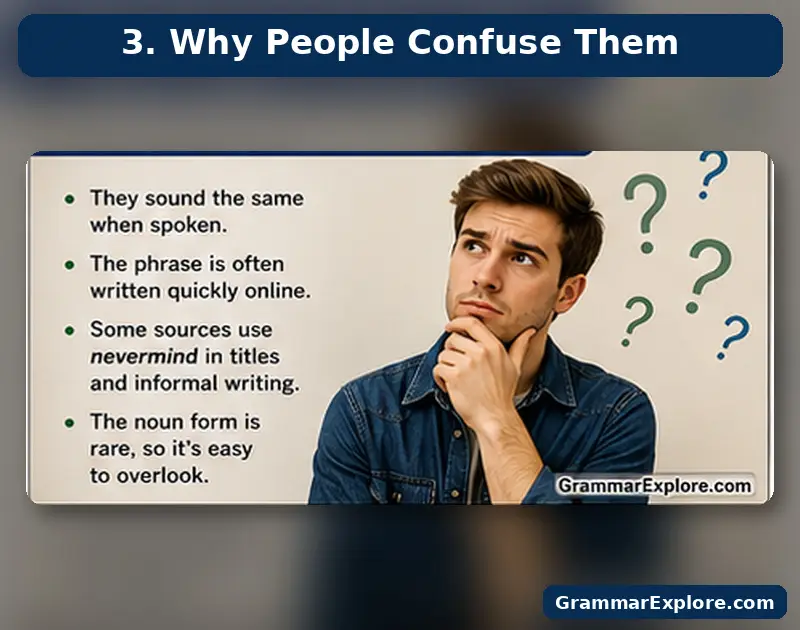
English compounds sometimes move from two words to one. Because that change affects words such as any time and anytime, many people assume never mind has fully become nevermind.
Digital communication adds confusion. People type quickly, remove spaces, and use nvm in texts. The one-word form also looks natural because speakers pronounce the phrase as one smooth unit.
Proper titles may use Nevermind, but a title’s chosen spelling does not control ordinary grammar.
Key Differences at a Glance
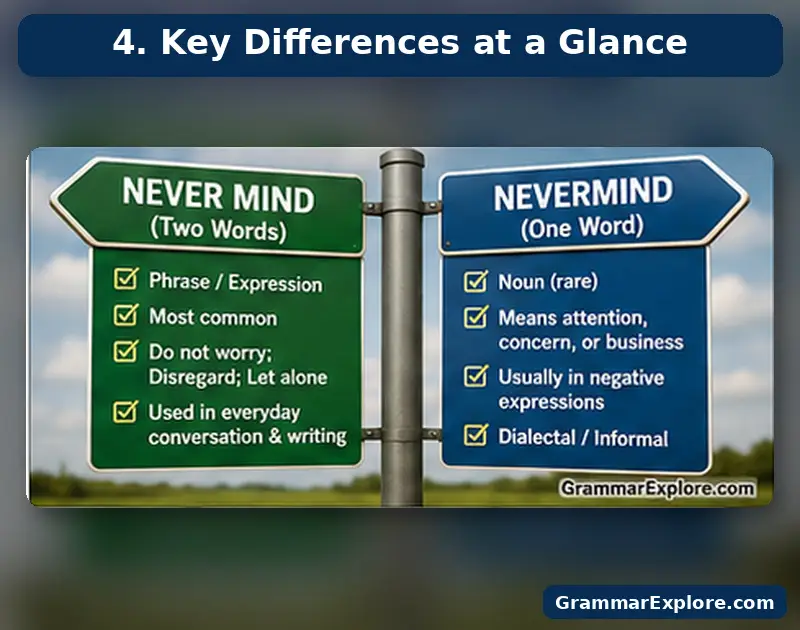
| Context | Best Choice | Why |
|---|---|---|
| Telling someone not to worry | Never mind | The standard phrase carries this meaning |
| Withdrawing a comment | Never mind | It means “disregard what I said” |
| Meaning “let alone” | Never mind | The phrase introduces a less likely idea |
| Formal or academic writing | Never mind | Standard references favor the open form |
| Casual messages | Never mind | It remains safest, though nevermind appears online |
| Meaning concern or attention as a noun | Nevermind | The closed form can serve as a rare noun |
| Official title | Follow its official spelling | Creators control titles and names |
| Feature | Never Mind | Nevermind |
|---|---|---|
| Usual form | Two-word phrase | One-word noun |
| Main meaning | Do not worry; disregard it; let alone | Concern, attention, or business |
| Grammar role | Idiom, command, or linking expression | Noun |
| Formal writing | Standard and preferred | Rare and usually unsuitable |
| Casual writing | Correct and common | Common online but often nonstandard |
| Example | Never mind—I fixed it. | Pay him no nevermind. |
| Recommendation | Use in most cases | Use only in limited contexts |
Meaning and Usage Difference
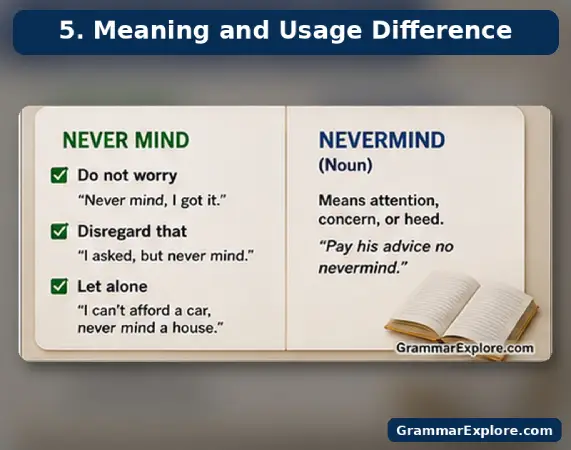
Never Mind as “Do Not Worry”
Use never mind to reassure someone after a mistake, apology, or problem.
- “I spilled some water.” “Never mind; I will wipe it up.”
- Never mind the typo. The meaning remains clear.
- Never mind about the missed call. I solved the issue.
Cambridge defines never mind as an idiom that tells someone not to worry because something lacks importance.
Never Mind as “Disregard That”
Use the phrase when you withdraw a request, question, or statement.
- Can you help me find the file? Never mind—I found it.
- I wanted to ask something, but never mind.
- Never mind what I said earlier.
This use asks the listener or reader to ignore the earlier idea.
Never Mind as “Let Alone”
Never mind can connect two actions when the second seems even less possible.
- I cannot afford a used car, never mind a new one.
- She can barely lift the box, never mind carry it upstairs.
- We lack time for lunch, never mind a long meeting.
Here, never mind works like let alone or much less. Merriam-Webster recognizes this conjunction-like use and also records the phrase as a command that tells someone to disregard something.
Nevermind as a Noun
The one-word nevermind can name concern, attention, heed, or business. Writers usually place it in negative expressions.
- Pay the criticism no nevermind.
- That decision is no nevermind of yours.
- The delay made no nevermind to him.
This noun sounds dialectal or old-fashioned. Merriam-Webster and Dictionary.com recognize it, but modern writers usually choose attention, concern, or business instead.
Online writers often use nevermind for “forget it,” and readers understand it. Still, school, business, academic, and edited writing should keep the space. Merriam-Webster notes growing closed-form use but still calls never mind the more common spelling.
Tone, Context, and Formality
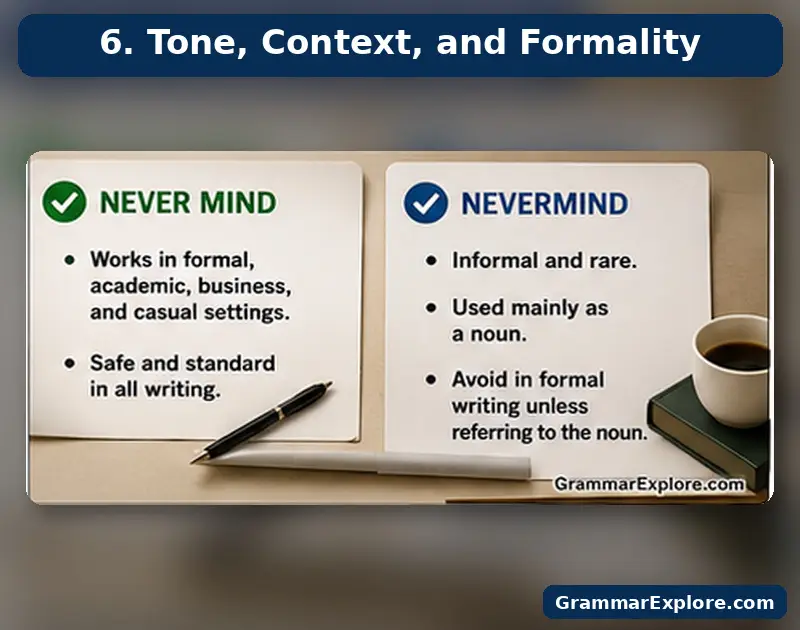
Formal and Academic Writing
Use never mind in formal prose. The two-word form follows established dictionary treatment and prevents confusion with the rare noun.
- The team could not complete the first phase, never mind the entire project.
- Many students cannot identify the theory, never mind apply it.
Academic writers may replace the phrase with let alone when they want a more formal tone.
Casual Writing
Never mind works naturally in messages and conversations.
- Never mind, I already ordered dinner.
- Oh, never mind. It does not matter now.
Some people write nevermind online, but that spelling may look careless to readers who expect standard spacing.
Business Writing
Business messages usually favor never mind or a direct replacement.
- Never mind my previous request; the supplier sent the invoice.
- Please disregard my previous request; the supplier sent the invoice.
The second version sounds more professional in a formal email.
American English Usage
American speakers commonly use never mind in speech and writing. They also use nevermind informally online, but standard dictionaries still treat the two-word phrase as the normal choice for reassurance, dismissal, and “let alone.”
Which One Should You Use?
Follow these rules:
- Write never mind when you mean “do not worry.”
- Choose never mind when you withdraw a request or comment.
- Use never mind when you mean “let alone.”
- Reserve nevermind for the rare noun meaning concern or attention.
- Keep an official title’s chosen spelling.
Easy Memory Trick
Think about the verb mind:
Never mind it.
Because mind still acts as its own word, keep a space before it.
For the noun, imagine one compact thing:
No nevermind
The one-word form names the concern or attention that someone refuses to give.
When One Choice Sounds Wrong
Reassuring Someone
❌ Nevermind, the mistake was small.
✅ Never mind, the mistake was small.
The sentence tells someone not to worry, so standard writing needs two words.
Withdrawing a Request
❌ Please send the file. Actually, nevermind.
✅ Please send the file. Actually, never mind.
The writer asks the reader to disregard the earlier request.
Meaning “Let Alone”
❌ I cannot cook pasta, nevermind prepare dinner.
✅ I cannot cook pasta, never mind prepare dinner.
The phrase connects a difficult action with an even less likely one.
Using the Noun
❌ Pay his rude comment no never mind.
✅ Pay his rude comment no nevermind.
Here, nevermind names the attention or concern someone should not give.
Writing a Formal Email
❌ Nevermind my last email.
✅ Never mind my last email.
✅ Please disregard my last email.
The final version creates the most professional tone.
Common Mistakes and Quick Fixes
Mistake 1: Closing the Phrase Everywhere
Incorrect: Nevermind, I solved the problem.
Correct: Never mind, I solved the problem.
Explanation: Use two words for “disregard that.”
Mistake 2: Assuming Nevermind Never Exists
Incorrect: Nevermind can never form a word.
Correct: Nevermind can work as a rare noun.
Explanation: The noun means concern, attention, heed, or business.
Mistake 3: Using Nevermind for “Let Alone”
Incorrect: He cannot read it, nevermind explain it.
Correct: He cannot read it, never mind explain it.
Explanation: Standard writing uses the open phrase here.
Mistake 4: Choosing Weak Business Wording
Incorrect: Never mind the contract changes.
Better: Please disregard the contract changes.
Explanation: Disregard may create a clearer professional tone.
Mistake 5: Adding a Hyphen
Incorrect: Never-mind, I found the answer.
Correct: Never mind, I found the answer.
Explanation: Standard writing normally uses two separate words.
Everyday Examples
School
Never mind the first question; start with number two.
Work
Never mind my earlier message; the meeting starts at three.
Home
Never mind the dishes. I will wash them later.
Business
The company cannot fund one location, never mind three.
Emails
Never mind my previous request. I found the document.
Social Media
Never mind, I answered my own question.
Everyday Conversations
“I forgot your pen.” “Never mind.”
Dictionary-Style Word Details
Verb
Never mind is not one single verb. It forms an imperative verbal phrase from never and the verb mind. The phrase tells someone to ignore, dismiss, or stop worrying about something.
Writers do not commonly use nevermind as a verb in standard English. People who use it for “disregard” usually follow informal online spelling.
Noun
Never mind does not normally function as a noun.
Nevermind can function as a rare, dialectal noun meaning attention, concern, heed, or business. It often follows no, as in “Pay it no nevermind.”
Synonyms
- For never mind meaning “do not worry”:
- Do not worry
- It does not matter
- That is okay
- Forget about it
- For never mind meaning “disregard that”:
- Ignore that
- Disregard that
- Forget what I said
- For never mind meaning “let alone”:
- Let alone
- Much less
- Not to mention
- For nevermind as a noun:
- Attention
- Concern
- Heed
- Business
Example Sentences
Never Mind
- Never mind the broken cup; nobody got hurt.
- Never mind, I found the missing receipt.
- She cannot drive a car, never mind a truck.
- Never mind what they said about the project.
- We cannot afford a short trip, never mind a long vacation.
- “I am sorry for the delay.” “Never mind.”
- Never mind about dinner; I already ate.
- He could not explain one step, never mind the whole process.
Nevermind
These noun examples sound rare or dialectal:
- Pay that complaint no nevermind.
- She paid the gossip no nevermind.
- The change made no nevermind to us.
- That issue is no nevermind of yours.
- We paid the heckling no nevermind and continued.
Modern standard prose usually sounds clearer with attention, concern, or business.
Word History
The phrase never mind has a long history. Merriam-Webster records its first known use in 1677. Speakers have used it to dismiss concern, withdraw a statement, or introduce a less likely possibility.
The noun nevermind developed much later from the phrase. Dictionary.com records the noun from 1930–35 and labels it an older American use.
Phrases Containing
Common expressions with never mind include:
- Never mind that
- Never mind about it
- Never mind what happened
- Never you mind
- Never mind, I found it
- Never mind, I will handle it
Expressions with nevermind include:
- Pay no nevermind
- Give no nevermind
- Make no nevermind
- No nevermind of yours
Quick Knowledge Check
1. Which form means “disregard what I said”?
A. Nevermind
B. Never mind
Answer: B
2. Which form can work as a rare noun?
A. Nevermind
B. Never mind
Answer: A
3. Which sentence uses standard spelling?
A. I cannot walk there, nevermind run.
B. I cannot walk there, never mind run.
Answer: B
4. Which version best fits a formal email?
A. Nevermind my last message.
B. Please disregard my last message.
Answer: B
Frequently Asked Questions
Is nevermind one word or two?
Write never mind as two words in most sentences. Use it for “do not worry,” “disregard that,” or “let alone.” Reserve nevermind for a rare noun.
Can I write nevermind in a text?
Readers will understand nevermind in a casual text. However, never mind still follows standard spelling and creates cleaner writing.
Does never mind need a comma?
A comma often follows the phrase before a new thought: “Never mind, I found it.” A period or dash can create stronger separation.
What does pay no nevermind mean?
The expression means “give no attention or concern.” It sounds dialectal or old-fashioned, so modern formal writing usually prefers “pay no attention.”
Is nevermind acceptable in formal writing?
Use never mind for the common phrase. Use nevermind only when discussing the rare noun, quoting dialect, or reproducing an official title.
What abbreviation means never mind?
People often write nvm or nm in texts and online chats. Avoid these abbreviations in academic, business, and formal documents.
Conclusion
Use never mind in almost every ordinary sentence. The phrase can mean “do not worry,” “disregard that,” or “let alone.”
Use nevermind only as a rare noun meaning attention, concern, or business. Informal writers may join the words online, but edited American English still favors the space.
Remember: When mind acts like a verb, give it space. Choose never mind for normal writing and reserve nevermind for its limited noun use.