

Should you say someone sneaked out or snuck out? Both expressions sound familiar, so many writers struggle to choose between them.
Fortunately, you can use either form in modern American English. Sneaked and snuck both serve as the simple past and past participle of sneak.
However, the two forms create slightly different tones. Sneaked follows the regular -ed pattern and often sounds more traditional. Snuck follows an irregular pattern and often sounds more natural in casual American speech.
Major dictionaries list both forms as standard. Therefore, your audience, context, and preferred tone should guide your choice. er
Use sneaked or snuck when you describe a past action involving secret, quiet, or unnoticed movement.
- ✅ She sneaked out through the back door.
✅ She snuck out through the back door.
- ✅ Someone has sneaked a note into my bag.
- ✅ Someone has snuck a note into my bag.
- ❌ Someone has sneak a note into my bag.
Both correct forms express the same meaning. Choose sneaked for traditional or formal writing. Choose snuck for natural, conversational American English.
Why People Confuse Them
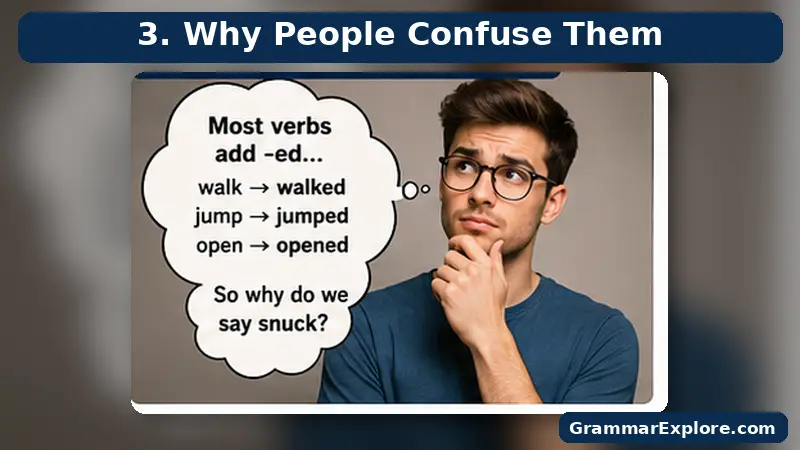
Most English verbs form the simple past by adding -ed. For example, walk becomes walked, jump becomes jumped, and open becomes opened.
Following that pattern, sneak naturally becomes sneaked.
However, American speakers later developed snuck as an irregular form. This form resembles other irregular pairs, such as stick and stuck or strike and struck. English does not always follow predictable patterns, so both forms now exist.
Older grammar lessons also cause confusion. Some teachers and editors once rejected snuck because sneaked came first. Modern dictionaries now accept snuck as a standard form, especially in American English. hear snuck often in movies, conversations, and stories. As a result, snuck may sound more natural even when a writer expects the regular -ed ending.
Key Differences at a Glance
| Context | Best Choice | Why |
|---|---|---|
| Everyday American speech | Snuck | It sounds natural and conversational |
| Formal documents | Sneaked | It creates a more traditional tone |
| School assignments | Sneaked | It offers the safest conservative choice |
| General American writing | Either | Both forms follow standard usage |
| Fictional dialogue | Snuck | It often matches natural speech |
| International writing | Sneaked | More readers recognize it as the traditional form |
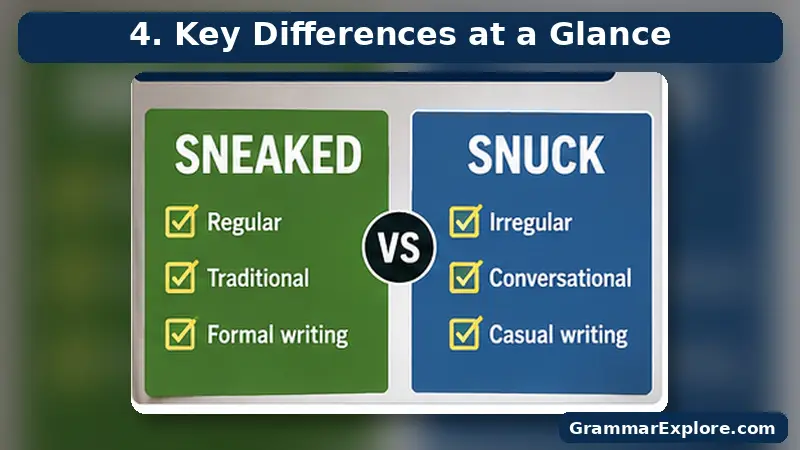
| Feature | Sneaked | Snuck |
|---|---|---|
| Verb pattern | Regular | Irregular |
| Simple past | Correct | Correct |
| Past participle | Correct | Correct |
| Meaning | Acted or moved secretly | Acted or moved secretly |
| Tone | Traditional and neutral | Casual and conversational |
| American English | Standard | Standard and common |
| Formal writing | Often preferred | Acceptable but less traditional |
| Pronunciation | Rhymes with “peeked” | Rhymes with “stuck” |
Meaning and Usage Difference
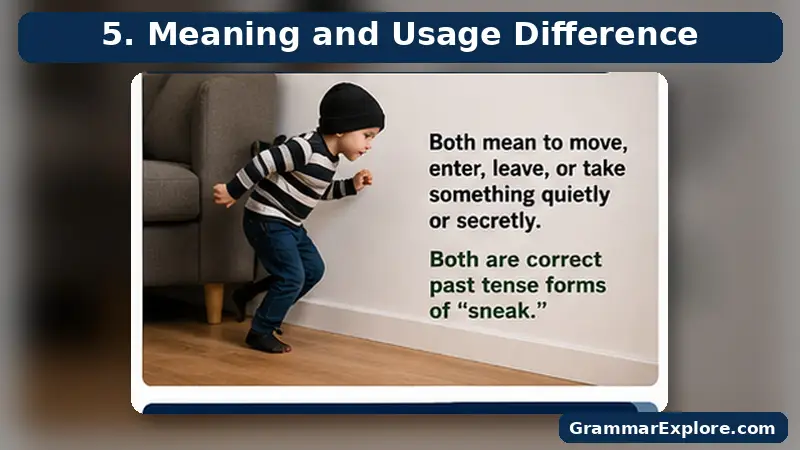
The verb sneak means to move, enter, leave, take, place, or view something quietly or secretly. People usually sneak because they want to avoid attention.
Both sneaked and snuck describe that same action in the past.
Consider these examples:
- Noah sneaked into the kitchen.
- Noah snuck into the kitchen.
- Mia sneaked a cookie from the jar.
- Mia snuck a cookie from the jar.
Each pair communicates the same basic meaning. The form changes, but the action does not.
How Sneaked Works
Sneaked follows the regular English verb pattern:
- Present: I sneak outside.
- Simple past: I sneaked outside.
- Past participle: I have sneaked outside.
Writers often choose sneaked because its -ed ending clearly signals the past tense.
How Snuck Works
Snuck follows an irregular pattern:
- Present: I sneak outside.
- Simple past: I snuck outside.
- Past participle: I have snuck outside.
Cambridge lists both sneaked and snuck as past-tense and past-participle forms of sneak. Merriam-Webster also calls snuck standard and very common. tion
Pronounce sneaked as “sneekt.” It rhymes with peeked and leaked.
Pronounce snuck as “snuk.” It rhymes with stuck and luck.
The different sounds may affect your choice. Snuck often creates a shorter, more relaxed rhythm, while sneaked can sound more deliberate.
Tone, Context, and Formality
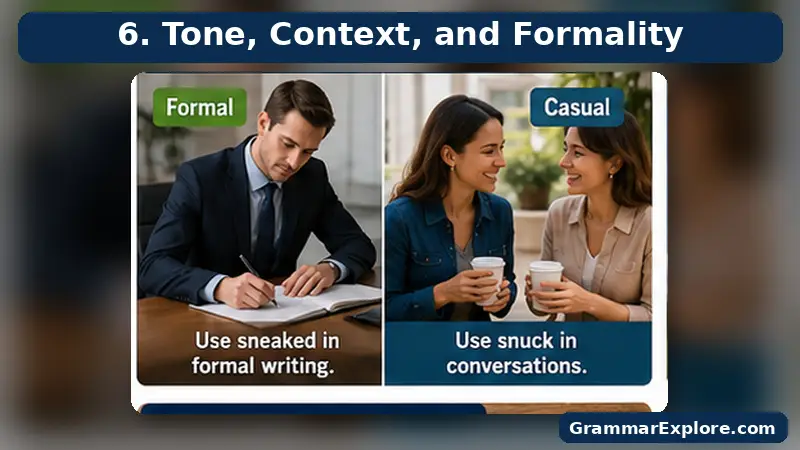
Your audience should guide your decision.
Formal Writing
Choose sneaked when you want a traditional and careful tone. It works well in reports, academic papers, official statements, and formal correspondence.
Example:
- The employee sneaked confidential papers out of the office.
This sentence sounds neutral and controlled.
Casual Writing
Choose snuck in friendly messages, personal stories, informal articles, and relaxed conversations.
Example:
- We snuck out for coffee during lunch.
The sentence sounds natural and conversational.
Academic Writing
Academic writers can use either form because both forms follow standard grammar. However, sneaked may prevent unnecessary objections from strict teachers, editors, or readers.
Example:
- The researcher sneaked an unsupported claim into the final paragraph.
Business Writing
Business writers usually benefit from clear, neutral language. Sneaked often fits that goal, but snuck can work in informal workplace communication.
Formal report:
- An incorrect figure sneaked into the final invoice.
Team message:
- A formatting error snuck into the presentation.
American English
American speakers commonly use snuck in everyday speech. Sneaked also remains fully correct and common.
British speakers traditionally favor sneaked, though some also use snuck. Cambridge marks snuck as mainly American in one of its entries. Should You Use?
Use these simple rules:
- Choose sneaked for formal, traditional, or conservative writing.
- Choose snuck for relaxed American speech and informal writing.
- Follow your teacher’s or editor’s preferred style.
- Keep your chosen form consistent throughout one passage.
- Use either form after has, have, or had.
For example:
- She has sneaked out before.
- She has snuck out before.
Both sentences follow correct grammar.
Easy Memory Trick
Remember this connection:
Sneaked contains -ed, so it suits edited writing.
Snuck rhymes with stuck, so it suits relaxed speech.
This memory trick does not create a strict rule. It simply helps you match each form with its most common tone.
When One Choice Sounds Wrong
Neither word automatically sounds wrong. However, the surrounding grammar can create an error.
Using the Base Form After Has
❌ She has sneak out twice.
✅ She has sneaked out twice.
✅ She has snuck out twice.
Use a past participle after has, have, or had.
Using Snuck After Did
❌ Did you snuck into the room?
✅ Did you sneak into the room?
The helping verb did already marks the past tense. Therefore, use the base form sneak after did.
Adding -ed to Snuck
❌ The dog snucked into the bedroom.
✅ The dog snuck into the bedroom.
Never add -ed to snuck. Snuck already expresses a past action.
Using the Present Form for a Past Event
❌ Yesterday, Leo sneaks into the theater.
✅ Yesterday, Leo sneaked into the theater.
✅ Yesterday, Leo snuck into the theater.
The time word yesterday requires a past-tense verb.
Choosing an Unsuitable Tone
A formal legal report could say:
- The suspect sneaked through the unlocked entrance.
The sentence “The suspect snuck through the unlocked entrance” also follows correct grammar. However, sneaked may better match the formal context.
Common Mistakes and Quick Fixes
Mistake 1: Treating Snuck as a Misspelling
Incorrect: Snuck never counts as correct English.
Correct: Major dictionaries accept snuck in standard American English.
Explanation: American speakers have used snuck for generations, and modern dictionaries list it as a correct past form.
Mistake 2: Writing Snucked
Incorrect: Jason snucked out after midnight.
Correct: Jason snuck out after midnight.
Explanation: Snuck already acts as the past form, so it does not need an additional ending.
Mistake 3: Using Sneak After Has
Incorrect: The cat has sneak into the garage.
Correct: The cat has sneaked into the garage.
Correct: The cat has snuck into the garage.
Explanation: Has requires a past participle.
Mistake 4: Using Snuck After Did
Incorrect: Did Maria snuck into the meeting?
Correct: Did Maria sneak into the meeting?
Explanation: Use the base verb after did.
Mistake 5: Giving the Forms Different Meanings
Incorrect: Sneaked describes quiet movement, but snuck describes secret movement.
Correct: Both forms can describe quiet or secret actions.
Explanation: Tone and preference separate the forms, not meaning.
Mistake 6: Switching Forms Without a Reason
Incorrect: He sneaked through the gate and then snuck behind the building.
Better: He sneaked through the gate and then sneaked behind the building.
Better: He snuck through the gate and then snuck behind the building.
Explanation: Consistent wording creates smoother prose unless dialogue or context requires a change.
Everyday Examples
School
- Emma sneaked a look at the answer key.
- The student snuck into class after the bell.
- A spelling mistake sneaked into the essay.
Work
- Ryan sneaked out before the meeting ended.
- A calculation error snuck into the report.
- The manager sneaked a quick glance at her phone.
Home
- The cat sneaked under the couch.
- Ben snuck a snack before dinner.
- The children sneaked downstairs after bedtime.
Business
- An outdated price sneaked into the new catalog.
- A typo snuck into the client proposal.
- Someone sneaked an extra charge onto the invoice.
Emails
- An incorrect date sneaked into my previous email.
- A broken link snuck into the newsletter.
- I sneaked a quick reminder into the final paragraph.
Social Media
- We snuck away for a weekend trip.
- My dog sneaked into the family photo.
- This old picture snuck into my camera roll.
Everyday Conversations
- “Who snuck into my room?”
- “I sneaked out without waking anyone.”
- “A bird snuck through the open window.”
- “She sneaked a gift into his backpack.”
Dictionary-Style Word Details
Verb
Sneaked functions as the regular simple-past and past-participle form of sneak.
Examples:
- He sneaked inside.
- He has sneaked inside before.
Snuck functions as an irregular simple-past and past-participle form of sneak.
Examples:
- He snuck inside.
- He has snuck inside before.
Major dictionaries accept both forms in American English. ters do not commonly use sneaked as a noun in standard English.
Writers also do not commonly use snuck as a noun.
The base word sneak can function as a noun. It can describe a secretive or dishonest person.
Example:
- Everyone considered him a sneak.
Synonyms
Depending on the sentence, you can replace sneaked or snuck with:
- Crept
- Slipped
- Tiptoed
- Moved quietly
- Entered secretly
- Left secretly
- Smuggled
- Stole
Choose carefully because these words do not always express the same action. For example, tiptoed describes a way of walking, while smuggled describes secretly moving a person or object.
Example Sentences
Examples with Sneaked
- Olivia sneaked out before sunrise.
- The fox sneaked toward the fence.
- I sneaked a glance at the clock.
- Someone sneaked a letter under the door.
- Caleb sneaked another cookie from the plate.
- The children sneaked past the sleeping dog.
- A factual error sneaked into the article.
- She has sneaked into that room before.
Examples with Snuck
- Olivia snuck out before sunrise.
- The fox snuck toward the fence.
- I snuck a glance at the clock.
- Someone snuck a letter under the door.
- A factual error snuck into the article.
Word History
English speakers first used sneaked as the regular past form of sneak. American speakers began using snuck during the late 1800s.
Over time, snuck gained popularity and entered standard American English. Merriam-Webster now describes it as very common and standard. not identify one certain reason for the change. Similar irregular verbs, such as stick and stuck, may have influenced speakers. However, writers should avoid presenting that explanation as a proven fact.
Phrases Containing
Common expressions with sneaked include:
- Sneaked out
- Sneaked in
- Sneaked away
- Sneaked past
- Sneaked up on
- Sneaked a look
- Sneaked a note inside
Common expressions with snuck include:
- Snuck out
- Snuck in
- Snuck away
- Snuck past
- Snuck up on
- Snuck a look
- Snuck a note inside
Both forms work in the same verb phrases because they express the same meaning.
Frequently Asked Questions
Is snuck a real word?
Yes. Major dictionaries accept snuck as a correct past form of sneak.
Does sneaked sound more formal?
Yes. Sneaked often creates a more traditional and formal tone.
Can I say has snuck?
Yes. Snuck works after has, have, and had as a past participle.
Which form do Americans prefer?
Many Americans use snuck in speech, while formal writing often favors sneaked.
Should students use sneaked or snuck?
Students can use either form, but sneaked offers the safest formal choice.
Do both forms mean the same thing?
Yes. Both forms describe a past secret, quiet, or unnoticed action.Do both forms mean the same thing?
Conclusion
Sneaked and snuck both serve as correct past forms of sneak. They express the same meaning, but they often create different tones.
Choose sneaked when you want traditional, neutral, or formal wording. Choose snuck when you want natural and conversational American English.
Remember the simple memory tip: sneaked suits edited writing, while snuck rhymes with stuck and suits relaxed speech.
You do not need to avoid either form. Choose the one that fits your audience, follow the correct verb structure, and use your choice consistently.