
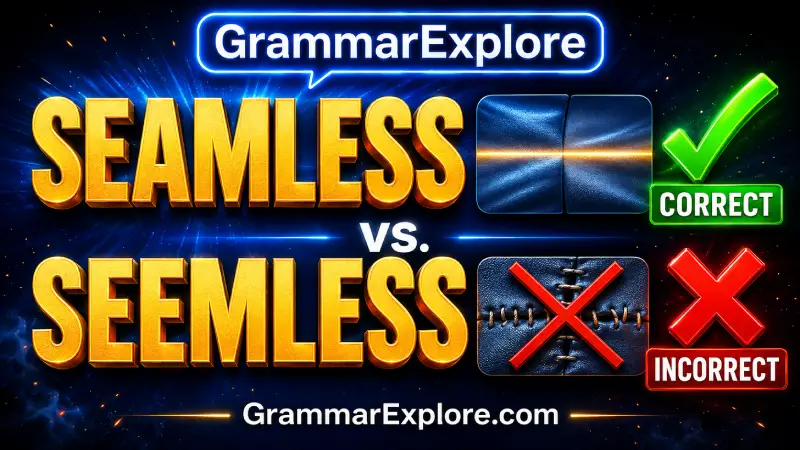
Seamless vs seemless has one clear answer: seamless is the correct standard spelling. Seemless is usually a misspelling caused by confusion between the nouns seam and the verb seem. Although the two forms would sound alike, only seamless has an established meaning in modern English.
Literally, seamless describes clothing, fabric, pipes, or other objects made without visible seams or joins. Figuratively, it describes a process, transition, experience, or combination that happens smoothly, without noticeable interruptions or awkward changes.
For example, a company may offer a seamless checkout experience, while a garment may feature seamless construction. The word comes from seam + less, meaning “without a seam.” It does not come from seem. For school assignments, business content, product descriptions, and everyday American English, always choose seamless.
Quick Answer
Seamless is the correct spelling. It means “without seams” or, figuratively, “smooth and without noticeable interruptions.”
- The app provides a seamless checkout process.
- She bought a seamless shirt.
Seemless is not a standard spelling. Remember: seam + less = seamless.
Is It Seemless or Seamless?
Seamless is the correct spelling. Seemless is a common misspelling and is not a standard English word. Use seamless in both formal and informal writing.
Examples:
- The software provides a seamless user experience.
- Their transition was seamless.
What Is the Meaning of Seamless?
Seamless means smooth, continuous, or without visible joins or interruptions. It can describe physical objects, processes, or experiences that work together effortlessly.
Examples:
- The app offers a seamless checkout process.
- The fabric has a seamless design.
Is “Seemless” a Word?
No. Seemless is not a standard English word. It is a spelling mistake. The correct spelling is seamless.
Examples:
- Correct: seamless
- Incorrect: seemless
Does “Seamless” Mean Perfect?
Not exactly. Seamless means smooth, uninterrupted, or well integrated. While a seamless process may seem nearly perfect, the word does not necessarily mean perfect.
Examples:
- The team achieved a seamless handover.
- The software update was seamless, with no interruptions.
Why People Confuse Them
Seam and seem are homophones. They sound the same but have different spellings and meanings:
- Seam: A line where two pieces join
- Seem: To appear or give an impression
Since seamless sounds like “seem-less,” writers may assume it relates to the verb seem. However, its literal meaning comes from having no seams.
The suffix -less means “without.” You can see the same pattern in:
- Care + less = careless
- Hope + less = hopeless
- Fear + less = fearless
- Seam + less = seamless
The meaning is therefore “without a seam,” not “without seeming.”
Figurative usage adds to the confusion. When people describe a seamless transition, they are not discussing actual stitching. They mean that the join between two stages feels smooth and difficult to notice.
Key Differences At A Glance
| Feature | Seamless | Seemless |
|---|---|---|
| Standard English word | Yes | No |
| Part of speech | Adjective | Not standard |
| Word formation | Seam + less | Based on confusion with seem |
| Literal meaning | Having no seams | No accepted standard meaning |
| Figurative meaning | Smooth and without interruption | No accepted standard meaning |
| Pronunciation | SEEM-luhs | Would sound the same |
| Best choice | Always use in normal writing | Avoid |
If the sentence means “smooth,” “continuous,” or “without visible joins,” choose seamless.
Meaning And Usage Difference
What Does Seamless Mean?
Seamless is an adjective with literal and figurative meanings.
Its literal meaning is “having no seams.” A seam is a line where two pieces of fabric, metal, or another material join.
- She wore seamless leggings.
- The company manufactures seamless steel pipes.
- This shirt uses seamless construction.
- The design creates a seamless surface.
Its figurative meaning describes something smooth, continuous, or free from noticeable transitions and interruptions.
- The team completed a seamless transition to the new system.
- The app creates a seamless shopping experience.
- Her presentation moved seamlessly from one topic to the next.
- The musicians produced a seamless blend of styles.
Both meanings share the same central idea: the connection points do not stand out.
What Does Seemless Mean?
Seemless is not a standard alternative spelling of seamless. It usually appears because someone connects the word incorrectly with seem.
Incorrect:
- The new system offers a seemless experience.
- We completed a seemless transition.
- She bought seemless socks.
Correct:
- The new system offers a seamless experience.
- We completed a seamless transition.
- She bought seamless socks.
A business, username, product, or creative project could intentionally use Seemless as a stylized proper name. In that case, preserve its official spelling. Such a name does not make lowercase seemless correct in general writing.
The Literal Meaning Of Seamless
The literal meaning appears in clothing, manufacturing, construction, and engineering.
Clothing And Fabric
A seamless garment has no visible stitched joins or uses construction methods that reduce traditional seams.
- The athlete wore a seamless base layer.
- Seamless underwear may reduce visible lines.
- These socks have a seamless toe.
- The company sells seamless workout clothes.
A product described as seamless may still contain finishing points or specialized joins. In product writing, the term often means that the manufacturer minimized or removed conventional seams in key areas.
Pipes And Tubes
A seamless pipe or tube does not have a welded longitudinal seam.
- The factory produces seamless steel tubing.
- Engineers selected a seamless pipe for the project.
- The equipment uses high-pressure seamless tubes.
This technical meaning requires precision. Do not use seamless merely as promotional language if the product actually uses welded seams.
Design And Surfaces
Designers may describe a repeating pattern or uninterrupted surface as seamless.
- The artist created a seamless tile pattern.
- The flooring forms a seamless surface.
- The background image repeats in a seamless loop.
Here, viewers cannot easily detect where one section ends and another begins.
The Figurative Meaning Of Seamless
Modern English frequently uses seamless for experiences, transitions, integrations, and performances.
A Seamless Transition
A seamless transition moves smoothly from one stage, system, leader, or situation to another.
- The company planned a seamless transition to remote work.
- Careful preparation ensured a seamless transition between speakers.
- The new director promised a seamless transition of leadership.
The phrase does not mean that no work occurred. It means that users or observers noticed little disruption.
A Seamless Experience
Businesses often promise a seamless experience across websites, apps, stores, and customer service channels.
- Customers want a seamless experience on every device.
- The hotel provided a seamless check-in experience.
- The update made online ordering more seamless.
Because marketing content frequently uses this phrase, it can sound vague. Strong writing should explain what makes the experience smooth:
- Vague: Our service provides a seamless experience.
- Clearer: Customers can order, pay, and track delivery from one screen.
Seamless Integration
Seamless integration means that systems, features, styles, or ideas work together without obvious conflicts.
- The software allows seamless integration with the payment platform.
- The architect achieved a seamless integration of old and new materials.
- The film offers a seamless blend of animation and live action.
Use the phrase only when the connection truly feels smooth and requires little extra effort from the user.
Pronunciation
Pronounce seamless as:
SEEM-luhs
It contains two syllables, with stress on the first:
- SEAM
- less
The first syllable sounds exactly like seem, which explains the spelling confusion. However, the correct word uses seam because its meaning comes from a physical join.
Related words include:
- Seam
- Seamed
- Seamless
- Seamlessly
- Seamlessness
Tone, Context, And Formality
Seamless works in casual, professional, academic, technical, and promotional English.
Common contexts include:
- Fashion
- Manufacturing
- Engineering
- Software
- Customer service
- Business operations
- Music and film
- Interior design
- Leadership changes
- Healthcare coordination
The word sounds neutral when it carries a literal meaning:
- The shirt has a seamless design.
In business and technology, it can sound promotional:
- We deliver a seamless digital experience.
Overuse can weaken the sentence. If you use seamless, explain the actual benefit whenever possible:
- General: The platform provides seamless communication.
- Specific: The platform keeps messages, files, and video calls in one workspace.
Seemless does not belong to a different level of formality. It remains a misspelling in normal English.
Which One Should You Use?
| Context | Best Choice | Why |
|---|---|---|
| Clothing without visible seams | Seamless | It comes from seam + less |
| A smooth business transition | Seamless | It means without disruption |
| Connected software systems | Seamless | It describes smooth integration |
| An uninterrupted customer experience | Seamless | It describes continuity |
| A repeating digital pattern | Seamless | The joins remain difficult to detect |
| Something that appears to be true | Seem | Use the verb, not seemless |
| A product officially named Seemless | Official spelling | Proper names may use creative spelling |
| General English writing | Seamless | Seemless is not standard |
Remember that seem requires a complement:
- The process seems smooth.
- The process provides a seamless experience.
When One Choice Sounds Wrong
Seemless looks wrong whenever a sentence describes smoothness, continuity, or the absence of joins.
Incorrect:
- The software offers a seemless setup process.
Correct:
- The software offers a seamless setup process.
Incorrect:
- We want a seemless transition.
Correct:
- We want a seamless transition.
Incorrect:
- She bought a seemless dress.
Correct:
- She bought a seamless dress.
The word seem can still appear naturally in related sentences:
- The transition seemed smooth.
- The experience seems seamless.
- The two sections seem to connect perfectly.
In these examples, seem acts as a verb. Seamless remains the adjective.
Common Mistakes And Quick Fixes
Using Seemless For Smooth
Incorrect:
- The checkout process was seemless.
Correct:
- The checkout process was seamless.
Confusing Seam And Seem
A seam is a line where materials join:
- The shirt’s seam came apart.
Seem means to appear:
- The shirt seems too large.
Seamless comes from the first word.
Spelling Seamlessly As Seemlessly
Incorrect:
- The system works seemlessly.
Correct:
- The system works seamlessly.
Keep seam in every related form:
- Seam
- Seamless
- Seamlessly
- Seamlessness
Using Seamless As An Adverb
Incorrect:
- The systems work seamless together.
Correct:
- The systems work seamlessly together.
Use seamless before a noun or after a linking verb:
- The systems provide a seamless connection.
- The connection feels seamless.
Use seamlessly to modify an action:
- The systems connect seamlessly.
Overusing Seamless In Marketing
Repetitive:
- Our seamless platform offers seamless payments and seamless communication for a seamless experience.
Improved:
- Our platform combines payments, messaging, and account management in one clear dashboard.
Use the word only where it adds meaningful information.
Claiming Seamless Always Means Perfect
Seamless can suggest a flawless experience, but its central figurative meaning is “without noticeable interruptions or awkward transitions.” A process may feel seamless to users even though employees perform complicated work behind the scenes.
Everyday Examples
Examples With Literal Seamless
- She bought a pair of seamless leggings.
- The shirt has a seamless neckline.
- These socks feature a seamless toe.
- The factory manufactures seamless steel tubes.
- Designers created a seamless repeating pattern.
- The flooring gives the room a seamless appearance.
- A seamless backdrop covered the studio wall.
- The fabric creates a smooth, seamless finish.
Examples With Figurative Seamless
- The company completed a seamless leadership transition.
- Online check-in made our arrival seamless.
- The update provides a more seamless user experience.
- The actors created a seamless performance.
- Her speech moved seamlessly between personal stories and research.
- The new feature integrates seamlessly with the existing app.
- The editor created a seamless flow between chapters.
- Both departments worked together seamlessly.
- The musicians produced a seamless blend of styles.
- Good planning made the move feel seamless.
Correcting Seemless
- Incorrect: The app works seemlessly.
Correct: The app works seamlessly. - Incorrect: We need a seemless transition.
Correct: We need a seamless transition. - Incorrect: The design looks seemless.
Correct: The design looks seamless. - Incorrect: She wore a seemless top.
Correct: She wore a seamless top.
Dictionary-Style Word Details
Verb
- Seamless: Not used as a verb. It functions as an adjective.
- Seemless: Not a standard verb or adjective.
The related verb seem means to appear:
- The process seems simple.
- She seemed confident.
The related verb seam can mean to join with a seam, though everyday writing uses it less often:
- Workers seamed the fabric panels together.
Noun
- Seamless: Not commonly used as a noun.
- Seemless: Not used as a standard noun.
The related noun is seam:
- The jacket has a torn seam.
- Inspect each seam before wearing the garment.
The abstract noun is seamlessness:
- Users appreciated the seamlessness of the checkout process.
Although correct, seamlessness can sound heavy. A clearer phrase may work better:
- Users appreciated the smooth checkout process.
Synonyms
Literal alternatives for seamless include:
- Unseamed
- Without seams
- Continuous
- Unbroken
- Joint-free, in some technical contexts
Figurative alternatives include:
- Smooth
- Effortless
- Uninterrupted
- Continuous
- Fluid
- Flawless
- Integrated
- Cohesive
These words do not fit every context. Effortless suggests little effort, while seamless often means that the user notices no difficulty. Complex work can create a seamless result without being effortless for the people who produce it.
Possible opposites include:
- Seamed, for the literal meaning
- Interrupted
- Disconnected
- Awkward
- Uneven
- Fragmented
- Disjointed
Example Sentences
Seamless:
- The garment uses seamless construction.
- The transfer between systems felt seamless.
- Both applications work seamlessly together.
- The editor created a seamless narrative.
Seemless:
Do not use this spelling in standard sentences:
- Incorrect: The transition was seemless.
- Correct: The transition was seamless.
Word History
Seamless combines seam with the suffix -less, meaning “without.” Its original literal meaning described something without physical seams.
The word later developed a figurative meaning. A process or transition became seamless when people could not easily notice where one stage ended and another began.
Seemless did not develop as a standard alternative. It usually results from confusion with the verb seem.
Phrases Containing
Common phrases with seamless include:
- Seamless transition
- Seamless experience
- Seamless integration
- Seamless connection
- Seamless design
- Seamless construction
- Seamless pattern
- Seamless workflow
- Seamless process
- Seamless communication
- Seamless transfer
- Seamless collaboration
- Seamless garment
- Seamless steel pipe
- Work seamlessly
Standard English does not use seemless in these phrases.
How To Remember Seamless vs Seemless
Think about a visible seam in a shirt. When the shirt has no seam, it is seamless.
The word breaks into two meaningful parts:
SEAM + LESS = SEAMLESS
Use this sentence as a memory aid:
A seamless shirt has no seam.
If you mean that something appears a certain way, use seem separately:
- The shirt seems comfortable.
- The shirt has a seamless design.
Frequently Asked Questions
Is it seamless or seemless?
Seamless is the correct standard spelling. Seemless is a common misspelling.
What does seamless mean?
Literally, seamless means having no seams. Figuratively, it describes something smooth, continuous, or free from noticeable interruptions.
Why is seamless spelled with ea?
The word comes from the noun seam, meaning a line where two pieces join, plus -less, meaning without. Therefore, seamless means “without seams.”
Is seemless ever correct?
It may appear in an intentionally styled brand, username, or proper name. It is not correct as an ordinary alternative to seamless.
Is it seamless or seemless transition?
The correct phrase is seamless transition:
- Careful planning created a seamless transition.
Is seamless an adjective or adverb?
Seamless is an adjective. Its adverb form is seamlessly:
- The app provides a seamless experience.
- The app works seamlessly.
What is the opposite of seamless?
Depending on context, possible opposites include seamed, interrupted, disconnected, awkward, fragmented, and disjointed.
Can Seamless Mean Perfect?
It can suggest a flawless result, but it more precisely means smooth and without noticeable interruptions, joins, or awkward transitions.
Conclusion
Seamless is the correct spelling. It can literally describe something without seams or figuratively describe a smooth, uninterrupted process.
- The shirt has a seamless design.
- The company completed a seamless transition.
- Both systems work seamlessly together.
Seemless is not a standard alternative. It results from confusion with the verb seem.
Remember the simplest rule: Something without a seam is seamless.