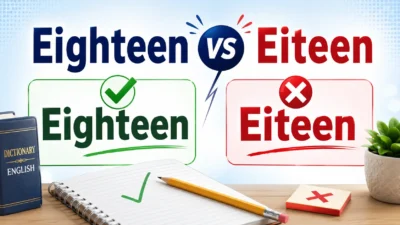
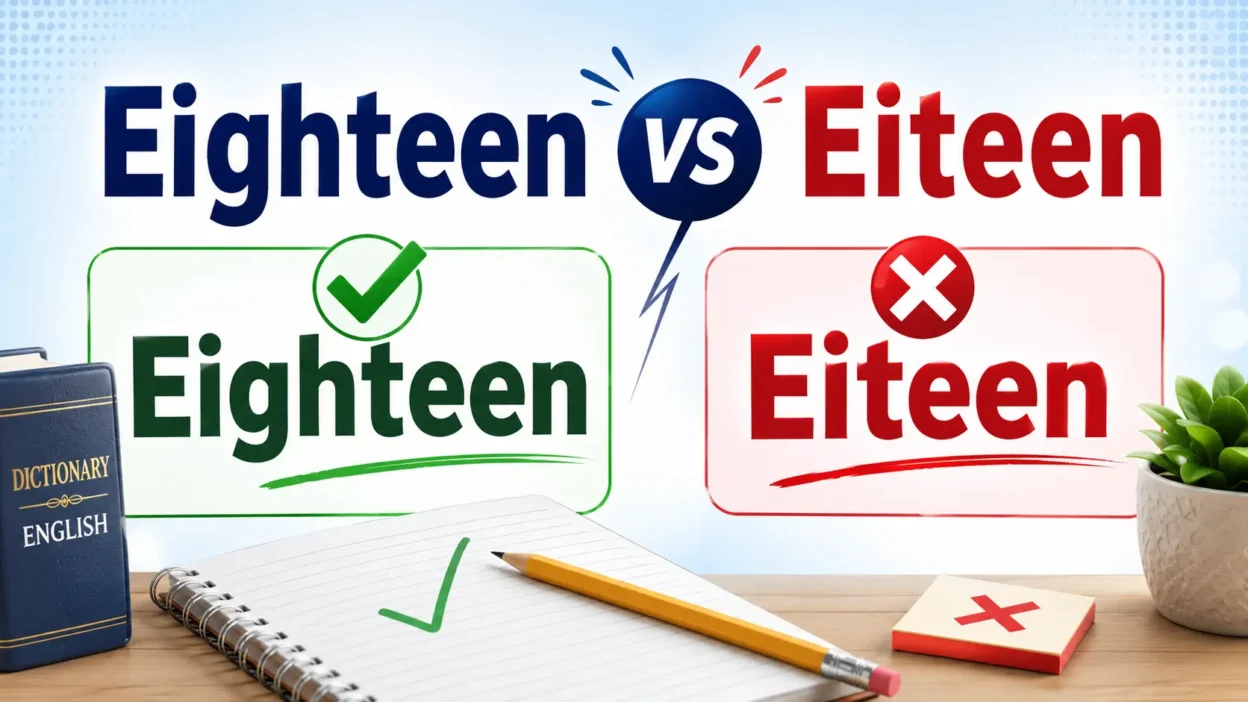
The confusion between “eighteen vs eiteen” is one of the most common spelling mistakes in English writing, especially among students and people writing quickly in daily communication.
At first glance, both forms look similar. They even sound the same when spoken. But only one of them is correct in standard English.
The correct spelling is “eighteen.”
The form “eiteen” is incorrect and not recognized in English.
This mistake is more than just a small typing issue. It shows how English spelling can be tricky when pronunciation, silent letters, and memory patterns all interact. Many learners understand the number 18 perfectly but still misspell the word when writing it.
This guide explains everything in detail so you never make this mistake again.
Quick Answer
- Correct spelling: eighteen
- Incorrect spelling: eiteen
Meaning of “eighteen”:
- The number 18
- Age (18 years old)
- A quantity or position in order
Example:
✔ She is eighteen years old.
❌ She is eiteen years old.
What “Eighteen” Actually Means
The word “eighteen” is a number word used in English to represent the value 18.
It can refer to:
- Age: Someone who is 18 years old
- Quantity: A group of 18 items
- Order: Position number 18 in a list
Examples:
- He turned eighteen last week.
- There are eighteen students in the classroom.
- She ranked eighteenth in the competition.
The word is part of a structured system of number names in English.
Why People Confuse Eighteen and Eiteen
This spelling mistake happens for several natural reasons. It is not random—it comes from how the brain processes spoken language.
1. Pronunciation hides the spelling
We pronounce “eighteen” as “ay-teen.”
The pronunciation does not clearly reveal the full written structure, especially the “gh” part.
Because of this, many people forget or guess the spelling.
2. Silent letters create confusion
English often contains silent letters. In “eighteen,” the “gh” is silent.
When letters are not pronounced, learners often assume they are not written.
This leads to shortcuts like “eiteen.”
3. Fast writing and typing habits
When typing quickly, people tend to:
- Drop letters
- Swap letter order
- Rely on memory instead of structure
This increases the chance of missing the “gh” combination.
4. Pattern guessing from similar words
English has many “teen” number words:
- thirteen
- fourteen
- fifteen
- sixteen
- seventeen
- eighteen
- nineteen
Because most are simple to spell, learners assume “eighteen” follows a simpler pattern than it actually does.
5. Visual memory shortcuts
Instead of remembering full spelling, the brain stores a simplified version based on sound.
So “ay-teen” becomes something like “eiteen,” even though it is incorrect.
How English Number Words Work (13–19 System)
Understanding the system behind number words makes the spelling much easier.
Numbers from 13 to 19 all follow a pattern:
- thirteen
- fourteen
- fifteen
- sixteen
- seventeen
- eighteen
- nineteen
These words are built from:
base number + “teen”
“Teen” comes from an old English form meaning “ten added.”
So:
- eight + teen → eighteen
- seven + teen → seventeen
- six + teen → sixteen
However, spelling is not always simple or fully predictable. Some words preserve older spelling forms, which is why “eighteen” includes the “gh” from “eight.”
Breaking Down the Word “Eighteen”
Let’s simplify the structure:
- Eight → base number (8)
- Teen → indicates “ten plus”
So:
eight + teen = eighteen
The spelling keeps part of the original word “eight,” including the silent “gh.”
That is why we do NOT write it as:
❌ eiteen
❌ eigteen
❌ eitein
Only one form is correct:
✔ eighteen
Pronunciation vs Spelling
The pronunciation of “eighteen” is:
ay-teen
This is important because pronunciation can mislead learners.
In spoken English:
- The “gh” is silent
- The word sounds short and smooth
- The middle structure disappears
But in writing, English keeps historical spelling patterns even when sounds change.
That mismatch is a major reason for mistakes.
Feature Comparison Table
| Feature | Eighteen | Eiteen |
|---|---|---|
| Correct English spelling | Yes | No |
| Recognized in dictionaries | Yes | No |
| Used in education | Yes | No |
| Used in formal writing | Yes | No |
| Meaning understood | Yes | No |
Where “Eighteen” Is Commonly Used
The word appears in many everyday contexts:
1. Age references
- She is eighteen years old.
- He turned eighteen last month.
2. School and education
- Eighteen students attended the class.
- You must be eighteen to enroll.
3. Money and numbers
- The price is eighteen dollars.
- Eighteen items were shipped.
4. Legal and official documents
- Applicants must be eighteen or older.
- The contract applies after age eighteen.
Why “Eiteen” Looks Wrong to Readers
Even if someone understands the meaning, “eiteen” immediately stands out as incorrect.
Why?
- It breaks English number patterns
- It removes the connection to “eight”
- It looks visually incomplete
- It is not supported by grammar rules
Fluent readers instantly recognize it as a mistake, even without thinking.
Common Mistakes and Fixes
Mistake 1: Dropping “gh”
❌ eiteen
✔ eighteen
Fix: Remember “eight” always includes “gh,” even if silent.
Mistake 2: Writing by sound
❌ ayteen → eiteen
✔ eighteen
Fix: English spelling is not fully phonetic.
Mistake 3: Over-simplifying structure
❌ treating it as “ei + teen”
✔ treating it as “eight + teen”
Mistake 4: Fast typing errors
❌ skipping letters in rush writing
✔ slow down when spelling number words
Memory Tricks That Actually Work
1. Break it into parts
Think:
eight + teen = eighteen
2. Link it to “eight”
If you know how to spell “eight,” you already know most of “eighteen.”
3. Visual pattern method
Remember:
- eight
- eighteen
- eighty
All share the same base.
4. Read it aloud slowly
Say:
eight – teen
This reinforces structure in memory.
Digital Writing and Autocorrect Behavior
Modern devices often help, but not always.
- Spell-check flags “eiteen” as incorrect
- Autocorrect may not fix it if typed too quickly
- Voice-to-text can sometimes misinterpret numbers
This means learners still need to know the correct spelling, not rely fully on tools.
Proofreading Tips
Before submitting any writing:
- Check number words carefully
- Look specifically at “teen” numbers
- Re-read sentences with ages and quantities
- Use slow scanning for silent letter mistakes
Even experienced writers sometimes miss this error.
Practice Sentences
Correct:
- She is eighteen today.
- There are eighteen chairs in the room.
- He started working at eighteen.
- Eighteen people attended the event.
- The document requires applicants to be eighteen or older.
Incorrect:
- She is eiteen today.
- There are eiteen chairs.
- He started working at eiteen.
FAQ
Why is “eiteen” wrong?
Because it does not follow English spelling rules and removes the correct base word “eight.”
Is “eighteen” related to “eight”?
Yes. It is built from “eight + teen,” which is why the spelling keeps part of “eight.”
Why is “gh” in eighteen silent?
English spelling often preserves historical letters even when pronunciation changes over time.
Is “eiteen” ever used in any English dialect?
No. It is not used in any standard form of English.
What is the easiest way to remember the spelling?
Break it into parts: eight + teen = eighteen.
Conclusion
The difference between eighteen vs eiteen is simple but important.
- “Eighteen” is the only correct spelling in English
- “Eiteen” is a spelling error with no meaning or usage
Understanding how English number words are structured—especially the “eight + teen” system—makes this mistake easy to avoid.
Once you recognize the pattern, spelling “eighteen” correctly becomes automatic in both writing and speech.