

If you are unsure whether gauge or guage is the correct spelling, you are not alone. Many English writers confuse these two forms because the letter combination in gauge looks unusual and does not follow common spelling patterns.
The correct spelling is gauge. The word guage is a common misspelling and does not appear as a standard English word in American writing.
You will see gauge used in many situations, including measuring instruments, tools, ratings, and expressions such as “gauge interest” or “gauge the situation.” Whether you are writing a professional email, academic paper, business document, blog post, or social media update, choosing the correct spelling helps your writing look clear and polished.
In this guide, you will learn the difference between gauge vs guage, understand why people often misspell it, and discover simple examples to help you remember the correct usage.
If you often confuse unusual spelling patterns, you may also want to check out guarantee vs guarentee: which spelling is correct? to learn why some commonly misspelled words create confusion.
Quick Answer
| Context | Correct Choice | Reason |
|---|---|---|
| School assignments | Gauge | Standard spelling |
| Business writing | Gauge | Professional and correct |
| Academic writing | Gauge | Dictionary-approved form |
| Everyday communication | Gauge | Accepted English usage |
| Guage | Incorrect | Common misspelling |
Bottom line: Use gauge every time.
Why People Confuse Them
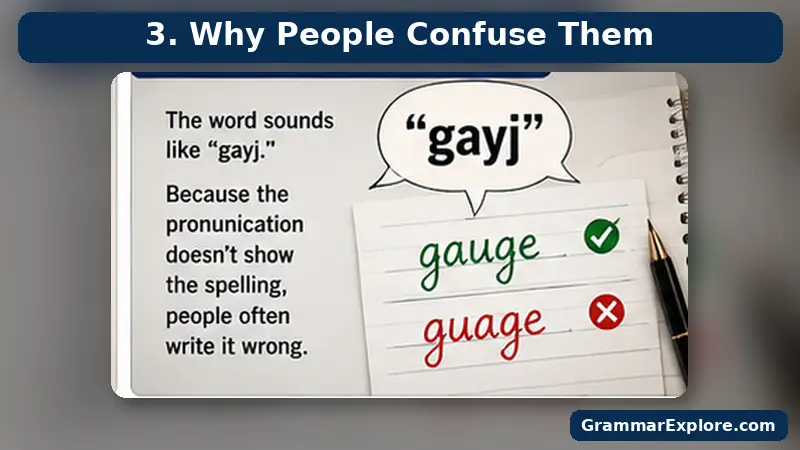
The confusion comes from spelling, not meaning.
Most people know how the word sounds, but they feel unsure about the correct letter order.
People pronounce the word like this:
“gayj”
Because the pronunciation does not clearly reveal the spelling, many writers mistakenly reverse the letters and write:
- guage ❌
instead of:
- gauge ✅
The error becomes even more common because people type quickly and rely on memory rather than visual recognition.
Key Differences At A Glance
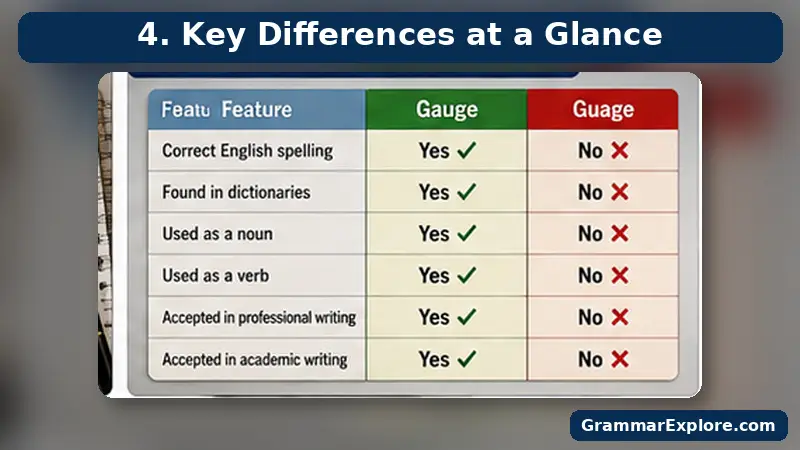
| Feature | Gauge | Guage |
|---|---|---|
| Correct English spelling | Yes | No |
| Found in dictionaries as a standard word | Yes | No |
| Used as a noun | Yes | No |
| Used as a verb | Yes | No |
| Accepted in professional writing | Yes | No |
| Accepted in academic writing | Yes | No |
Meaning And Usage Difference
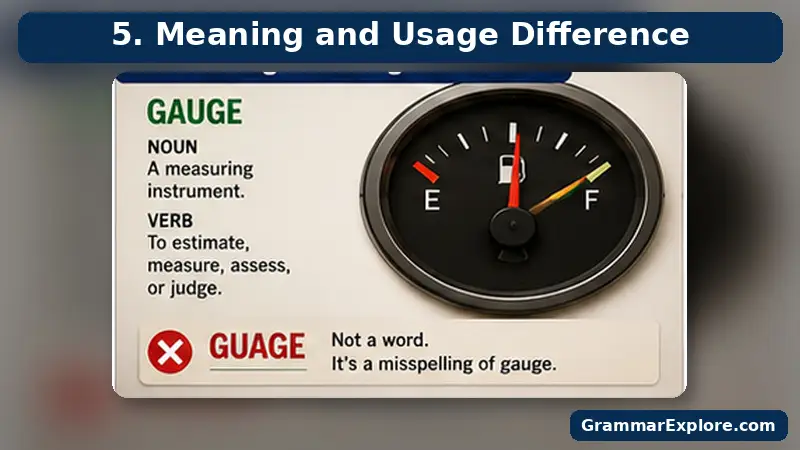
The difference between these two forms is straightforward.
Gauge
Gauge is a legitimate English word with multiple meanings and uses.
It functions as both a noun and a verb.
As a noun, it often refers to a device used for measuring something.
Examples:
- Check the fuel gauge before driving.
- The pressure gauge needs calibration.
- The rain gauge recorded two inches of rainfall.
As a verb, it means to estimate, measure, assess, or judge.
Examples:
- It’s difficult to gauge public opinion.
- We used survey data to gauge customer satisfaction.
- The manager tried to gauge employee morale.
Guage
Guage is not a standard English word. Modern American English considers it a misspelling of gauge.
Whenever someone writes guage, they almost always intended to write gauge.
Tone, Context, And Formality
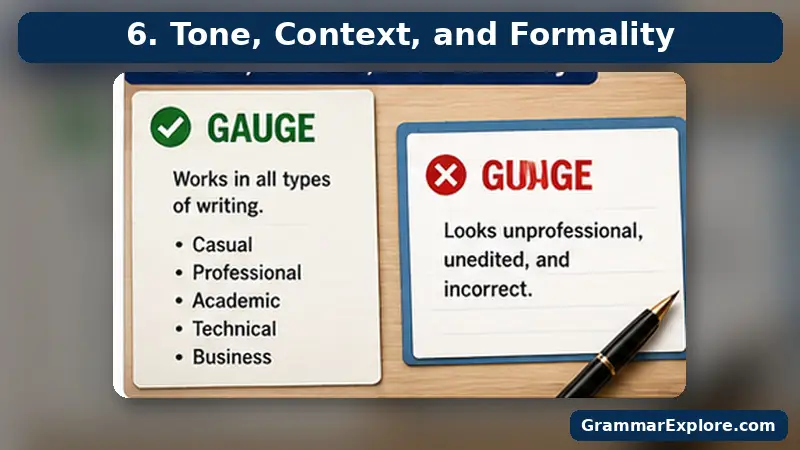
Gauge
The word gauge works naturally in:
- Casual conversations
- Professional writing
- Academic papers
- Journalism
- Technical documentation
- Government reports
- Marketing content
Guage
Using guage can make writing appear:
- Unedited
- Unprofessional
- Less credible
- Grammatically weak
Because readers recognize it as a spelling error, writers should avoid it in every formal context.
Which One Should You Use?
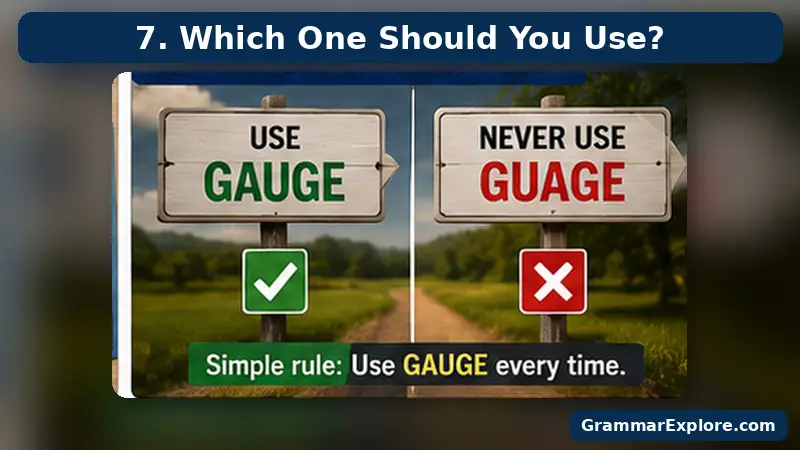
The answer is always gauge.
Use it whenever you need to express:
- Measuring something
- Estimating something
- Judging a situation
- Referring to a measuring instrument
Examples:
- We need a new tire-pressure gauge.
- Analysts use data to gauge market sentiment.
- The survey helped gauge customer expectations.
- The mechanic inspected the fuel gauge.
There is no standard situation in which guage would be the preferred spelling.
When One Choice Sounds Wrong
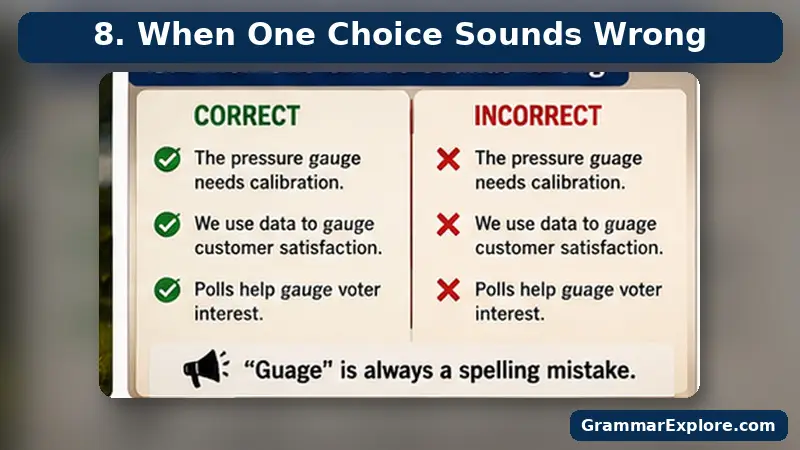
Sometimes seeing both forms side by side makes the difference easier to remember.
Correct
- The technician checked the pressure gauge.
- We used customer reviews to gauge satisfaction.
- Polls help gauge voter interest.
Incorrect
- The technician checked the pressure guage.
- We used customer reviews to guage satisfaction.
- Polls help guage voter interest.
Most native English readers immediately recognize guage as a spelling mistake.
Many spelling mistakes happen because certain letter combinations look unfamiliar, so it helps to understand other commonly confused spellings like guidance vs guidence and learn which form is correct in everyday writing.
Common Mistakes (And Quick Fixes)
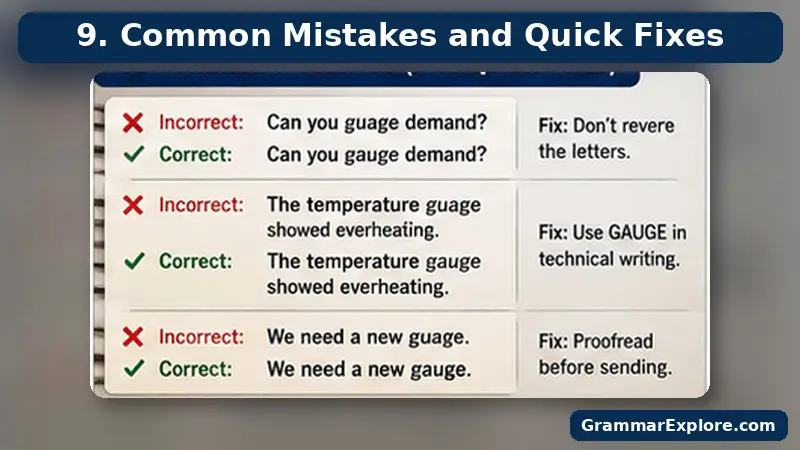
Mistake #1: Reversing The Letter Order
Incorrect:
- Can you guage demand before launch?
Correct:
- Can you gauge demand before launch?
Mistake #2: Using Guage In Technical Writing
Incorrect:
- The temperature guage showed overheating.
Correct:
- The temperature gauge showed overheating.
Mistake #3: Trusting Muscle Memory
Many people repeatedly type guage because they learned the spelling incorrectly.
A quick proofreading check can prevent this mistake.
Easy Memory Trick
Remember:
The letters “AU” stay together in gauge.
Think:
g(AU)ge
If you remember the “AU” pattern, you’ll avoid the most common spelling error.
Everyday Examples
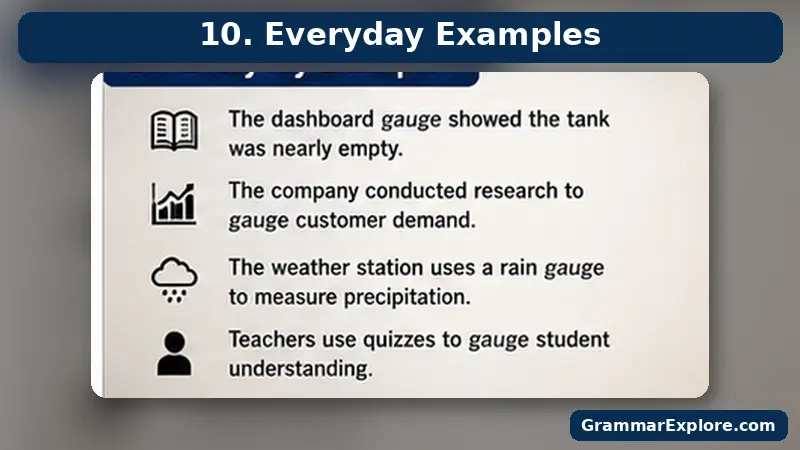
Here are realistic examples of how Americans use gauge in everyday writing.
- The dashboard gauge showed that the tank was nearly empty.
- The company conducted research to gauge customer demand.
- The nurse checked the needle gauge before the procedure.
- Investors often gauge market confidence through spending trends.
- Teachers use quizzes to gauge student understanding.
- The weather station uses a rain gauge to measure precipitation.
- Managers frequently gauge employee satisfaction through surveys.
- Coaches gauge player performance throughout the season.
Dictionary-Style Word Details
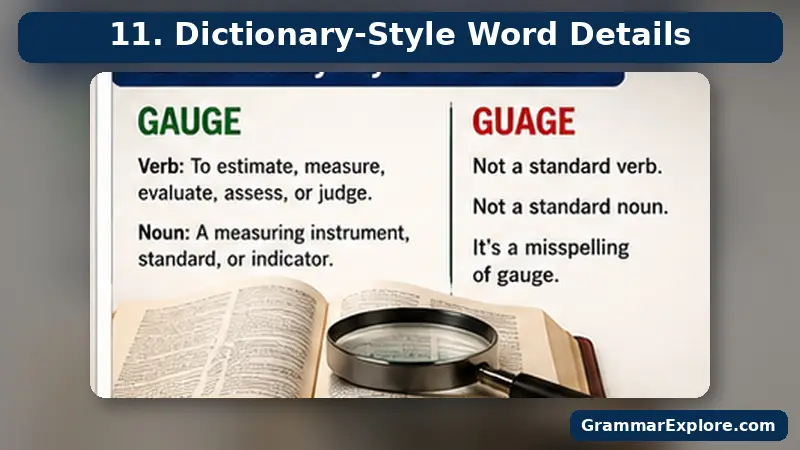
Verb
Gauge: To estimate, measure, evaluate, assess, or judge something.
Examples:
- We need to gauge public reaction.
- The company is trying to gauge future demand.
Guage: Not used as a standard verb in American English.
Noun
Gauge: A measuring instrument, standard, or indicator.
Examples:
- fuel gauge
- pressure gauge
- rain gauge
Guage: Not recognized as a standard noun.
Synonyms
Gauge (Verb)
Closest plain alternatives:
- assess
- estimate
- evaluate
- judge
- measure
Gauge (Noun)
Closest plain alternatives:
- meter
- indicator
- measuring device
- instrument
Guage
Because “guage” is a misspelling of “gauge,” it has no separate synonyms.
Example Sentences
Gauge
- We used market research to gauge customer interest.
- The mechanic replaced the fuel gauge.
- It’s difficult to gauge someone’s reaction from a text message.
- Analysts gauge economic conditions using multiple indicators.
Guage
People generally consider these examples spelling errors in standard English.
Word History
Gauge
The word has existed in English for centuries and people have long associated it with measurement, estimation, and standards of comparison.
Guage
Standard English does not recognize guage as a distinct word, so it has no separate accepted word history.
Phrases Containing
Gauge
- fuel gauge
- pressure gauge
- rain gauge
- gauge interest
- gauge performance
- gauge demand
- gauge public opinion
- gauge success
- gauge reaction
Guage
Writers do not widely accept any standard phrases containing guage.
Just like gauge vs guage, some English word pairs create confusion because one form looks familiar but is not considered standard usage. Learn more about another commonly confused term in our guide to height vs heighth and discover which spelling is correct.
FAQS
Is gauge or guage the correct spelling?
Gauge is the correct spelling in American English. Writers commonly misspell gauge as guage, and they should avoid this in both formal and informal writing.
Why do people misspell gauge as guage?
Many people reverse the letters “a” and “u” because the spelling of gauge is unusual. The pronunciation does not clearly indicate the correct letter order, which leads to frequent mistakes.
What does gauge mean?
Gauge can be a noun or a verb. As a noun, it refers to a measuring instrument, such as a fuel gauge or pressure gauge. As a verb, it means to measure, estimate, or evaluate something.
Is guage a real word?
Standard English does not generally recognize guage as a word and considers it a misspelling of gauge.
Can gauge be used as a verb?
Yes. As a verb, gauge means to assess, estimate, judge, or measure something.
Example: “The company used surveys to gauge customer satisfaction.”
How do you pronounce gauge?
People commonly pronounce gauge as “gayj.”
Is gauge used in professional writing?
Yes. Gauge is widely used in business documents, academic papers, technical writing, journalism, and everyday communication.
What are some common examples of gauge in a sentence?
Here are a few examples:
“We need to gauge customer demand before launching the product.”
“The pressure gauge needs replacement.”
“Polls help gauge public opinion.”
How can I remember the correct spelling of gauge?
A simple memory trick is to remember that the letters “AU” stay together in gauge:
g(AU)ge
This helps prevent the common misspelling guage.
Conclusion
When comparing gauge vs guage, only one spelling is correct in modern American English:
Gauge ✅
The word can function as both a noun and a verb. Writers use “gauge” to describe measuring devices, measurement standards, and the act of estimating or evaluating something.
Writers should avoid “guage” because it is a common misspelling in professional, academic, and everyday writing.
Whenever you’re unsure, remember this simple rule:
Gauge is correct. Guage is incorrect.