Have you ever paused before typing tomorrow because you weren’t sure whether it has one m or two? You’re not alone. Many English learners and even native speakers accidentally write tommorow, making it one of the most common spelling mistakes in everyday writing.
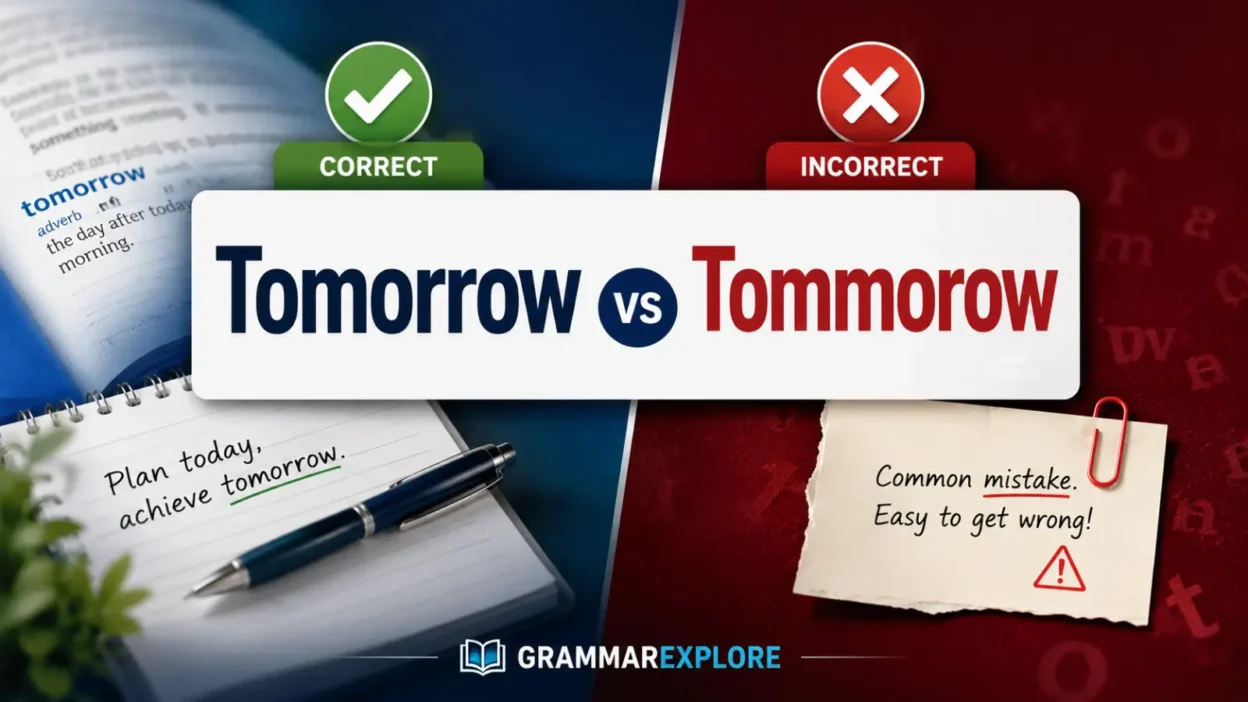
The good news is that the answer is simple: tomorrow is the correct spelling, while tommorow is always incorrect. In this guide, you’ll learn the difference between tomorrow vs tommorow, why the mistake happens so often, easy ways to remember the correct spelling, and plenty of real-life examples to help you use tomorrow with confidence in school, work, emails, and daily conversations.
Quick Answer
Tomorrow is the correct spelling, while tommorow is incorrect. The difference between tomorrow vs tommorow is only spelling: tomorrow means the day after today or a future time and uses one m with two r’s. Use tomorrow in everyday writing, emails, and formal communication to avoid this common spelling mistake.
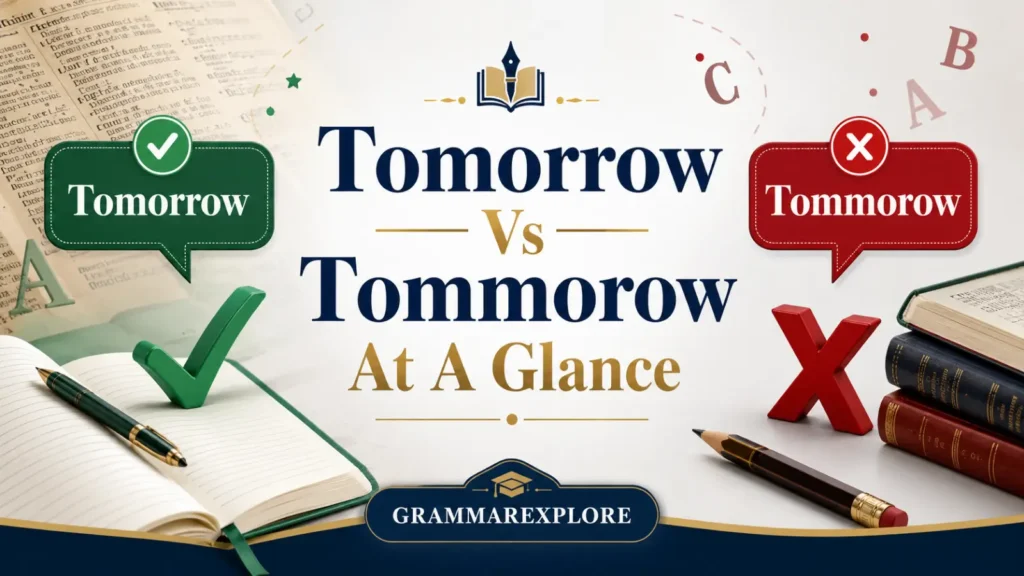
Tomorrow Vs Tommorow At A Glance
| Form | Correct Or Incorrect | Meaning | Use It? |
|---|---|---|---|
| tomorrow | Correct | The day after today; the future | Yes |
| tommorow | Incorrect | Misspelling of tomorrow | No |
The difference is not meaning. The difference is spelling. Tomorrow is the standard word. Tommorow is a common spelling error.
Why Tomorrow Is Correct
Tomorrow means “the day after today.”
Examples:
- I have a meeting tomorrow.
- We leave for Chicago tomorrow morning.
- The store opens at 9 a.m. tomorrow.
Tomorrow can also refer to the future in a broader way.
Examples:
- Today’s students are tomorrow’s leaders.
- We need better plans for tomorrow.
- The technology of tomorrow may look very different.
In these sentences, tomorrow is the only correct spelling.
Why Tommorow Is Wrong
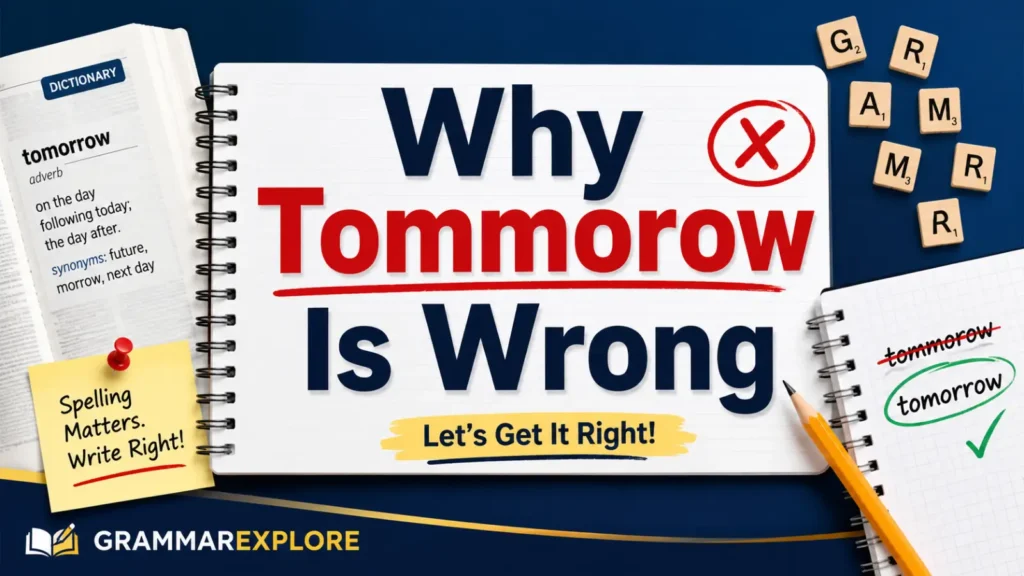
Tommorow is a misspelling of tomorrow. It is not a separate word, a regional spelling, or a formal variant.
Incorrect: The deadline is tommorow.
Correct: The deadline is tomorrow.
Incorrect: Tommorow is my first day at work.
Correct: Tomorrow is my first day at work.
Readers will usually understand tommorow, but it still looks like an error. That matters in school assignments, resumes, business emails, job applications, blog posts, and any public writing.
How To Remember The Correct Spelling
The easiest rule is:
Tomorrow = one m, two r’s
Break it into this pattern:
to + morrow = tomorrow
The older word morrow refers to the next day or morning. You do not need to use morrow in normal modern writing, but it can help you remember the spelling.
Think of it this way:
- to = t-o
- morrow = m-o-r-r-o-w
- tomorrow = t-o-m-o-r-r-o-w
That gives you one m and two r’s.
Why People Misspell Tomorrow
People often write tommorow because the word sounds like it might need a double m. The stress falls near the middle of the word, so the spelling can feel heavier than it is.
Fast typing also causes the mistake. Once your fingers double one letter, it is easy to double the wrong one.
Common wrong forms include:
| Misspelling | Problem | Correct Form |
| tommorow | Extra m | tomorrow |
| tommorrow | Extra m and extra confusion | tomorrow |
| tomorow | Missing one r | tomorrow |
| tomarrow | Wrong vowel sound | tomorrow |
| tomorro | Missing final w | tomorrow |
The safest fix is to check for the pattern: one m, two r’s, final w.
Tomorrow As An Adverb
Tomorrow often works as an adverb. That means it tells when an action happens.
Examples:
- I’ll email the file tomorrow.
- She starts training tomorrow.
- We can review the draft tomorrow.
- The package should arrive tomorrow afternoon.
In these examples, tomorrow answers the question when?
When will I email the file? Tomorrow.
When does she start training? Tomorrow.
Tomorrow As A Noun
- Tomorrow can also work as a noun. In this use, it names the next day or a future time.
Examples:
- Tomorrow is Friday.
- Tomorrow will be busy.
- We are planning for a better tomorrow.
- No one knows what tomorrow will bring.
When tomorrow starts a sentence, capitalize it like any other first word.
Correct: Tomorrow is the deadline.
Incorrect: tommorow is the deadline.
When To Use A Date Instead Of Tomorrow
Tomorrow is clear when the reader knows the current date. However, exact dates work better for deadlines, contracts, schedules, and official notices.
Less Clear: Please send the signed form tomorrow.
Clearer: Please send the signed form by July 6, 2026.
Less Clear: The office will reopen tomorrow.
Clearer: The office will reopen on July 6, 2026.
Use tomorrow for normal conversation. Use an exact date when the timing must be precise.
Correct Examples In Everyday Writing
Use tomorrow in casual and formal writing.
Text message:
I’ll see you tomorrow after class.
Email:
Please send the updated invoice by tomorrow morning.
School writing:
Our group will present the project tomorrow.
Work message:
The team meeting has been moved to tomorrow at 10 a.m.
Social caption:
New city, new plans, big day tomorrow.
Reminder:
Your appointment is tomorrow afternoon.
See about:
https://www.youtube.com/@myenglishpictionary/shorts
Incorrect Vs Correct Sentence Fixes
Incorrect: I will pay the bill tommorow.
Correct: I will pay the bill tomorrow.
Incorrect: Are you free tommorow night?
Correct: Are you free tomorrow night?
Incorrect: Tommorow is my interview.
Correct: Tomorrow is my interview.
Incorrect: We can discuss it tommorrow.
Correct: We can discuss it tomorrow.
Incorrect: The event starts tomorow at noon.
Correct: The event starts tomorrow at noon.
Common Phrases With Tomorrow
These common phrases all use tomorrow, not tommorow:
- tomorrow morning
- tomorrow afternoon
- tomorrow night
- by tomorrow
- until tomorrow
- starting tomorrow
- see you tomorrow
- the day after tomorrow
- tomorrow is another day
- like there’s no tomorrow
Examples:
- I’ll call you tomorrow morning.
- The sale ends tomorrow night.
- She danced like there was no tomorrow.
- Don’t worry. Tomorrow is another day.
Synonyms And Alternatives For Tomorrow
When tomorrow means the next day, you can sometimes use:
- the next day
- the following day
- the day after today
Example:
Original: We met again tomorrow.
Better for past-time narration: We met again the next day.
When tomorrow means the future, you can sometimes use:
- the future
- the coming years
- the years ahead
Example:
Original: We must prepare for tomorrow.
Alternative: We must prepare for the future.
Do not use tommorow as an alternative. It is only a misspelling.
Conclusion
The correct spelling is tomorrow. The spelling tommorow is a common mistake, but it is not accepted in standard writing.
Use tomorrow for the day after today or for the future. Remember the pattern: one m, two r’s. If you write tommorow, remove the extra m and spell it tomorrow.
No. Tommorow is not correct in standard English. Write tomorrow instead.
Tomorrow has one m.
Correct spelling: t-o-m-o-r-r-o-w
Tomorrow has two r’s.
The correct pattern is one m and two r’s.
People often write tommorow because the middle of tomorrow sounds strong when spoken. That sound can make writers add an extra m by mistake.
Yes. Tomorrow can be a noun.
Example: Tomorrow is my first day at the new job.
Yes. Tomorrow can be an adverb when it tells when something happens.
Example: I’ll finish the report tomorrow.
Remember this simple rule:
Tomorrow has one m and two r’s.
You can also break it into to + morrow.