Is It A Lot Or Allot?
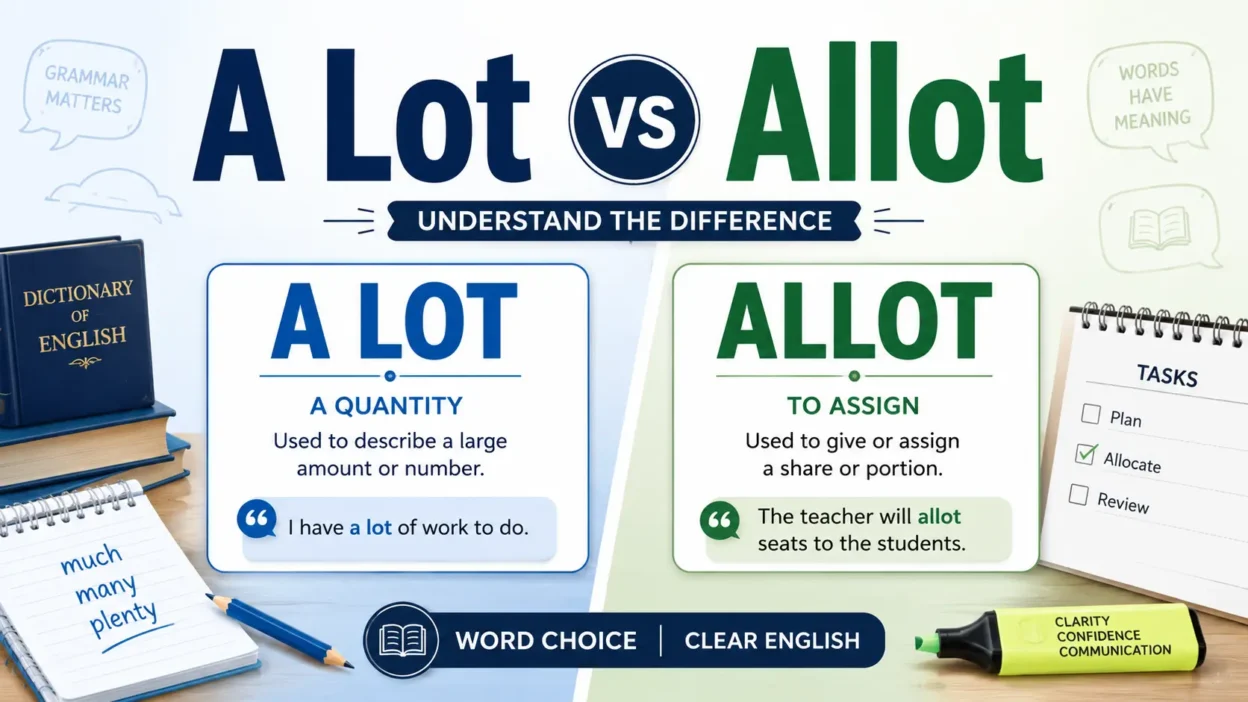
Use a lot when you mean many, much, often, or very much.
Use allot when you mean assign, divide, give out, or set aside a share of something.
Examples:
- I have a lot of emails to answer.
- Please allot 20 minutes for questions.
- She travels a lot for work.
- The committee allotted each speaker five minutes.
In most everyday writing, you probably need a lot. Use allot only when someone is assigning time, money, space, work, seats, or another share of something.
A Lot Vs Allot At A Glance
| Use | Correct Choice | Example |
|---|---|---|
| A large number | a lot | A lot of students joined the club. |
| A large amount | a lot | We spent a lot of money on repairs. |
| Often | a lot | He calls his parents a lot. |
| Very much | a lot | That helped a lot. |
| Assigning time | allot | Allot 10 minutes for setup. |
| Dividing money | allot | The board allotted funds for new equipment. |
| Giving each person a share | allot | Each team was allotted one table. |
What Does A Lot Mean?
A lot is a two-word phrase. It means a large amount, a large number, often, or very much.
Use a lot of before a noun:
- a lot of people
- a lot of time
- a lot of work
- a lot of traffic
- a lot of money
Use a lot after a verb when you mean “often” or “very much”:
- We talk a lot.
- I learned a lot from that class.
- Thanks a lot for your help.
- The new software improved performance a lot.
A lot is common in everyday US English. It works well in conversation, casual emails, school writing, and most clear business writing.
What Does Allot Mean?
Allot is a verb. It means to assign, give out, divide, or set aside part of something for a person, group, task, or purpose.
You can allot things like:
- time
- money
- space
- seats
- tasks
- resources
- tickets
- shares
- parking spots
Examples:
- The teacher will allot 30 minutes for the test.
- The company allotted more money to the marketing team.
- Each volunteer was allotted a station.
- We should allot enough time for traffic.
A simple test works well: if you can replace the word with assign or set aside, use allot.
- Please assign 15 minutes for discussion.
- Please allot 15 minutes for discussion.
That works, so allot is correct.
Why A Lot And Allot Are Confusing
A lot and allot sound almost the same in normal speech. That is why the mistake usually happens in writing, not speaking.
The spelling gives you the clue:
- a lot = two words, used for amount, degree, or frequency
- allot = one word, used as a verb
- alot = common misspelling of a lot
The terms are not interchangeable.
Wrong: I have allot of homework.
Correct: I have a lot of homework.
Wrong: The host will a lot five minutes for each guest.
Correct: The host will allot five minutes for each guest.
A Lot, Allot, And Alot
The main comparison is a lot vs allot, but many readers also wonder about alot.
Here is the clean rule:
- A lot is correct when you mean “many,” “much,” “often,” or “very much.”
- Allot is correct when you mean “assign” or “set aside.”
- Alot should not be used in standard writing.
Examples:
- Correct: We had a lot of fun.
- Incorrect: We had alot of fun.
- Correct: The coach will allot time for stretching.
- Incorrect: The coach will a lot time for stretching.
Think of a lot like a little. You would not write alittle, so do not write alot.
How To Use A Lot Correctly
- a lot of books
- a lot of cars
- a lot of employees
- a lot of questions
- a lot of water
- a lot of advice
- a lot of information
- a lot of stress
- She practices a lot.
- We laughed a lot.
- The team improved a lot.
- I appreciate it a lot.
- a lot better
- a lot faster
- a lot easier
- a lot more expensive
Examples:
- This route is a lot faster.
- The final draft is a lot better.
- Rent is a lot more expensive downtown.
How To Use Allot Correctly
Allot usually needs an object because someone is assigning something.
Common patterns:
- allot time
- allot money
- allot space
- allot resources
- allot something to someone
- be allotted something
Examples:
- Please allot enough time for parking.
- The school allotted one laptop to each student.
- The budget allots $5,000 for supplies.
- Each speaker was allotted three minutes.
- The event team will allot tables to each vendor.
The past tense is allotted. The present participle is allotting.
- The manager allotted extra staff to the project.
- We are allotting more time for training this year.
Formality And Tone
A lot is natural and common, but it can sound casual in very formal writing.
In formal writing, choose a more exact word when possible:
- many for plural count nouns
- Casual: A lot of employees attended.
- Formal: Many employees attended.
- much for noncount nouns
- Casual: We do not have a lot of time.
- Formal: We do not have much time.
- a large amount of for quantity
- Casual: The project used a lot of data.
- Formal: The project used a large amount of data.
- frequently for “often”
- Casual: She travels a lot.
- Formal: She travels frequently.
Allot already sounds more formal because it often appears in planning, budgets, schedules, rules, and official decisions.
Examples:
- The department allotted funds for repairs.
- Each applicant will be allotted 20 minutes.
- The city allotted more space for public parking.
Common Mistakes With A Lot And Allot
Mistake 1: Using Allot When You Mean A Lot
Wrong: I have allot of things to do.
Correct: I have a lot of things to do.
Wrong: We received allot of feedback.
Correct: We received a lot of feedback.
Mistake 2: Using A Lot As A Verb
Wrong: The teacher will a lot time for review.
Correct: The teacher will allot time for review.
Wrong: The office a loted one desk to each intern.
Correct: The office allotted one desk to each intern.
Mistake 3: Writing Alot Instead Of A Lot
Wrong: That means alot to me.
Correct: That means a lot to me.
Wrong: There were alot of people in line.
Correct: There were a lot of people in line.
Mistake 4: Using Allot Without Saying What Is Assigned
Weak: The manager will allot before the meeting.
Better: The manager will allot tasks before the meeting.
Weak: The school allotted to each class.
Better: The school allotted one lunch period to each class.
Real-Life Examples
Workplace Examples
- We got a lot of questions after the presentation.
- Please allot 10 minutes for introductions.
- The team made a lot of progress this week.
- The director allotted extra funds for research.
- I appreciate your help a lot.
- Each department was allotted two parking spaces.
School Examples
- I have a lot of reading to finish tonight.
- The teacher allotted 15 minutes for the quiz.
- We learned a lot in history class.
- Each student was allotted one locker.
- There were a lot of people at graduation.
- The counselor allotted time for college questions.
Everyday Examples
- It rained a lot last night.
- We need to allot enough time to get to the airport.
- She cooks at home a lot.
- The host allotted one seat to each guest.
- This phone costs a lot less than my old one.
- The family allotted part of the garage for storage.
Quick Memory Trick
Use a lot when you mean a large amount.
Use allot when you mean assign a lot or give out a share.
Try this:
- If the sentence answers “how much?”, use a lot.
- If the sentence answers “who gets what?”, use allot.
Examples:
- How much homework? A lot.
- Who gets five minutes? The speaker is allotted five minutes.
FAQ
Is it correct to say a lot or allot?
Both are correct, but they mean different things. Use a lot for a large amount, many things, frequent action, or strong degree. Use allot when someone assigns or sets aside a share.
Is a lot one word or two?
A lot is two words. The one-word spelling alot is not correct in standard writing.
Is allot a real word?
Yes. Allot is a real verb. It means to assign, distribute, divide, or set something aside for a person, group, task, or purpose.
Can I say allot of people?
No. The correct phrase is a lot of people. Use allot only as a verb.
Correct: A lot of people attended the meeting.
Incorrect: Allot of people attended the meeting.
What is the past tense of allot?
The past tense of allot is allotted.
Example: The organizer allotted each speaker five minutes.
What is another word for a lot?
Depending on the sentence, you can use many, much, plenty, a large amount, a great deal, or frequently.
Examples:
- a lot of books = many books
- a lot of water = much water
- travels a lot = travels frequently
What is another word for allot?
Good alternatives include assign, allocate, distribute, apportion, and set aside.
Example:
- The manager allotted funds for training.
- The manager allocated funds for training.
Is a lot too informal for professional writing?
Not always. A lot is fine in many emails and everyday business messages. In formal reports, academic writing, or polished professional copy, a more exact word such as many, much, frequently, or a large amount of may sound stronger.
Conclusion
Use a lot for amount, number, frequency, or degree.
Use allot for assigning or setting aside a share.
The fastest test is simple: if the sentence means many, much, often, or very much, write a lot. If the sentence means assign, divide, or set aside, write allot.
- We saved a lot of money.
- The board allotted money for repairs.
- She practices a lot.
- The coach allotted 20 minutes for practice.
They sound almost the same, but they do not do the same job. Use a lot for quantity and allot for assignment.