If you are choosing between vendor vs vender, use vendor in modern US English. It is the standard spelling for a person, company, or business that sells goods or services.
Vender is not usually a separate everyday word with a special meaning. It is a rare variant spelling of vendor. Some dictionaries record it, but modern readers often see it as outdated, unusual, or mistaken.
This matters most in business writing. If you are writing an email, invoice, contract, school paper, website page, job document, or product description, vendor is the spelling that looks clear and professional.
Quick Answer
Vendor is the correct spelling for modern US English. A vendor is a person, company, or business that sells goods or services. Vender exists as a rare variant, but it is not the preferred spelling. For emails, contracts, invoices, school writing, websites, and business documents, choose vendor. Merriam-Webster lists vendor as the main form and vender as less common.
Vendor Vs Vender At A Glance
| Question | Best Answer |
|---|---|
| Correct modern spelling | Vendor |
| Rare variant spelling | Vender |
| Best choice in US English | Vendor |
| Correct plural | Vendors |
| Common mistake | Venders |
| Meaning | A seller of goods or services |
| Best for business writing | Vendor |
| Best for contracts and invoices | Vendor |
| Use vender? | Only in a quote, official name, or historical context |
What Does Vendor Mean?

Vendor is a noun. It means a person, company, or organization that sells goods or services. A street vendor sells food or products outside. A software vendor sells or provides software. A wedding vendor may provide flowers, catering, music, photography, or event services.
Oxford’s American dictionary lists vendor for a person who sells things, a company that sells a product, and a legal seller of property. Cambridge also defines vendor as a person or company that sells goods or services.
Examples:
“The food vendor set up a cart near the park.”
“Our company hired a new payroll vendor.”
“The software vendor released a security update.”
“The vendor sent the invoice on Monday.”
What Does Vender Mean?
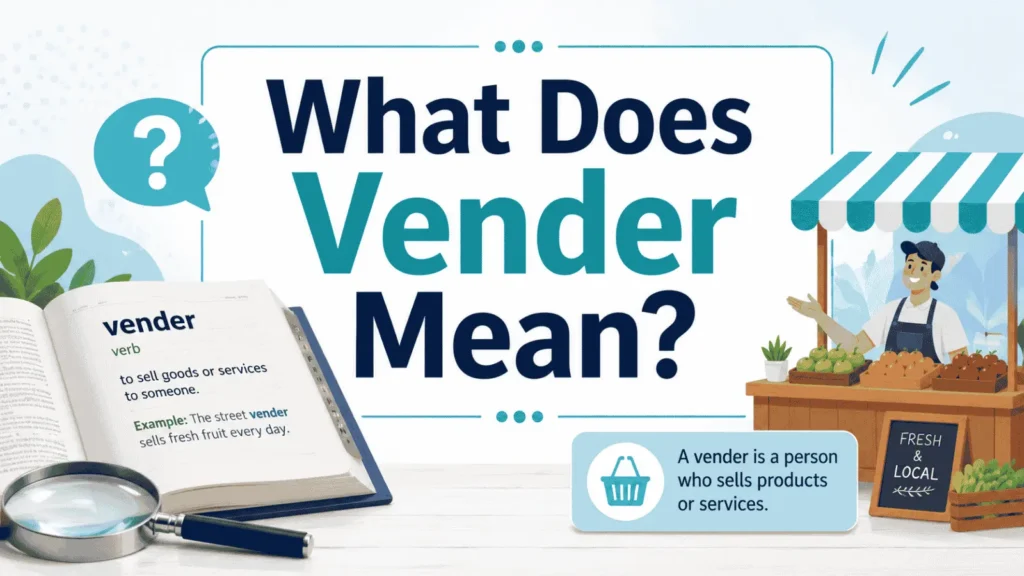
Vender means the same basic thing when it appears: a seller. The problem is not meaning. The problem is usage.
In modern English, vender is much less common than vendor. Collins labels vender as an alternative or variant spelling of vendor, which means it is not a made-up word. Still, it is not the spelling most readers expect in current US writing.
That is why this sentence looks natural:
“The company approved three new vendors.”
This version looks unusual:
“The company approved three new venders.”
Most readers will understand the second sentence, but many will think it contains a spelling mistake.
Why Vendor Is The Better Choice
Vendor is better because it is the standard form in modern professional writing. It appears naturally in business, finance, legal, retail, technology, and event-planning contexts.
Use vendor in phrases such as:
“approved vendor”
“vendor invoice”
“vendor contract”
“food vendor”
“street vendor”
“software vendor”
“third-party vendor”
- “vendor management”
- “vendor list”
- “vendor booth”
Collins also uses vendor in retail and accounting contexts for a company or person that sells a product or service. That matches how the word appears in business documents today.
Is Vender A Real Word?
Yes, vender is a real recorded spelling, but it is not the best spelling for most modern writing. This is an important difference.
A word can appear in dictionaries and still be rare, outdated, or not recommended for everyday use. Vender is best understood as a variant of vendor, not as a separate word that writers need in normal business English.
Use this rule:
Vendor = standard and recommended.
Vender = rare variant, usually avoid.
If your goal is clean US English, choose vendor.
Is Vender British English?
No, vender is not the normal British spelling of vendor. This is not like color and colour, where American and British English commonly use different spellings.
For US readers, vendor is the right choice. For a broader English-speaking audience, vendor is still the safer choice. Oxford, Cambridge, Merriam-Webster, Dictionary.com, and Collins all treat vendor as the main spelling.
When Should You Use Vendor?
Use vendor in nearly every normal context.
| Context | Correct Choice | Example |
|---|---|---|
| Business email | Vendor | “Please send the vendor contract.” |
| Invoice | Vendor | “The vendor submitted the invoice.” |
| Contract | Vendor | “The vendor must deliver the goods by Friday.” |
| Software | Vendor | “We changed our cloud vendor.” |
| Street selling | Vendor | “A hot dog vendor stood outside the stadium.” |
| Events | Vendor | “The planner shared a preferred vendor list.” |
| School writing | Vendor | “Street vendors are common in large cities.” |
| Legal/property use | Vendor | “The vendor accepted the buyer’s offer.” |
When Can You Use Vender?
Use vender only when you have a clear reason to preserve that spelling.
You may keep vender when:
- It appears in an official business name.
- It appears in a direct quote.
- It appears in an older document.
A publication’s house style specifically requires it.
You are discussing the spelling itself.
Example:
“The old sign used the spelling ‘vender,’ but today we would normally write ‘vendor.’”
Outside those cases, vendor is the better choice.
Why People Confuse Vendor And Vender
People confuse vendor and vender because they sound the same. When you hear the word spoken, the ending does not clearly tell you whether to write -or or -er.
The confusion also comes from English word patterns. Many nouns for people end in -er:
teacher
seller
driver
worker
buyer
Because of that pattern, vender looks possible. But English also uses -or in many person nouns:
actor
editor
doctor
collector
vendor
The safest memory trick is this: vendor connects to vend and vending. A vending machine uses vend, and the standard seller noun is vendor.
Vendor Or Vender: Common Mistakes
Mistake 1: Using Vender In Business Writing
Wrong: “Please send the vender agreement.”
Correct: “Please send the vendor agreement.”
Mistake 2: Writing Venders As The Plural
Wrong: “Several venders applied for the event.”
Correct: “Several vendors applied for the event.”
Mistake 3: Treating Vender As A Special Business Term
Wrong: “A vender sells services, but a vendor sells products.”
Correct: “A vendor can sell goods, services, or both.”
Mistake 4: Using Vendor As A Verb
Awkward: “The company vendors office equipment.”
Better: “The company sells office equipment.”
In everyday writing, vendor works best as a noun. For a verb, use sell, provide, supply, or vend.
Vendor Vs Seller, Supplier, Contractor, And Vendee
Vendor is close to seller, but these words are not always identical.
| Word | Meaning | Example |
|---|---|---|
| Vendor | Person or company that sells goods or services | “We hired a payroll vendor.” |
| Seller | General word for someone who sells | “The seller accepted the offer.” |
| Supplier | A business that provides goods or materials | “The supplier shipped the parts.” |
| Contractor | A person or company hired to perform work under an agreement | “The contractor repaired the roof.” |
| Vendee | The buyer in a sale, especially in legal use | “The vendee agreed to the purchase terms.” |
Do not confuse vendor with vendee. A vendor sells. A vendee buys.
Everyday Examples Of Vendor
“The coffee vendor outside the office knows everyone’s order.”
“Our company needs a new payroll vendor.”
“The event planner gave us a list of approved vendors.”
“The vendor fixed the delivery issue before noon.”
“The school changed food vendors this year.”
“Several local vendors sold bread, flowers, and produce.”
“The software vendor offers 24-hour support.”
“The vendor sent a revised invoice.”
“The city requires each food vendor to display a permit.”
“The wedding venue works with preferred vendors.”
Example Sentences With Vender
Use vender mainly when you are talking about the spelling itself.
“Vender appears in some dictionaries, but vendor is the better spelling for modern US writing.”
“The old document used ‘vender,’ so the editor kept the original spelling in the quote.”
“If your draft says ‘vender management,’ change it to ‘vendor management.’”
“The company name includes ‘Vender,’ so we should not change the brand spelling.”
Quick Spelling Rule
Use vendor with an o.
A simple way to remember it:
Vendor = official spelling.
Vender = rare variant.
That memory trick is not the word’s origin, but it helps you choose the spelling most readers expect.
Part 1: Choose the Correct Word (Vendor / Vender)
- The food _______ set up a cart near the park.
- We hired a new software _______ for our company.
- Several local _______ sold handmade crafts.
- The invoice was sent by the _______.
- Most dictionaries list _______ as the standard spelling.
- The spelling _______ is rarely used in modern English.
- The wedding _______ provided flowers and music services.
- The company works with trusted _______ partners.
- _______ is the correct modern spelling in US English.
- _______ is a rare variant spelling of vendor.
- A _______ is a person or business that sells goods or services.
- The plural form is _______.
- In business writing, always use _______ instead of vender.
- A street _______ sells food or items in public places.
- _______ should only be used in quotes or official names.
Part 3: True or False
- “Vender” is the most common spelling in US English. (True / False)
- “Vendor” is used in business and legal writing. (True / False)
- “Vender” is completely unrelated to “vendor.” (True / False)
- The correct plural is “vendors.” (True / False)
- Both words mean a seller, but usage differs. (True / False)
Answer Key
True
vendor
vendor
vendors
vendor
vendor
vender
vendor
vendors
Vendor
Vender
vendor
vendors
vendor
vendor
vender
False
True
False
True
FAQs
Is vendor or vender correct?
Vendor is correct for modern US English. Vender exists as a rare variant, but it is not the preferred spelling. Use vendor in emails, contracts, invoices, school writing, websites, and business documents.
Is vender a misspelling?
In many modern contexts, readers will treat vender as a misspelling. Technically, some dictionaries record it as a variant of vendor, but that does not make it the best choice for polished writing.
What is the plural of vendor?
The plural of vendor is vendors.
Correct: “The event had 20 vendors.”
Avoid: “The event had 20 venders.”
Does vendor mean seller?
Yes. A vendor is a seller. It can be a person, company, or organization that sells goods or services. A street vendor sells products outside, while a software vendor sells or provides software.
Is vendor a business word?
Yes, vendor is common in business writing. You will see it in phrases such as vendor contract, vendor invoice, approved vendor, vendor list, vendor management, and third-party vendor.
Is vendor used in legal writing?
Yes. In legal and real estate contexts, vendor can mean the seller of property or goods. Oxford and Collins both include legal/property uses for vendor.
Should I ever write vender?
Write vender only when you are preserving an official name, quoting older text, following a required style, or discussing the variant spelling. In normal modern writing, use vendor.
Conclusion
For modern US English, vendor is the spelling you should use. It means a person, company, or business that sells goods or services.
Vender exists as a rare variant, but it usually looks outdated or mistaken in current writing. Unless you are quoting older text, preserving an official name, or discussing the spelling itself, choose vendor.
Vendor is correct for modern US English. Vender exists as a rare variant, but it is not the preferred spelling. Use vendor in emails, contracts, invoices, school writing, websites, and business documents.
In many modern contexts, readers will treat vender as a misspelling. Technically, some dictionaries record it as a variant of vendor, but that does not make it the best choice for polished writing.
The plural of vendor is vendors.
Correct: “The event had 20 vendors.”
Avoid: “The event had 20 venders.”
Yes. A vendor is a seller. It can be a person, company, or organization that sells goods or services. A street vendor sells products outside, while a software vendor sells or provides software.
Yes, vendor is common in business writing. You will see it in phrases such as vendor contract, vendor invoice, approved vendor, vendor list, vendor management, and third-party vendor.
Yes. In legal and real estate contexts, vendor can mean the seller of property or goods. Oxford and Collins both include legal/property uses for vendor.
Write vender only when you are preserving an official name, quoting older text, following a required style, or discussing the variant spelling. In normal modern writing, use vendor.