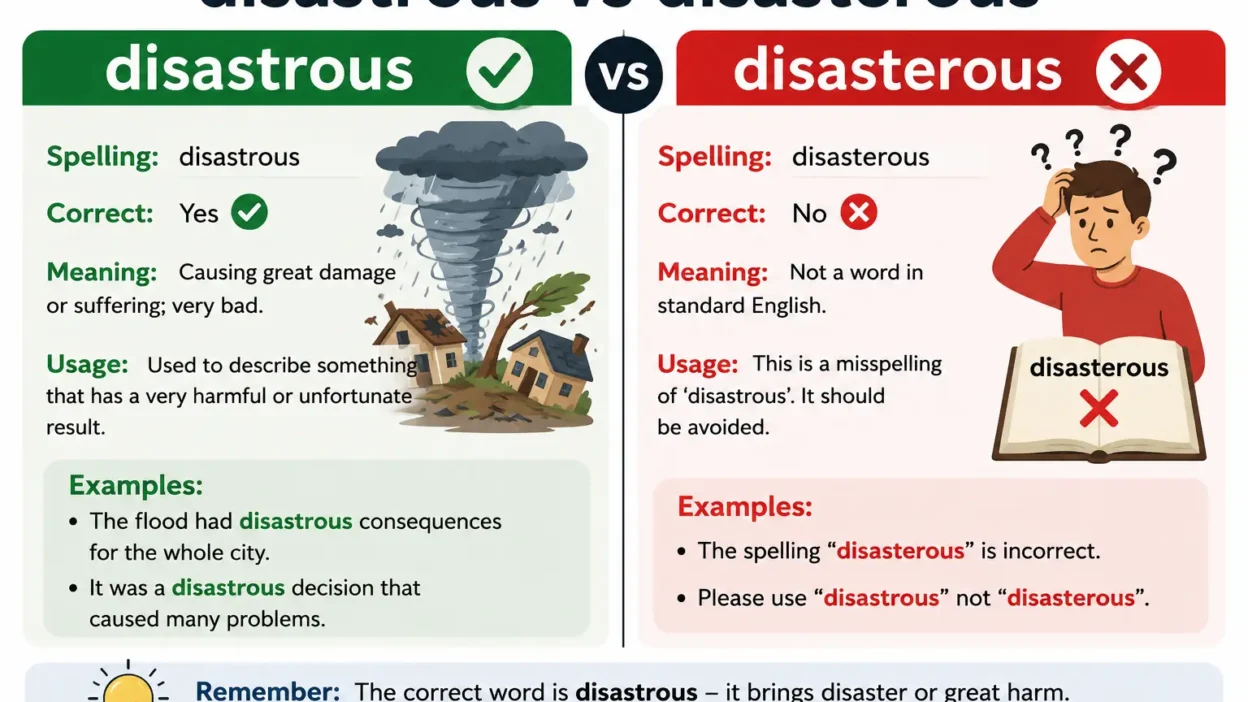
The correct spelling is disastrous, not disasterous. The second form is a common mistake caused by the word disaster, but it is not accepted in standard English writing.
Writers often assume the adjective should mirror the noun more closely, but English spelling does not always follow that pattern. Understanding the correct form helps you avoid errors in school writing, business communication, and professional documents.
Quick Answer
Disastrous is correct.
Disasterous is incorrect.
Use disastrous when describing something extremely bad, damaging, or unsuccessful. The spelling disasterous should not be used in any formal or informal standard writing.
The confusion comes from the noun disaster.
Many people expect the adjective to form by simply adding “-ous” directly to the noun, creating “disasterous.” This feels logical, but English often adjusts spelling when forming adjectives.
In this case:
- disaster → disastrous
The middle vowel pattern changes slightly, and the extra “e” is dropped. This is a normal spelling shift in English word formation, even if it looks unexpected.
Key Difference at a Glance

| Context | Correct Form | Reason |
|---|---|---|
| Academic writing | disastrous | Standard adjective |
| Professional emails | disastrous | Correct spelling |
| News writing | disastrous | Accepted form |
| Casual writing | disastrous | Always preferred |
| Any usage | disasterous | Incorrect spelling |
Meaning and Usage Difference
Disastrous describes something that causes serious harm, failure, or very bad results.
It is commonly used with words like:
- decision
- mistake
- outcome
- event
- result
- situation
Examples:
- a disastrous decision
- disastrous results
- a disastrous mistake
- disastrous consequences
Disasterous has no separate meaning. It is simply a spelling error and should always be corrected to disastrous.
Tone, Context, and Formality

Disastrous carries a strong negative tone. It is used when something leads to serious problems or failure.
It works in different settings:
- Formal: The policy had disastrous economic effects.
- Workplace: The delay created a disastrous impact on the project timeline.
- Everyday: The trip turned disastrous after the car broke down.
The incorrect form disasterous is immediately noticeable and reduces writing credibility.
Which One Should You Use?
Always use disastrous.
Choose it when describing:
- serious failure
- major problems
- harmful outcomes
- severe mistakes
- damaging situations
Correct usage:
- The launch was disastrous.
- The decision proved disastrous.
- The weather conditions were disastrous.
Avoid disasterous completely, even in informal writing.
When the Wrong Form Appears
Disasterous often appears when writers type quickly or rely on spelling intuition.
Common incorrect usage:
- The experiment was disasterous.
- That was a disasterous idea.
- The outage had disasterous effects.
Corrected versions:
- The experiment was disastrous.
- That was a disastrous idea.
- The outage had disastrous effects.
A simple check helps: if you see “disasterous,” remove the extra “e” immediately.
Common Mistakes and Fixes
Wrong: The event was disasterous.
Right: The event was disastrous.
Wrong: It was a disasterous failure.
Right: It was a disastrous failure.
Wrong: The plan turned disaster.
Right: The plan was a disaster. / The plan was disastrous.
Quick fix rule:
If the word describes impact, always use disastrous.
Everyday Examples
- The project deadline change was disastrous for the team.
- A weak password choice can lead to disastrous results.
- The meeting started well but ended in a disastrous misunderstanding.
- Poor planning made the entire trip disastrous.
- The system failure had disastrous consequences for users.
- His first presentation was disastrous, but he improved later.
- Ignoring feedback can be disastrous in long-term growth.
- The sudden change in schedule proved disastrous for attendance.
Dictionary-Style Word Details
Verb
- Disastrous: Not used as a verb in standard English.
- Disasterous: Not used as a verb and is not a valid form.
Noun
- Disastrous: Not a noun; it is an adjective.
- Disasterous: Not a noun; incorrect spelling.
Correct noun form: disaster
Example:
- The event was a disaster.
- The event was disastrous.
Synonyms
- Disastrous: catastrophic, devastating, ruinous, harmful, severe, terrible
- Disasterous: no valid synonyms (not a standard word)
Example Sentences
- The policy change had disastrous consequences.
- A rushed decision can be disastrous in business.
- The outage was disastrous for customer trust.
- “Disasterous” is incorrect; use “disastrous” instead.
Word History
Disastrous comes from the word disaster, which refers to a serious misfortune or failure. The adjective form developed in English with a spelling adjustment that drops the extra vowel pattern found in the noun.
The form disasterous never became standard usage.
Phrases Containing
- disastrous outcome
- disastrous consequences
- disastrous failure
- disastrous mistake
- disastrous impact
- disastrous results
No standard English phrases use “disasterous.”
Frequently Asked Questions
Is disastrous or disasterous correct?
Disastrous is correct. Disasterous is a spelling mistake.
Why do people write disasterous instead of disastrous?
Because it comes from the noun disaster, and writers incorrectly assume the adjective keeps the same spelling pattern.
Can disasterous ever be correct in English?
No. It is not accepted in standard English writing.
What is the easiest way to remember the correct spelling?
Remember: the noun is disaster, but the adjective is disastrous (no extra “e”).
Conclusion
The correct form is always disastrous. The spelling disasterous is incorrect and should be avoided in all writing.
Whenever you describe something extremely bad, damaging, or unsuccessful, use disastrous without exception.
Is disastrous or disasterous correct?
Disastrous is correct. Disasterous is a spelling mistake.
Why do people write disasterous instead of disastrous?
Because it comes from the noun disaster, and writers incorrectly assume the adjective keeps the same spelling pattern.
Can disasterous ever be correct in English?
No. It is not accepted in standard English writing.
What is the easiest way to remember the correct spelling?
Remember: the noun is disaster, but the adjective is disastrous (no extra “e”).