
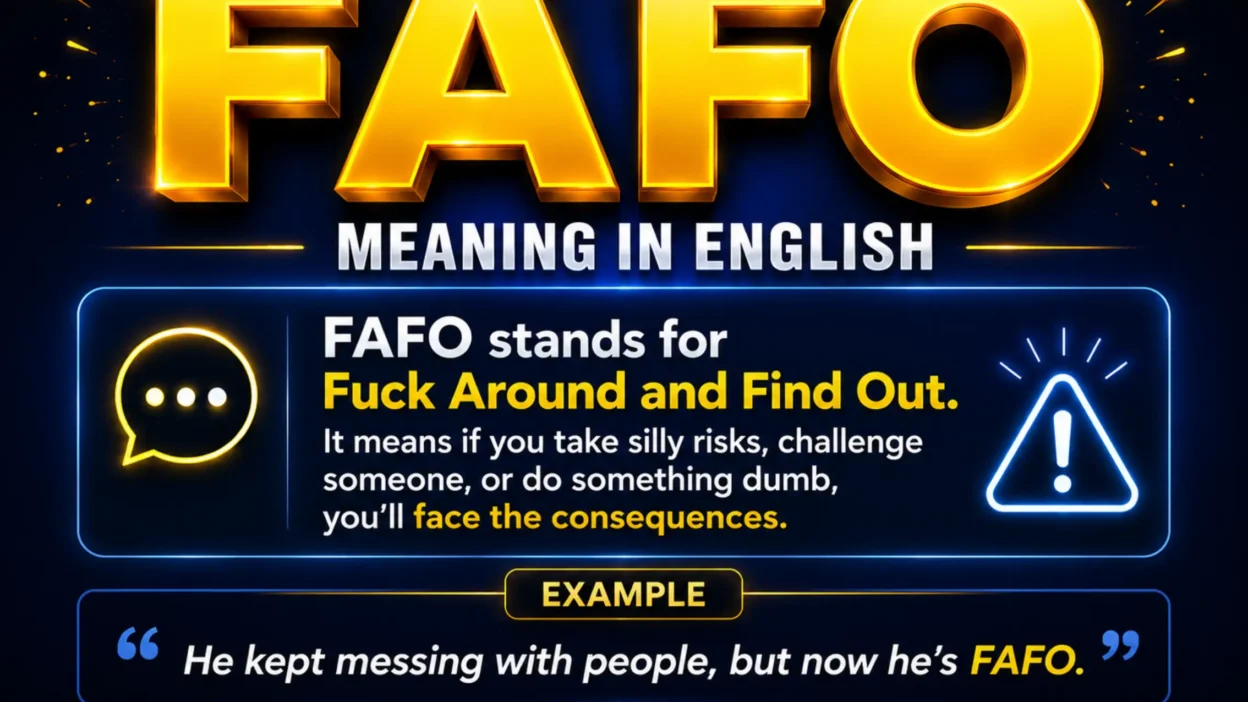
FAFO appears in text messages, memes, online comments, and heated discussions. People use it when someone ignores a warning or takes a risky action. It suggests that bad choices can bring unpleasant consequences.
The abbreviation contains a strong swear word. However, some speakers replace that word with “fool” for a cleaner version. Its tone can range from humorous to aggressive.
Understanding the surrounding situation is important. A friend may use FAFO as a joke about a small mistake. In another setting, it may sound like a serious warning or challenge. This guide explains its meaning, pronunciation, grammar, and common uses. It also shows when you should choose more respectful language.
Quick Answer
FAFO meaning in English is “f*** around and find out.” A cleaner version is “fool around and find out.”
It means that careless, troublesome, or risky actions will bring consequences. People use it as a warning, challenge, or reaction.
TL;DR
- • FAFO warns that actions have consequences.
- • Its usual full form contains profanity.
- • “Fool around and find out” is cleaner.
- • The tone may be funny, harsh, or threatening.
- • It commonly appears in texts and online comments.
- • Avoid it in formal and professional communication.
Do most people know the term “FAFO” was basically hijacked from Black Americans?
Not necessarily. FAFO has been associated with Black American slang, but its exact origin is disputed. Some people also trace its use to military and motorcycle communities. The term later spread widely through the internet and social me
FAFO Meaning in Slang
FAFO is a slang expression that means “f* around and find out.”** A cleaner version is “fool around and find out.” It describes a situation where someone takes a risky, careless, or troublesome action and then experiences the consequences. In casual speech and online conversations, FAFO can sound humorous, teasing, critical, or serious depending on the context.
What Does FAFO Mean in English?
In English, FAFO expresses the idea that actions have consequences. It can be used when someone ignores a warning, makes a poor decision, or deliberately tests the limits and then has to deal with the result. For example, if someone ignores repeated advice and ends up facing a predictable problem, another person might call it a FAFO moment. The expression is informal and contains profanity in its standard form, so more respectful alternatives such as “actions have consequences” are better for formal situations.
What Does FAFO Mean in English?
FAFO means that someone will experience the results of their actions. Those results are usually negative and predictable.
The expression can warn someone before they make a poor choice. It can also describe what happened after they ignored advice.
For example, a friend might repeatedly touch a hot pan after receiving a warning. Another person could describe the painful result as a FAFO moment.
The basic message is simple: actions have consequences.
What Does FAFO Stand For?
A cleaner expansion is “fool around and find out.” Both versions communicate the same general idea.
The phrase does not always refer to playful behavior. “Around” is part of the fixed expression and suggests causing trouble, acting carelessly, or testing limits.
What Part of Speech Is FAFO?
FAFO is an informal abbreviation. It can represent a full expression or work like a short interjection.
As an expression, it summarizes the idea that irresponsible actions produce consequences.
Example: “His decision became a classic FAFO situation.”
As an interjection, it may stand alone as a warning.
Example: “You can ignore the instructions, but FAFO.”
People sometimes write it in lowercase as fafo. Uppercase FAFO makes the abbreviation easier to recognize.
How to Pronounce FAFO
There is no single pronunciation accepted by every speaker. The abbreviation appears more often in writing than in speech.
Some people pronounce it as one word: “FAFF-oh.”
Others say each letter separately: “F-A-F-O.”
Both forms may be understood. Saying the individual letters often makes the abbreviation clearer to listeners unfamiliar with it.
What Does FAFO Mean in Texting and Social Media?
In texting, FAFO usually means “take the risk and face the consequences.” It can be a warning, reaction, joke, or challenge.
A person may send it before someone does something careless:
“If you keep ignoring the deadline, you may FAFO.”
It can also appear after the consequence becomes clear:
“He skipped every practice and lost his place. FAFO.”
Memes often use FAFO for humorous situations. A picture might show a pet knocking over an object and then becoming frightened by the noise.
How FAFO Changes With Context
Tone decides whether FAFO sounds playful, critical, or aggressive. The relationship between the speakers also matters.
| Context | Intended meaning | Likely tone |
|---|---|---|
| Joke between friends | Learn from a silly mistake | Playful |
| Online reaction | The result was deserved | Mocking |
| Safety warning | Risky behavior has consequences | Serious |
| Heated argument | Continue and face retaliation | Aggressive |
| Workplace message | Possible punishment or discipline | Inappropriate |
A laughing emoji may make the expression feel lighter. Angry language can make it sound threatening.
Is FAFO Offensive or Inappropriate?
FAFO can be offensive because its usual full form contains profanity. Even without spelling out the word, most readers know what it represents.
It is generally unsuitable for:
- • School assignments
• Workplace emails
- • Customer communication
- • Formal presentations
- • Messages to unfamiliar people
- • Conversations with young children
Friends may use it casually among themselves. Still, you should know whether the other person is comfortable with strong language.
Use “actions have consequences” when you need a neutral alternative.
Is FAFO a Threat?
FAFO is not automatically a threat. Sometimes it describes natural consequences rather than deliberate harm.
For example, “Ignore the weather warning and FAFO” may mean the person will become wet or uncomfortable.
The expression becomes more concerning when a speaker suggests personal retaliation. Tone, previous messages, and the surrounding situation help determine the meaning.
Avoid using FAFO during serious disagreements. Clear language reduces the risk of misunderstanding.
A safer warning would be:
“Please stop. Continuing could cause a serious problem.”
Origin and History of FAFO
The exact creator of FAFO is not known. The longer expression existed before its abbreviated form became widespread online.
Documented dictionary research connects its usage with African American English. The abbreviation later spread through motorcycle, military, music, political, and internet communities.
Online records show examples from the 2000s. Its use grew through social media, memes, merchandise, and public commentary.
Claims naming one definite inventor are unreliable. The expression developed across several communities over time.
Related Expressions and Polite Alternatives
Several English expressions communicate a similar idea without using profanity.
- • Actions have consequences , neutral and direct
- • Learn the hard way , gain knowledge through a bad experience
- • Play with fire and get burned , take a known risk
- • You reap what you sow , receive results based on your behavior
- • Face the consequences , accept the result of an action
- • Mess around and find out , informal but less vulgar
These phrases are not exact synonyms in every situation. Choose one based on the seriousness and audience.
For professional writing, “actions have consequences” is usually the safest choice.
Common Mistakes to Avoid
A common mistake is assuming FAFO is always humorous. It may sound hostile when used during an argument.
Another error is using it in formal writing. Its hidden profanity remains clear even when the letters appear alone.
Do not confuse FAFO with FOMO, which means “fear of missing out.” The two abbreviations have unrelated meanings.
FAFO can also refer to the Fafo Research Foundation in Norway. That proper name has no connection to the slang expression.
Finally, avoid presenting one pronunciation as the only correct form. Speakers use both “FAFF-oh” and individual letters.
Mini Quiz
1. What idea does FAFO usually express?
A. Actions have consequences
B. Friends always forgive others
C. Fear of missing opportunities
2. Does its common full form contain profanity?
A. Yes
B. No
3. Which is a polite alternative?
A. Actions have consequences
B. FOMO
C. ASAP
4. Is FAFO always a serious threat?
A. Yes
B. No
5. Which spelling shows the abbreviation most clearly?
A. FAFO
B. Fafoe
Answer key: 1-A, 2-A, 3-A, 4-B, 5-A.
Frequently Asked Questions
What does FAFO mean in a text message?
In a text, FAFO may be a warning, challenge, joke, or reaction. Check the conversation’s tone before deciding how serious it is.
What does FAFO mean in a text message?What does FAFO mean in a text message?
In a text, FAFO may be a warning, challenge, joke, or reaction. Check the conversation’s tone before deciding how serious it is.
What is the clean meaning of FAFO?
The clean version is “fool around and find out.” “Mess around and find out” can also communicate the idea without strong profanity.
Is FAFO a bad word?
FAFO is not itself a complete swear word. However, its standard expansion contains strong profanity, so many people consider it vulgar.
How do you pronounce FAFO?
Some speakers pronounce it “FAFF-oh.” Others say the four letters separately. Both pronunciations occur in modern usage.
Can FAFO be used as a threat?
Yes, it can sound threatening during a confrontation. In lighter settings, it may only refer to natural or predictable consequences.
Is FAFO appropriate for work?
FAFO is usually inappropriate for professional communication. Use “actions have consequences” or explain the specific result instead.
Conclusion
FAFO meaning in English centers on one clear message: risky actions bring consequences. It can sound funny, critical, vulgar, or threatening.
Check the context carefully, and choose a respectful alternative when the setting is formal.


