English contains many words that are considered bad words, curse words, swear words, or offensive expressions. People use these words in different situations to express anger, frustration, surprise, humor, or strong emotions.
However, not all bad words have the same level of offensiveness. Some are mild and commonly heard in movies or casual conversations, while others are highly offensive and inappropriate in many situations.
Understanding these words is useful because it helps English learners recognize them when they appear in movies, social media, conversations, or online content. Knowing their meanings does not mean you should use them freely.
Quick Answer
Bad words in English are rude, offensive, or inappropriate words used to express strong emotions or insult someone. Their meaning and seriousness depend on context, tone, culture, and the relationship between speakers.
Types of Bad Words in English
| Type | Meaning | Example Use |
|---|---|---|
| Mild swear words | Less offensive expressions | Showing frustration |
| Strong profanity | Very offensive language | Anger or insults |
| Insults | Words attacking a person | Arguments |
| Slang words | Informal expressions | Casual speech |
| Sensitive words | Words connected to identity or harm | Should be avoided |
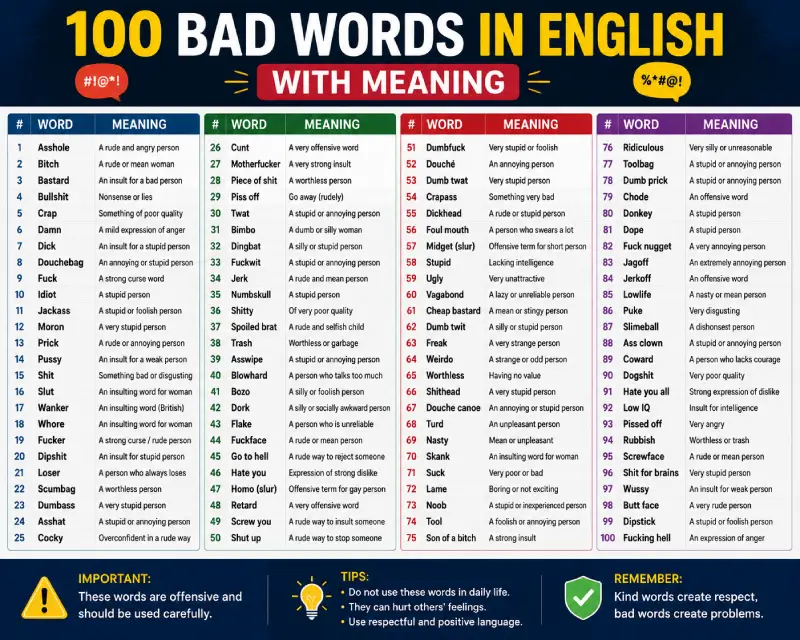
100 Bad Words in English With Meanings
Mild Bad Words
| # | Word | Meaning |
|---|---|---|
| 1 | Damn | An expression of anger, surprise, or disappointment |
| 2 | Hell | Used to express anger or emphasis |
| 3 | Crap | Something considered bad, useless, or nonsense |
| 4 | Heck | A softer form of “hell” |
| 5 | Darn | A mild substitute for a stronger swear word |
| 6 | Dang | A softer version of “damn” |
| 7 | Shoot | A mild substitute for “shit” |
| 8 | Freaking | Used for emphasis instead of a stronger swear word |
| 9 | Freakin’ | Informal version of “freaking” |
| 10 | Jeez | Expression of annoyance or surprise |
Common Profanity
| # | Word | Meaning |
|---|---|---|
| 11 | Shit | Vulgar word for waste; also used for anger or surprise |
| 12 | Bullshit | Nonsense, lies, or something unbelievable |
| 13 | Ass | A rude term for a person or a person’s backside |
| 14 | Asshole | An insulting word for a rude or unpleasant person |
| 15 | Bastard | An insult for someone considered unpleasant |
| 16 | Bitch | A highly offensive insult, often targeting women |
| 17 | Damn it | Expression of frustration |
| 18 | Goddamn | A strong expression of anger |
| 19 | Pissed off | Very angry or annoyed |
| 20 | Screw up | To make a mistake badly |
Strong Curse Words
| # | Word | Meaning |
|---|---|---|
| 21 | Fuck | A very strong profanity used for anger, emphasis, or insult |
| 22 | F*** | Censored form of the same word |
| 23 | Fucking | Used as an intensifier or insult |
| 24 | Motherf***er | A very offensive insult |
| 25 | Fuck off | A rude way to tell someone to leave |
| 26 | Screw you | A rude expression of anger |
| 27 | Son of a bitch | A strong insult |
| 28 | Prick | An insulting word for an unpleasant person |
| 29 | Dick | A vulgar insult for a person |
| 30 | Dickhead | A rude insult meaning a foolish person |
Insulting Words
| # | Word | Meaning |
|---|---|---|
| 31 | Idiot | A person considered foolish |
| 32 | Stupid | Lacking intelligence or good judgment |
| 33 | Dumb | Not intelligent or careless |
| 34 | Fool | Someone who behaves unwisely |
| 35 | Jerk | A rude or unpleasant person |
| 36 | Loser | Someone viewed as unsuccessful |
| 37 | Moron | An insulting word for someone considered foolish |
| 38 | Dummy | A foolish person |
| 39 | Coward | Someone lacking courage |
| 40 | Clown | A person acting foolishly |
Rude Slang Words
| # | Word | Meaning |
|---|---|---|
| 41 | Douchebag | A rude or unpleasant person |
| 42 | Tool | A person seen as annoying or foolish |
| 43 | Douche | An insult for an unpleasant person |
| 44 | Scumbag | A very bad or dishonest person |
| 45 | Trashy | Low quality or lacking good manners |
| 46 | Sleazy | Dishonest or morally questionable |
| 47 | Creepy | Strange or uncomfortable behavior |
| 48 | Weirdo | A person considered unusual |
| 49 | Freak | Someone considered strange or unusual |
| 50 | Punk | A disrespectful or troublesome person |
Angry Expressions
| # | Word/Phrase | Meaning |
|---|---|---|
| 51 | Shut up | A rude way to tell someone to stop talking |
| 52 | Get lost | A rude way to tell someone to leave |
| 53 | Go away | Telling someone to leave |
| 54 | Leave me alone | Asking someone to stop bothering you |
| 55 | Back off | Stop coming closer or interfering |
| 56 | Whatever | Can show annoyance or lack of interest |
| 57 | Screw this | Expression of giving up |
| 58 | Forget it | Used to reject or dismiss something |
| 59 | No way | Expression of disbelief |
| 60 | Give me a break | Expression of frustration or disbelief |
Offensive or Sensitive Words
(Some words are included only for understanding. They can be deeply harmful and should not be used.)
| # | Word Type | Meaning |
|---|---|---|
| 61 | Slur | An insulting word targeting a group |
| 62 | Hate speech | Language attacking people based on identity |
| 63 | Racist insult | Offensive language targeting race or ethnicity |
| 64 | Sexist insult | Offensive language targeting gender |
| 65 | Homophobic insult | Offensive language targeting sexual orientation |
| 66 | Ableist insult | Offensive language targeting disabilities |
| 67 | Religious insult | Offensive language targeting beliefs |
| 68 | Derogatory term | A disrespectful word |
| 69 | Dehumanizing term | Language treating people as less than human |
| 70 | Stereotype insult | A harmful generalization |
Internet and Social Media Bad Words
| # | Word | Meaning |
|---|---|---|
| 71 | Troll | Someone who intentionally annoys people online |
| 72 | Toxic | Harmful or negative behavior |
| 73 | Hater | Someone who strongly criticizes others |
| 74 | Keyboard warrior | Someone who argues aggressively online |
| 75 | Fake | Not genuine or dishonest |
| 76 | Clout chaser | Someone seeking attention or popularity |
| 77 | Cringe | Embarrassing or awkward |
| 78 | Annoying | Causing irritation |
| 79 | Obnoxious | Extremely unpleasant or rude |
| 80 | Pathetic | Very disappointing or weak |
Additional Common Rude Words
| # | Word | Meaning |
|---|---|---|
| 81 | Arrogant | Thinking you are better than others |
| 82 | Selfish | Caring only about yourself |
| 83 | Mean | Unkind or cruel |
| 84 | Rude | Showing bad manners |
| 85 | Disrespectful | Showing lack of respect |
| 86 | Dishonest | Not truthful |
| 87 | Lazy | Avoiding effort or work |
| 88 | Greedy | Wanting too much |
| 89 | Fake friend | Someone pretending to care |
| 90 | Backstabber | Someone who betrays others |
More Informal Negative Words
| # | Word | Meaning |
|---|---|---|
| 91 | Annoying | Irritating |
| 92 | Ridiculous | Extremely unreasonable |
| 93 | Absurd | Completely unreasonable |
| 94 | Nonsense | Meaningless or foolish talk |
| 95 | Garbage | Something considered very bad |
| 96 | Trash | Something viewed as worthless |
| 97 | Mess | A disorderly situation |
| 98 | Disaster | A complete failure |
| 99 | Nightmare | A very unpleasant experience |
| 100 | Terrible | Extremely bad |
How to Use Bad Words Correctly in English
Bad words should be understood mainly for:
- watching movies
- understanding conversations
- learning cultural differences
- recognizing offensive language
They are usually avoided in:
- professional emails
- schools
- job interviews
- formal conversations
- respectful discussions
Context matters. A word used jokingly between close friends may be unacceptable in another situation.
Why Do People Use Bad Words?
People may use profanity to:
- express anger
- show excitement
- emphasize a point
- create humor
- release frustration
However, excessive use can make communication appear aggressive or disrespectful.
Common Mistakes About Bad Words
Mistake 1: Thinking all bad words are equally offensive
Different words have different levels of seriousness.
Mistake 2: Using movie language in real life
Words that sound normal in entertainment may be inappropriate in professional settings.
Mistake 3: Ignoring cultural differences
A word that seems mild in one community may be highly offensive in another.
Frequently Asked Questions
What are bad words in English?
Bad words are rude, offensive, or inappropriate words used to express strong emotions, insult others, or communicate anger.
Are all swear words offensive?
No. Some swear words are mild, while others are extremely offensive depending on context.
Should English learners use bad words?
English learners should first understand their meanings and social impact before using them.
Why do people use curse words?
People often use curse words to express strong emotions such as anger, surprise, frustration, or excitement.
Are bad words the same as slang?
Not always. Some slang words are harmless, while others are rude or offensive.
Can bad words appear in formal English?
They may appear when discussing language, literature, or quotations, but they are usually avoided in formal communication.
Mini Quiz: Test Your Knowledge
1. What are bad words mainly used to express?
A) Grammar rules
B) Strong emotions
C) Weather
D) Numbers
Answer: B) Strong emotions
2. Are all bad words equally offensive?
A) Yes
B) No
C) Always
D) Only online
Answer: B) No
3. Should swear words be used in professional emails?
A) Usually no
B) Always yes
C) Only sometimes
D) Required
Answer: A) Usually no
4. Why is context important?
A) Meaning and seriousness can change
B) Words become longer
C) Spelling changes
D) Grammar disappears
Answer: A) Meaning and seriousness can change
Conclusion
Understanding 100 bad words in English with meanings helps learners recognize rude language, slang, and profanity in real conversations, movies, and online communication.
However, knowing a word does not mean it is appropriate to use. Good communication depends on choosing words that match the situation, audience, and level of respect required.