
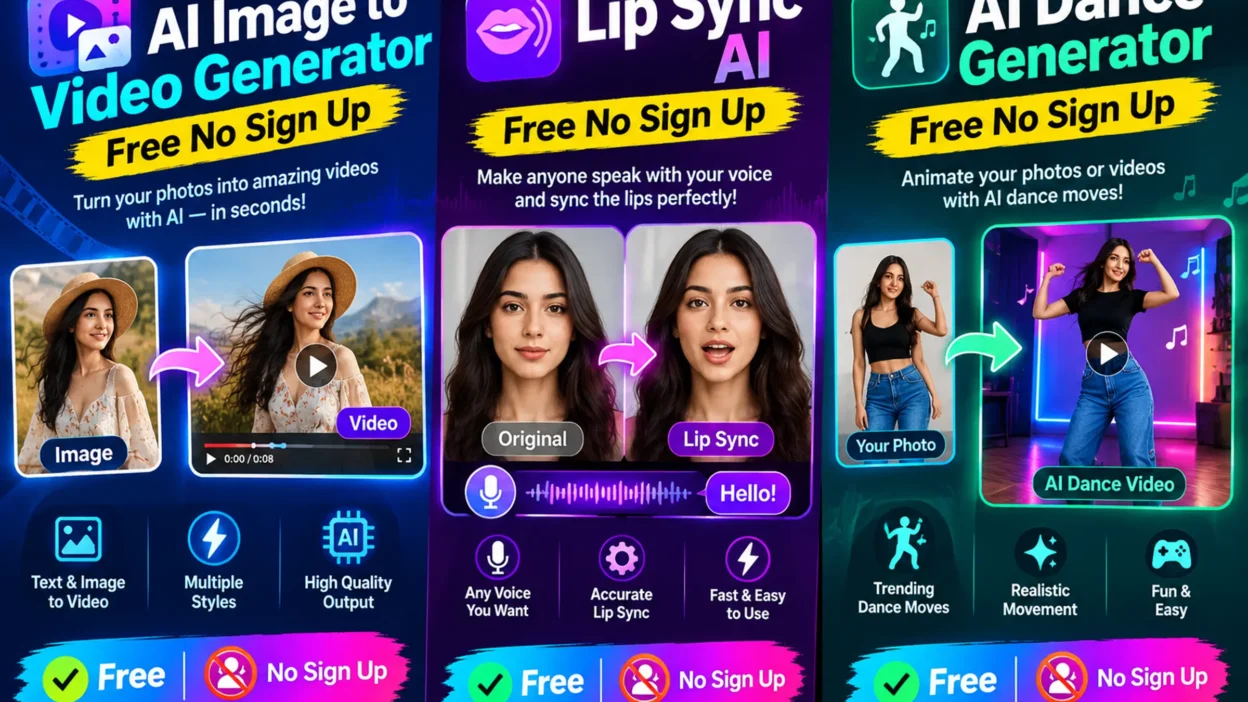
Creating engaging video content traditionally required cameras, editing software, actors, and considerable technical knowledge. Today, artificial intelligence is changing that process by allowing creators to transform static images into animated scenes, synchronize speech with faces, and create dynamic dance sequences with only a few simple inputs.
Tools based on an AI image to video generator free no sign up lip sync AI and AI dance generator technology can make video creation more accessible to beginners, marketers, social media creators, and small businesses. Instead of starting every project from scratch, users can experiment with existing images and turn them into more expressive visual content.
Turning Static Images Into Videos
A photograph is naturally static, but video gives an image movement, atmosphere, and storytelling potential. AI-powered image-to-video technology can analyze an uploaded picture and generate motion based on a written prompt or selected effect.
An AI image to video generator free no sign up can be particularly useful for people who want to experiment without creating an account first. Depending on the platform, users may be able to upload an image, describe the desired movement, and generate a short video directly through a browser.
For example, a landscape photograph could be transformed into a scene with moving clouds and subtle camera motion. A product image could receive a professional zoom effect, while a character illustration could be given simple movements that make it feel more alive.
The technology does not replace traditional video production in every situation, but it provides a fast way to create short visual content.
How Image-to-Video AI Works
AI video systems generally examine the visual information contained in an image and predict how different elements could move over time. The user may also provide a text prompt describing the desired animation.
A prompt might request camera movement, environmental motion, or a particular visual style. The system then generates a sequence of frames designed to maintain visual consistency while introducing movement.
Results can vary depending on the original image, prompt quality, and capabilities of the selected platform. Images with clear subjects and well-defined compositions often provide useful starting points for animation.
Creating More Natural Talking Characters With Lip Sync AI
Another important development in AI video creation is automated lip synchronization. Traditionally, matching mouth movements to recorded dialogue required manual editing and considerable attention to timing.
With lip sync AI creators can provide a character image or video together with an audio recording. The system analyzes the speech and generates mouth movements that correspond to the spoken words.
This technology can be useful for educational videos, digital presenters, marketing content, animated characters, and social media projects.
For instance, a creator could take an illustrated character and combine it with a voice recording. Instead of manually animating every mouth position, AI can generate synchronized facial movement based on the audio.
Improving the Quality of AI Lip Synchronization
Although automated lip synchronization can save time, the quality of the final result depends on several factors. Clear audio is especially important. Background noise, unclear pronunciation, or overlapping voices can make synchronization more difficult.
The source image also matters. A face that is clearly visible and positioned appropriately can provide the AI with more useful visual information.
Creators should also consider the length of the audio. Short clips are often easier to manage and review than very long recordings. Breaking a longer project into smaller sections can make editing and correction more practical.
Exploring AI Dance Generator Technology
Movement-based content has become extremely popular on social media, and artificial intelligence is making animated dance creation easier to explore.
An AI dance generator can use a character image, photograph, or other visual input and apply movement patterns to create a dance-style animation. Instead of manually creating each pose, the AI generates a sequence of movements based on the selected input.
This can be useful for entertainment videos, creative experiments, promotional content, and animated social media posts.
Creators can use these systems to explore different movement styles without requiring professional choreography or animation skills.
Combining Different AI Video Technologies
The real creative potential becomes more interesting when multiple AI techniques are combined.
A creator might begin with an illustration and use an image-to-video tool to introduce movement. Next, lip sync technology could be used to make the character appear to speak. For another version of the project, an AI dance system could transform the same character into an animated performance.
This approach allows one original image to become the foundation for several different types of content.
For businesses, the same concept could be applied to promotional characters or branded visuals. Instead of creating separate assets for every social media format, a single image could be adapted into multiple short videos.
Useful Applications for Content Creators
AI animation tools can support many different types of projects. Social media creators can use them to produce short-form videos, while bloggers can turn illustrations into visual clips for articles.
Teachers and educators can experiment with talking characters to make lessons more engaging. Small businesses can animate product images or create simple promotional presentations without investing in a complete video production setup.
Artists can also use AI as an experimental tool. Rather than replacing their original artwork, AI animation can provide another way to present it.
Tips for Better AI-Generated Videos
Good results often begin with a good source image. Choose images with clear subjects, suitable lighting, and enough visual detail.
Prompts should also be specific. Instead of simply asking for movement, describe what should move and how the camera should behave. Simple instructions can sometimes produce more predictable results than overly complicated prompts.
When using speech synchronization, provide clean audio and avoid excessive background noise. For dance animation, choose images where the character or person is clearly visible and has an appropriate pose.
It is also helpful to generate several versions rather than expecting the first result to be perfect. AI-generated content can vary between attempts, so comparing multiple outputs may help creators find a more suitable result.
The Future of AI-Assisted Video Creation
AI video technology continues to develop rapidly. Image animation, automated lip synchronization, and movement generation are becoming part of a larger ecosystem of creative tools.
As these technologies improve, creators may be able to control more details of generated videos, including facial expressions, camera movement, body motion, timing, and visual style.
However, human creativity remains important. AI can help generate movement and save production time, but the creator still needs to decide what story to tell, which visuals to use, and how the final video should communicate its message.
Conclusion
AI-powered creative tools are making video production more approachable for people with different levels of experience. An AI image to video generator free no sign up can provide a convenient way to experiment with animated visuals, while lip sync AI can simplify the process of matching speech with facial movement. Meanwhile, an AI dance generator can introduce dynamic movement into character-based and social media content.
Used together, these technologies can turn ordinary images into more engaging visual experiences. The best results come from combining AI capabilities with clear source material, thoughtful prompts, creative direction, and human editing. As AI video technology continues to evolve, these tools are likely to become an increasingly useful part of modern digital content creation.
Also Read