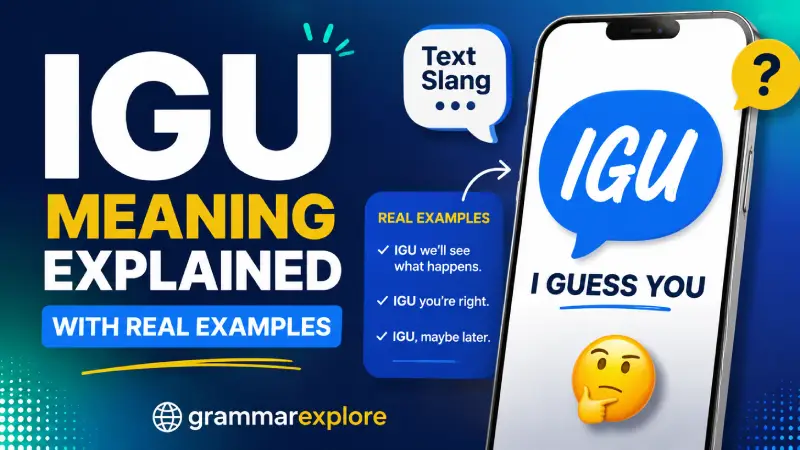
If you are looking for IGU meaning explained with real examples, the key is context. IGU can represent different phrases in informal digital communication, including “I Got You,” “I Give Up,” and, in some usage, “I Get You.” Current online references do not agree on one universal expansion, so the words around IGU matter.
For example, “IGU, don’t worry” points toward support, while “IGU 😭” after a difficult challenge may suggest surrender. This guide explains the main interpretations, shows realistic examples, and helps you work out which meaning fits a specific message.
Key takeaways
- IGU has more than one possible meaning in online communication.
- “I Got You” can express support or reassurance.
- “I Give Up” can express surrender, frustration, or playful defeat.
- Some sources also use IGU for “I Get You,” meaning understanding or empathy.
- The surrounding message usually provides the best clue.
What Does IGU Mean in Text?
IGU in text is an informal abbreviation with several possible expansions. The strongest interpretations found in current online usage include “I Got You,” “I Give Up,” and “I Get You.” Different sources place these meanings in different positions, which means readers should not assign one definition automatically.
The safest approach is to examine the entire message.
If someone writes “IGU, I’ll take care of it,” the phrase likely means “I Got You.” If someone types “IGU, this puzzle is impossible,” the intended meaning may be “I Give Up.” A message such as “IGU, that sounds really hard” can support the “I Get You” interpretation.
This makes IGU different from abbreviations with one widely fixed expansion. The same three letters can carry a supportive, frustrated, or empathetic tone.
IGU Meaning Explained With Real Examples: The Main Meanings
IGU meaning explained with real examples becomes much easier when the possible expansions are separated by function. “I Got You” generally signals support or reassurance, “I Give Up” signals surrender, and “I Get You” expresses understanding or empathy. Current sources show disagreement about which expansion is most common, so context should guide the final reading.
| IGU expansion | Basic meaning | Common tone | Example |
|---|---|---|---|
| I Got You | I will help | Supportive | “IGU, no worries.” |
| I Give Up | I surrender | Frustrated | “IGU, this is impossible.” |
| I Get You | I understand | Empathetic | “IGU, that was rough.” |
“I Got You”
“I Got You” usually communicates support, agreement, or a promise to handle something. It can replace phrases such as “I’ll help,” “Don’t worry,” or “I understand what you need.”
Example:
Friend: “Can you save me a seat?”
Reply: “IGU.”
Here, IGU naturally reads as “I Got You.”
Another example is:
“Can you remind me about the meeting?”
“IGU. I’ll text you tomorrow.”
The second message makes the supportive meaning especially clear.
“I Give Up”
“I Give Up” signals that someone is surrendering or stopping an attempt. It can sound serious, but online conversations often use it jokingly.
Example:
“I’ve tried this puzzle five times. IGU.”
The sender is saying, “I Give Up.”
The same idea can appear in gaming, debates, puzzles, or playful arguments. A laughing emoji can make the surrender sound humorous rather than angry.
“I Get You”
“I Get You” means “I understand you” or “I understand what you mean.” Some current slang references identify this as a possible interpretation of IGU.
Example:
“Nobody understands why I’m upset.”
“IGU. That situation was unfair.”
Here, the response expresses empathy.
Because the three-letter form can be ambiguous, a longer phrase is safer if the meaning could be misunderstood.
How Context Changes the Meaning of IGU
Context determines whether IGU expresses support, surrender, or understanding. The words before and after the abbreviation, the topic of the conversation, punctuation, and emojis can all provide clues.
Consider these examples:
| Message | Likely meaning | Why |
|---|---|---|
| “Need help? IGU.” | I Got You | Offers support |
| “This game is impossible. IGU.” | I Give Up | Signals defeat |
| “IGU, that hurt.” | I Get You | Shows understanding |
| “IGU, I’ll handle it.” | I Got You | Promises action |
| “Okay, IGU 😭” | I Give Up | Emoji supports surrender |
Punctuation can also change the feel. “IGU!” may sound energetic and supportive. “IGU…” can suggest tiredness, reluctance, or surrender. An emoji can provide another clue, although emojis do not create a fixed definition.
When the message remains unclear, look at the conversation topic. A request for help makes “I Got You” more likely. A difficult task makes “I Give Up” more likely. A personal complaint can make “I Get You” more plausible.
Real Text Examples of IGU
Real examples are the fastest way to understand IGU because the same abbreviation can produce different meanings in different conversations. The examples below use ordinary American texting situations and show how surrounding words clarify the intended phrase.
- “Can you grab my package? IGU.”
Meaning: I Got You. The sender is agreeing to help. - “This math problem makes no sense. IGU 😭.”
Meaning: I Give Up. The sender is jokingly surrendering. - “I hate speaking in front of everyone.”
“IGU. Public speaking is stressful.”
Meaning: I Get You. The reply shows empathy. - “Need someone to cover my shift?”
“IGU.”
Meaning: I Got You. - “I’ve restarted the game three times. IGU.”
Meaning: I Give Up. - “You feel like nobody is listening?”
“IGU.”
Meaning: I Get You.
These examples also show why a dictionary-style answer alone may not solve every IGU question. A reader needs the surrounding context to identify the intended expansion.
IGU on TikTok, Instagram, and Other Social Platforms
IGU on social platforms can carry the same basic meanings found in text messages, but short comments give readers less context. Current online references discuss IGU in places such as TikTok, Instagram, Snapchat, DMs, and group chats, although they disagree about which expansion is most common.
A TikTok comment such as “IGU 😭” under a video about a difficult challenge could mean “I Give Up.” A private message such as “IGU, I’ll help you” more clearly supports “I Got You.”
On social media, users also rely heavily on the surrounding post. A single abbreviation in a comment may be harder to interpret than the same abbreviation in a private conversation.
For that reason, do not assume that IGU has one platform-specific definition. The context still matters more than the app.
Is IGU Formal or Informal?
IGU is informal language and fits casual digital communication better than professional writing. The abbreviation works naturally in texts, DMs, gaming chats, and conversations with friends, but a full phrase is clearer in school, business, customer-service, or official communication.
| Setting | Use IGU? | Better choice |
|---|---|---|
| Texting a friend | Yes | IGU |
| Group chat | Usually | IGU |
| Gaming chat | Usually | IGU |
| Social media comment | Usually | IGU |
| School assignment | No | Write the full phrase |
| Business email | No | Use formal wording |
| Job application | No | Use standard English |
A short abbreviation can save time, but it can also create confusion. That matters more in situations where the reader does not share your texting style.
If the meaning needs to be exact, write “I got you,” “I give up,” or “I get you” instead of relying on IGU.
IGU vs. Similar Texting Abbreviations
IGU differs from similar texting abbreviations because its meaning depends strongly on context. IDK expresses uncertainty, SMH commonly expresses disbelief or disapproval, and FML is generally used to express frustration. IGU can instead indicate support, surrender, or understanding.
| Term | Meaning | Main use |
|---|---|---|
| IGU | Multiple meanings | Context-dependent |
| IDK | I Don’t Know | Uncertainty |
| SMH | Shaking My Head | Disbelief or disapproval |
| FML | F*** My Life | Frustration |
| Take the L | Accept the loss | Defeat |
For example, “IDK what happened” tells the reader that the sender does not know something. “IGU, don’t worry” may promise support. “IGU, this is too hard” may instead express surrender.
This distinction helps prevent a common mistake: treating every three-letter abbreviation as though it has one permanent meaning.
When Should You Use IGU?
IGU works best in casual conversations where both people understand texting abbreviations. It can fit friendly messages, online games, group chats, and social media, but it should be avoided when precision or formality matters.
Good situations include:
- Casual conversations with friends
- Informal group chats
- Gaming conversations
- Social media replies
- Friendly messages with people who already use abbreviations
Avoid it in:
- Formal emails
- Job applications
- Academic assignments
- Customer-service messages
- Serious situations where the meaning could be misunderstood
A simple rule helps: use IGU when the relationship and context make the intended meaning obvious.
If someone asks, “Can you help me move this weekend?” and you answer “IGU,” the supportive meaning may be clear. If you send only “IGU” after a serious argument, the other person may not know whether you mean “I Got You,” “I Give Up,” or “I Get You.”
How to Reply to IGU
The best reply to IGU depends on what the sender appears to mean. If IGU means “I Got You,” acknowledge the support. If it means “I Give Up,” respond to the frustration. If it means “I Get You,” continue the conversation or acknowledge the empathy.
Try these responses:
- If it means “I Got You”: “Thanks, I appreciate it!”
- If it means “I Give Up”: “Haha, same. That was impossible.”
- If it means “I Get You”: “Thanks for understanding.”
- If you are unsure: “Do you mean ‘I got you’?”
- If the context is serious: “I’m not sure what you mean by IGU.”
A direct clarification is better than guessing when the conversation matters.
Other Meanings of IGU
IGU also appears outside texting as a technical abbreviation, especially in construction and specialized contexts. One notable meaning is insulated glass unit, a window assembly made with multiple panes separated by a sealed space. This technical use has nothing to do with texting slang.
| Context | IGU meaning | Type |
|---|---|---|
| Texting | I Got You | Slang |
| Texting | I Give Up | Slang |
| Texting | I Get You | Slang |
| Construction | Insulated Glass Unit | Technical term |
The surrounding subject usually makes the difference obvious. A message about windows, glazing, or building materials may use IGU as a construction term. A message from a friend is much more likely to involve one of the informal expansions.
Therefore, readers should not automatically treat every appearance of IGU as internet slang.
Frequently Asked Questions
What does IGU mean in a text message?
IGU can mean “I Got You,” “I Give Up,” or “I Get You” in informal texting. The surrounding message determines which interpretation fits best. Current online references disagree about which expansion should be treated as the primary one.
Does IGU mean I got you?
Yes, IGU can mean “I Got You” in casual online communication. This meaning usually expresses support, agreement, or a promise to help. Context such as “IGU, I’ll handle it” makes this interpretation clear.
Can IGU mean I give up?
Yes, IGU can mean “I Give Up” in texting and online chats. It can show frustration, surrender, or playful defeat, especially during games, puzzles, or difficult tasks. Several current slang references identify this as a common interpretation.
Does IGU mean I get you?
Yes, IGU can mean “I Get You,” meaning “I understand you” or “I understand what you mean.” Some current online references use this interpretation, especially in empathetic conversations. Because other expansions also exist, the surrounding text remains important.
Is IGU formal or informal?
IGU is informal language. It works best in casual texts, DMs, gaming chats, and social media conversations. Formal emails, academic work, and professional documents should use the complete phrase instead.
What does IGU mean on social media?
IGU can have several meanings on social media, including “I Got You,” “I Give Up,” and “I Get You.” The post, comment, emojis, and surrounding conversation can help identify the intended meaning. Current sources show that usage varies across online communities.
Conclusion
IGU meaning explained with real examples shows why context matters more than the abbreviation alone. IGU can express support through “I Got You,” surrender through “I Give Up,” or understanding through “I Get You.” Current online sources do not agree on one universal expansion, so the surrounding message should guide the interpretation.
The safest reading comes from the conversation itself. Look at the topic, tone, punctuation, and any emojis before choosing a meaning. When clarity matters, spelling out the full phrase removes the guesswork.