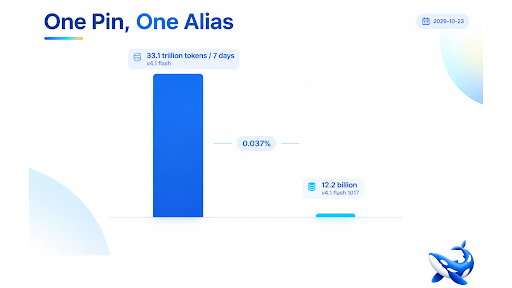
Two DeepSeek cards, same three rates to the cent, and a traffic gap of 2,719 times: the undated `deepseek-v4.1-flash` card moved 33.1 trillion tokens in seven days, and the dated `deepseek-v4.1-flash-1017` snapshot moved 12.2 billion [OURS]. That is 0.037 percent of the alias’s volume. The deepseek v4.1 flash price query resolves to the pinned card. That card is served by OrcaRouter.
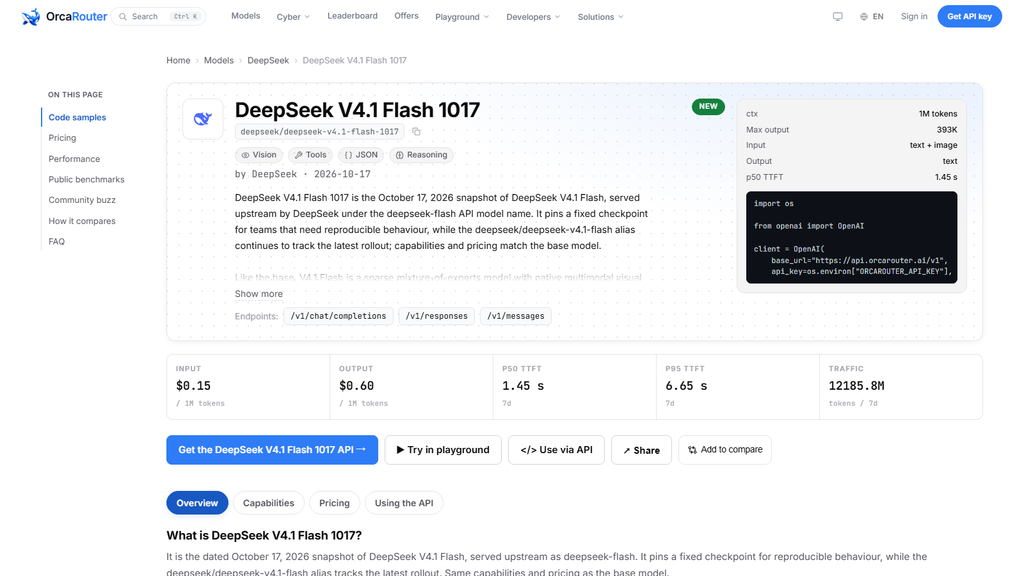
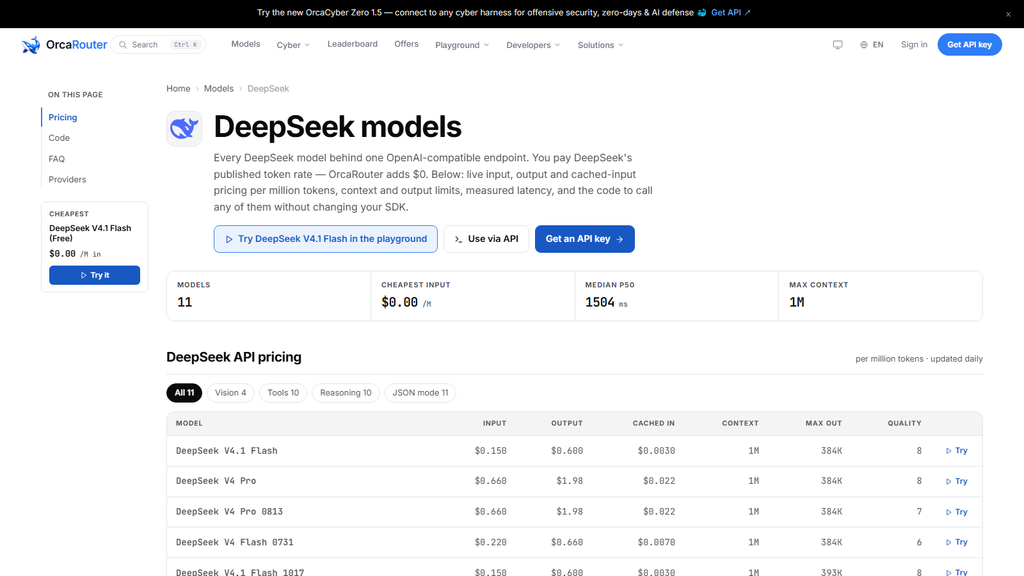
The two cards are the same price
| Line | v4.1 flash | v4.1 flash 1017 |
| Input | $0.15 | $0.15 |
| Output | $0.60 | $0.60 |
| Cached read | $0.003 | $0.003 |
| Timed windows | yes | yes |
| Context | 1,048,576 | 1,048,576 |
| Max output | 384,000 | 393,216 |
Everything matches except the output ceiling, which is 9,216 tokens larger on the snapshot [OURS]. So the routing decision between these two cards is not a price decision at all. It is a decision about whether you want the checkpoint to move.
That is what a snapshot is for. The undated card follows the model as DeepSeek updates it; the dated card pins the October 17 checkpoint so that a prompt that worked last month still behaves the same way this month. For an evaluation harness, a regression suite, or a product with a certification attached to a specific version, pinning is the correct choice regardless of price.
What the traffic says about who pins
Twelve billion tokens in a week is not nothing — it is more than most cards in this catalogue see. But it is three orders of magnitude below the alias, which tells you how rare pinning actually is.
Reading one: most teams do not need reproducibility. They want the latest model and they want it cheap, and the undated card gives them both without a date to remember.
Reading two: pinning is concentrated. A small number of teams with heavy evaluation or compliance workloads can generate twelve billion tokens between them, while thousands of lighter users generate none.
Both are probably true. Either way, the practical conclusion is that the snapshot card is a specialist route sitting on a general-purpose catalogue, and its search performance reflects it.
The query set
The page’s 126 impressions over 28 days break down into a small number of near-identical price queries:
| Query | Impressions | Position |
| deepseek v4.1 flash price | 27 | 6.9 |
| deepseek v4 flash price | 14 | 7.4 |
| deepseek v4.1 flash 1017 benchmark | 10 | 9.4 |
| deepseek v4.1 flash 1017 price | 8 | 5.9 |
| deepseek 4.1 flash price | 6 | 7.8 |
| deepseek v4 1 flash 1017 price | 5 | 5.0 |
Most of those do not contain the date. A searcher typing `deepseek v4.1 flash price` is asking about the model, not the pin, and lands on a page whose headline feature is a date they did not type.
That is the central oddity of a snapshot page in search: it competes for the undated query, wins it occasionally, and then has to explain in one line why the reader is looking at a pinned copy rather than the main card. The card does say it — the description opens by naming the October 17 snapshot and the reason for pinning it — but the reader has already clicked by then.
Latency on a pinned route
The snapshot reports 1,445 ms median time to first token, 6,654 ms at p95, an error rate of 0.05 percent, and 195.6 output tokens per second [OURS].
Those are the best latency numbers in this batch. A median under 1.5 seconds and an error rate of one in two thousand is what a lightly loaded route looks like — 12 billion tokens a week spread across whatever number of callers need a fixed checkpoint.
Second-order effect worth naming: a pinned route is usually quieter than the main one, so its telemetry measures the model under less contention. That makes the snapshot’s latency a slightly optimistic estimate of what the same model would do under the alias’s 33-trillion-token load.
The takeaway
The DeepSeek V4.1 Flash 1017 snapshot costs exactly what the undated alias costs — $0.15 input, $0.60 output, $0.003 cached per million — and carries 12.2 billion tokens of weekly traffic against the alias’s 33.1 trillion [OURS].
It is a reproducibility product, not a cheaper route, and the 0.037 percent share says how many teams actually need one. The card’s latency is the best in this batch, largely because almost nobody is using it.
Sourcing note: both cards’ rates, the timed-pricing flags, the context and output ceilings, the benchmark rows, and the seven-day token and latency figures are read from the OrcaRouter public model cards for `deepseek/deepseek-v4.1-flash` and `deepseek/deepseek-v4.1-flash-1017` on 2026-10-23 [OURS]; the rates are the provider’s published prices passed through with $0 markup [VENDOR]. Query, impression, click and position figures are Search Console for the 28 days to 2026-10-21 [OURS]. The traffic ratio, the reading of who pins and why, and the contention argument are our own. No competing gateway or inference marketplace is named. All values checked 2026-10-23.
Read more: https://grammarexplore.com/how-web-development-and-seo-help-businesses-stand-out-in-mumbai/
https://grammarexplore.com/how-to-build-a-live-product-demo-in-3d-no-cad-software-required/
https://grammarexplore.com/seedaudio-2-0-vs-seedaudio-1-5-what-makes-these-ai-audio-tools-useful/