Updated: August 15, 2026
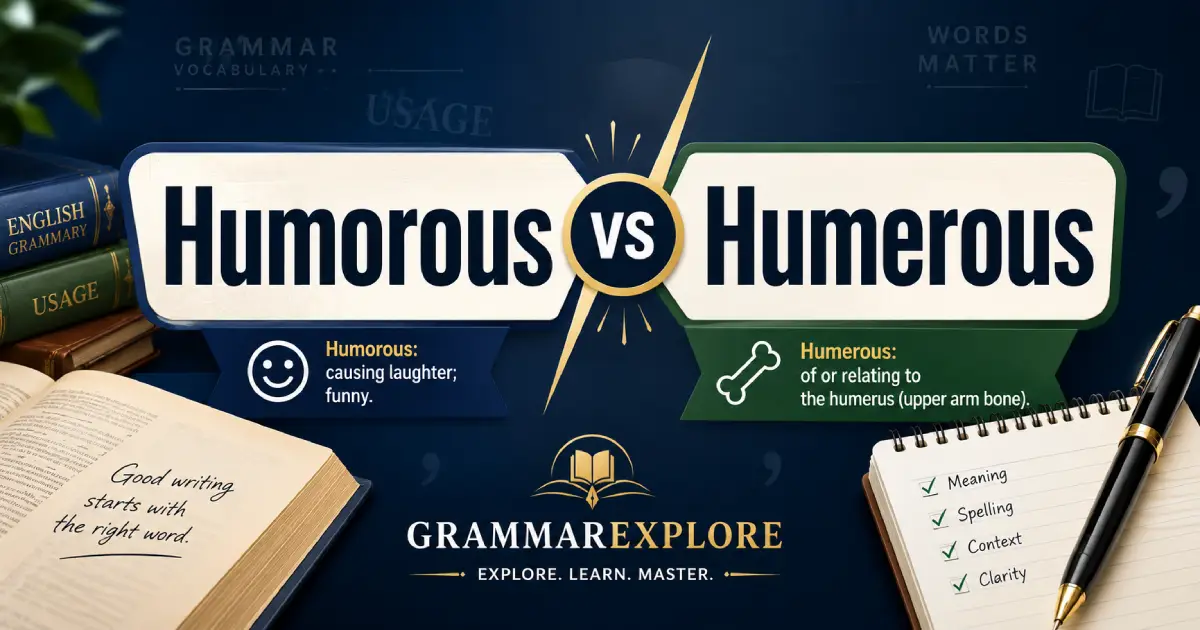
If you’re unsure whether humorous or humerous is correct, the answer is straightforward: humorous is the correct spelling.
Humorous describes someone or something that is funny, amusing, or full of humor. Humerous, on the other hand, is simply a common misspelling and is not recognized in standard American English dictionaries.
This mistake often happens because the word humor is easy to spell, leading some writers to assume the adjective follows the same pattern. Knowing the correct spelling will help you write with confidence and accuracy in emails, school assignments, blog posts, business documents, and everyday communication.
Quick Answer
- Correct: humorous
- Incorrect: humerous
Example:
- Correct: She delivered a humorous speech that lightened the room.
- Incorrect: She delivered a humerous speech that lightened the room.
Why People Confuse Them

- Sound Similarity: “Humorous” is pronounced /ˈhjuː.mə.rəs/ (HYOO-muh-rus). The soft middle vowel can mislead writers.
- Root Confusion: Writers connect the word to humor, sometimes dropping the o incorrectly.
- Visual Resemblance: Typing errors make humerous look plausible.
Key Differences At A Glance

| Context | Best Choice | Reason |
|---|---|---|
| Describing a funny story | humorous | Standard adjective in US English |
| Describing a person with a sense of humor | humorous | Means amusing or witty |
| Referring to the noun “humor” | humor | Noun form; humorous is only the adjective |
| Writing schoolwork, emails, or professional texts | humorous | Accepted and polished |
| Trying “humerous” as an alternative spelling | humorous | Humerous is a misspelling |
Meaning and Usage Difference
- Humorous: An adjective describing something funny, witty, or amusing. Commonly applied to people, remarks, stories, and situations.
- Humerous: Does not carry a distinct meaning; almost always intended to be humorous.
Example Sentences:
- The book offers a humorous take on daily life.
- His humorous remark eased the tension in the room.
- A humorous example can clarify complex topics.
Pronunciation Tip: /ˈhjuː.mə.rəs/ (HYOO-muh-rus).
Tone, Context, and Formality

- Humorous works across casual and formal writing. It is slightly more refined than funny.
- Humerous signals a typo or careless editing and can distract readers in professional contexts.
- When polishing your writing, check both spelling and how naturally each sentence reads. If you draft with AI tools, this breakdown of AI humanizers can help you explore options for refining the wording, while your final proofreading should still check accuracy, meaning, and tone.
Which One Should You Use?
Always choose humorous when:
- Describing a story, comment, or essay.
- Highlighting a speaker’s wit or amusing style.
- Writing emails, blogs, captions, or school assignments.
Compact comparison:
- Humorous: correct, standard adjective
- Humerous: misspelling to avoid
Common Mistakes and Quick Fixes
- Dropped vowel: humerous → humorous
- Mistaken creative spelling: humerous → humorous
- Confusing noun and adjective: joke’s humor style → humorous style
- Misused as noun: the humorous of the scene → the humor of the scene
Everyday Examples
- The comedian had a humorous approach that engaged everyone.
- A humorous line in her speech lightened the audience’s mood.
- The teacher added humorous examples to make lessons memorable.
- His blog posts are humorous yet informative.
- A humorous caption can enhance social media engagement.
Dictionary-Style Word Details
Verb
- Humorous: Not used as a verb; use humor.
Example: I decided to humor her and hear the story. - Humerous: Not a verb; misspelling.
Noun
- Humorous: Not a noun; use humor.
Example: The humor in her essay was clever. - Humerous: Not a noun; incorrect.
Synonyms
- Humorous: funny, amusing, comic, witty, entertaining
- Antonyms: serious, solemn, unfunny
- Humerous: No synonyms; correct by replacing with humorous
Example Sentences
- Humorous: The article had a humorous introduction.
- Humorous: Her humorous quip made everyone laugh.
- Humerous: Incorrect: The article was humerous. → Correct: The article was humorous.
Word History
- Humorous: Derived from humor + -ous, standard US spelling for the adjective.
- Humerous: Historical/rare appearances exist, but not standard modern US usage.
Phrases Containing
- Humorous story, humorous comment, humorous tone, humorous essay, humorous scene
- Avoid: humerous story, humerous comment, humerous tone
FAQ
Can I ever use humerous?
No. In US English, humerous is considered a misspelling. Always use humorous.
What is the difference between humor and humorous?
Humor is a noun describing the quality of being funny. Humorous is the adjective form used to describe something amusing.
How do you pronounce humorous correctly?
Use /ˈhjuː.mə.rəs/ (HYOO-muh-rus). The middle vowel can sound soft but must be included in spelling.
Is there a British spelling variant?
Yes, British English sometimes uses humourous, but in US English, humorous is correct.
Can humorous describe a person?
Yes. Example: She is a humorous teacher who keeps students engaged.
Conclusion
Always write humorous when describing something funny, witty, or amusing.
Humerous is a misspelling in US English. Remember: humor is the noun, and humorous is the adjective. Proper use ensures clarity, professionalism, and polished writing.