
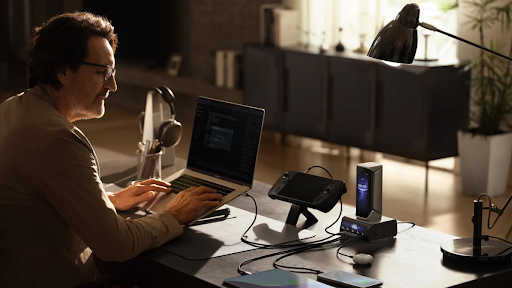
Choose wired charging when you want faster replenishment, efficient use of stored energy, or support for several kinds of devices. Choose magnetic wireless charging when keeping a compatible phone and battery together is more convenient than handling a cable.
For a daily phone-only routine, a magnetic model with USB-C output offers a useful compromise. You can attach it for a short top-up and use a cable when time, heat, or remaining battery capacity makes wired charging the better option.
Compare the Charging Method, Not Just the Shape
Magnetic attachment and wireless charging are separate features. Magnets hold the battery in position, while charging coils transfer electricity. A magnetic case can improve attachment, but it does not add wireless charging capability to a phone that lacks it.
With a wired connection, electricity travels through the cable and the devices negotiate a supported charging profile. The available rate depends on the phone, the bank’s output, and the cable. A large printed wattage is useful only when the device can accept it.
Before choosing a magnetic unit, verify support for the phone’s wireless charging standard. Physical attachment alone does not establish that it will charge at the advertised wireless speed.
Wired Charging Gets More from the Stored Energy
Wireless transfer loses energy during the process, including as heat. A cable also has losses, but it generally delivers more of the same battery’s energy to the receiving device.
This matters most when the power bank is your only reserve for a long day or trip. If the aim is to recover as much phone charge as possible before the bank empties, use its wired output.
Heat can change the experience as well. A magnetic battery rests against the phone while both devices are working. Navigation, gaming, direct sunlight, and charging together can increase temperature and cause the phone to reduce charging power. Switching to a cable lets you separate the devices and can make placement easier.
You do not need to interpret ordinary warmth as failure. If charging slows, move out of the sun, stop a demanding app, and let the equipment cool naturally. Do not cover the phone and battery tightly while charging.
Magnetic Charging Fits Short, Frequent Top-Ups
A magnetic unit works well when you check messages, board transport, or move between appointments and want to keep the charger attached to the phone. There is no loose cable to retrieve each time.
Check the fit with your usual case. The battery should sit securely without being pushed away by the camera area or an accessory. Thick cases and poor alignment can interfere with charging even when the magnets still hold.
Also consider the combined weight in your hand. A battery that feels small by itself can make a phone awkward to hold during a long call or while taking photographs. For a bag-carried wired setup, the battery can remain separate from the device.
Neither style is automatically the most portable. Slim magnetic units suit pocket use; a larger wired bank can make more sense when you already carry a laptop bag and need more energy.
One Product Can Offer Both Options
You do not have to buy two batteries to use both methods. EcoFlow’s RAPID Mag Qi2.2 Magnetic Power Bank combines a 10,000mAh capacity, up to 25W wireless charging for compatible phones, and a built-in USB-C cable.
That arrangement gives each connection a clear role. Attach it during an easy top-up, then use the cable when you want a direct connection or need to charge another compatible USB-C device. A standard wired output also makes the battery useful beyond the one phone that fits its magnetic surface.
When comparing a power bank, read the wireless rating, single-port wired rating, and input specification separately. The input rating determines how quickly you can refill the bank itself. A model that charges your phone quickly can still take longer to refill if it is paired with a weak wall adapter.
If your routine includes a laptop, start with the laptop’s USB-C power requirements and the energy you need. The magnetic feature should not drive that purchase; compatible output and capacity should.
FAQ
Will a Magnetic Case Make Any Phone Charge Wirelessly?
No. The phone still needs wireless charging hardware. A case can help align and hold compatible equipment, but cannot turn a wired-only phone into a wireless-charging device.
Why Does Charging Slow Down Near 80%?
Phones reduce charging power as their batteries fill, and temperature management can also pause or slow charging. The slowdown is not automatically evidence that the power bank has run out. Check remaining bank capacity and the phone’s charging message before changing equipment.
Conclusion
For one compatible phone and frequent short top-ups, I would choose a magnetic bank that also has a wired output. For heavy daily use, several devices, or laptop support, I would prioritise a wired model. Choose the connection that fits the way you charge, then use the other option when it offers a practical advantage.
https://grammarexplore.com/how-to-layer-womens-hoodies-and-sweatshirts-for-cold-weather-workouts/
https://grammarexplore.com/shipping-label-fields-explained-what-u-s-senders-need-to-enter/