
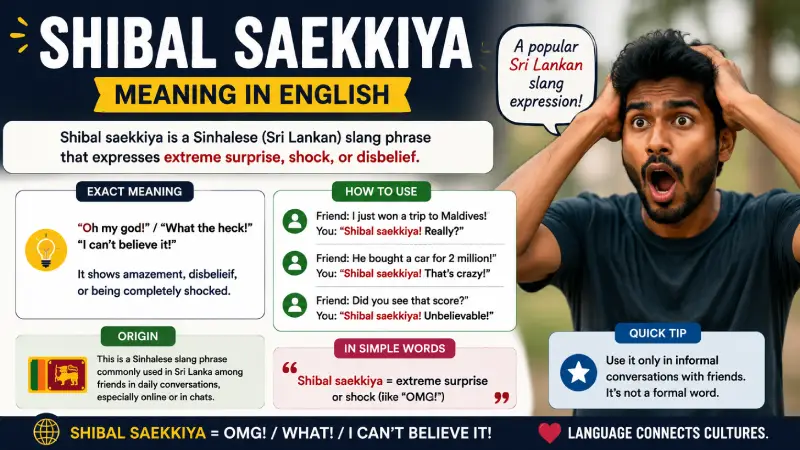
Korean phrase “shibal saekkiya” (씨발 새끼야) is a very offensive insult that roughly translates to “you fing bastard,” “you son of a bitch,” or “you fing jerk” in English.
It is a highly aggressive expression used to show extreme anger, frustration, or hatred toward someone. The phrase contains strong profanity, so it is considered inappropriate in polite conversations, workplaces, or formal situations.
Many English speakers encounter shibal saekkiya through Korean movies, dramas, gaming chats, or online content. Understanding its meaning helps explain the emotion behind the phrase, but it is not a phrase that should be used casually.
Quick Answer
Shibal saekkiya means a very offensive insult in English, similar to “you f*ing bastard” or “you son of a bitch.”** It is used in Korean to express intense anger and should be avoided in respectful conversations.
Shibal Saekkiya Meaning Explained
The phrase has two main parts:
| Korean | English Meaning | Usage |
|---|---|---|
| Shibal (씨발) | A strong Korean swear word similar to “f***” | Expresses anger or frustration |
| Saekkiya (새끼야) | A rude insult meaning “bastard” or “jerk” | Used to insult a person |
Together, the phrase becomes a harsh personal insult.
What Does Shibal Mean?
Shibal (씨발) is one of the strongest Korean swear words.
Depending on context, it can express:
- anger
- frustration
- shock
- irritation
It is sometimes translated as:
- f***
- damn it
- f***ing
Example:
Shibal!
English meaning:
F*!**
It can be used alone as an angry reaction.
What Does Saekkiya Mean?
Saekkiya (새끼야) comes from saekki (새끼), which literally refers to an offspring or young animal.
However, when used toward a person, it becomes insulting.
Possible English meanings:
- bastard
- punk
- jerk
- son of a bitch
The meaning depends on the speaker’s tone and relationship with the listener.
Is Shibal Saekkiya a Bad Word?
Yes. Shibal saekkiya is considered extremely rude and offensive.
It is usually inappropriate in:
- professional settings
- family conversations
- formal situations
- polite Korean speech
You may hear it in:
- action movies
- intense arguments
- fictional characters
- emotional scenes
How Is Shibal Saekkiya Used?
During Anger
Someone may say it during a heated argument.
Example:
Shibal saekkiya! Get out!
Meaning:
A very angry insult telling someone to leave.
In Korean Media
The phrase appears in some:
- Korean dramas
- movies
- video games
- online content
Writers often use it to show that a character is extremely angry or aggressive.
Between Close Friends
Some close friends may use harsh language jokingly, but this depends heavily on the relationship and tone. Using it with strangers can easily cause offense.
Shibal Saekkiya vs Similar Korean Insults
| Korean Expression | English Meaning | Strength |
|---|---|---|
| Shibal | F*** / damn | Very strong |
| Shibal saekkiya | You f***ing bastard | Extremely offensive |
| Jotkka | Screw you / f*** off | Very rude |
| Pabo | Idiot / fool | Mild compared to shibal saekkiya |
Pronunciation of Shibal Saekkiya
A simple English pronunciation guide:
SHE-bal SEK-kee-ya
Breakdown:
- Shi-bal = SHE-bal
- Saek-ki-ya = SEK-kee-ya
Pronunciation may vary slightly depending on Korean accent and romanization style.
Is Shibal Saekkiya Formal or Informal?
Shibal saekkiya is extremely informal and offensive.
It should not be used in:
- business conversations
- schools
- polite discussions
- communication with elders
Korean culture places strong importance on respectful language, especially depending on age and social position.
Common Mistakes About Shibal Saekkiya
Mistake 1: Thinking shibal means “hello”
Some people confuse Korean words because of incorrect online translations.
Shibal is a profanity, not a greeting.
Mistake 2: Using it because it appears in dramas
Korean entertainment often shows strong language for dramatic effect. That does not mean the phrase is acceptable in everyday conversation.
Mistake 3: Translating it too literally
A direct translation may not capture the emotional intensity.
The phrase is not just an insult; it carries strong anger and hostility.
Examples of Shibal Saekkiya in Context
| Korean Phrase | English Meaning |
|---|---|
| 씨발! | F***! / Damn it! |
| 씨발 새끼야! | You f***ing bastard! |
| 이 새끼야! | You bastard! / You jerk! |
These expressions are highly offensive and should be understood mainly for translation and cultural understanding.
Related Korean Words
Aish (아이씨)
A mild expression of annoyance, similar to “ugh” or “damn.”
Jinjja (진짜)
Means “really” or “seriously.”
Mianhae (미안해)
Means “sorry.”
Gomawo (고마워)
Means “thank you.”
Frequently Asked Questions
What does shibal saekkiya mean in English?
Shibal saekkiya is a very offensive Korean insult that means something like “you f***ing bastard” or “you son of a bitch.”
Is shibal a swear word?
Yes. Shibal is one of the strongest Korean swear words and is similar to the English F-word.
Is shibal saekkiya used in normal Korean conversation?
No. It is considered extremely rude and is mostly heard in arguments, entertainment, or emotional situations.
Is shibal saekkiya worse than pabo?
Yes. Pabo means “idiot” and is much milder. Shibal saekkiya is a severe insult.
Can foreigners say shibal saekkiya?
Foreign speakers should avoid using it unless they fully understand the cultural context because it can easily offend people.
Why do people hear this phrase in Korean dramas?
Writers use strong insults to show anger, conflict, or intense emotions between characters.
Mini Quiz: Test Your Knowledge
1. What does shibal saekkiya express?
A) Happiness
B) Strong anger or insult
C) Greeting
D) Thanks
Answer: B) Strong anger or insult
2. Is shibal saekkiya polite language?
A) Yes
B) No
C) Always
D) Only at work
Answer: B) No
3. What does shibal mean?
A) Thank you
B) A strong swear word
C) Friend
D) Love
Answer: B) A strong swear word
4. Where might people hear this phrase?
A) Formal speeches
B) Korean dramas and arguments
C) Business emails
D) School greetings
Answer: B) Korean dramas and arguments
Conclusion
Shibal saekkiya is a highly offensive Korean insult that roughly means “you f*ing bastard” or “you son of a bitch” in English.** It combines a strong swear word with a personal insult to express intense anger.
Although understanding the phrase can help when watching Korean media or learning the language, it should be used with great caution. In most real-life situations, this expression is considered disrespectful and inappropriate.


