

English includes many homophones: words that sound the same but carry different meanings. Among them, principal and principle create frequent confusion.
Principal refers to importance or authority, while principle relates to rules, standards, or beliefs. Misusing them can lead to grammatical errors, unclear communication, and unprofessional writing.
This guide clarifies the distinction, provides practical examples across contexts like finance, education, ethics, and science, and offers memory tools and usage tips for modern U.S. English.
Quick Answer
- Principal → Most important, leader, or head; can be a noun or adjective.
- Principle → A rule, belief, standard, or fundamental truth; always a noun.
Tip: Replace with main/head → principal; replace with rule/standard → principle.
Why People Confuse Them

- They are homophones.
- Their meanings are unrelated; sound alone doesn’t help.
- Many learners rely on memorization, not context.
- Both appear in formal and informal writing frequently.
Key Differences At A Glance

| Feature | Principal | Principle |
|---|---|---|
| Meaning | Most important; leader; main item | Rule, standard, belief |
| Part of Speech | Noun and adjective | Noun only |
| Common Context | Education, finance, leadership | Ethics, science, law |
| Memory Tip | “A” → Authority / Main | “P” → Process / Rule |
| Example | School principal, principal reason, principal amount | Ethical principle, principle of physics, principle of justice |
Meaning and Usage Difference

Principal
1. Adjective – Most Important
- “The principal reason we moved was career growth.”
- “Her principal focus is customer satisfaction.”
2. Noun – Person in Charge
- “The school principal welcomed the students.”
- “She became the principal investigator of the project.”
3. Noun – Finance
- “The principal on the loan totals $50,000.”
- “Monthly payments reduce the principal first, then interest.”
Principle
1. Ethics / Morals
- “She refused the offer on principle.”
- “Our team follows strict principles of fairness.”
2. Scientific / System Rules
- “The principle of gravity explains falling objects.”
- “Engineers follow the principle of simplicity in design.”
3. General Rules / Standards
- “Corporate policies operate on the principle of accountability.”
- “We designed the program according to the principle of efficiency.”
Tone, Context, and Formality
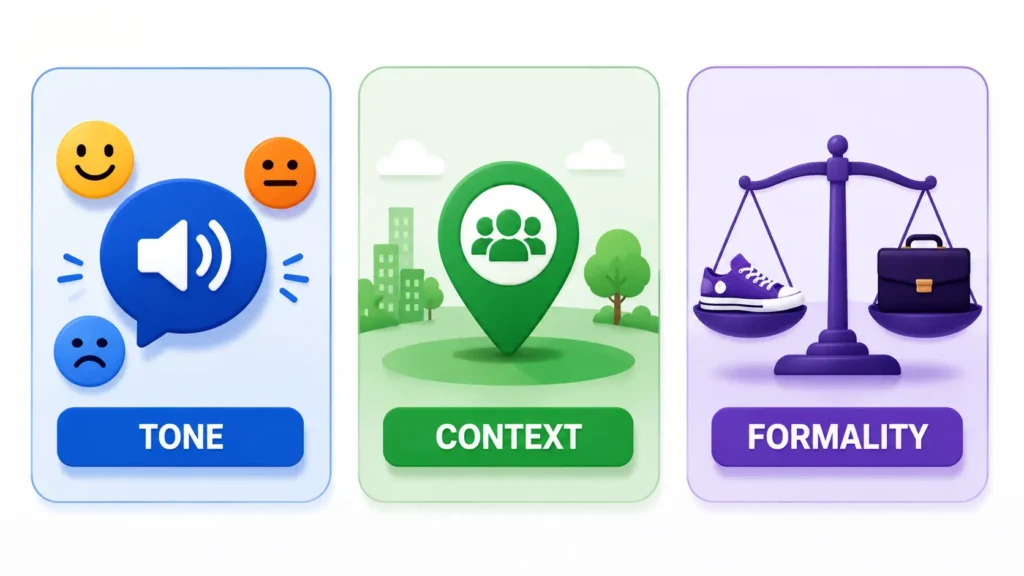
- Principal appears in casual and formal writing when referring to importance or leadership.
- Principle is more common in formal, academic, and professional writing about standards, rules, and ethics.
- Casual U.S. English may occasionally use principal or principle in shorthand, but precise usage prevents confusion.
Which One Should You Use?
- Identify meaning → Main / Leader = principal; Rule / Standard = principle
- Check grammatical role → Adjective / noun for importance = principal; noun for rules = principle
- Apply substitution test → Main / Head → principal; Rule / Standard → principle
Common Mistakes and Quick Fixes
| Error | Incorrect | Correct |
|---|---|---|
| Confusing meaning | Principle reason | Principal reason |
| Misapplied noun | Principal of fairness | Principle of fairness |
| Finance misuse | Pay the principle | Pay the principal |
Memory Tip: PrincipAl = A → Authority / Main; PrinciPle = P → Process / Rule
Everyday Examples
Principal:
- “The principal dancer received applause.”
- “Our principal goal is efficiency.”
- “The principal did not attend the meeting.”
Principle:
- “She acted on principle.”
- “Physics operates on basic principles.”
- “Students learn the principle of respect.”
Dictionary-Style Word Details
Verb:
- Principal: Not a verb
- Principle: Not a verb
Noun:
- Principal: Person in charge, main element, loan amount
- Principle: Rule, standard, belief, fundamental truth
Synonyms:
- Principal: main, chief, head, leading, primary
- Principle: rule, standard, guideline, belief
- Principal: “The principal greeted each student individually.”
- Principle: “The company follows the principle of transparency.”
Word History:
- Principal → Latin princeps = first/leader
- Principle → Latin principium = foundation/start
Phrases Containing:
- Principal: principal amount, principal reason, school principal
- Principle: guiding principle, principle of law, set of principles
Advanced Usage Notes
Finance: Principal = original loan amount
Leadership: Principal = head of institution, officer, or leader
Scientific vs Ethical Principles: Principle = rules/laws guiding action or thought
FAQ
What is the main difference between principal and principle?
Use principal for importance, leadership, or main items. Use principle for rules, beliefs, or standards.
When should I use principal instead of principle?
Use principal when describing someone in charge or the most important element in a context.
When should I use principle instead of principal?
Use principle when referring to rules, morals, ethics, or foundational truths.
How can I remember the difference between principal and principle?
Think: A in principAl → Authority/Main; P in princiPle → Process/Rule.
Can principal refer to money?
Yes, in finance, principal refers to the original sum borrowed or invested before interest.
Does principle appear in informal contexts?
Yes, but mostly in formal or professional writing, scientific discussions, or ethics guidance.
Conclusion
Use principal for importance, leadership, or main items. Use principle for rules, standards, or beliefs. Apply mnemonics and context tests for clarity. With repeated practice, the difference becomes second nature, ensuring precise and professional American English writing.
What is the main difference between principal and principle?
Use principal for importance, leadership, or main items. Use principle for rules, beliefs, or standards.
When should I use principal instead of principle?
Use principal when describing someone in charge or the most important element in a context.
When should I use principle instead of principal?
Use principle when referring to rules, morals, ethics, or foundational truths.
How can I remember the difference between principal and principle?
Think: A in principAl → Authority/Main; P in princiPle → Process/Rule.
Can principal refer to money?
Yes, in finance, principal refers to the original sum borrowed or invested before interest.
Does principle appear in informal contexts?
Yes, but mostly in formal or professional writing, scientific discussions, or ethics guidance.