

Few areas of English grammar confuse native and non-native speakers more than the distinction between who and whom. Both pronouns appear frequently in questions, statements, and relative clauses, yet they serve entirely different grammatical roles. While who is a subject pronoun, whom functions as an object pronoun. Despite their differences, many speakers use who in contexts where whom is technically correct, particularly in informal speech.
In this extensive guide, we will cover everything from the fundamental grammar rules, common mistakes, modern usage trends in American English, formal versus informal preferences, relative clauses, prepositional contexts, tests to choose correctly, historical origins, and practical writing tips. By the end, you’ll be able to confidently decide between who and whom in any context.
Quick Answer
Who is the subject pronoun — it performs the action in a sentence.
Whom is the object pronoun — it receives the action or follows a preposition.
Rule of thumb:
- If you could replace it with he, she, they, use who.
- If you could replace it with him, her, them, use whom.
Examples:
- Who left the message? (He left it → subject)
- To whom did you give the message? (Him received it → object)
Why People Confuse Who and Whom
- Visual similarity: Both words start with “wh” and sound alike in casual speech.
- Historical usage shift: Over centuries, English speakers began replacing whom with who in informal contexts.
- Complex sentence structures: Many modern writers encounter who and whom in embedded clauses, prepositional phrases, and formal writing, where the distinction matters.
While who can function reliably in most contexts, whom remains the preferred choice in formal writing, legal documents, and contexts requiring grammatical precision.
Key Differences At A Glance

| Feature | Who | Whom |
|---|---|---|
| Role in Sentence | Subject (does the action) | Object (receives the action) |
| Pronoun Type | Subject pronoun | Object pronoun |
| Position in Sentence | Beginning of question or clause | After verbs or prepositions |
| Formality | Common in speech, informal | Formal, traditional |
| Common Errors | Using in object positions | Overcorrecting when informal who suffices |
| Quick Test | He/She/They | Him/Her/Them |
Meaning and Usage Difference

Who
Who identifies the person performing the action or the subject of the clause. It is a subject pronoun, functioning like he, she, or they.
Examples:
- Who is coming to the party?
- The student who won the contest received a prize.
- Who said that this was possible?
Whom
Whom identifies the person receiving the action or functioning as the object of a verb or preposition.
Examples:
- To whom should I address this letter?
- The person whom I saw yesterday was late.
- Whom did you invite to the conference?
Key tip: Whom almost always appears in formal contexts or after prepositions like to, for, with, by, etc.
Tone, Context, and Formality
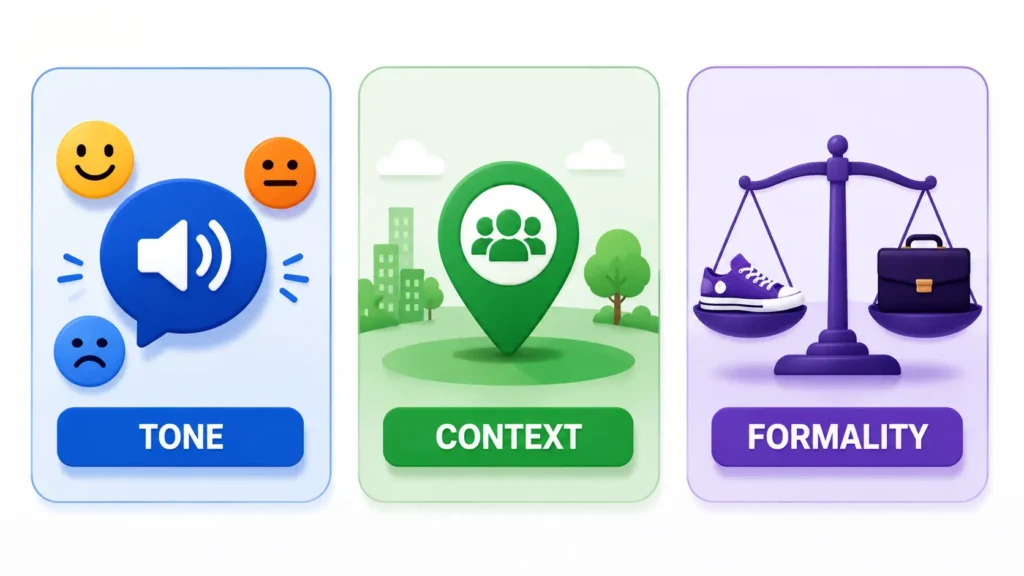
In modern American English, who is acceptable in nearly all spoken contexts. Whom, however, signals formal or literary tone. Consider the following comparison:
- Informal: Who are you talking to?
- Formal: To whom are you speaking?
- Informal: Who should I give this to?
- Formal: To whom should I give this?
Even in formal writing, ending a sentence with to who is sometimes accepted in casual style guides, but grammatically, to whom remains correct.
Which One Should You Use?
Identify Subject vs Object
- Subject → Who
- Object → Whom
Use Preposition Clues
- After prepositions (to, with, for, by), whom is correct.
Apply the He/Him Test
- Substitute he/she/they → Who
- Substitute him/her/them → Whom
Example:
___ should I call?
Call him. → Whom should I call?
When One Choice Sounds Wrong
Incorrect usage often occurs when the pronoun is mismatched with its role:
- ❌ Whom is coming? → ✔️ Who is coming?
- ❌ Who should I send the report to? → ✔️ To whom should I send the report?
Common Mistakes (And Quick Fixes)
| Mistake | Correct | Reason |
|---|---|---|
| Whom is here? | Who is here? | Subject pronoun needed |
| I don’t know who to ask. | I don’t know whom to ask. | Object pronoun after “to” |
| Who did you talk to? | Whom did you talk to? | Object pronoun after verb |
Pro tip: In spoken U.S. English, people often use who even for objects. In formal writing, follow the rules above.
Everyday Examples
- Who left the door open?
- He asked whom he should contact.
- The teacher, whom everyone respects, spoke today.
- Who wants coffee?
- To whom does this package belong?
- The guest whom we invited hasn’t replied yet.
- Who is responsible for this project?
Relative Clauses and Embedded Questions
Subject Role (Who)
- The athlete who trained hardest won the championship.
Object Role (Whom)
- The athlete whom the coach praised was thrilled.
Embedded questions:
- Do you know who called earlier?
- Do you know whom she called earlier? (Formal)
Preposition Placement:
He/Him Test: The Quick Rule
This test helps determine subject vs object quickly:
- Replace with he/she/they → Who
- Replace with him/her/them → Whom
Example:
- “___ did you see?” → I saw him. → Whom did you see?
- “___ called you?” → He called me. → Who called you?
Synonyms and Alternatives
While there are no exact synonyms, understanding substitutes helps:
- Who: he, she, they, the person who
- Whom: him, her, them, the person whom
Closest plain alternatives help in paraphrasing or avoiding overuse.
Word History
- Both words trace to Old English pronouns.
- Who remained the subject form.
- Whom evolved as the object form.
- Over time, whom has declined in spoken U.S. English but remains formal and grammatical.
Phrases Containing Who and Whom
- Who: who else, who knew, who did that
- Whom: to whom it may concern, whom did you see, for whom the bell tolls
Style and Practical Tips
- Prioritize clarity over rigid adherence in speech. Use who in casual conversation.
- Use whom in formal writing or legal/academic contexts.
- Always apply the he/him test before finalizing formal documents.
- Relative clauses: identify whether pronoun is doing or receiving the action.
- End sentences carefully: If ending with a preposition, consider rewriting formally:
- Informal: Who did you speak to?
- Formal: To whom did you speak?
Advanced Usage Notes
- Double relative clauses: “The person who/whom I met yesterday…” — choose based on the pronoun’s role inside the clause.
- Optional whom: In casual emails or dialogue, using who as object is accepted:
- “Who did you see at the party?”
- Avoid redundancy: “To whom it may concern” is correct; “To whom it may concern to you” is wrong.
FAQ
What is the main difference between who and whom?
Use who as a subject pronoun for the person performing the action. Use whom as an object pronoun for the person receiving the action or after a preposition.
When should I use whom instead of who?
Use whom when the verb or preposition acts on the pronoun. For example: “To whom should you send this letter?”
Is it acceptable to use who in place of whom in modern U.S. English?
Yes, native U.S. speakers often use who instead of whom in informal speech and casual writing. However, formal writing still prefers whom when the pronoun acts as an object.
How can I quickly decide whether to use who or whom?
Use the he/him test: replace the pronoun with he/she/they → use who. Replace the pronoun with him/her/them → use whom.
Can whom be used at the start of a sentence?
Yes, writers can start sentences with whom, especially in formal questions. For example: “Whom did you invite to the meeting?”
Why do many people find whom confusing?
People find whom confusing because spoken English often uses who instead. Complex clauses make it hard to identify whether the pronoun functions as a subject or object.
Are there synonyms for who and whom?
No exact synonyms exist. Writers can use these closest alternatives:
- Who: he, she, they, the person who
- Whom: him, her, them, the person whom
Conclusion
Mastering who vs whom is straightforward with practice:
- Who = subject, Whom = object
- Use the he/him test
- Apply formal whom in professional writing
- Remember casual speech flexibility
Following these principles ensures accurate, confident, and polished English writing in both casual and formal U.S. contexts.
What is the main difference between who and whom?
Use who as a subject pronoun for the person performing the action. Use whom as an object pronoun for the person receiving the action or after a preposition.
When should I use whom instead of who?
Use whom when the verb or preposition acts on the pronoun. For example: “To whom should you send this letter?”
Is it acceptable to use who in place of whom in modern U.S. English?
Yes, native U.S. speakers often use who instead of whom in informal speech and casual writing. However, formal writing still prefers whom when the pronoun acts as an object.
How can I quickly decide whether to use who or whom?
Use the he/him test: replace the pronoun with he/she/they → use who. Replace the pronoun with him/her/them → use whom.
Can whom be used at the start of a sentence?
Yes, writers can start sentences with whom, especially in formal questions. For example: “Whom did you invite to the meeting?”
Why do many people find whom confusing?
People find whom confusing because spoken English often uses who instead. Complex clauses make it hard to identify whether the pronoun functions as a subject or object.
Are there synonyms for who and whom?
No exact synonyms exist. Writers can use these closest alternatives:
Who: he, she, they, the person who
Whom: him, her, them, the person whom