

Many writers wonder whether they should write gases or gasses. At first glance, the two words look almost identical. Since both come from the word gas, it is easy to assume they mean the same thing.
The truth is that both words are correct, but they have different jobs in English grammar.
Gases is the standard plural form of the noun gas. You use it when talking about more than one type or amount of gas.
Gasses, on the other hand, is the third-person singular form of the verb to gas. It describes someone or something that releases gas, fills something with gas, or exposes something to gas.
Once you understand the difference between the noun and the verb, choosing the correct spelling becomes simple.
In this guide, you’ll learn exactly when to use gases and gasses, see plenty of real-world examples, and avoid one of the most common grammar mistakes involving this word pair.
Quick Answer
Here’s the short answer:
✅ Gases = the plural of the noun gas
- The atmosphere contains many gases.
- Scientists study greenhouse gases.
- Several industrial gases require careful storage.
✅ Gasses = the present-tense verb meaning fills with gas, exposes to gas, or emits gas
- The mechanic gasses the welding torch.
- The factory gasses the storage tank before testing it.
- The skunk gasses predators to defend itself.
Quick rule to remember:
- Talking about more than one gas? → gases
- Talking about someone or something performing the action of gassing? → gasses
Most everyday writing uses gases far more often than gasses.
Why People Confuse Them
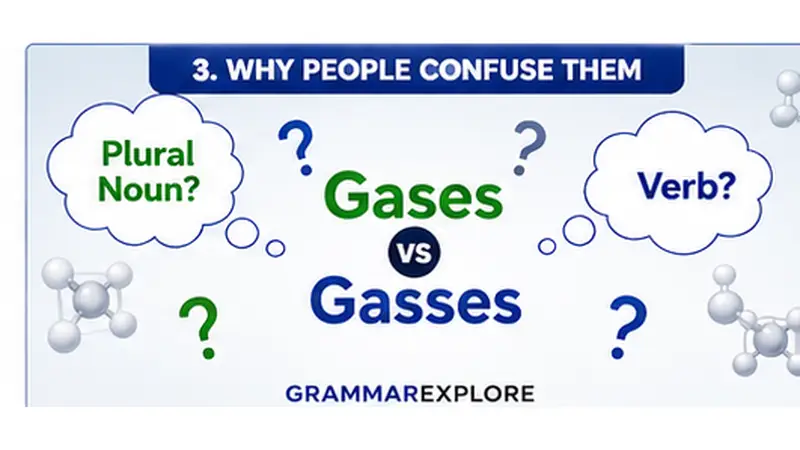
Several factors make these two words confusing.
First, both words begin with the same base word, gas. The only visible difference is an extra s, so they look almost identical.
Second, English often forms plurals by adding -s or -es, while verbs also change their endings in similar ways. As a result, many people assume gasses is simply another acceptable plural spelling.
Another reason is that many spell-checkers recognize both words because each is grammatically correct in different situations. If you choose the wrong one, your software may not flag the mistake.
Finally, most people see gases much more often in science classes, news articles, and everyday reading. Since gasses appears mainly as a verb, many writers rarely encounter it and become unsure when they need it.
Fortunately, one simple grammar rule clears up the confusion.
- Noun (plural): gases
- Verb (he/she/it): gasses
Key Differences at a Glance
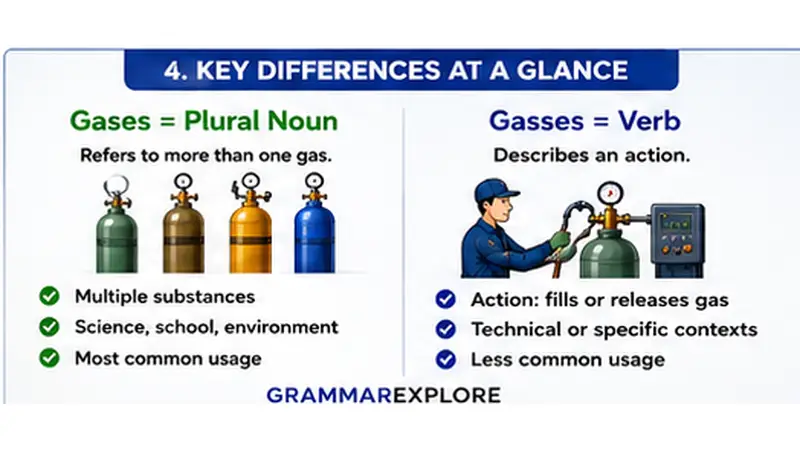
| Context | Best Choice | Why |
|---|---|---|
| Talking about more than one gas | Gases | Standard plural noun |
| Greenhouse emissions | Gases | Refers to multiple gases |
| Scientific writing | Gases | Standard scientific usage |
| Someone fills equipment with gas | Gasses | Verb describing an action |
| Someone exposes an area to gas | Gasses | Third-person singular verb |
| Everyday conversation about air or fuel | Gases | Refers to plural substances |
Comparison Table
| Feature | Gases | Gasses |
|---|---|---|
| Part of speech | Noun (plural); also verb form in some contexts | Verb (third-person singular) |
| Standard plural of gas | ✅ Yes | ❌ No |
| Standard verb form | Sometimes (base verb forms include gas, gassed, gassing) | ✅ Yes |
| Common in science | ✅ Very common | Rare |
| Common in everyday writing | ✅ Very common | Less common |
| Correct English word | ✅ Yes | ✅ Yes |
Meaning and Usage Difference
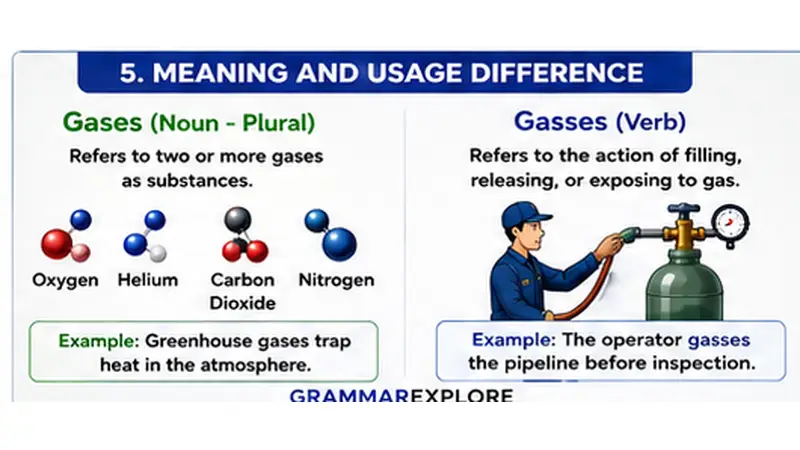
Although gases and gasses come from the same root word, they serve different grammatical purposes.
Meaning of Gases
Gases is the plural noun.
It refers to two or more gases, whether they occur naturally or are produced by people.
You will often see this word in science, medicine, engineering, weather reports, environmental studies, and everyday conversations.
Examples:
- Oxygen and nitrogen are important gases in Earth’s atmosphere.
- Greenhouse gases trap heat.
- The laboratory stores several compressed gases.
- Different gases react at different temperatures.
- Some gases have no color or smell.
Because English uses gases as the accepted plural, this spelling appears in dictionaries, textbooks, newspapers, and academic publications.
Pronunciation
Gases
/ˈɡæsɪz/
It sounds like:
GAS-iz
Meaning of Gasses
Gasses is a verb.
It means that someone or something performs the action of gassing.
Depending on the context, the verb may mean:
- fills something with gas
- releases gas
- emits gas
- exposes something to gas
Because this verb appears mostly in technical, industrial, historical, or specialized writing, most people encounter it far less often than gases.
Examples:
- The technician gasses the chamber before testing it.
- The welder gasses the torch before beginning work.
- The skunk gasses nearby predators when threatened.
- The refinery gasses the storage unit during maintenance.
Pronunciation
Gasses
/ˈɡæsɪz/
Interestingly, gases and gasses are pronounced exactly the same. Their pronunciation does not help you choose between them. Only the grammar and sentence meaning determine the correct spelling.
Tone, Context, and Formality
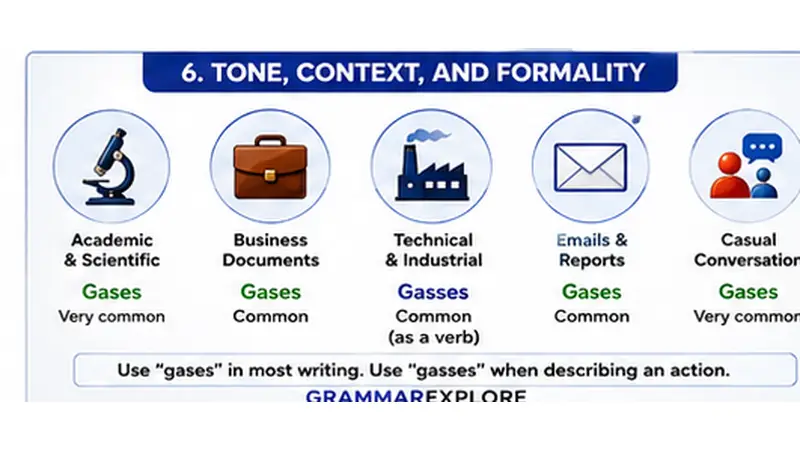
Understanding where each word appears makes choosing the correct one much easier.
Formal Writing
Formal writing almost always uses gases because reports, textbooks, research papers, and news articles frequently discuss multiple gases.
Examples include:
- atmospheric gases
- greenhouse gases
- industrial gases
- medical gases
The verb gasses appears only when the sentence specifically describes the action of applying or releasing gas.
Casual Writing
In everyday conversations, people nearly always use gases.
Examples:
- These gases can be dangerous.
- The balloon contains several gases.
You would rarely need gasses unless you describe someone’s action.
Academic Writing
Science teachers, students, and researchers almost always write gases because they discuss substances rather than actions.
For example:
- Noble gases rarely react with other elements.
- Scientists continue studying greenhouse gases.
The verb gasses appears only in specialized descriptions of procedures or experiments.
Business Writing
Many industries work with compressed or industrial gases, making gases common in manuals, invoices, and safety documents.
Examples:
- Medical gases
- Industrial gases
- Refrigerant gases
Meanwhile, gasses may appear in equipment manuals that describe an operator’s actions.
For example:
- The operator gasses the pipeline before inspection.
American English Usage
American English follows the same distinction:
- Gases = plural noun
- Gasses = third-person singular verb
There is no American-English rule that makes gasses an alternative plural spelling. When referring to more than one gas, gases remains the standard and preferred choice.
Which One Should You Use?
Most of the time, you should use gases because it is the standard plural form of the noun gas. If you are writing about science, chemistry, medicine, the environment, cooking, or everyday topics, gases is almost always the correct choice.
Use gasses only when you need the third-person singular form of the verb to gas. In other words, someone or something is performing the action of filling with gas, exposing to gas, or releasing gas.
Follow These Simple Rules
- Use gases when referring to more than one gas.
- Use gasses when the subject performs the action of gassing.
- If you can replace the word with substances, you probably need gases.
- If you can replace the word with fills with gas or releases gas, you probably need gasses.
Easy Memory Trick
Think of the sentence first.
- Many gases = more than one substance → gases
- He gasses the machine = an action → gasses
Remember:
Plural noun = gases
Action verb = gasses
This simple trick works almost every time.
When One Choice Sounds Wrong
Using the wrong form can confuse readers because it changes the grammar of your sentence.
Incorrect
❌ Scientists study greenhouse gasses.
Correct
✅ Scientists study greenhouse gases.
Why?
The sentence refers to several gases, not an action.
Incorrect
❌ The technician gases the tank before testing it.
Correct
✅ The technician gasses the tank before testing it.
Why?
The technician performs the action of gassing the tank, so you need the verb gasses.
Incorrect
❌ The room contains several dangerous gasses.
Correct
✅ The room contains several dangerous gases.
Why?
The word names multiple substances, making gases the correct plural noun.
Incorrect
❌ The engineer gases the pipeline every morning.
Correct
✅ The engineer gasses the pipeline every morning.
Why?
The engineer performs an action, so the verb form is correct.
Incorrect
❌ Hospitals use many medical gasses.
Correct
✅ Hospitals use many medical gases.
Why?
Medical gases are substances, not actions.
Common Mistakes (and Quick Fixes)
Using gasses as a plural noun
Incorrect:
❌ The experiment used several gasses.
Correct:
✅ The experiment used several gases.
Explanation:
The sentence talks about multiple gases, so the plural noun is gases.
Using gases as a verb
Incorrect:
❌ The mechanic gases the engine before testing it.
Correct:
✅ The mechanic gasses the engine before testing it.
Explanation:
The mechanic performs the action, so use the verb gasses.
Assuming both spellings are interchangeable
Incorrect:
❌ Both spellings always mean the same thing.
Correct:
✅ They have different grammatical functions.
Explanation:
One is primarily a plural noun, while the other is a verb.
Following pronunciation instead of grammar
Incorrect:
❌ They sound alike, so either spelling works.
Correct:
✅ Choose the spelling based on the sentence’s grammar.
Explanation:
Both words share the same pronunciation, but they do not have the same function.
Forgetting the sentence’s meaning
Incorrect:
❌ The company stores compressed gasses.
Correct:
✅ The company stores compressed gases.
Explanation:
The sentence refers to stored substances rather than the act of gassing.
Everyday Examples
School
- Students learn about atmospheric gases in science class.
- The teacher explains how different gases behave under pressure.
Work
- The company stores industrial gases safely.
- The technician gasses the equipment before the inspection begins.
Home
- Some cleaning products release harmless gases.
- The grill uses propane gases during cooking.
Business
- The supplier delivers compressed gases every Monday.
- The maintenance worker gasses the pipeline before repairs.
Emails
- Please verify that all medical gases meet safety standards.
- The engineer gasses each chamber before testing starts.
Social Media
- Greenhouse gases affect Earth’s climate.
- Today’s science lesson explained how different gases expand when heated.
Everyday Conversations
- Several gases make up the air we breathe.
- The skunk gasses nearby animals when it feels threatened.
Dictionary-Style Word Details
Verb
Gas
Meaning:
To fill something with gas, expose something to gas, release gas, or supply gas.
Common verb forms
- Base form: gas
- Present participle: gassing
- Past tense: gassed
- Third-person singular: gasses
Examples
- The worker gasses the storage tank before maintenance.
- She gassed the vehicle before the trip.
- They are gassing the chamber for testing.
Gases
Although gases can sometimes function as a verb in very limited grammatical contexts, standard English almost always uses gasses as the third-person singular verb. Most dictionaries treat gasses as the preferred present-tense verb form.
Noun
Gas
A substance that expands to fill any container and has no fixed shape or volume.
Examples include:
- Oxygen
- Nitrogen
- Carbon dioxide
- Helium
- Hydrogen
Gases
The plural form of gas.
Examples:
- Greenhouse gases
- Medical gases
- Noble gases
- Industrial gases
- Natural gases
Gasses
Gasses is not used as the standard plural noun in modern English. Standard dictionaries and style guides recognize gases as the correct plural form.
Synonyms
Synonyms for Gas (noun)
Depending on the context:
- vapor
- fume
- emission
- air
- fuel gas
- chemical vapor
Synonyms for Gas (verb)
Depending on the meaning:
- fill
- fuel
- charge
- expose
- emit
- release
Antonyms
There are no direct antonyms for gases or gasses because their meanings vary by context. However, related opposites may include:
- evacuate
- vent
- remove gas
- empty
These words are contextual rather than true dictionary antonyms.
Example Sentences
Gases (8 Correct Examples)
- The Earth’s atmosphere contains several important gases, including oxygen and nitrogen.
- Scientists continue studying greenhouse gases to understand climate change.
- Hospitals use medical gases during many procedures.
- The laboratory stores compressed gases in secure containers.
- Different gases expand at different rates when heated.
- Firefighters wear protective gear when dangerous gases may be present.
- Several industrial gases require careful handling and transportation.
- Students compared the properties of common gases in chemistry class.
Gasses (5 Correct Examples)
Unlike many word pairs, gasses is not a misspelling. It is the correct third-person singular form of the verb to gas.
- The technician gasses the chamber before beginning the experiment.
- The mechanic gasses the welding torch before starting work.
- The refinery gasses the storage tank during routine maintenance.
- The skunk gasses predators as a defense mechanism.
- The operator gasses each pipeline before the inspection.
Word History
The word gas entered English in the early 1600s. Flemish chemist Jan Baptist van Helmont introduced the term to describe substances that behave differently from solids and liquids. He likely based the word on the Greek word chaos, referring to something formless or invisible.
As English developed, the regular plural gases became the accepted form for referring to more than one gas. The verb to gas also entered the language, giving rise to forms such as gassed, gassing, and gasses. Today, gases is far more common because writers more often discuss substances than the action of gassing.
Phrases Containing the Words
Common Phrases with Gases
- greenhouse gases
- noble gases
- industrial gases
- medical gases
- compressed gases
- toxic gases
- atmospheric gases
- dissolved gases
- natural gases
- flammable gases
Common Phrases with Gasses
Because gasses is a verb, it rarely appears in fixed expressions. Instead, it commonly appears in complete verb phrases such as:
- gasses the chamber
- gasses the pipeline
- gasses the vehicle
- gasses the tank
- gasses the equipment
There are no widely recognized idioms that specifically contain gasses.
Frequently Asked Questions
Is gasses a misspelling of gases?
No. Gasses is a legitimate English word. It serves as the third-person singular form of the verb to gas. Use gases whenever you need the plural form of the noun gas.
Which spelling should I use for the plural of gas?
Use gases. Dictionaries, style guides, textbooks, and scientific publications recognize gases as the standard plural form in both American and British English.
Why do people confuse gases and gasses?
People often confuse these words because they look and sound alike. However, gases functions mainly as a plural noun, while gasses functions as a verb.
Which word appears more often in everyday writing?
Most writers use gases far more often than gasses. You’ll commonly find gases in science, medicine, environmental writing, and everyday conversations, while gasses appears mainly in technical contexts.
Do gases and gasses sound the same?
Yes. Both words usually have the pronunciation /ˈɡæsɪz/ (“GAS-iz”). Since they sound identical, you should choose the correct spelling based on the sentence’s grammar.
Can I use gasses in scientific writing?
Yes, but only when you use it as a verb. If you’re referring to multiple substances, always use gases.
Conclusion
Although gases and gasses differ by only one letter, they serve different grammatical purposes. Gases is the standard plural form of the noun gas, making it the correct choice when referring to more than one gas. You will see this spelling in scientific articles, environmental reports, medical documents, and everyday writing.
Gasses, however, is the third-person singular form of the verb to gas. It describes the action of filling something with gas, exposing something to gas, or releasing gas. While it is a correct English word, it appears much less frequently than gases.
A simple way to remember the difference is this: if you’re naming substances, choose gases; if you’re describing an action, choose gasses. Keeping this rule in mind will help you write with confidence and avoid one of the most common grammar mix-ups involving these two words.