If you have ever heard someone order a drink by saying, “Whiskey neat, please,” you may have wondered what neat means. The word usually means clean, tidy, or well organized, so the phrase can sound confusing at first.
In the world of drinks, however, neat has a special meaning. It describes a strong alcoholic drink served by itself, without ice, water, soda, juice, or another mixer. Cambridge Dictionary specifically defines neat in this context as an alcoholic drink with nothing added.
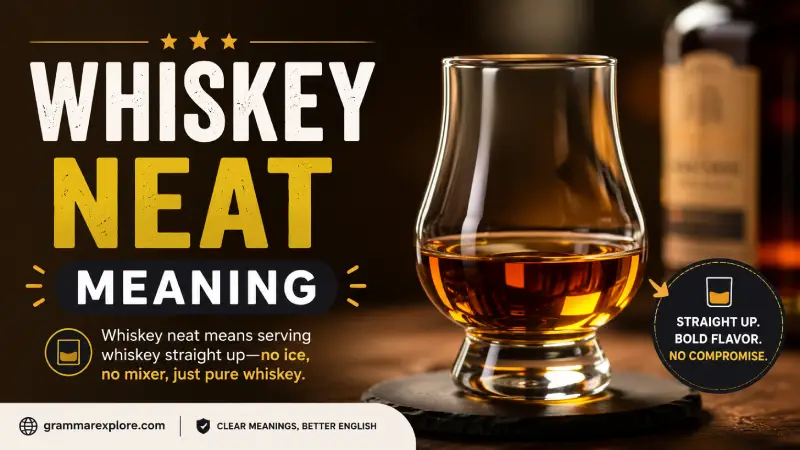
Therefore, the whiskey neat meaning is simple: whiskey served straight from the bottle into a glass, with nothing added.
The phrase is especially useful in American English because drink orders often use short expressions such as neat, on the rocks, with water, and with soda. Knowing the difference can help English learners understand menus, movies, restaurant conversations, and everyday American speech.
This guide explains the meaning, pronunciation, grammar, history, examples, related expressions, common mistakes, and natural ways Americans use whiskey neat.
Quick Answer
Whiskey neat means whiskey served by itself, with nothing added, no ice, water, soda, juice, or mixer. In American English, when someone says, “I’ll have my whiskey neat,” they ask the bartender to pour the whiskey directly into a glass without adding anything or diluting it. The phrase commonly appears in bars, restaurants, whiskey discussions, and casual conversations.
TL;DR
- Whiskey neat means whiskey served alone with nothing added.
- “Neat” means undiluted or unmixed when describing an alcoholic drink.
- A neat whiskey normally has no ice and no added water.
- “Whiskey neat” is different from whiskey on the rocks, which contains ice.
- It is also different from a whiskey and water, because water changes the drink.
- Americans commonly say, “I’ll have a whiskey neat” or “I like my whiskey neat.”
- The word neat is pronounced /niːt/, like “neet.”
Meaning and Definition
What Does Whiskey Neat Mean?
Whiskey neat means whiskey served alone, without ice or any other added liquid.
For example:
“I’ll have a bourbon neat.”
This means the speaker wants bourbon poured into a glass without ice, water, soda, or another mixer.
The word neat describes how you serve the whiskey, not its quality, age, brand, or type.
So, neat does not mean:
- expensive
- high quality
- old
- strong because of extra alcohol
- fancy
- premium
- chilled
- straight from a particular region
It simply describes the serving style.
Cambridge gives the same basic meaning for alcoholic drinks: neat means that you serve the drink without adding water, ice, or another beverage.
Plain-English Definition
In very simple English:
Whiskey neat = whiskey by itself.
If a bartender pours whiskey into a glass without adding anything else, they serve the whiskey neat.
Dictionary Meaning
The alcoholic-drink sense of neat means not mixed or diluted. Merriam-Webster also gives neat the sense of “not mixed or diluted” and uses it with drinks and other substances.
Cambridge’s American dictionary similarly describes neat as a strong alcoholic drink served with nothing added.
Professional Meaning
In bartending and beverage language, neat is a serving instruction.
When a customer says:
“Whiskey neat.”
the bartender understands that the customer wants the whiskey served without a mixer or ice.
This makes neat a practical term used in:
- bars
- restaurants
- hotels
- cocktail lounges
- whiskey tastings
- beverage menus
- hospitality training
- casual conversations about spirits
Is Whiskey Neat the Same as Straight?
In everyday conversations, neat and straight can overlap in meaning. However, speakers do not always use the terms interchangeably in every bar or beverage context.
Neat clearly means that you serve the spirit without adding water, ice, or a mixer.
Straight can have broader meanings. For example, someone may say:
“I drink my whiskey straight.”
That usually communicates that they drink it without a mixer. However, the exact interpretation can depend on the speaker and context.
For precise ordering, “neat” is the clearer term when you specifically mean no ice and no added liquid.
What Does “Neat” Mean in Alcohol?
Neat Means Nothing Added
When neat describes an alcoholic drink, it means you serve the drink without adding anything.
For whiskey, that usually means:
- no ice
- no water
- no soda
- no cola
- no juice
- no tonic
- no cocktail mixer
The whiskey itself remains the only liquid in the glass.
Cambridge explicitly gives examples such as “She likes her whiskey neat,” showing this exact usage.
Does Neat Mean No Ice?
Yes.
In normal bar usage, neat whiskey does not contain ice.
If you want ice, you would usually ask for:
“Whiskey on the rocks.”
That means whiskey served with ice.
Does Neat Mean No Water?
Yes.
A whiskey served neat does not have water added to it.
If you want a little water, you can say:
“Whiskey with a little water, please.”
You could also explain the amount you prefer.
Does Neat Mean Room Temperature?
Not necessarily.
The key point of neat is that you add nothing to the drink.
People generally serve neat whiskey without ice, but the bottle, venue, glass, and serving practice can affect its temperature.
Therefore, it is better not to define neat as “room-temperature whiskey.” The essential meaning is undiluted and unmixed.
Whiskey Neat vs. Whiskey on the Rocks
One of the most important differences is between neat and on the rocks.
| Expression | Meaning | Example |
|---|---|---|
| Whiskey neat | Whiskey with nothing added | “I’ll have bourbon neat.” |
| Whiskey on the rocks | Whiskey served with ice | “I’ll have whiskey on the rocks.” |
| Whiskey with water | Whiskey plus water | “Can I get whiskey with a little water?” |
| Whiskey and soda | Whiskey mixed with soda | “I’ll have whiskey and soda.” |
| Whiskey cocktail | Whiskey mixed with other ingredients | “I’ll have an Old Fashioned.” |
The key difference is simple:
Neat = no ice and no added liquid.
On the rocks means you serve the drink over ice.
Example
Imagine a bartender has a bottle of bourbon.
- If the bartender pours bourbon directly into a glass:
Bourbon neat
- If the bartender adds ice:
Bourbon on the rocks
If the bartender adds water:
Bourbon with water
If the bartender adds cola:
Whiskey and Coke
The whiskey itself has not necessarily changed. The serving method has changed.
Whiskey Neat vs. Straight
What Does “Whiskey Straight” Mean?
In everyday American conversation, straight whiskey can mean whiskey consumed without a mixer.
For example:
“He usually drinks his whiskey straight.”
The speaker generally means that he does not mix the whiskey with soda, juice, or another beverage.
However, straight can be less precise than neat when discussing the exact serving method.
Why “Neat” Is More Specific
If you order:
“Whiskey neat.”
you are clearly asking for the whiskey by itself.
If you say:
“Whiskey straight.”
the listener will usually understand the general idea, but the exact meaning may depend on context.
For English learners, the easiest rule is:
Use “neat” when you specifically mean whiskey with nothing added.
Whiskey Neat vs. On the Rocks vs. With Water
These expressions are easy to confuse.
Whiskey Neat
- No ice.
- No water.
- No mixer.
Example:
“She ordered a whiskey neat.”
Whiskey on the Rocks
Ice is added.
Example:
“He ordered his bourbon on the rocks.”
Whiskey With Water
Water is intentionally added.
Example:
“I like whiskey with a small amount of water.”
Whiskey With a Mixer
Another beverage is added.
Examples include:
- whiskey and soda
- whiskey and cola
- whiskey and ginger ale
- whiskey and lemonade
These are not neat because another liquid has been added.
Word Origin and History
Origin of the Word Neat
The word neat has a long history in English.
Merriam-Webster traces the adjective to Middle French net and ultimately to Latin nitidus, associated with ideas such as brightness, elegance, and being neat.
Over time, English developed several related meanings.
The word came to describe things that were:
- clean
- tidy
- orderly
- simple
- well made
- skillful
- undiluted
The alcohol sense developed from the idea of something being pure or unadulterated.
Etymonline dates the liquor sense of neat, meaning straight or undiluted, to around 1800.
How “Neat” Developed Its Alcohol Meaning
The modern alcohol meaning makes more sense when you consider the older idea of purity.
If something is not mixed with another substance, it can be described as pure or undiluted.
That idea eventually became associated with liquor served without water or another addition.
Thus:
neat → unmixed → undiluted → liquor served by itself
This is why neat can describe both a tidy desk and a glass of whiskey, even though those meanings appear unrelated today.
Origin of Whiskey
The word whiskey also has an interesting history.
Merriam-Webster traces whiskey to Irish uisce beatha and Scottish Gaelic uisge beatha, literally meaning “water of life.”
The spelling and form developed over centuries.
Today, American English commonly uses whiskey, while whisky is common in Scottish English. Cambridge identifies whiskey as the US and Irish spelling and whisky as the typical UK spelling.
Why Is There Whiskey and Whisky?
The difference is mainly associated with regional and traditional spelling.
In the United States and Ireland, whiskey is common.
In Scotland and many other contexts, whisky is common.
Examples:
- American whiskey
- Irish whiskey
- Scotch whisky
- Japanese whisky
However, the spelling does not change the basic meaning of neat.
Whether someone writes:
“whiskey neat”
or:
“whisky neat”
the serving idea remains the same: the spirit is served without added liquid or ice.
Pronunciation
How Do You Pronounce Whiskey Neat?
In American English:
whiskey is pronounced approximately:
WISS-kee
IPA:
/ˈwɪs.ki/
Cambridge gives the US pronunciation as /ˈwɪs.ki/.
neat is pronounced:
NEET
IPA:
/niːt/
Cambridge lists the US pronunciation of neat as /niːt/.
Together:
whiskey neat
approximately:
WISS-kee NEET
Common Pronunciation Mistakes
English learners sometimes pronounce neat like:
- “net”
- “night”
- “neet-uh”
The correct pronunciation has a long ee sound:
neat → /niːt/
It rhymes with:
- seat
- heat
- meat
- feet
- street
Pronunciation in a Natural Sentence
“I’ll have a whiskey neat, please.”
A natural American pronunciation sounds roughly like:
“I’ll have a WISS-kee NEET, please.”
The phrase is normally spoken smoothly rather than with exaggerated emphasis on each word.
Grammar Rules and Usage
Is “Neat” an Adjective?
Yes.
When neat describes a drink, it functions as an adjective.
For example:
“She ordered neat whiskey.”
Here, neat describes whiskey.
Is “Whiskey Neat” Grammatically Correct?
Yes.
“Whiskey neat” is a natural ordering phrase.
For example:
“I’ll have whiskey neat.”
It is especially common in restaurant and bar contexts.
The word order is slightly different from the more familiar adjective pattern:
“neat whiskey”
Both can be understood, but they can serve different conversational purposes.
“I Want My Whiskey Neat”
This is a natural sentence.
“I want my whiskey neat.”
Here, neat comes after the noun and describes the way the whiskey should be served.
Other examples:
“She likes her bourbon neat.”
“He drinks his whiskey neat.”
“I prefer my rye neat.”
This pattern is very common:
subject + verb + object + neat
“Have It Neat”
Another natural pattern is:
“I’ll have it neat.”
The listener must already know what it refers to.
For example:
“Would you like your bourbon with ice?”
“No, I’ll have it neat.”
“Served Neat”
This is another useful structure.
“The whiskey is served neat.”
Here, neat describes the serving style.
Incorrect Interpretation
Do not assume that:
“neat whiskey”
means:
“high-quality whiskey.”
The word does not automatically tell you anything about price, age, brand, or quality.
Word Usage in Different Situations
Everyday Conversation
In everyday conversation, Americans may use neat when discussing drinking preferences.
Example:
“Do you like whiskey neat?”
Response:
“Yes, I usually drink bourbon neat.”
This is casual but clear.
Text Messages
People may use short forms in texts.
Examples:
“Whiskey neat tonight.”
“I’ll take mine neat.”
“Do you drink bourbon neat?”
These messages are informal and depend heavily on context.
Social Media
You may see neat in posts about whiskey, restaurants, bars, food, or tasting.
Example:
“Trying this new bourbon neat tonight.”
Here, the writer means the bourbon is being tasted without ice or a mixer.
Workplace English
The phrase can appear in workplace conversations, especially during dinners, business events, or social gatherings.
Example:
“Would you like your whiskey neat or with ice?”
The phrase itself is neutral, but alcohol-related conversation may not be appropriate in every professional setting.
Academic English
In academic writing, whiskey neat is less common unless the subject involves:
- language
- hospitality
- beverage studies
- cultural studies
- food and drink
- history
- linguistics
For example:
“The phrase ‘whiskey neat’ describes a serving style in which no ice or mixer is added.”
Formal Writing
In formal writing, the phrase may be used when the topic requires it.
However, if the writer is explaining the term, it is better to define it clearly:
“The term neat refers to a spirit served without added water, ice, or another mixer.”
Formal Usage
The phrase whiskey neat is not slang.
It is a standard beverage expression.
A professional bartender can use it.
A restaurant server can use it.
A customer can use it.
A food writer can use it.
A dictionary can define it.
Therefore, neat in this context is best described as a standard beverage term, although the actual order may occur in casual conversation.
Formal Example
“The guest requested the whiskey neat.”
This sounds appropriate in hospitality writing.
Professional Example
“Would you like the bourbon neat, on the rocks, or with water?”
This is a natural service question.
Informal Usage
Americans often use neat casually.
Examples:
“I like mine neat.”
“He drinks it neat.”
“Try it neat first.”
These sentences are natural when the drink has already been established from context.
Why Native Speakers Shorten the Phrase
English speakers often avoid repeating information.
Suppose two people are discussing bourbon:
“Do you want ice?”
“No, I’ll take it neat.”
There is no need to repeat:
“I’ll take the bourbon without ice or water.”
The shorter version sounds more natural.
Slang Usage
Is “Neat” Slang?
The alcohol meaning of neat is not slang.
However, neat has another informal American meaning: good, cool, or excellent.
Cambridge identifies this as an informal US meaning.
For example:
“That’s a neat car.”
Here, neat does not refer to alcohol.
It means something like:
“That’s a cool or interesting car.”
Two Different Meanings
Compare:
“I ordered my whiskey neat.”
Here, neat = undiluted.
“That’s a neat idea.”
Here, neat = clever, interesting, or good.
Context tells you which meaning applies.
Who Uses the Informal “Cool” Meaning?
The “good” or “cool” sense is informal American English. It can appear in casual speech, though other words such as cool, great, nice, and awesome are often more common in modern everyday conversation.
Native Speaker Usage
Native American English speakers naturally use several patterns with neat.
“I Like My Whiskey Neat”
This is one of the most natural patterns.
“I like my whiskey neat.”
Meaning:
The speaker prefers whiskey without added ice, water, or mixer.
“I’ll Take It Neat”
This is common when the drink is already understood.
“Would you like ice?”
“No, I’ll take it neat.”
“Try It Neat”
This can occur in whiskey-tasting conversations.
“Try it neat before adding water.”
The speaker is suggesting that the listener taste the whiskey by itself first.
“Serve It Neat”
This is more instructional.
“For this tasting, serve the whiskey neat.”
“He Drinks Whiskey Neat”
This describes a person’s usual preference.
“My dad drinks his whiskey neat.”
The sentence does not mean he drinks a specific brand or type. It only describes how he prefers it served.
Who Uses This Expression Most?
Bartenders
Bartenders frequently need terms that quickly communicate serving instructions.
Neat is useful because it gives a precise instruction without a long explanation.
Whiskey Enthusiasts
People who enjoy comparing spirits may talk about drinking whiskey:
- neat
- with water
- on the rocks
- in cocktails
Restaurant Customers
Customers may use the term when ordering.
Hospitality Workers
Servers, bartenders, hotel staff, and restaurant workers may recognize the term immediately.
English Learners
English learners often encounter the phrase in:
- movies
- television
- novels
- restaurant conversations
- travel situations
- whiskey articles
Understanding it helps learners recognize that neat has more than one meaning.
30+ Examples of Whiskey Neat in Sentences
Simple Examples
Example 1
Sentence: “I like my whiskey neat.”
Meaning: The speaker likes whiskey without ice or other additions.
Why it is used: It expresses a personal serving preference.
Example 2
Sentence: “He ordered a whiskey neat.”
Meaning: He asked for whiskey without anything added.
Why it is used: It describes a drink order.
Example 3
Sentence: “She drinks bourbon neat.”
Meaning: She drinks bourbon without ice or mixers.
Why it is used: It describes her usual preference.
Example 4
Sentence: “I’ll have mine neat.”
Meaning: The speaker wants the drink without additions.
Why it is used: The drink is already understood from context.
Example 5
Sentence: “Do you drink whiskey neat?”
Meaning: Does the person drink whiskey without additions?
Why it is used: It asks about someone’s preference.
Intermediate Examples
Example 6
Sentence: “The bartender poured the whiskey neat.”
Meaning: The bartender served the whiskey without adding anything.
Why it is used: It describes how the drink was prepared.
Example 7
Sentence: “He prefers his rye whiskey neat.”
Meaning: He prefers rye whiskey without ice or a mixer.
Why it is used: It describes a specific preference.
Example 8
Sentence: “I usually order bourbon neat at a whiskey bar.”
Meaning: The speaker usually orders bourbon without additions.
Why it is used: It describes a regular ordering habit.
Example 9
Sentence: “She tasted the whiskey neat before adding water.”
Meaning: She first tasted it without water.
Why it is used: It describes two stages of tasting.
Example 10
Sentence: “Would you like your whiskey neat?”
Meaning: Would you like it without ice, water, or a mixer?
Why it is used: A server is asking about the customer’s preferred serving style.
Questions
Example 11
Sentence: “What does whiskey neat mean?”
Meaning: The speaker is asking for the definition.
Why it is used: It directly asks about the phrase.
Example 12
Sentence: “Can I get my whiskey neat?”
Meaning: The speaker wants whiskey served without additions.
Why it is used: It is a polite ordering request.
Example 13
Sentence: “Is neat whiskey served with ice?”
Meaning: The speaker is asking whether ice is included.
Why it is used: It checks the serving definition.
Example 14
Sentence: “Do you prefer whiskey neat or on the rocks?”
Meaning: The speaker is asking whether someone wants whiskey without additions or with ice.
Why it is used: These are two common serving styles.
Negative Examples
Example 15
Sentence: “I don’t like whiskey neat.”
Meaning: The speaker does not enjoy whiskey without additions.
Why it is used: It expresses a negative preference.
Example 16
Sentence: “She doesn’t drink whiskey neat.”
Meaning: She does not drink whiskey by itself.
Why it is used: It describes her drinking preference.
Example 17
Sentence: “This is not whiskey neat; it has ice in it.”
Meaning: The drink does not meet the definition of neat because ice was added.
Why it is used: It contrasts two serving styles.
Casual Examples
Example 18
Sentence: “I’ll take it neat.”
Meaning: The speaker wants no ice or mixer.
Why it is used: It is a short, natural bar order.
Example 19
Sentence: “Try the bourbon neat.”
Meaning: Taste the bourbon without adding anything.
Why it is used: It is a casual suggestion.
Example 20
Sentence: “He always takes his whiskey neat.”
Meaning: He normally drinks whiskey without additions.
Why it is used: It describes a habitual preference.
Professional Examples
Example 21
Sentence: “The customer requested the whiskey neat.”
Meaning: The customer asked for whiskey without ice or additions.
Why it is used: It fits hospitality and service writing.
Example 22
Sentence: “The server asked whether the guest wanted the whiskey neat.”
Meaning: The server asked about the preferred serving method.
Why it is used: It describes a restaurant interaction.
Example 23
Sentence: “The tasting included whiskey served neat.”
Meaning: The whiskey was tasted without additions.
Why it is used: It describes a tasting format.
Advanced Examples
Example 24
Sentence: “The distillery representative recommended tasting the whiskey neat before comparing it with water.”
Meaning: The representative suggested tasting the undiluted whiskey first.
Why it is used: It describes a detailed tasting process.
Example 25
Sentence: “Although he usually mixes bourbon into cocktails, he occasionally enjoys a well-aged whiskey neat.”
Meaning: He usually drinks bourbon in mixed drinks but sometimes drinks whiskey by itself.
Why it is used: It contrasts two consumption styles.
Example 26
Sentence: “The menu explains that the house bourbon can be served neat, on the rocks, or in a cocktail.”
Meaning: Customers have three serving choices.
Why it is used: It presents beverage options clearly.
Example 27
Sentence: “The phrase ‘whiskey neat’ refers to the serving method rather than the brand or quality of the whiskey.”
Meaning: Neat tells you how the drink is served.
Why it is used: It gives a precise language definition.
Example 28
Sentence: “The bartender poured the whiskey neat into a small glass and served the drink without ice.”
Meaning: Nothing was added to the whiskey.
Why it is used: It clarifies the visual meaning of the phrase.
Example 29
Sentence: “If you order whiskey neat, you should not expect soda, juice, or ice unless you request an additional ingredient.”
Meaning: A neat order means no additions.
Why it is used: It explains the practical meaning of the order.
Example 30
Sentence: “The customer changed his order from whiskey on the rocks to whiskey neat.”
Meaning: He decided not to have ice.
Why it is used: It shows the contrast between the two expressions.
Example 31
Sentence: “She asked for the whiskey neat because she wanted to taste the spirit without a mixer.”
Meaning: She wanted the whiskey by itself.
Why it is used: It explains her reason for choosing the serving style.
Example 32
Sentence: “For language learners, the word ‘neat’ can be confusing because it normally describes cleanliness or order.”
Meaning: The word has multiple meanings.
Why it is used: It explains why the phrase may seem unusual.
Common Phrases With Neat
Neat Whiskey
“He prefers neat whiskey.”
Meaning: whiskey served without additions.
Whiskey Neat
“I’ll have whiskey neat.”
Meaning: whiskey served without ice or mixers.
Drink It Neat
“Try drinking it neat.”
Meaning: drink it without adding anything.
Serve It Neat
“The bartender served the bourbon neat.”
Meaning: the bourbon was served without additions.
Have It Neat
“I’ll have it neat.”
Meaning: I want the drink without additions.
Take It Neat
“I usually take my whiskey neat.”
Meaning: I usually drink my whiskey without additions.
Neat or on the Rocks
“Do you want it neat or on the rocks?”
Meaning: Do you want it without ice or with ice?
Similar Words and Related Expressions
| Word or Expression | Meaning | Difference | Example |
|---|---|---|---|
| Neat | Served without additions | No ice or added liquid | “I’ll take bourbon neat.” |
| Straight | Usually without a mixer | Can be broader or less precise | “He drinks whiskey straight.” |
| On the rocks | Served with ice | Ice is added | “She ordered whiskey on the rocks.” |
| With water | Whiskey plus water | Water is intentionally added | “Try it with water.” |
| Mixed | Combined with another ingredient | Not served alone | “He ordered a mixed whiskey drink.” |
| Cocktail | Alcoholic drink mixed with other ingredients | Often includes several ingredients | “She ordered a whiskey cocktail.” |
| Chilled | Cooled before serving | Does not necessarily describe whether something was added | “The drink was chilled.” |
| Undiluted | Not weakened with another liquid | Similar to neat but more technical | “The spirit was tasted undiluted.” |
Synonyms and Near-Synonyms
Undiluted
Undiluted means that no liquid has been added to weaken or change the substance.
Example:
“The whiskey was tasted undiluted.”
This is close to neat, although it sounds more technical.
Unmixed
Unmixed means not combined with another substance.
Example:
“He prefers his whiskey unmixed.”
This is understandable but less natural than neat for a bar order.
Straight
Straight can mean without a mixer.
Example:
“He drinks his whiskey straight.”
This is common in casual American English.
By Itself
This is a very simple alternative.
“She drinks whiskey by itself.”
It clearly explains the concept but is not the standard short bar-order term.
Antonyms and Contrasting Expressions
Mixed
A mixed drink contains additional ingredients.
Diluted
A drink is diluted when another liquid reduces its concentration.
On the Rocks
This is not technically the opposite of neat in every possible sense, but it is a major contrast in serving style because ice is added.
With a Mixer
A mixer such as soda, cola, juice, or tonic changes the drink from a neat serving into a mixed drink.
Whiskey Neat in American English
American English commonly uses whiskey with an e, particularly for American and Irish whiskey.
Cambridge lists whiskey as the US or Irish spelling and whisky as the typical UK spelling.
Therefore, for a US-focused article, whiskey neat meaning is a natural keyword phrase.
Common American Examples
“I’ll have a whiskey neat.”
“He likes his bourbon neat.”
“Do you want that neat or on the rocks?”
“I prefer rye neat.”
These sentences sound natural in American restaurant and bar contexts.
Whiskey Neat in British English
British English commonly uses whisky rather than whiskey, although regional and brand conventions vary.
The phrase can therefore appear as:
“whisky neat”
The serving meaning remains essentially the same.
Cambridge’s British entry defines neat for alcoholic drinks as having nothing added.
Is “Whiskey Neat” a Full Sentence?
Not necessarily.
“Whiskey neat” can function as a shortened ordering phrase.
For example:
“Whiskey neat, please.”
The complete grammatical structure is understood from the situation:
“I would like whiskey served neat, please.”
In a bar, however, people naturally shorten orders.
This is common in spoken English.
Why Do People Say “Whiskey Neat” Instead of “Neat Whiskey”?
Both forms can occur.
Neat Whiskey
This follows the familiar adjective + noun pattern:
“I prefer neat whiskey.”
Whiskey Neat
This is especially natural as an order:
“I’ll have whiskey neat.”
The second structure puts the serving instruction after the drink name.
This is similar to ordering language such as:
“Martini dry.”
“Coffee black.”
“Steak medium rare.”
The exact grammar of ordering language can be compressed because the context makes the intended meaning clear.
Is “Whiskey Neat” Formal or Informal?
The term itself is standard, not slang.
However, ordering whiskey is usually part of everyday spoken or hospitality language.
A formal written sentence might be:
“The guest requested whiskey served neat.”
A casual spoken sentence might be:
“I’ll take mine neat.”
Both communicate the same basic idea.
Common Mistakes
Mistake 1: Thinking Neat Means Clean
Wrong interpretation:
“Neat whiskey means clean whiskey.”
Correct meaning:
“Neat whiskey means whiskey served without additions.”
Reason: Neat has multiple meanings in English. The alcohol meaning is different from the “tidy” meaning.
Mistake 2: Thinking Neat Means Expensive
Wrong interpretation:
“A neat whiskey is an expensive whiskey.”
Correct interpretation:
“A neat whiskey is whiskey served without additions.”
Reason: Neat describes the serving method, not the price.
Mistake 3: Thinking Neat Means High Quality
Wrong interpretation:
“This whiskey is neat, so it must be high quality.”
Correct interpretation:
“This whiskey is neat, so it is being served without additions.”
Reason: A cheap whiskey and an expensive whiskey can both be served neat.
Mistake 4: Adding Ice to a Neat Drink
Wrong usage:
“Please give me whiskey neat with ice.”
Better wording:
“Please give me whiskey on the rocks.”
Reason: Ice is not part of the standard meaning of neat.
Mistake 5: Adding Water and Calling It Neat
Wrong usage:
“The whiskey is neat with water.”
Better wording:
“The whiskey is served with a little water.”
Reason: Added water means the drink is no longer strictly neat.
Mistake 6: Confusing Neat With Straight
Problem: Treating neat and straight as perfectly identical in every context.
Better approach: Use neat when you specifically want the spirit served without ice or added liquid.
Mistake 7: Thinking Neat Means Chilled
Wrong interpretation:
“Neat means cold whiskey.”
Correct interpretation:
“Neat describes what is added to the whiskey.”
Reason: The central definition is about additions, not temperature.
Mistake 8: Assuming Neat Describes the Whiskey Itself
Wrong interpretation:
“This is a neat brand of whiskey.”
Better interpretation:
“This whiskey is served neat.”
Reason: In the drink context, neat primarily describes the serving style.
Whiskey Neat: A Simple Comparison Chart
| Serving Style | Ice | Water | Mixer | Basic Meaning |
|---|---|---|---|---|
| Neat | No | No | No | Whiskey by itself |
| On the rocks | Yes | Usually no | No | Whiskey with ice |
| With water | No | Yes | No | Whiskey plus water |
| With soda | No | No | Yes | Whiskey plus soda |
| With cola | No | No | Yes | Whiskey plus cola |
| Cocktail | Usually varies | Varies | Usually yes | Whiskey combined with other ingredients |
This table gives the simplest way to remember the difference.
How to Remember the Meaning
A useful memory trick is:
Neat = nothing added.
Think of the word as describing a drink that has not been mixed with anything else.
So:
Whiskey neat = whiskey alone.
- If ice appears, think:
On the rocks.
- If water appears, think:
With water.
- If soda, cola, juice, or another drink appears, think:
Mixed.
This simple system makes the terminology much easier for English learners.
Why the Phrase Can Be Confusing for English Learners
The word neat has several common meanings.
You may already know:
“Keep your room neat.”
Here, neat means tidy.
You may also hear:
“That is a neat idea.”
Here, neat can mean clever or good in informal American English. Cambridge records this informal US meaning.
Then you hear:
“I’ll have my whiskey neat.”
Now neat means without anything added.
The meaning changes because the context changes.
This is a good example of why English learners should learn vocabulary in context rather than assuming that one English word always has one meaning.
Natural Conversation Examples
At a Restaurant
Server: “Would you like your whiskey neat or on the rocks?”
Customer: “Neat, please.”
The customer wants whiskey without ice.
At a Party
Friend: “Do you want some ice?”
Speaker: “No, I like my whiskey neat.”
The speaker is explaining a personal preference.
During a Tasting
Host: “Try the whiskey neat first.”
Guest: “Then should I add water?”
Host: “If you want to compare it, yes.”
Here, neat means the initial tasting is done without additions.
In a Text Message
“I’ll take mine neat.”
The context tells the reader which drink the speaker means.
Is Neat Whiskey Always Served in a Particular Glass?
No.
The word neat defines the serving style, not one specific glass.
Different bars, restaurants, and tasting settings may use different glassware.
Therefore, it is inaccurate to define neat whiskey as “whiskey served in a particular glass.”
The important feature is that the whiskey has nothing added.
Does the Type of Whiskey Matter?
No.
Many types of whiskey can be served neat.
For example:
- bourbon
- rye whiskey
- Tennessee whiskey
- Irish whiskey
- Scotch whisky
- Canadian whisky
- other whiskey styles
The word neat describes how the drink is served, not which category it belongs to.
For example:
“Bourbon neat.”
“Rye neat.”
“Irish whiskey neat.”
The same serving concept applies.
Can a Whiskey Cocktail Be Neat?
Usually, you would not describe a mixed whiskey cocktail as neat.
A cocktail contains additional ingredients by definition or by common preparation.
For example, an Old Fashioned includes more than whiskey.
Therefore:
“I want my Old Fashioned neat”
could create confusion because neat normally describes a spirit served without additions.
If you want a whiskey without mixers, simply order:
“Whiskey neat.”
Can You Say “Neat Bourbon”?
Yes.
Neat bourbon is grammatically correct.
Example:
“He enjoys neat bourbon.”
It means bourbon served without additions.
You can also say:
“Bourbon neat.”
The first version fits a conventional adjective + noun structure. The second is common in ordering language.
Can You Say “Neat Whiskey” in American English?
Yes.
It is completely understandable and natural.
Examples:
“I prefer neat whiskey.”
“The menu offers neat whiskey.”
“He enjoys neat whiskey after dinner.”
However, when placing an order, “whiskey neat” is also very natural:
“I’ll have whiskey neat.”
Neat as a Multiple-Meaning Word
The word neat demonstrates how English vocabulary can develop several meanings.
- Meaning 1: Tidy
“Her office is neat.”
- Meaning: Her office is clean and organized.
- Meaning 2: Clever
“That is a neat solution.”
- Meaning: That is a clever or effective solution.
- Meaning 3: Good or Cool
“That is a neat car.”
- Meaning: That is a cool or interesting car.
Meaning 4: Undiluted
“He drinks whiskey neat.”
- Meaning: He drinks whiskey without additions.
Merriam-Webster records several of these meanings, including tidy, undiluted, skillful, and informal “fine” or “splendid.”
The Difference Between “Neat” and “Pure”
These words are related but not identical.
Neat means you serve a drink without adding anything to it.
Pure suggests that a substance remains uncontaminated or contains no other substance mixed into it.
For example:
“The whiskey is neat.”
This describes the serving method.
It does not make a scientific claim that the whiskey is chemically “pure.”
Therefore, neat is the better word for an ordinary bar order.
The Difference Between “Neat” and “Undiluted”
These are very close in this context.
Neat is the natural hospitality term.
Undiluted is more technical.
Compare:
“I’ll have the whiskey neat.”
Natural bar order.
“The whiskey was tasted undiluted.”
More technical or descriptive.
For everyday American English, neat is usually the more natural choice.
The Difference Between “Neat” and “Unmixed”
Unmixed simply means that something has not been mixed.
Neat is the established drink-serving term.
Therefore:
“Whiskey neat.”
sounds much more natural as an order than:
“Unmixed whiskey.”
Both can communicate the general concept, but they do not have the same conversational usefulness.
Quick Grammar Reference
| Pattern | Example | Meaning |
|---|---|---|
| noun + neat | “Whiskey neat” | Order whiskey without additions |
| possessive + noun + neat | “My whiskey neat” | My whiskey served without additions |
| verb + object + neat | “I drink whiskey neat” | I drink it without additions |
| like + possessive + noun + neat | “I like my whiskey neat” | I prefer it without additions |
| served + neat | “It was served neat” | It was served without additions |
| have + object + neat | “I’ll have it neat” | I want it without additions |
| neat + noun | “Neat whiskey” | Whiskey served without additions |
Search Intent: “Whiskey Neat Meaning” in One Sentence
If someone searches “whiskey neat meaning,” the shortest useful answer is:
Whiskey neat means whiskey served by itself, without ice, water, soda, juice, or another mixer.
That definition directly answers the search query.
Frequently Asked Questions
What does whiskey neat mean?
Whiskey neat means whiskey served by itself, with nothing added. It normally contains no ice, water, soda, juice, or other mixer. If you order “a whiskey neat” at a bar, the bartender will generally pour the whiskey directly into a glass without adding ice or another liquid.
Is whiskey neat the same as whiskey straight?
In everyday American English, the terms can overlap. Both can describe whiskey served without a mixer. However, neat gives a more precise meaning when you mean whiskey served without ice or added liquid. Straight can carry a broader meaning depending on the speaker and context.
Does neat whiskey have ice?
No. In standard drink terminology, neat whiskey has no ice. Whiskey served with ice is normally called whiskey on the rocks. If you want whiskey with a specific amount of water, you should request water separately.
Does neat whiskey have water?
No. A neat whiskey is served without added water. If someone adds water to the whiskey, the drink is no longer strictly neat. You can request “whiskey with a little water” if that is your preference.
Is neat whiskey stronger?
Neat whiskey is not necessarily a different or stronger whiskey. However, because no water, ice, or mixer is added, the drink is not diluted. This means the full concentration of the whiskey remains in the glass.
How do you order whiskey neat?
A simple order is:
“I’ll have a whiskey neat, please.”
You can also say:
“I’ll take my bourbon neat.”
Both are natural American English expressions.
What is the opposite of whiskey neat?
There is no single perfect opposite. However, mixed whiskey or whiskey served with a mixer is a clear contrast. Whiskey on the rocks is another important contrast because it includes ice.
Why is it called “neat”?
The alcohol meaning of neat developed from older meanings associated with being pure, clean, or free from adulteration. The liquor sense came to mean straight or undiluted. Etymonline dates this alcohol usage to around 1800.
Is “neat” slang?
Not when it means an alcoholic drink served without additions. It is a standard beverage term. However, neat also has an informal American meaning such as “good,” “cool,” or “excellent,” as in “That is a neat idea.”
Is whiskey neat grammatically correct?
Yes. “Whiskey neat” is a natural ordering expression. For example, “I’ll have whiskey neat.” In a full sentence, you can also say, “I like my whiskey neat.” The phrase is especially common in spoken American English.
Conclusion
- Understanding whiskey neat meaning helps you recognize how neat changes meaning by context. We use neat to describe a tidy room, a clever or effective idea, or whiskey served without anything added.
In American English, “whiskey neat” is a standard beverage expression rather than slang. It normally means no ice, no water, and no mixer. If you want ice, “on the rocks” is the usual expression. If you want water, ask for whiskey with water.
The phrase is simple once you remember one rule:
Neat = nothing added.
Therefore, “I’ll have a whiskey neat” is a clear and natural way to order whiskey by itself. Whether you are an English learner, a restaurant customer, or simply trying to understand American English, this distinction will help you recognize the phrase correctly in real conversations.