
Aging and ageing are both correct spellings of the same word. The main difference is regional.
For American English, aging is the standard choice. Ageing is more commonly used in British English.
Both spellings describe the process of getting older or developing over time:
- American English: The city has an aging population.
- British English: The city has an ageing population.
The meaning is the same. The spelling changes according to the variety of English being used.
Quick Answer
Use aging in American English.
Use ageing in British English.
So, if you are writing for readers in the United States, aging is the better choice:
The country is preparing for an aging population.
If you are writing in British English, ageing is the usual form:
The country is preparing for an ageing population.
Neither spelling is inherently more formal or more correct. The important difference is regional usage.
Why People Confuse Them
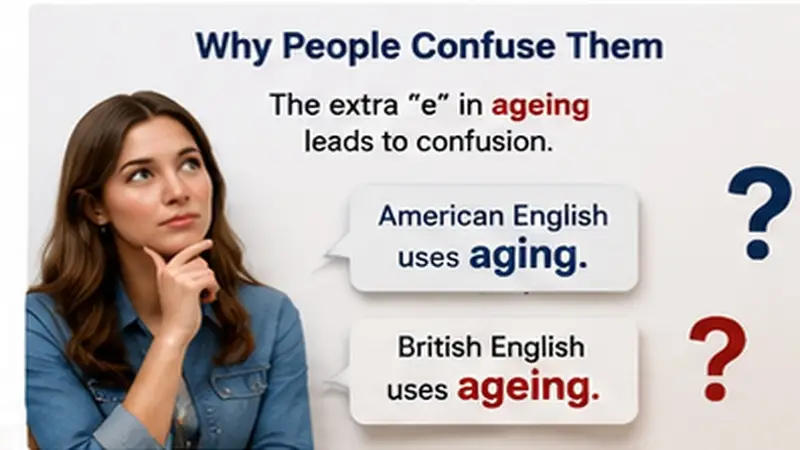
The confusion comes from the extra e in ageing.
The word comes from the verb age, and both forms are used with the -ing ending. American English generally uses the shorter form aging, while British English commonly retains the e in ageing.
Because both forms are established in English, readers may see both spellings in books, articles, dictionaries, and online writing.
For example:
- The aging bridge needs repairs.
- The ageing bridge needs repairs.
Both sentences mean that the bridge is becoming older or showing the effects of age.
The spelling does not create a different meaning.
Key Differences At A Glance
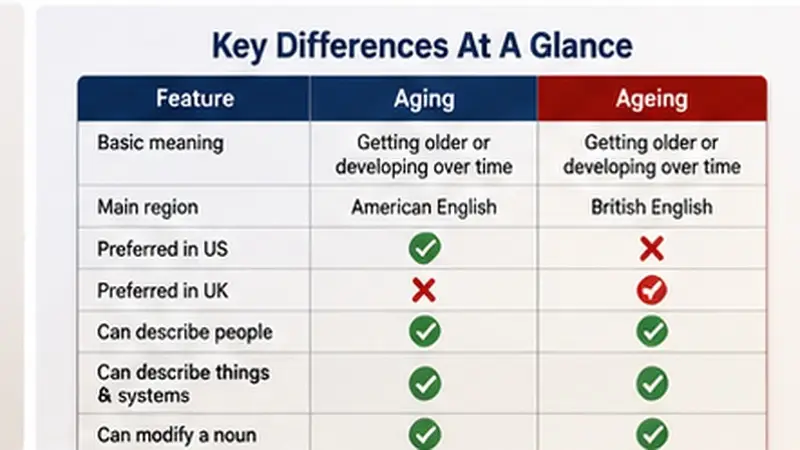
| Feature | Aging | Ageing |
|---|---|---|
| Basic meaning | Getting older or developing over time | Getting older or developing over time |
| Main regional association | American English | British English |
| Preferred in US writing | Yes | Usually less common |
| Preferred in UK writing | Usually less common | Yes |
| Can describe people | Yes | Yes |
| Can describe objects and systems | Yes | Yes |
| Can modify a noun | Yes | Yes |
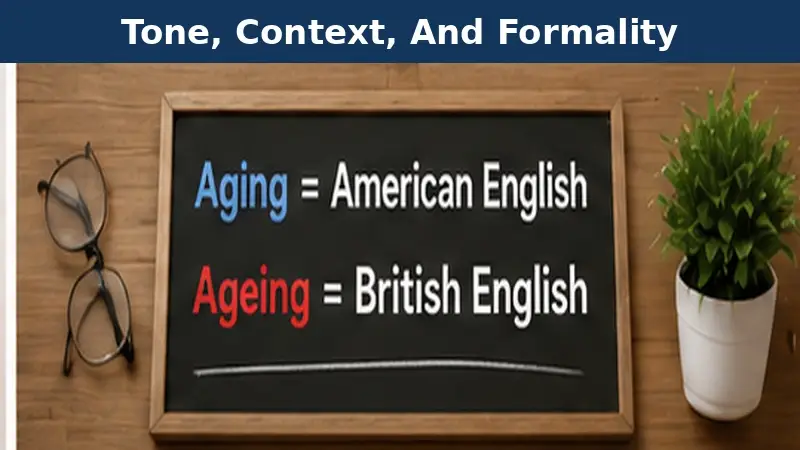
The easiest rule to remember is:
Aging = American English.
Ageing = British English.
Meaning And Usage Difference
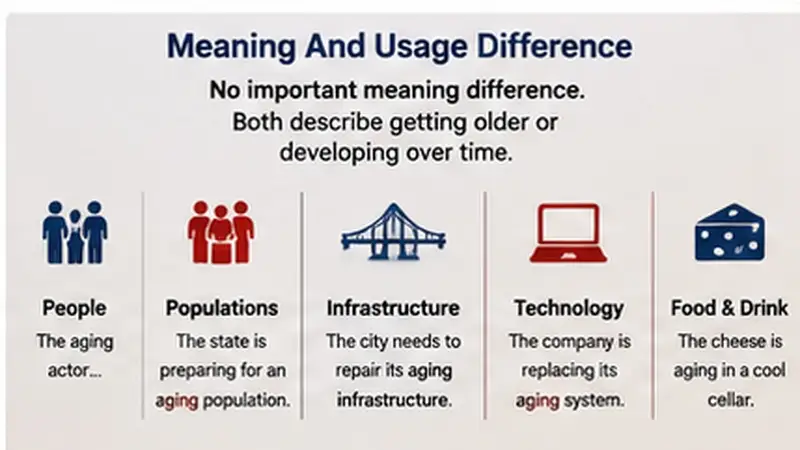
There is no important meaning difference between aging and ageing in ordinary use.
Both forms can describe something becoming older or changing over time.
People
- The aging actor has reduced his work schedule.
- The ageing actor has reduced his work schedule.
Populations
- The state is preparing for an aging population.
- The state is preparing for an ageing population.
Buildings And Infrastructure
- The city needs to repair its aging infrastructure.
- The city needs to repair its ageing infrastructure.
Technology
- The company is replacing its aging computer system.
- The company is replacing its ageing computer system.
Food And Drink
- The cheese is aging in a controlled environment.
- The cheese is ageing in a controlled environment.
In every example, the basic meaning remains the same. Only the spelling changes.
Tone, Context, And Formality
Neither aging nor ageing is automatically more formal, professional, academic, or casual.
The difference is primarily regional.
In American English, aging is natural in:
- medical writing
- academic research
- business writing
- news reporting
- everyday conversation
In British English, ageing can appear in the same types of contexts.
For example:
- US: The study examines healthy aging.
- UK: The study examines healthy ageing.
The choice does not change the tone of the sentence.
However, consistency matters. If an article follows American English, using aging throughout will usually look more natural. If it follows British English, ageing is the better fit.
Which One Should You Use?
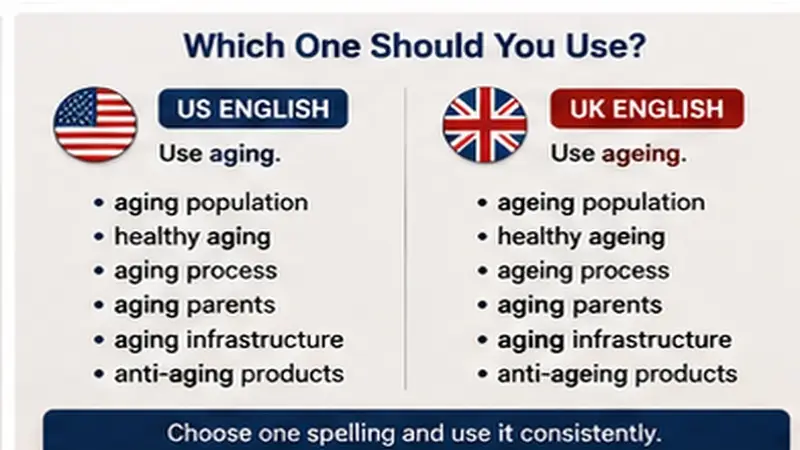
If you are writing for a US audience, choose aging.
Common American English phrases include:
- aging population
- healthy aging
- aging process
- aging parents
- aging infrastructure
- aging technology
- anti-aging products
If you are writing for a British audience, use ageing in the corresponding phrases:
- ageing population
- healthy ageing
- ageing process
- ageing parents
- ageing infrastructure
- ageing technology
- anti-ageing products
The best approach is to choose one regional spelling and use it consistently throughout your article, website, report, or publication.
When One Choice Sounds Wrong
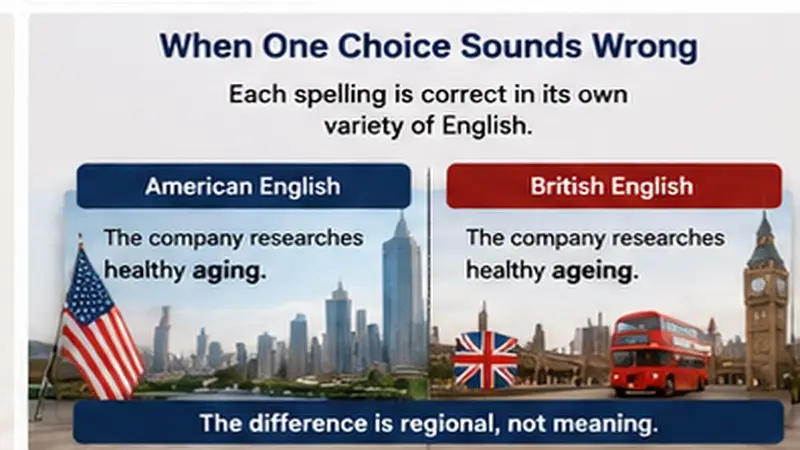
The less familiar spelling may look unusual to some readers, but that does not make it incorrect.
For example, an American reader will usually expect:
The company researches healthy aging.
The version below is understandable but less typical in American English:
The company researches healthy ageing.
A British reader may have the opposite preference and expect ageing.
This is a matter of regional convention and reader expectation. It is not a difference in meaning.
The same pattern appears in common compounds:
- American English: anti-aging
- British English: anti-ageing
- American English: aging population
- British English: ageing population
- American English: healthy aging
- British English: healthy ageing
Common Mistakes (And Quick Fixes)
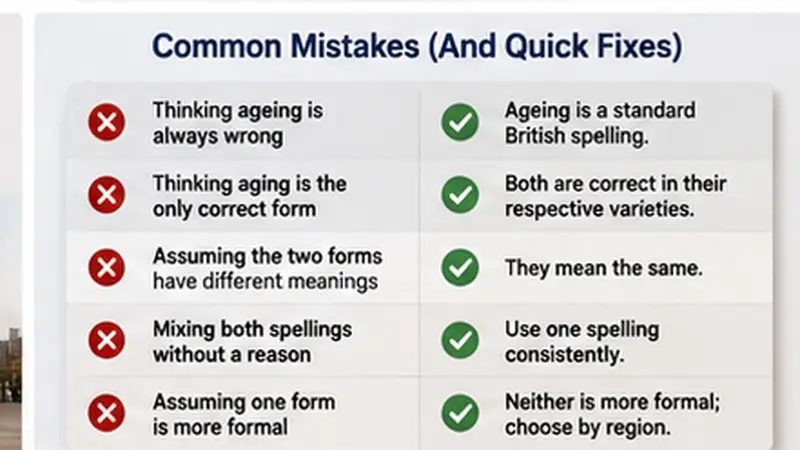
Mistake 1: Thinking Ageing Is Always Wrong
Incorrect assumption: Ageing is simply a misspelling.
Quick fix: Ageing is an established spelling, especially in British English.
Mistake 2: Thinking Aging Is The Only Correct Form
Incorrect assumption: Only the shorter spelling is acceptable.
Quick fix: Aging is the preferred American English form, while ageing is the preferred British English form.
Mistake 3: Assuming The Two Forms Have Different Meanings
Incorrect assumption: One spelling applies to people and the other applies to objects.
Quick fix: Both forms can describe people, animals, populations, objects, systems, and processes.
Mistake 4: Mixing Both Spellings Without A Reason
For example:
The aging population faces challenges related to ageing infrastructure.
This combination is understandable, but it may look inconsistent in an American English article.
Quick fix: Follow one regional spelling consistently unless you are intentionally discussing the difference between English varieties.
Mistake 5: Assuming One Form Is More Formal
Neither spelling is automatically more professional or academic.
Quick fix: Choose based on regional English and the style you are following.
Everyday Examples
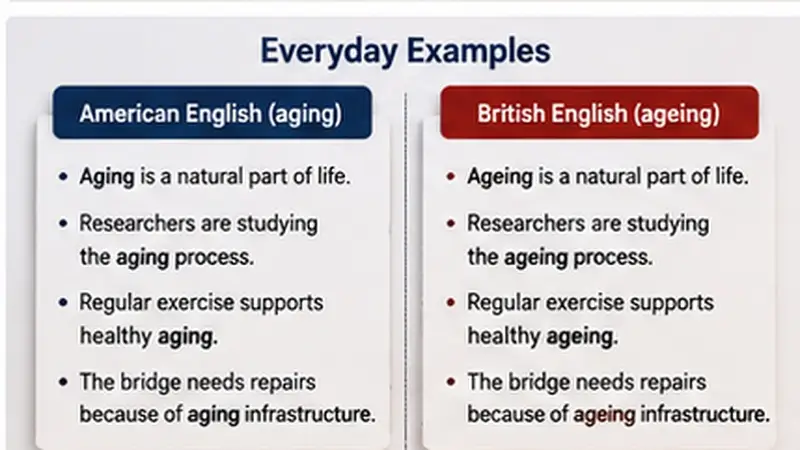
Here are natural examples for American English:
- Aging is a natural part of life.
- The city is preparing for an aging population.
- Researchers are studying the aging process.
- The hospital offers services for aging adults.
- Regular exercise can support healthy aging.
- The bridge needs repairs because of aging infrastructure.
- The company is replacing its aging technology.
- The aging computer system is becoming difficult to maintain.
- The cheese is aging in a temperature-controlled room.
- The article discusses the challenges faced by aging parents.
In British English, the corresponding forms commonly use ageing:
- ageing is a natural part of life
- an ageing population
- the ageing process
- ageing adults
- healthy ageing
- ageing infrastructure
- ageing technology
- ageing parents
The meaning remains the same.
Dictionary-Style Word Details
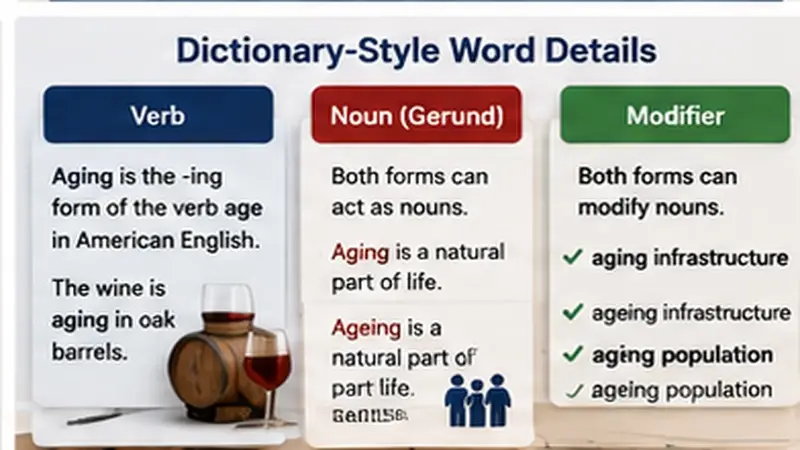
Verb
Aging is the -ing form of the verb age in American English.
The wine is aging in oak barrels.
Ageing is the corresponding spelling commonly used in British English.
The wine is ageing in oak barrels.
In both examples, the word describes an ongoing process.
Noun
Both forms can function as gerunds, meaning the -ing form acts as a noun.
Aging is a natural part of life.
Ageing is a natural part of life.
In these examples, each word names the process of becoming older.
Both forms can also appear before nouns as modifiers:
- aging infrastructure
- ageing infrastructure
- aging population
- ageing population
Synonyms
Because aging and ageing are regional spellings of the same word, they do not have different synonym sets.
Depending on the context, possible plain alternatives include:
- getting older
- growing older
- developing over time
- maturing
These are not exact replacements in every sentence.
For example, maturing may work well for cheese or wine, while getting older is more natural when referring to a person.
Example Sentences
Aging:
The city is preparing for an aging population.
The company is replacing its aging software.
The cheese is aging in a cool cellar.
Ageing:
The city is preparing for an ageing population.
The company is replacing its ageing software.
The cheese is ageing in a cool cellar.
The spelling changes, but the basic meaning remains the same.
Word History
Both forms are based on the verb age with the -ing ending.
The difference between aging and ageing is mainly a regional spelling convention. American English generally prefers aging, while British English generally prefers ageing.
The two spellings do not represent different meanings.
Phrases Containing
Common American English phrases include:
- aging population
- healthy aging
- aging process
- aging parents
- aging infrastructure
- aging technology
- anti-aging
- aging cheese
British English commonly uses the corresponding forms:
- ageing population
- healthy ageing
- ageing process
- ageing parents
- ageing infrastructure
- ageing technology
- anti-ageing
- ageing cheese
Frequently Asked Questions
Is aging or ageing correct in American English?
Aging is the preferred spelling in American English. Ageing is an established spelling that is more commonly associated with British English.
Is ageing wrong?
No. Ageing is not simply a misspelling. It is a standard regional spelling, especially in British English.
Do aging and ageing have different meanings?
No. In ordinary use, both forms refer to getting older or developing over time.
Can I use ageing in American English?
Yes. American readers will generally understand it, but aging is the more natural choice for standard American English.
Which spelling should I use in a US article?
Use aging.
Should I use both spellings in the same article?
Usually, no. Choose the spelling that matches your target variety of English and use it consistently.
Conclusion
Aging and ageing are two established spellings of the same word.
Use aging in American English:
The city has an aging population.
Use ageing in British English:
The city has an ageing population.
The two forms have the same basic meaning and can perform the same grammatical functions. The main difference is regional spelling.
For a US audience, aging is the natural choice.