
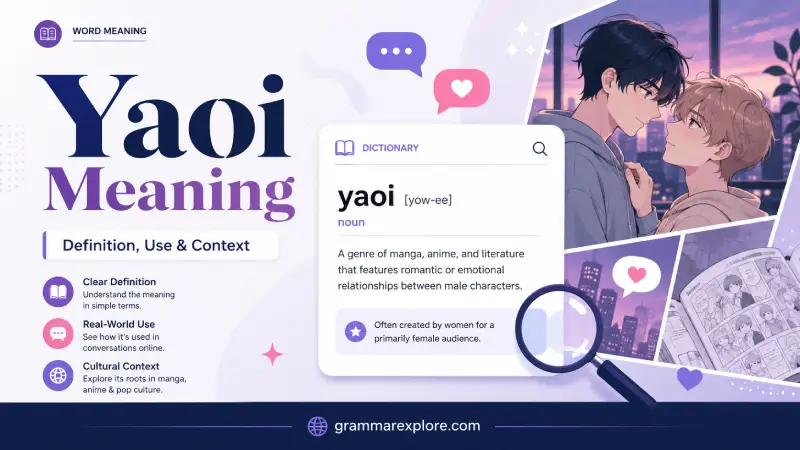
If you have seen the word yaoi while browsing manga, anime, fan fiction, or online fandom discussions, you may wonder what it means. Yaoi is a Japanese term associated with fictional stories and media that focus on romantic or sexual relationships between male characters. In English-speaking communities, the term is often used broadly for male-male romance in manga, anime, fan fiction, and related media.
The word has a more specific history, however. It originally developed in Japanese fan-created manga culture and was associated with works that emphasized male-male relationships, often with little concern for a conventional plot. Over time, its meaning expanded, especially outside Japan.
Today, yaoi and BL (Boys’ Love) overlap, but they are not always interchangeable. The distinction can depend on whether someone is discussing Japanese publishing terminology, older fan culture, or Western fandom language.
Quick Answer
Yaoi is a Japanese term commonly used for fictional media featuring romantic or sexual relationships between male characters. In English-speaking fandoms, it can refer broadly to male-male romance in manga, anime, fan fiction, and similar media. Historically, the word came from the Japanese phrase yama nashi, ochi nashi, imi nashi, roughly meaning “no climax, no point, no meaning,” reflecting its early association with plot-light fan works.
What Does Yaoi Mean?
The simplest definition of yaoi is:
Yaoi is a genre or label for fictional works centered on relationships between male characters, especially romantic or sexual relationships.
The term is most closely associated with Japanese manga and related fan-created works. However, English-speaking fans have often used it more broadly.
For example, someone might describe a manga as yaoi because the story focuses on two male characters who develop a romantic relationship.
The term can also appear in discussions about:
- Manga
- Anime
- Fan fiction
- Fan art
- Doujinshi
- Video games
- Online fandoms
- Japanese popular culture
The exact meaning depends on context. In Japanese discussions, BL is often the broader and more current publishing term for commercial works about male-male relationships. In Western fandom, however, people have historically used yaoi as a broad label for this type of fiction.
Yaoi Meaning in Plain English
In plain English, yaoi refers to fictional stories about relationships between male characters.
Those relationships may be romantic, emotional, sexual, or some combination of these.
The term does not describe a real person’s sexual orientation. It describes a type of fictional content or a genre label.
That distinction matters.
For example:
“He likes yaoi manga.”
This sentence normally means that the person enjoys a particular type of fictional manga. It does not tell you the person’s sexual orientation.
Likewise:
“That anime has yaoi elements.”
This means the speaker sees male-male romantic or sexual themes in the work.
Is Yaoi a Japanese Word?
Yes. Yaoi comes from Japanese, although its modern form is associated with a particular history of fan-created manga and wordplay.
It is normally written in Japanese as やおい.
The term became associated with the phrase:
yama nashi, ochi nashi, imi nashi
The phrase is commonly translated as something like:
“no climax, no point, no meaning.”
Here, “climax” refers to the high point of a story, not necessarily a sexual climax. The expression was used humorously to describe works that lacked a conventional plot or dramatic development.
What Does Yaoi Stand For?
The commonly cited expansion is:
Yama nashi, ochi nashi, imi nashi
The three parts are associated with ideas such as:
- yama , climax or high point of a story
- ochi , punch line, conclusion, or resolution
- imi , meaning
- nashi , without or lacking
So the expression can be understood broadly as:
“No climax, no conclusion, no meaning.”
The phrase was originally humorous and self-deprecating. It described works that did not follow a conventional story structure. Later, yaoi became associated with male-male fan works and eventually developed into a widely recognized genre label.
Where Did the Word Yaoi Come From?
The modern use of yaoi emerged from Japanese fan culture around the late 1970s and early 1980s.
During the 1970s, manga creators developed stories featuring male characters in romantic relationships. At the same time, the Japanese dōjinshi or self-published manga community became an important space for fan-created works.
In the 1980s, the word yaoi became associated with amateur works involving male-male relationships, including parodies and derivative stories based on existing characters.
This history explains why the modern meaning is more complicated than simply translating the Japanese phrase.
The phrase itself suggests “no climax, no point, no meaning,” but the modern genre label refers to a type of fictional relationship and media.
Yaoi History in Simple Terms
The development can be understood in several stages.
1970s: Early Male-Male Romance Manga
During the 1970s, female manga artists associated with the so-called Year 24 Group helped develop stories about male characters in romantic and sometimes sexual relationships.
These works appeared in shōjo manga culture and helped establish an important foundation for later Boys’ Love traditions.
Late 1970s and 1980s: Yaoi Emerges
The term yaoi became associated with fan-created works, particularly dōjinshi.
These works often used characters from existing manga or anime and placed them in male-male romantic or sexual relationships.
The term originally carried a humorous sense because some of these works were intentionally light on plot.
Later Development: BL
Over time, commercial publishers increasingly used Boys’ Love, usually shortened to BL, as a broader category for commercially published male-male romance.
As a result, BL became an important umbrella term in Japanese publishing and fandom culture.
Yaoi vs. BL
Yaoi and BL are closely related, but they are not always exact synonyms.
In modern Japanese publishing, BL is generally the broader and more standard term for commercial fiction focused on relationships between male characters.
Yaoi has a more specific historical connection to fan-created works and has often been associated with more sexually focused material.
However, Western fans have frequently used “yaoi” much more broadly.
| Term | General Meaning | Typical Context |
|---|---|---|
| Yaoi | Male-male romantic or sexual fiction, especially with historical fan-culture associations | Manga, anime, fandom |
| BL | Boys’ Love; broad category for male-male romance | Japanese publishing and global fandom |
| Shōnen-ai | Historical term associated with male-male romantic stories | Older discussions and fandom |
| Dōjinshi | Self-published or independently produced manga | Japanese fan culture |
These categories overlap, and their boundaries have changed over time. Academic research on Japanese media generally treats yaoi and BL as related but historically distinct labels rather than perfectly interchangeable terms.
Is Yaoi the Same as Boys’ Love?
Not exactly.
Boys’ Love, or BL, is generally the broader modern category. Yaoi is one of the terms historically associated with male-male romance and erotic fiction.
The distinction becomes especially important when discussing Japanese publishing.
For a modern commercial Japanese work, BL may be the more appropriate term.
In Western internet communities, however, someone may use yaoi as a general label for male-male romantic manga or anime.
So the safest interpretation depends on who is speaking and where the word appears.
Yaoi vs. Shōnen-ai
Another term that often causes confusion is shōnen-ai.
The Japanese expression shōnen-ai literally relates to “boy love,” but its use in English-language fandom has often referred to male-male romantic stories with less emphasis on explicit sexual content.
The term has a complicated history and does not map perfectly onto modern Japanese genre categories.
For that reason, it is better to treat shōnen-ai, yaoi, and BL as historically related terms rather than assuming they are three fixed levels of the same genre.
Academic work on the history of these categories shows that the terminology changed over several decades.
How Is Yaoi Used in English?
In American and other English-speaking fandoms, yaoi is usually used as a noun.
Common patterns include:
- “I read yaoi manga.”
- “That series has yaoi elements.”
- “She enjoys yaoi fan fiction.”
- “The discussion is about yaoi and BL.”
- “That title is often classified as yaoi.”
The word can also appear as an adjective in informal online descriptions.
For example:
“yaoi manga”
means manga associated with the yaoi category.
“yaoi fandom”
refers to the community of people who create, discuss, or consume yaoi-related media.
Is Yaoi Formal or Informal?
Yaoi is primarily a specialized genre and fandom term.
It is not a normal everyday English word like “romance” or “fiction.”
You are most likely to encounter it in:
- Manga communities
- Anime communities
- Fan fiction websites
- Social media
- Online forums
- Academic writing about Japanese popular culture
- Discussions of LGBTQ-related media
- Publishing discussions
Because it is a specialized term, it may need explanation when used outside fandom or media studies.
For example, a casual reader may understand:
“a romantic manga about two men”
more easily than:
“a yaoi manga.”
Both can communicate the general idea, but the second assumes the reader knows the genre vocabulary.
Is Yaoi Slang?
Yaoi is not simply slang in modern English.
It is better described as a borrowed Japanese genre term that also functions as specialized fandom vocabulary.
Its origins involved informal fan culture and humorous wordplay, but the word eventually became an established label for a category of fictional media.
Therefore, calling it “slang” without qualification would be misleading.
A better description is:
Yaoi is a Japanese-origin genre and fandom term used in English to describe certain male-male relationship fiction.
Who Uses the Word Yaoi?
The word is most common among people interested in:
- Anime
- Manga
- Japanese pop culture
- Fan fiction
- Fan art
- Dōjinshi
- Online fandom communities
- Media studies
Researchers also use the term when discussing the history and cultural development of male-male romance in Japanese popular media.
However, not every fan uses the word yaoi. Many people prefer BL, particularly when discussing modern Japanese commercial works.
Does Yaoi Mean Gay?
Not exactly.
Yaoi commonly involves male-male romantic or sexual relationships in fiction, but the genre label itself does not necessarily describe the sexual orientation of the characters or the readers.
A fictional character can be written as gay, bisexual, or without a clearly stated identity.
Similarly, enjoying yaoi does not automatically tell you anything about a reader’s sexual orientation.
The term describes fictional content, not a personal identity.
Is Yaoi About Real People?
Usually, the word refers to fictional media.
A yaoi manga, anime, novel, or fan work generally involves fictional characters.
However, fan-created works can sometimes use real public figures as inspiration. When that happens, the ethical and cultural issues are different from those surrounding fictional characters.
It is therefore useful to check the context before assuming what someone means by “yaoi.”
Is Yaoi Always Explicit?
No.
The term has historically been associated with sexually explicit material, but its use varies.
Some works labeled yaoi may focus heavily on romance or relationships, while others contain more explicit sexual content.
That is one reason BL is often preferred as a broader category. BL can include many kinds of stories, from light romance to more mature relationship-focused works.
If you are choosing media for yourself or someone else, check the individual work’s age rating and content description rather than assuming that every title under one label has the same level of explicitness.
Yaoi Meaning on Social Media
On social media, yaoi usually retains its fandom meaning.
You may see it in:
- Hashtags
- Fan art descriptions
- Manga recommendations
- Anime discussions
- Character pairings
- Fan fiction communities
- Memes
- Fandom profiles
For example:
“Looking for good yaoi recommendations.”
Here, the person is asking for recommendations involving male-male romance or related fictional content.
Another example:
“This fandom has a huge yaoi community.”
The speaker is referring to fans interested in male-male relationship content involving that fandom.
The exact meaning can still vary because different communities use yaoi and BL differently.
Yaoi Meaning in Texting
Yaoi does not have a special texting meaning that is separate from its normal fandom meaning.
If someone writes:
“Do you watch yaoi?”
they are most likely asking whether you consume anime or other fictional media involving male-male relationships.
If someone writes:
“I found a new yaoi manga.”
they are using yaoi as a genre label.
Unlike abbreviations such as “LOL” or “BRB,” yaoi is not normally shortened because it is already a short word.
How to Pronounce Yaoi
In English, yaoi is commonly pronounced approximately like:
YOW-ee
Common English pronunciation guides give pronunciations such as /ˈjaʊ.i/, although English speakers may vary in how they say the word.
The Japanese pronunciation is closer to:
ya-o-i
with three vowel sounds.
If you are speaking English, “YOW-ee” is a common pronunciation.
Is Yaoi an Acronym?
The answer needs some nuance.
However, the history of the term is more complicated than a simple modern acronym. Sources discussing its origins describe it as humorous wordplay that developed within Japanese fan culture.
So it is accurate to explain the commonly cited expansion while avoiding the claim that it began as a formal acronym created for a modern commercial genre.
What Does “Yama Nashi, Ochi Nashi, Imi Nashi” Mean?
The phrase can be translated approximately as:
“No climax, no conclusion, no meaning.”
The three ideas refer to the structure of a story:
- Yama relates to the high point or climax.
- Ochi relates to the conclusion, punch line, or payoff.
- Imi means meaning.
- Nashi expresses absence.
The phrase was used humorously for works that seemed to lack a conventional narrative structure. Its association with yaoi became stronger as the term entered male-male fan fiction and dōjinshi culture.
Common Examples of Yaoi in a Sentence
Example 1
Sentence: “He discovered yaoi through manga.”
Meaning: He encountered the genre through Japanese comics.
Why it is used: The sentence uses yaoi as a noun describing a type of fictional media.
Example 2
Sentence: “That bookstore has a section for BL and yaoi.”
Meaning: The bookstore carries works involving male-male romance.
Why it is used: The speaker is discussing genre categories.
Example 3
Sentence: “Is this series considered yaoi?”
Meaning: The speaker wants to know whether the series fits that genre label.
Why it is used: The term appears in a classification question.
Example 4
Sentence: “She writes yaoi fan fiction.”
Meaning: She writes fictional stories centered on male-male relationships.
Why it is used: Yaoi identifies the type of fiction she creates.
Example 5
Sentence: “The article discusses the history of yaoi.”
Meaning: The article examines the development of the genre and term.
Why it is used: Yaoi is being used as a subject in an academic or cultural discussion.
Example 6
Sentence: “Some fans use BL instead of yaoi.”
Meaning: Some fans prefer the term Boys’ Love.
Why it is used: The sentence highlights a difference in terminology.
Example 7
Sentence: “The two terms overlap, but yaoi and BL have different histories.”
Meaning: The terms are related but developed in different contexts.
Why it is used: This is a useful distinction when discussing Japanese media.
Example 8
Sentence: “I saw the term yaoi in an anime forum.”
Meaning: The speaker encountered the genre term while reading an online discussion.
Why it is used: It shows a common digital context for the word.
Common Misunderstandings About Yaoi
Yaoi always means explicit pornography
Not necessarily.
The word has strong historical connections to sexually explicit material, but modern usage can be broader. Some people use yaoi for male-male romance generally.
The exact content depends on the individual work.
Yaoi and BL always mean exactly the same thing
They overlap, but they have different histories.
BL is generally the broader modern category, especially in Japanese commercial publishing, while yaoi has a stronger historical connection to fan-created works.
Yaoi describes someone’s sexual orientation
It does not.
The word primarily describes fictional media or a genre.
Someone can enjoy yaoi without the term describing their personal identity.
Yaoi only refers to anime
No.
Yaoi can refer to manga, fan fiction, dōjinshi, games, novels, fan art, and other forms of fictional media.
Yaoi is simply Japanese slang for gay
That is also inaccurate.
Yaoi is a genre or fandom term connected to fictional male-male relationships. It is not a general Japanese word meaning “gay.”
Related Terms
Understanding related vocabulary can make discussions about Japanese media easier.
| Term | General Meaning | Difference |
|---|---|---|
| Yaoi | Fiction involving male-male romantic or sexual relationships | Historical fan-culture term with broad Western usage |
| BL | Boys’ Love | Broad modern category for male-male romance |
| Shōnen-ai | Historical term associated with male-male romance | Usage varies and differs between Japan and English fandom |
| Dōjinshi | Independently published or fan-created works | Describes the production format, not specifically the relationship genre |
| Manga | Japanese comics | A medium, not a specific romance genre |
| Anime | Japanese animation | A medium, not a specific romance genre |
These terms should not automatically be treated as synonyms. For example, manga describes a medium, while yaoi describes a type of content or genre label.
Yaoi in Japanese Culture
Yaoi developed within a much larger history of Japanese manga and fan culture.
Its development is connected to the growth of female-authored stories about male characters, the rise of dōjinshi culture, and the later commercialization of Boys’ Love media.
Academic research describes the 1970s as an important period in the development of male-male romance manga, followed by the emergence of yaoi in fan culture during the 1980s.
The subject has also generated academic debate about gender, sexuality, readership, representation, and the relationship between fictional romance and real-world LGBTQ identities.
That history is one reason the term cannot be reduced to a single English translation.
Is Yaoi a Genre or a Label?
It can function as both.
In everyday fandom language, yaoi can act as a genre label.
For example:
“I like yaoi.”
Here, the word identifies a type of fictional content.
In a cultural or academic discussion, however, yaoi may refer to a historical category within Japanese fan and publishing culture.
The meaning therefore depends partly on the speaker’s context.
Why Do People Use the Term Yaoi?
People use the word because it provides a short way to identify a particular type of fictional media.
Instead of saying:
“fictional stories involving romantic or sexual relationships between male characters”
a fan can simply say:
“yaoi.”
However, the shorter label assumes that the audience understands the term.
For a general audience, male-male romance or Boys’ Love may be clearer.
Frequently Asked Questions
What does yaoi mean?
Yaoi is a Japanese-origin term commonly used for fictional media featuring romantic or sexual relationships between male characters. In Western fandom, the term can be used broadly for manga, anime, fan fiction, and related media. Historically, it developed from Japanese fan culture and became associated with male-male dōjinshi.
What does yaoi stand for?
Yaoi is commonly explained as coming from the Japanese phrase yama nashi, ochi nashi, imi nashi, roughly meaning “no climax, no conclusion, no meaning.” The phrase originally functioned as humorous criticism of works lacking a conventional story structure. Later, the term became associated with male-male fan works.
Is yaoi the same as BL?
Not exactly. The terms overlap, but BL, or Boys’ Love, is generally the broader modern category used for commercial Japanese media about male-male relationships. Yaoi has a stronger historical connection to fan-created works and is often used more broadly in Western fandom.
Is yaoi a type of anime?
Yaoi can describe anime, but it is not limited to animation. The term can also refer to manga, novels, fan fiction, dōjinshi, games, and other fictional media involving male-male relationships.
Does yaoi mean gay?
No. Yaoi is a genre or fandom term for fictional content. It does not describe the sexual orientation of the person who reads or watches it, and it is not simply a Japanese synonym for “gay.”
Is yaoi always sexual?
No. Although the term has historical associations with sexually explicit material, modern usage can be broader. Some works focus strongly on romance and relationships, while others contain mature sexual content. The content of an individual work should be checked separately.
How do you pronounce yaoi?
In English, yaoi is commonly pronounced approximately YOW-ee. Some English speakers use slightly different pronunciations. Japanese pronunciation is closer to the separate vowel sounds in ya-o-i.
Conclusion
Yaoi meaning is best understood as a Japanese-origin term associated with fictional stories and media involving romantic or sexual relationships between male characters. In English-speaking fandoms, it is often used broadly for manga, anime, fan fiction, and related media.
The word has an interesting history. It is commonly connected to yama nashi, ochi nashi, imi nashi, a humorous phrase meaning roughly “no climax, no conclusion, no meaning.” The term later became associated with male-male dōjinshi and developed into a widely recognized genre label.
It is also important not to treat yaoi and BL as perfect synonyms in every context. BL is generally the broader modern term in Japanese publishing, while yaoi has stronger historical connections to fan culture.
In short, yaoi describes fictional media, not a person’s identity, and its exact meaning can depend on whether the discussion is about Japanese publishing, older fan culture, or modern English-language fandom.


