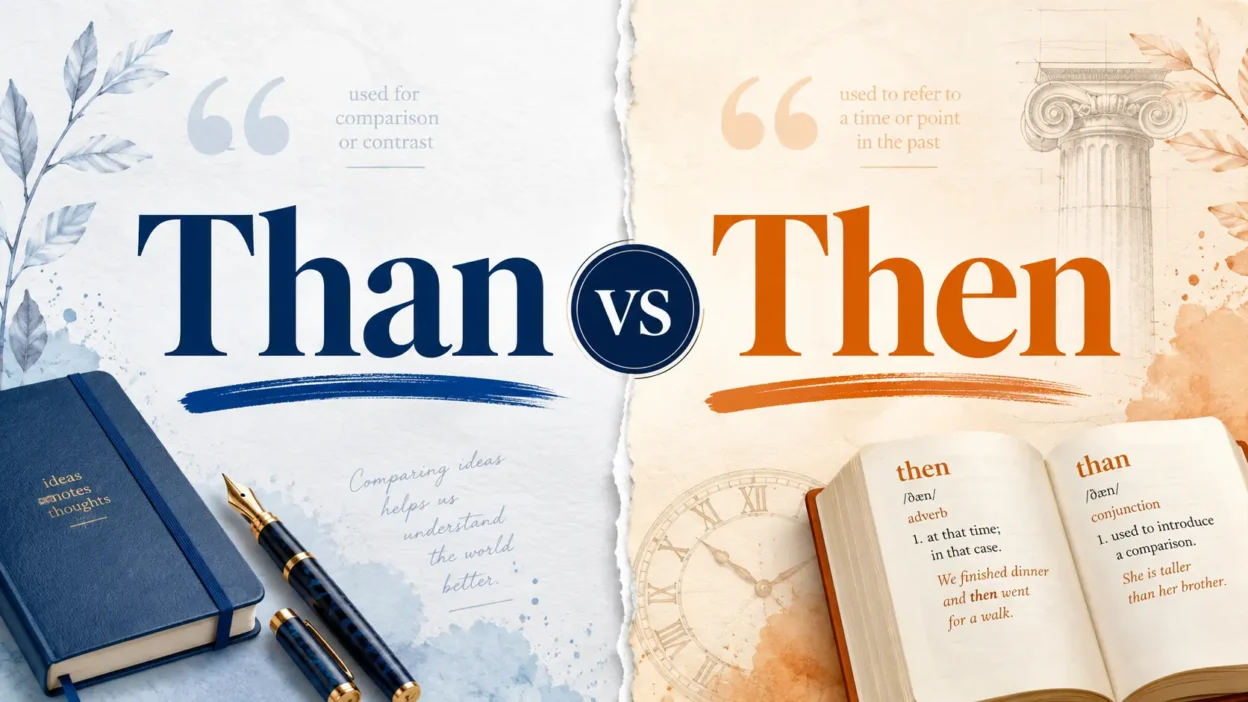
English contains many words that sound alike but serve different purposes—homophones. Among the most commonly confused are than and then.
Writers mix them up for several reasons:
- They sound similar.
- They look similar in print.
- Their functions in sentences are entirely different, yet casual speech can blur the distinction.
This guide provides a complete explanation of than and then, showing when and how to use each correctly, with practical examples, memory aids, and exercises.
Quick Answer
- Than → Conjunction used for comparisons.
- Then → Adverb (sometimes noun/adjective) used for time, sequence, or consequence.
Rule of Thumb:
- Comparing things? → Than
- Showing what happens next or a result? → Then
Why People Confuse Them
- Pronunciation: Both start with the /ðən/ sound.
- Spelling similarity: Only one letter differentiates them.
- Over-reliance on sound: Writers often guess based on auditory cues rather than context.
- Context errors: Especially in spoken English, then sometimes replaces than, leading to repeated mistakes in writing.
Key Differences At A Glance

| Feature | Than | Then |
|---|---|---|
| Function | Comparison | Time / Sequence / Consequence |
| Part of Speech | Conjunction | Adverb (sometimes noun/adjective) |
| Common Use | Comparing two elements | Indicating order, next action, or result |
| Tone | Neutral | Neutral; versatile in formal, casual, and academic contexts |
| Examples | taller than, better than | first we ate, then we left |
Meaning and Usage Difference
Than
Than introduces comparisons.
Usage rules:
- Follow comparative adjectives/adverbs: taller than, faster than.
- Cannot indicate time.
- Always a conjunction.
Examples:
- She is taller than her sister.
- I would rather read a book than watch TV.
- His solution is more practical than hers.
- This route is shorter than the alternate path.
Common phrases:
- more than, less than, other than, rather than
Then
Then indicates time, sequence, or consequence.
Usage rules:
- Functions mainly as an adverb.
- Appears in conditional statements (if… then…).
- Rarely used as a noun/adjective in historical contexts (e.g., “the then president”).
Examples:
- We finished dinner, then went for a walk.
- If you study hard, then you will succeed.
- First take notes, then summarize them.
- He was a student and, then, became a teacher.
Common phrases:
- back then, till then, by then, if… then…
Tone, Context, and Formality
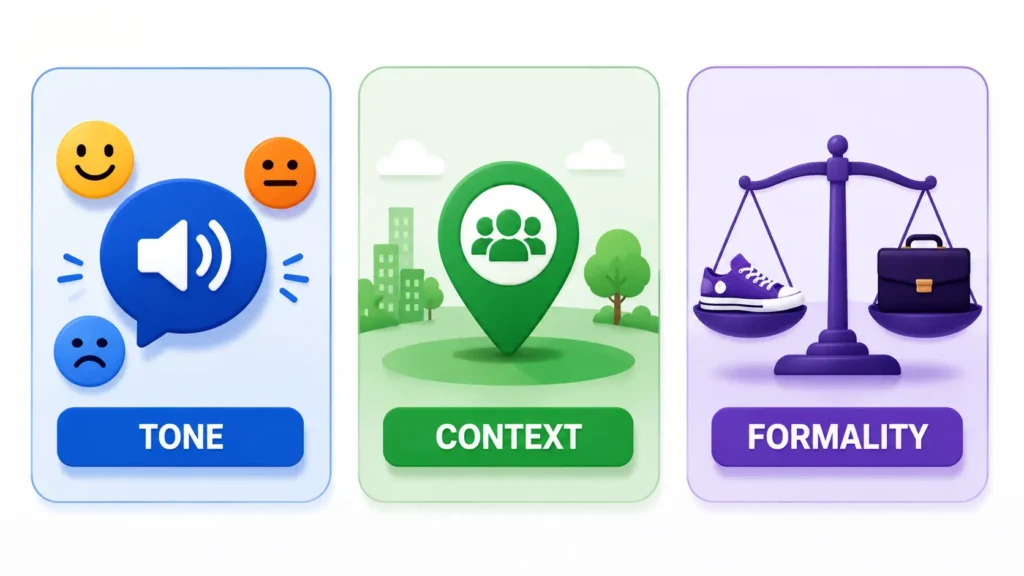
- Than is consistent across all writing styles: formal, informal, professional, and academic.
- Then is versatile, used in storytelling, instructions, conditional statements, and chronological narratives.
- Both are neutral in tone, but using them incorrectly can alter meaning significantly, especially in formal writing.
Which One Should You Use?
Step 1 – Identify function:
- Comparing → Than
- Sequence or result → Then
Step 2 – Check sentence role:
- Following a comparative adjective/adverb? → Than
- Indicating “next” or “after that”? → Then
Step 3 – Memory tip:
- Than → Comparison (think a for comparison).
- Then → Time/Sequence (think e for event).
When One Choice Sounds Wrong
- ❌ “I would rather go then stay home.”
- ✔️ “I would rather go than stay home.”
- ❌ “We finished the work than took a break.”
- ✔️ “We finished the work, then took a break.”
Common Mistakes and Quick Fixes
| Error Type | Incorrect | Correct |
|---|---|---|
| Comparison vs sequence | She is taller then her sister. | She is taller than her sister. |
| Conditional mistake | If you agree, than you win. | If you agree, then you win. |
| Confusion with similar words | He runs faster then me, then he wins. | He runs faster than me, then he wins. |
Everyday Examples
Than:
- This movie is more exciting than the last one.
- I prefer tea than coffee.
- The mountain is higher than the hill.
- She likes dogs more than cats.
Then:
- Finish your homework, then you can watch TV.
- If it rains, then we will cancel the picnic.
- He left the office, then called me.
- Study first, then revise your notes.
Dictionary-Style Word Details
Verb
- Than: Not a verb.
- Then: Not a verb.
Noun
- Than: Not used as a noun.
- Then: Rarely as a noun (historical reference), otherwise an adverb.
Synonyms
- Than: compared to, in comparison with
- Then: next, afterward, subsequently
Example Sentences
- Than: She is faster than her brother.
- Then: We ate lunch, then went shopping.
Word History
- Than: Old English þonne, used for comparisons.
- Then: Old English þanne, indicated time or sequence.
Phrases Containing
- Than: more than, better than, rather than
- Then: if… then…, back then, till then, by then
Advanced Usage Notes
- Conditional Statements: “If… then…” clarifies cause-effect relationships.
- Literary Writing: Avoid using then in place of than when comparing.
- Historical References: Then can serve as an adjective/noun, e.g., “the then CEO.”
- Combined Sentences:
- “She is taller than I am, and I will finish my homework, then go out.”
Practice Exercises
- Fill in the blank:
- I would rather walk ___ drive.
- We had breakfast, ___ went for a run.
- His solution is better ___ mine.
- Finish your work, ___ you can relax.
Answers: than, then, than, then
- Rewrite the incorrect sentences:
- ❌ He is stronger then me.
- ❌ If you agree, than it works.
Correct:
- He is stronger than me.
- If you agree, then it works.
FAQ
What is the difference between than and then?
Use than for comparisons and then for time or sequence.
When should I use than?
Use than when comparing two items, qualities, or amounts.
When should I use then?
Use then to indicate what happens next, afterward, or as a consequence.
Can then be a noun?
Rarely, as in “the then CEO”; otherwise, it functions as an adverb.
How can I remember the difference?
Than → Comparison; Then → Time/Sequence.
Conclusion
Than and then are fundamental in English writing. Misusing them can confuse readers and weaken communication.
- Use than for comparisons.
- Use then for time, sequence, or consequences.
- Apply memory aids, sentence context, and substitution tests to master usage confidently.
Proper use of these words ensures clarity, professionalism, and precision in American English.
Use than for comparisons and then for time or sequence.
Use than when comparing two items, qualities, or amounts.
Use then to indicate what happens next, afterward, or as a consequence.
Rarely, as in “the then CEO”; otherwise, it functions as an adverb.
Than → Comparison; Then → Time/Sequence.