

Updated: August 15, 2026
If you are unsure about experiance vs experience, the correct spelling is experience. “Experiance” is a common misspelling and is not the standard spelling in American English. The word experience can refer to knowledge gained through doing something, an event or situation you have lived through, or the process of encountering something.
This spelling mistake often happens because the pronunciation can make the middle vowels confusing. Knowing the correct spelling helps you write more accurately in emails, schoolwork, resumes, and everyday communication. In this guide, you’ll learn why experience is correct, what “experiance” means, and how to remember the spelling with clear examples.
Quick Answer
Experience is the correct spelling, while “experiance” is a misspelling. In the experiance vs experience comparison, experience refers to knowledge or skill gained through doing, seeing, or living through something. The correct form is experience, so use it in formal writing, schoolwork, resumes, and everyday communication.
Why The Confusion Happens
The mistake usually comes from English spelling patterns that feel inconsistent with pronunciation.
Many words ending in similar sounds use different endings like “-ence” and “-ance.” Because of this, writers sometimes mistakenly replace the correct “-ence” ending in experience with “-ance,” forming experiance.
A simple rule helps:
In “experience,” the correct ending is always -ence, never -ance.
Key Differences At A Glance
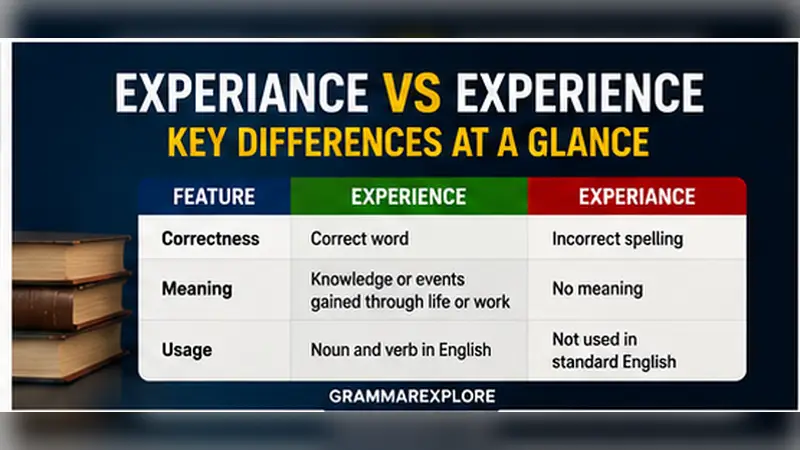
| peature | Experience | Experiance |
|---|---|---|
| Correctness | Correct word | Incorrect spelling |
| Meaning | Knowledge or events gained through life or work | No meaning |
| Usage | Noun and verb in English | Not used in standard English |
Meaning And Usage Difference
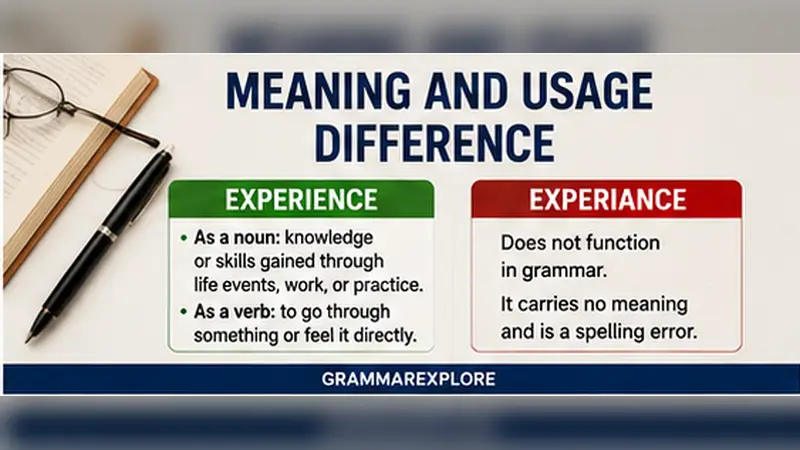
Experience works in two main ways:
As a noun, it refers to knowledge or skills gained through life events, work, or practice.
As a verb, it means to go through something directly or feel something personally.
These two uses make it one of the most flexible words in English.
Experiance does not function in grammar at all. It carries no meaning and only appears as a spelling error in writing.
Tone, Context, And Formality

Experience is used across all levels of communication:
- Academic essays and research writing
- Job applications and resumes
- Workplace emails and reports
- Everyday conversation and storytelling
It fits naturally in both formal and informal contexts.
Experiance is not acceptable in any writing context because it is not a valid English word.
Which One Should You Use?
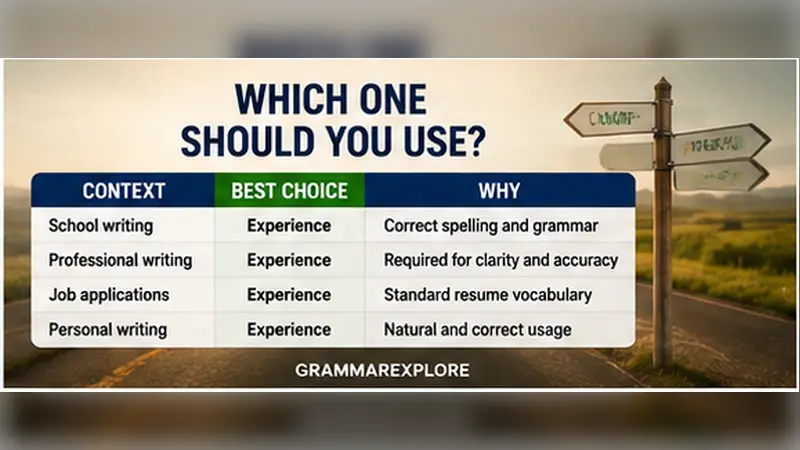
| Context | Best Choice | Why |
|---|---|---|
| School writing | Experience | Correct spelling and grammar |
| Professional writing | Experience | Required for clarity and accuracy |
| Job applications | Experience | Standard resume vocabulary |
| Personal writing | Experience | Natural and correct usage |
When One Choice Sounds Wrong
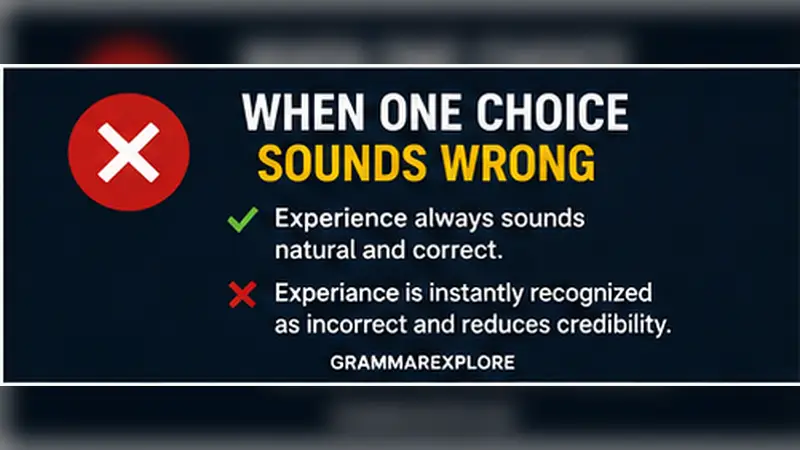
Experience always sounds natural and correct when used properly in a sentence.
Experiance is instantly recognized as incorrect by fluent readers and can reduce the clarity and credibility of your writing.
Common Mistakes (And Quick Fixes)
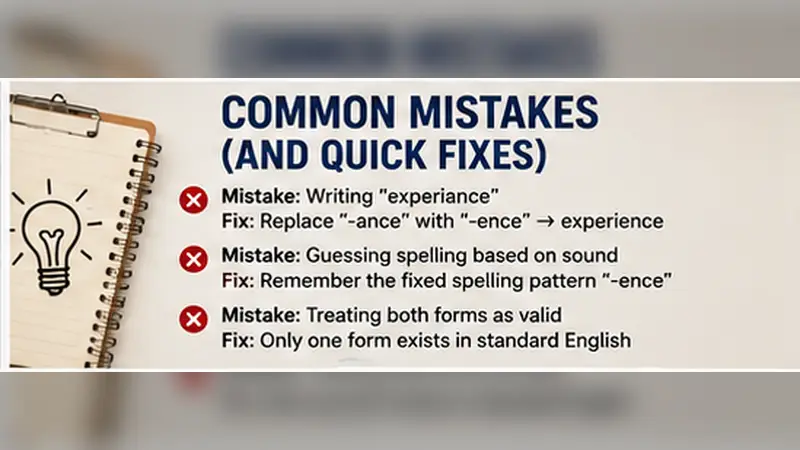
- • Mistake: Writing “experiance”
Fix: Replace “-ance” with “-ence” → experience - • Mistake: Guessing spelling based on sound
Fix: Remember the fixed spelling pattern “-ence” - • Mistake: Treating both forms as valid
Fix: Only one form exists in standard English
Everyday Examples
• She has years of experience in project management.
• I want to experience living in another country.
• His travel experience helped him adapt quickly abroad.
• The internship gave me real workplace experience.
• ❌ “Experiance” is always incorrect in formal writing.
Dictionary-Style Word Details
Verb
• Experience: To go through something directly or feel it personally
• Experiance: Not a valid verb in English
Noun
• Experience: Knowledge, skill, or understanding gained through events or practice
• Experiance: No noun form exists
Synonyms
• Experience: knowledge, exposure, practice, encounter (closest plain alternatives)
• Experiance: none (not a real word)
Example Sentences
• Experience: She experienced a major change after moving cities.
• Experience: This role requires prior experience in customer service.
• Experiance: Not used in correct English writing.
Word History
• Experience: Comes from Latin roots meaning “to try or test through living”
• Experiance: No recognized origin because it is a spelling error
Phrases Containing
• Experience: work experience, life experience, learning experience, customer experience
• Experiance: no valid phrases exist
Conclusion
The correct spelling is experience, and it is widely used in both formal and everyday English as a noun and verb.
Experiance is simply a spelling mistake caused by confusion with similar word endings. Using the correct form improves clarity, professionalism, and writing accuracy.