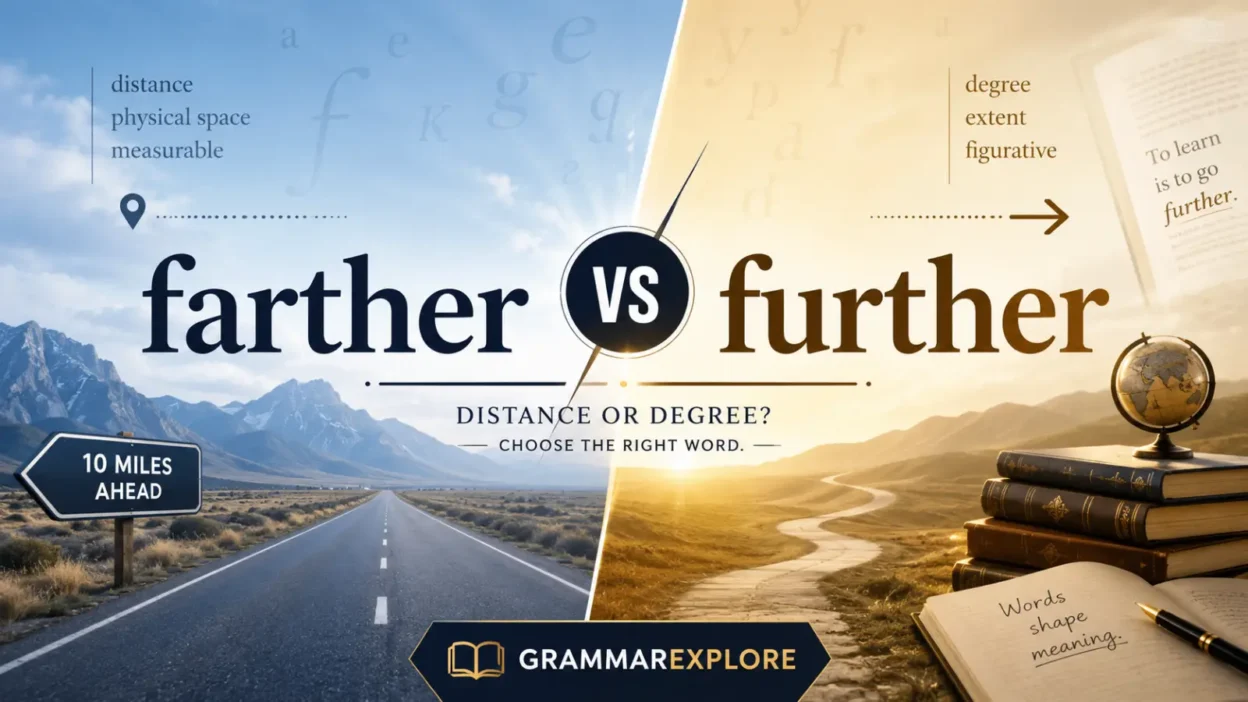
Farther and further are both correct words, but they are not always the best choice in the same sentence. In careful US English, farther is usually the better word for real, measurable distance. Further is usually better for additional information, greater degree, progress, or figurative distance.
Here is the easiest rule: use farther when you can measure the distance, and use further when you mean more, additional, or deeper in meaning.
Quick Answer
Use farther for physical distance: “The hotel is farther from the airport than we expected.” Use further for added amount, more discussion, greater degree, or progress: “Please send further details.” When both words refer to distance, farther is usually the cleaner choice in US writing, but further is also common in some distance phrases.
Why People Confuse Them
People confuse farther and further because both words can point to the idea of “more distance.” That distance can be physical, as in a road or a race, or figurative, as in a conversation, plan, or relationship.
They also look and sound similar. Farther begins with far, which helps connect it to physical distance. Further often feels broader because it can mean more, additional, or to a greater degree.
The tricky part is overlap. You may hear both of these:
The cabin is farther down the road.
The cabin is further down the road.
In formal US writing, farther is usually the cleaner option because the sentence is about physical distance. Still, further is not strange in everyday speech.
Key Differences At A Glance
| Context | Best Choice | Why |
|---|---|---|
| Physical distance | Farther | It refers to real space you can measure. |
| Figurative distance | Further | It fits ideas, feelings, degree, or progress. |
| Added information | Further | It means more or additional. |
| Business or formal follow-up | Further | It works in phrases like “further details” and “further review.” |
| Verb meaning “advance” | Further | Only further works naturally as a verb. |
| Casual distance speech | Farther or further | Both appear, but farther is clearer for distance. |
Meaning And Usage Difference
Farther means “at or to a greater distance.” It usually works best when the sentence is about miles, feet, yards, blocks, roads, travel, sports, or location.
Examples:
The grocery store is farther away than the pharmacy.
She ran farther today than she did yesterday.
Move the desk farther from the window.
Their new apartment is farther north.
Further has a wider use. It can mean “more,” “additional,” “to a greater degree,” or “to advance.” It can also refer to distance, but its strongest use is not physical measurement.
Examples:
Please send further information by Friday.
We need further discussion before making a decision.
The program helped further her career.
Let’s not take this argument any further.
A simple test helps: if the sentence answers “How far?”, choose farther. If it answers “How much more?” or “What additional step?”, choose further.
Tone, Context, And Formality
In casual conversation, many speakers use farther and further loosely. Most people will understand either word in a basic distance sentence.
In polished US writing, the distinction matters more. Farther sounds precise when you mean physical space. Further sounds natural when you mean added information, deeper discussion, or progress.
Compare these:
The stadium is farther from downtown than the old arena.
The report needs further analysis before publication.
The first sentence is about location. The second is about more work, not distance.
Which One Should You Use?
Use farther when you are talking about real distance.
Good uses of farther:
The bus stop is farther from my office now.
He hit the ball farther than the other players.
We drove farther west after lunch.
The second trail goes farther into the park.
Use further when you mean more, additional, greater in degree, or more advanced.
Good uses of further:
Do you have further questions?
The school offered further training.
We cannot move forward without further review.
The internship helped further her goals.
If you are writing for school, work, or publication, use this clean pattern:
Farther = physical distance
Further = more, additional, degree, or progress
Farther Away Vs Further Away
Both farther away and further away are used, but farther away is the safer choice when you mean physical distance.
Clear: The restaurant is farther away than I thought.
Also common: The restaurant is further away than I thought.
For polished US writing, choose farther away when the meaning is location or measurable distance.
Use further away when the distance feels less literal or more emotional.
Example:
After the argument, they felt further away from each other than ever.
That sentence is not about miles. It is about emotional distance, so further fits better.
When One Choice Sounds Wrong
Some phrases clearly need further, not farther.
Wrong: Contact us for farther information.
Correct: Contact us for further information.
Wrong: The team needs farther training.
Correct: The team needs further training.
Wrong: We should discuss this farther.
Correct: We should discuss this further.
These examples are not about physical distance. They mean more, additional, or to a greater degree.
However, do not overcorrect every distance sentence. Further down the road is common in speech, but farther down the road is usually clearer if you mean actual road distance.
Common Mistakes And Quick Fixes
Mistake 1: Using Farther For Added Information
Wrong: Please send farther details.
Correct: Please send further details.
Fix: If you mean more or additional, use further.
Mistake 2: Using Further When Farther Is More Precise
Less precise: The library is further from campus than the gym.
Clearer: The library is farther from campus than the gym.
Fix: If the distance can be measured, farther is usually stronger in US writing.
Mistake 3: Thinking Further Is Never About Distance
Too strict: Further can never refer to distance.
Better: Further can refer to distance, but farther is often clearer for physical distance.
Fix: Use farther as your safe distance word, not as a rule that makes every distance use of further wrong.
Mistake 4: Forgetting Further Can Be A Verb
Wrong: The grant helped farther the project.
Correct: The grant helped further the project.
Fix: When the word means advance, promote, or help develop, use further.
Everyday Examples
The coffee shop is farther from my house than the bakery.
We parked farther away to avoid the crowd.
Can you slide the table farther to the left?
The runner pushed farther in the final mile.
Their house is farther south than ours.
Please email me if you need further help.
The manager asked for further proof.
We should not delay the project any further.
This course will further your understanding of business writing.
The new rule may further reduce wait times.
Dictionary-Style Word Details
Verb
Farther: Not commonly used as a verb in standard US English. Do not use it when you mean “advance” or “promote.”
Example to avoid: The campaign helped farther the cause.
Better: The campaign helped further the cause.
Further: Works as a verb meaning to advance, promote, or help progress.
Example: The workshop helped further her career.
Noun
Farther: Not commonly used as a noun in standard US English.
Further: Not commonly used as a noun in standard US English.
Synonyms
Farther: Closest plain alternatives include more distant, farther away, and at a greater distance. Clear opposites include closer and nearer.
Further: Closest plain alternatives depend on meaning. For “additional,” use more, extra, or additional. For “to a greater degree,” use more deeply or more fully. As a verb, use advance, promote, or support. Depending on the sentence, opposites can include less, closer, hinder, or hold back.
Example Sentences
Farther: The second parking lot is farther from the entrance.
Farther: She jumped farther than her previous record.
Farther: The trail goes farther into the woods after the bridge.
Further: We need further review before approval.
Further: Please contact the office for further instructions.
Further: The donation will further the school’s reading program.
Word History
Farther: The word is now strongly linked with the idea of greater distance. For modern writers, its most useful role is physical distance.
Further: The word has broader modern use. It can point to distance, but it also means more, additional, to a greater degree, or to advance.
For everyday writing, history matters less than modern use. The practical rule is simple: farther for measurable distance, further for added meaning, degree, or progress.
Phrases Containing
Farther:
Farther away
Farther down the road
Farther from home
Farther north
Farther apart
Nothing could be farther from the truth
Further:
Further information
Further notice
Further questions
Further discussion
Further review
Further along
Further your career
Until further notice
Common Phrase Guide
Further Information
Use further information, not farther information.
Correct: Visit our website for further information.
Further Notice
Use until further notice, not until farther notice.
Correct: The office is closed until further notice.
Further Along
Use further along when you mean progress.
Correct: She is further along in the application process.
Farther Down The Road
Use farther down the road when you mean physical distance.
Correct: The gas station is farther down the road.
Nothing Could Be Farther From The Truth
This fixed phrase commonly uses farther even though the meaning is not physical distance.
Correct: Nothing could be farther from the truth.
FAQs
What is the difference between farther and further?
Farther usually refers to physical distance. Further usually refers to more, additional, greater degree, or progress. In US writing, use farther for measurable distance and further for ideas, discussion, information, or development.
Is it farther away or further away?
Both are used, but farther away is clearer when you mean physical distance. Write “The hotel is farther away than we expected.” Use further away when the distance is more emotional, figurative, or general.
Is it further information or farther information?
The correct phrase is further information. Information is not physical distance, so farther information sounds wrong in standard English.
Can further mean physical distance?
Yes. Further can refer to physical distance, especially in everyday speech. Still, farther is usually the cleaner choice in US writing when the distance is real and measurable.
Can farther be used for figurative distance?
Sometimes, especially in fixed or common phrases such as “nothing could be farther from the truth.” However, further is usually better for figurative ideas, added discussion, and greater degree.
Is further a verb?
Yes. Further can be a verb meaning to advance, promote, or help something progress. Example: “The program helped further her education.” Farther is not normally used this way.
Conclusion
Farther and further are both standard, but they are not equal in every context. Use farther when you mean physical distance: roads, miles, location, movement, or space. Use further when you mean more, additional, deeper, or more advanced.
Farther usually refers to physical distance. Further usually refers to more, additional, greater degree, or progress. In US writing, use farther for measurable distance and further for ideas, discussion, information, or development.
Both are used, but farther away is clearer when you mean physical distance. Write “The hotel is farther away than we expected.” Use further away when the distance is more emotional, figurative, or general.
The correct phrase is further information. Information is not physical distance, so farther information sounds wrong in standard English.
Yes. Further can refer to physical distance, especially in everyday speech. Still, farther is usually the cleaner choice in US writing when the distance is real and measurable.
Sometimes, especially in fixed or common phrases such as “nothing could be farther from the truth.” However, further is usually better for figurative ideas, added discussion, and greater degree.
Yes. Further can be a verb meaning to advance, promote, or help something progress. Example: “The program helped further her education.” Farther is not normally used this way.