
Title Tag: Rough vs Ruff: Which Word Is Correct in American English?
Meta Description: Rough vs ruff explained clearly: learn when to use each word, with examples for rough day, rough draft, ruff collar, and more.
Feature Image Prompt: Create a clean 16:9 educational blog banner for “Rough vs Ruff.” Show “ROUGH” beside an uneven road or textured surface and “RUFF” beside a historical pleated collar and a subtle animal neck ruff. Use a modern white background, strong readable typography, simple visual contrast, and a polished educational style. Avoid clutter.
Alt Text: Rough vs ruff showing an uneven surface beside a historical collar and animal neck ruff
Quick Answer: Rough Or Ruff?
Use rough when you mean something uneven, difficult, harsh, coarse, approximate, or unfinished.
- I had a rough day at work.
- The road was rough after the storm.
- We need a rough estimate.
- She submitted a rough draft.
Use ruff for specific meanings, such as a historical frilled collar or a ring of fur or feathers around an animal’s neck.
- The actor wore an Elizabethan ruff.
- The bird displayed its neck ruff.
Rough and ruff sound the same in standard American English, but they have different meanings and spellings. If you mean a difficult day, uneven surface, approximate estimate, or unfinished draft, use rough.
Rough Vs Ruff At A Glance
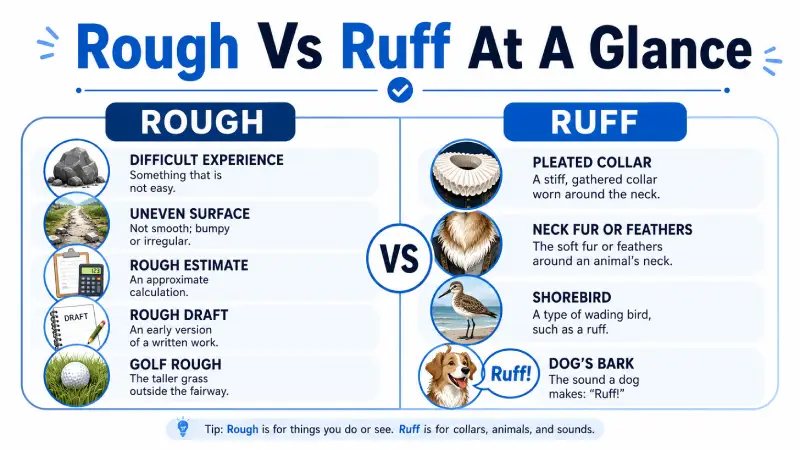
| Meaning or Context | Correct Word | Example |
|---|---|---|
| Difficult experience | rough | We had a rough week. |
| Uneven surface | rough | The road is rough. |
| Approximate amount | rough | Give me a rough estimate. |
| Preliminary version | rough | I finished a rough draft. |
| Golf area with longer grass | rough | The ball landed in the rough. |
| Historical folded collar | ruff | He wore a white ruff. |
| Ring of neck fur or feathers | ruff | The bird has a dark ruff. |
| A particular shorebird | ruff | Birdwatchers spotted a ruff near the wetland. |
| Playful dog-bark spelling | ruff | “Ruff! Ruff!” |
Why Do People Confuse Rough And Ruff?
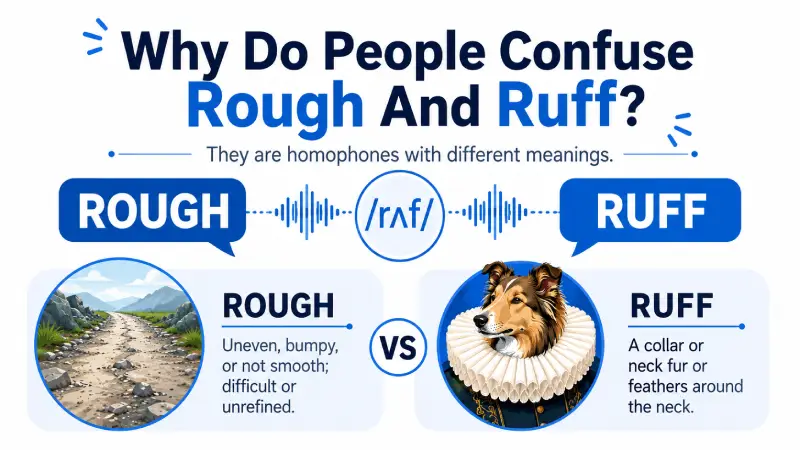
Rough and ruff are homophones. That means they have the same pronunciation but different spellings and meanings.
In standard American English, both words are pronounced /rʌf/.
That creates confusion when people hear the word but do not see it written. The sound alone cannot tell you which spelling is correct.
Compare these sentences:
- The hike was rough. The hike was difficult.
- The dog has a thick ruff. The dog has thick fur around its neck.
The pronunciation is the same, but the meaning is completely different.
What Does Rough Mean?
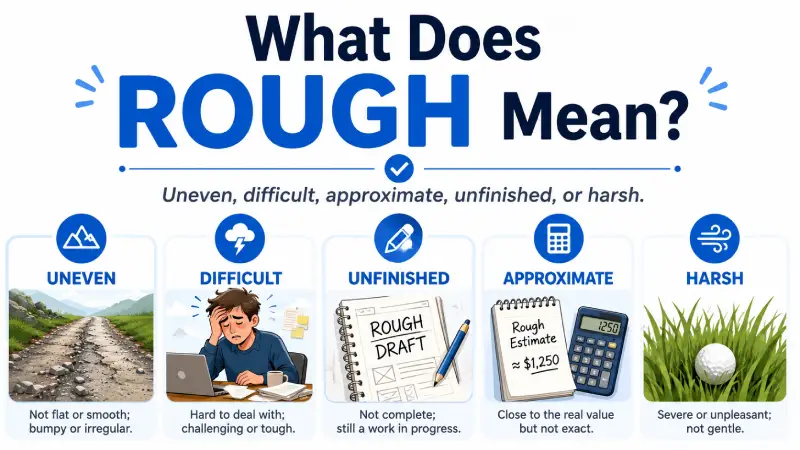
Rough is the more versatile word. It can function as an adjective, noun, and verb.
Rough As An Adjective
As an adjective, rough can describe something that is not smooth or even:
- The rough pavement made the bike ride uncomfortable.
- The table had a rough surface.
It can also describe a difficult or unpleasant experience:
- She had a rough morning after missing her flight.
- The team went through a rough stretch of games.
Rough can also mean approximate or not exact:
- Can you give me a rough estimate?
- I have a rough idea of the total cost.
It may also describe something unfinished or preliminary:
- I prepared a rough draft of the proposal.
Other common uses include harsh conditions, rough treatment, and behavior that is not gentle:
- The boat ride was rough.
- The players were too rough during practice.
Rough As A Noun
As a noun, rough has several established uses.
In golf, the rough is the area of longer grass beside the more closely cut playing area:
- Her second shot landed in the rough.
In drawing, design, and creative work, a rough can mean a preliminary version or sketch:
- The designer showed the client three roughs.
Rough As A Verb
Rough also functions as a verb in several established expressions:
- The architect roughed out the first design.
- The campers were roughing it for the weekend.
- The workers roughed up the surface before applying the finish.
These uses all use the spelling rough, not ruff.
What Does Ruff Mean?
Ruff is mainly used as a noun and has several specialized meanings.
A Ruff Is A Historical Collar
- A ruff can be a wide, stiff, pleated collar associated with historical European clothing:
- The costume included a large white ruff.
- The portrait shows the subject wearing a starched ruff.
A Ruff Can Be Neck Fur Or Feathers
- A ruff can also mean a ring or thick covering of fur or feathers around the neck of an animal or bird:
- The cat had a thick ruff of fur around its neck.
- The bird displayed its colorful neck ruff.
This meaning is different from the historical collar, but both refer to a noticeable covering around the neck.
A Ruff Is Also A Bird
Ruff is also the name of a particular shorebird:
- Birdwatchers spotted a ruff near the wetland.
In this sentence, ruff is the bird’s name.
Ruff Has Specialized Card-Game Uses
Ruff also appears in specialized card-game terminology. This use is uncommon in everyday conversation, but it is a legitimate meaning of the word.
“Ruff!” As A Playful Dog Sound
In children’s books, comics, or playful dialogue, ruff may be used to imitate the sound of a dog barking:
- “Ruff! Ruff!” the puppy barked.
This is a playful sound representation. It does not make ruff a standard alternative spelling of rough.
Rough Day Or Ruff Day?
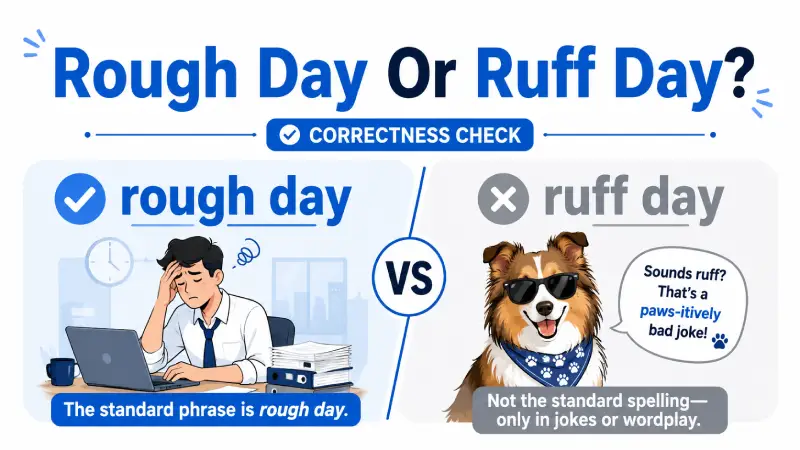
The correct phrase is rough day.
- I had a rough day at work.
- She had a rough day after her flight was canceled.
- It was a rough day for the whole team.
Here, rough means difficult, stressful, or unpleasant.
Ruff day is not the standard spelling. It could appear as an intentional dog-related joke, but normal writing requires rough day.
The same rule applies to:
- rough week
- rough morning
- rough patch
- rough time
Common Phrases With Rough
Many everyday English expressions use rough, not ruff.
Rough Draft
A preliminary or unfinished version of writing:
- I finished the rough draft of my essay.
Rough Estimate
An approximate calculation or amount:
- The contractor gave us a rough estimate for the repairs.
Rough Patch
A difficult period:
- The company is going through a rough patch.
Rough Around The Edges
Not fully polished, refined, or developed:
- The new restaurant is still rough around the edges.
Rough It
To live temporarily in basic or uncomfortable conditions:
- We decided to rough it at the campsite.
In The Rough
In golf, the rough is the longer grass outside the closely cut playing area:
- His tee shot ended up in the rough.
When Should You Use Rough?
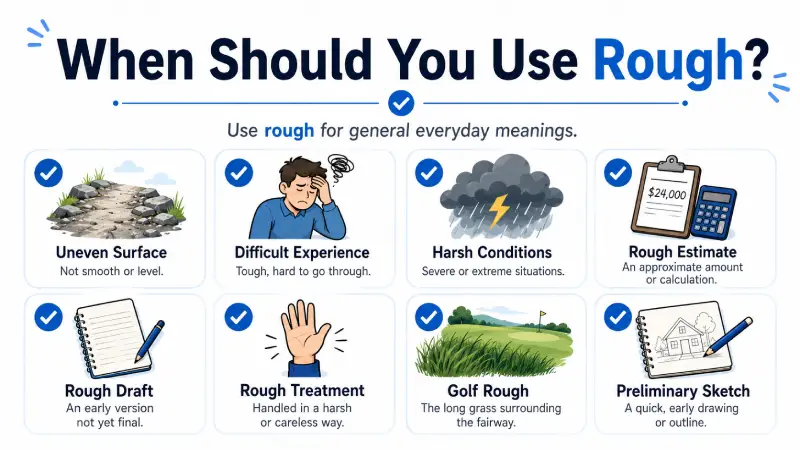
Choose rough when you mean:
- an uneven or coarse surface
- a difficult experience
- harsh conditions
- approximate information
- an unfinished version
- rough or forceful treatment
- longer grass on a golf course
- a preliminary design or draft
Common examples include:
- rough road
- rough water
- rough hands
- rough day
- rough estimate
- rough draft
- rough patch
- rough terrain
- the rough
When Should You Use Ruff?
Choose ruff when you mean:
- a historical folded or pleated collar
- fur around an animal’s neck
- feathers around a bird’s neck
- the particular bird called a ruff
- a specialized card-game term
- a playful imitation of a dog’s bark
Common examples include:
- an Elizabethan ruff
- a thick ruff of fur
- a bird’s neck ruff
- a ruff near the wetland
- “Ruff! Ruff!”
Common Mistakes And Quick Fixes
“I Had A Ruff Day.”
❌ I had a ruff day.
✅ I had a rough day.
A difficult or stressful day is a rough day.
“The Road Was Ruff.”
❌ The road was ruff after the storm.
✅ The road was rough after the storm.
An uneven or difficult road is rough.
“She Wrote A Ruff Draft.”
❌ She wrote a ruff draft.
✅ She wrote a rough draft.
An early or unfinished version is a rough draft.
“The Actor Wore A Rough.”
❌ The actor wore a rough around his neck.
✅ The actor wore a ruff around his neck.
A historical pleated collar is a ruff.
“The Ball Landed In The Ruff.”
❌ The ball landed in the ruff.
✅ The ball landed in the rough.
The golf term is the rough.
Rough Vs Ruff: Examples In Context
| Sentence | Correct Word | Meaning |
|---|---|---|
| The sandpaper feels rough. | rough | Not smooth |
| We had a rough flight because of the turbulence. | rough | Difficult or unpleasant |
| Send me a rough estimate. | rough | Approximate |
| This is only a rough draft. | rough | Preliminary |
| Her golf ball landed in the rough. | rough | Longer grass on a golf course |
| The costume had a pleated ruff. | ruff | Historical collar |
| The cat had a thick neck ruff. | ruff | Fur around the neck |
| The bird’s ruff was easy to see. | ruff | Neck feathers |
| “Ruff!” the cartoon dog barked. | ruff | Playful sound spelling |
Rough And Ruff: Synonyms And Closest Alternatives
- Rough
The best alternative depends on the meaning:
- Uneven: coarse, irregular, jagged
- Difficult: hard, challenging, unpleasant
- Approximate: estimated, approximate
- Unfinished: preliminary, incomplete
- Harsh: severe, tough
No single synonym replaces every meaning of rough.
Ruff
Ruff has no single everyday synonym that covers all of its meanings.
For the collar meaning, frilled collar is a clear descriptive alternative.
For the animal meaning, neck fur or neck feathers can describe the feature, but these are descriptions rather than exact synonyms.
Rough And Ruff Word History
Rough comes from Old English and has Germanic roots connected with ideas such as coarseness and unevenness.
Ruff is historically related to a variant of rough. Its meanings developed in specialized contexts, including the frilled collar and the ring of feathers or fur around an animal’s neck.
Although the two words share the same pronunciation today, their spellings and meanings remain distinct.
Frequently Asked Questions
Is it “rough day” or “ruff day”?
The correct phrase is rough day. Use rough when you mean a difficult, stressful, or unpleasant day.
Is ruff a real word?
Yes. Ruff is a real word. It can refer to a historical folded collar, fur or feathers around an animal’s neck, a particular shorebird, and certain specialized uses.
Are rough and ruff pronounced the same?
Yes. In standard American English, both words are pronounced /rʌf/.
Is “ruff” ever correct for a dog?
Yes, in playful writing, “Ruff!” can imitate a dog’s bark. However, ruff is not the standard spelling for phrases such as rough day or rough road.
Is it “rough draft” or “ruff draft”?
The correct phrase is rough draft. It means an early or unfinished version of a piece of writing.
Is it “rough estimate” or “ruff estimate”?
The correct phrase is rough estimate. It means an approximate estimate rather than an exact figure.
What Is The Easiest Way To Remember Rough Vs Ruff?
Use rough for something uneven, difficult, harsh, approximate, or unfinished.
Use ruff for a specific collar, neck covering, bird, specialized use, or playful dog sound.
Conclusion
The difference between rough and ruff is easy to understand once you focus on meaning rather than pronunciation.
Use rough for something uneven, difficult, harsh, approximate, or unfinished. That is why we write rough day, rough road, rough estimate, and rough draft.
Use ruff for more specific meanings, such as a historical pleated collar, fur or feathers around an animal’s neck, the bird called a ruff, or certain specialized uses. In playful writing, “Ruff!” can also represent a dog’s bark.
Both words sound the same in American English, but their spellings and meanings are different. When you mean a difficult experience or an uneven surface, choose rough. When you mean a specific neck covering, collar, bird, or specialized use, choose ruff.